Marketing Campaign Workflow: Build, Automate, Measure

The AI CMO team
Oct 23, 2026
Administrative work, reviews, and approvals consumed 41% of content-creation time, approximately 25 minutes of every working hour, according to a 2025 Adobe marketing study summarized in Bannerflow's analysis of creative workflow bottlenecks; 58% identified those activities as a major productivity drain, nearly 90% managed at least three approval stages, and almost half said each asset involved 51 to 200 people. Faster content production alone won't recover that calendar.
A useful marketing campaign workflow connects business objectives, customer data, creative production, approvals, execution, and evidence of commercial impact. Its strongest controls answer two questions before launch: who can authorize an action, and how will the team determine whether that action caused additional revenue?
Table of Contents
- Why Marketing Campaign Workflows Stall Before Launch
- The Six Stages of a Controlled Campaign Workflow
- Designing Behavior-Triggered Journeys That Actually Convert
- Choosing Between Unified Platforms and Stitched Tools
- Measuring Whether Your Campaign Caused Revenue
- Human Governance When AI Executes Campaigns
- Your First Week Building the Workflow
Why Marketing Campaign Workflows Stall Before Launch
An approved headline doesn't mean a campaign is ready. The landing page may still need review, the audience owner may be waiting for an exclusion list, and the analyst may not know which conversion event the channel manager selected.
Those are operational dependencies, not creative shortcomings. Teams lose usable campaign time when nobody owns the handoff between tasks, or when reviewers discover strategic disagreements after production has started.
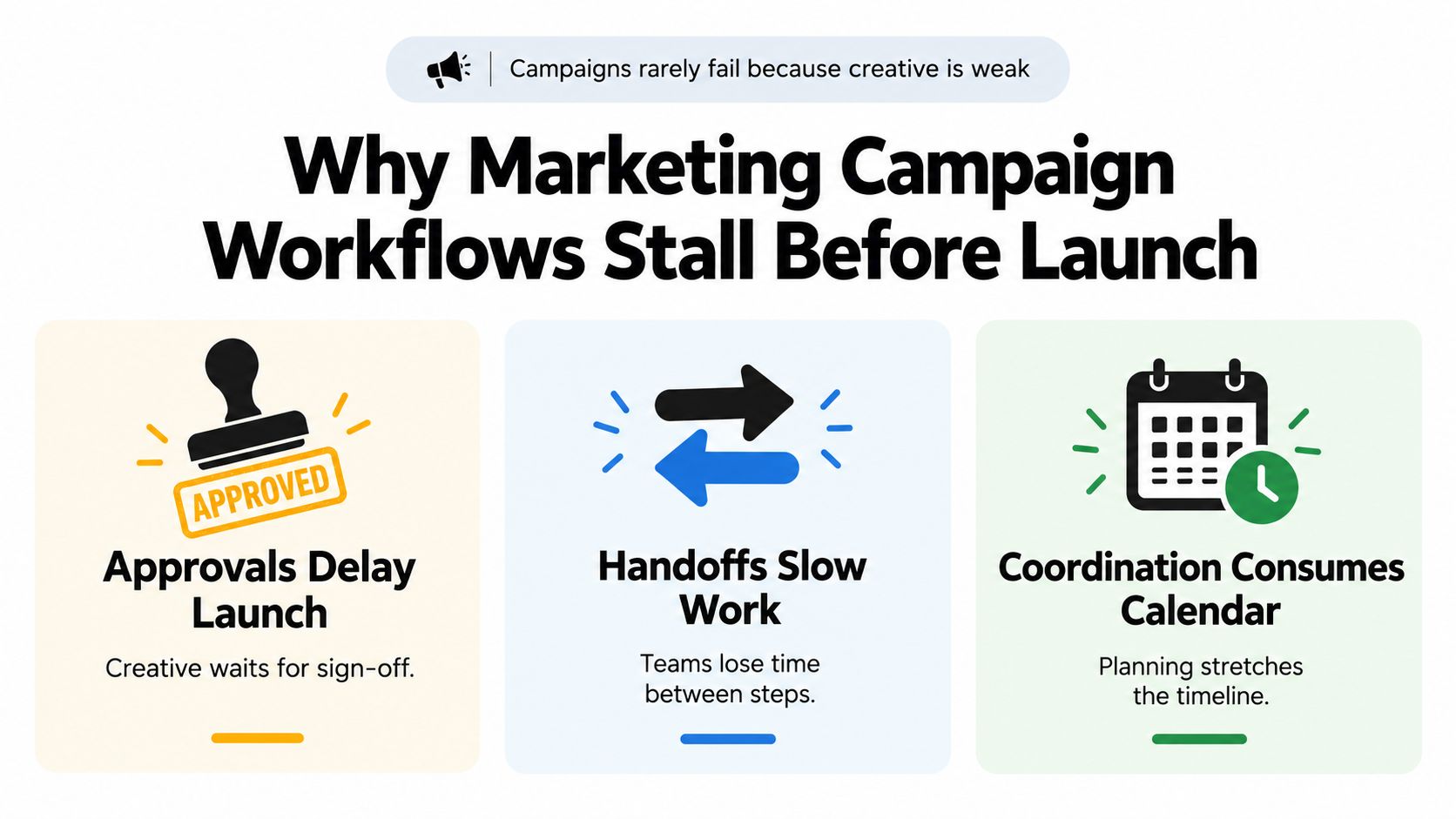
The most useful diagnosis separates approval delays from handoff and planning problems.
Give reviewers decisions, not open-ended invitations
A review request should specify what the reviewer can approve. Brand reviewers assess voice and presentation. Legal reviewers assess relevant claims and obligations. The campaign owner decides whether the execution supports the agreed commercial objective.
Without those boundaries, every review can become another strategy meeting. A stakeholder's preference for different wording can restart design, channel setup, and translation even when the original asset met its brief.
- Assign an accountable owner. Someone must resolve conflicting feedback and authorize progression.
- Define review scope. Separate required corrections from optional preferences.
- Set deadlines and escalation rules. Name a backup decision-maker rather than relying on repeated reminders.
- Record the approved version. Channel operators need certainty about which asset can ship.
Parallel review can shorten waiting time when reviewers assess independent issues. Sequential review is more appropriate when a later decision depends on an earlier one. Adding everyone to every review isn't a substitute for choosing the right sequence.
Practical rule: Every approval request should name the decision, the decision-maker, and what happens if the deadline passes.
Define completion beyond asset delivery
A practical workflow follows a controlled sequence: define, build, launch, monitor, and evaluate. Each transition requires an observable acceptance condition, not a vague status such as nearly finished.
That distinction changes capacity planning. Creative delivery is an intermediate milestone; the campaign still needs governance, activation, and commercial evaluation. A calendar that ends at asset delivery hides the work that determines whether customers receive the campaign and whether the business learns anything useful.
The answer isn't more administration. It's a smaller set of explicit decisions, made early enough that specialists can execute without repeatedly reopening the brief.
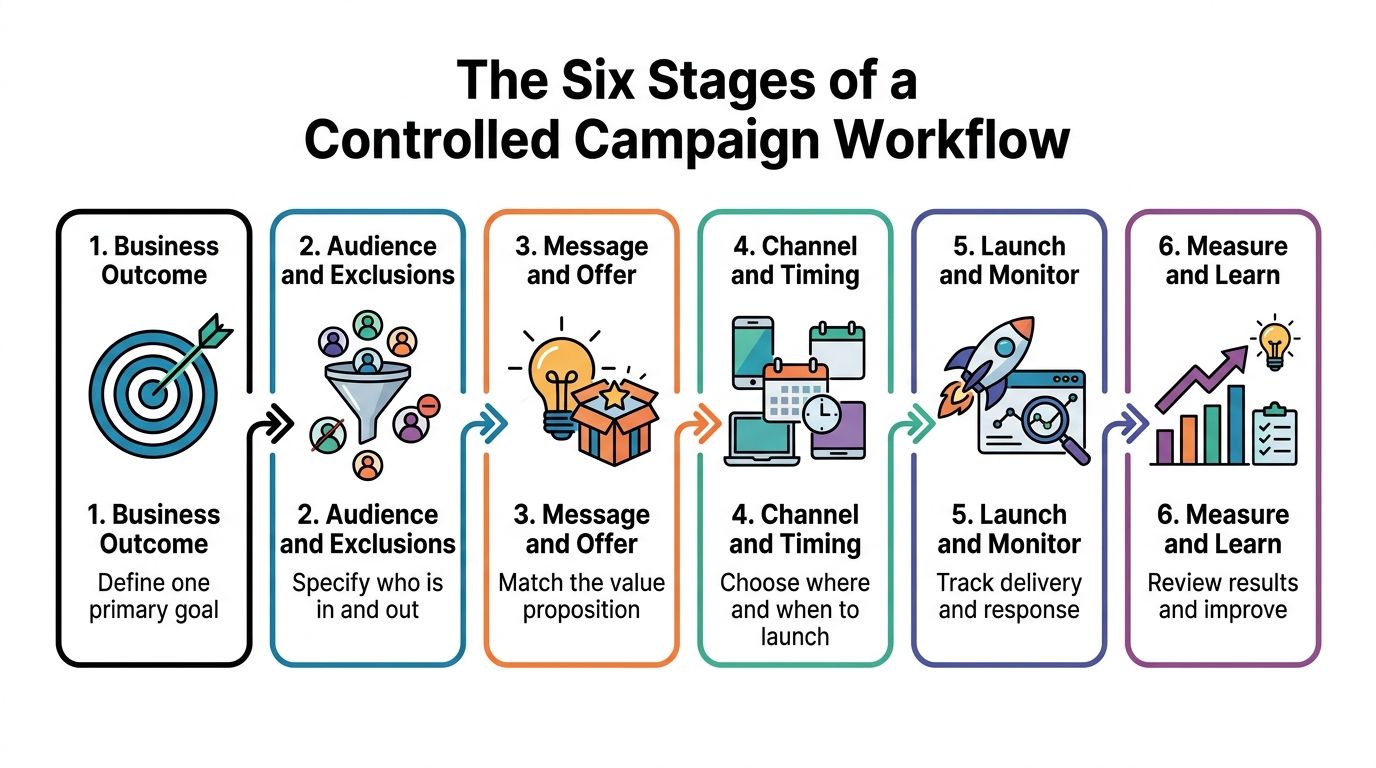
The Six Stages of a Controlled Campaign Workflow
Every stage needs an output that another operator can inspect. The campaign reporting checklist provides a useful foundation for connecting launch controls with funnel reporting and CRM outcomes.
The diagram summarizes the campaign's progression; the operational gates below make that progression auditable.
Establish the commercial and technical contract
Define one primary business outcome. Choose the result that will govern trade-offs, such as qualified pipeline or repeat purchases. The output is a campaign brief with an accountable business owner and a success definition.
Specify the operating boundaries. Document audience eligibility, exclusion rules, offer, channels, budget, and attribution window. Include the message and value proposition so creative teams don't have to infer the intended customer benefit.
Instrument every touchpoint. Establish consistent campaign IDs and conversion events across ads, messages, landing pages, and CRM records. Produce a tracking map that an analyst can use without asking the original campaign builder to reconstruct the setup.
For Shopify teams planning controlled messaging experiments, YipSMS Inc.’s resource on A/B testing for Shopify SMS automations offers a channel-specific starting point. The broader operating requirement is to document the experiment alongside the campaign configuration.
Control release and evaluate the full funnel
Gate launch on QA. Creative, landing pages, consent, suppression, and tracking must pass their checks before activation. A failed check should block the affected release rather than become an unresolved comment.
Monitor leading indicators. Delivery, reach, frequency, CTR, landing-page conversion, and cost per qualified action help operators diagnose execution. These metrics support intervention, but they aren't substitutes for commercial outcomes.
Evaluate downstream results. Review MQL-to-SQL progression, opportunity creation, closed-won revenue, ROAS, and payback. Reconcile ad-platform conversions with CRM outcomes rather than accepting each platform's account of success.
For B2B campaigns, review pipeline-sourced ROAS before closed-won ROAS, clearly labeling pipeline as unrealized value because sales-cycle lag delays revenue. Ecommerce teams can use total marketing efficiency ratio as an aggregate check against cross-channel double counting.
Cheap clicks are an operating signal, not evidence of qualified revenue.
During reconciliation, investigate inconsistent attribution windows, missing CRM joins, and duplicate conversion counts before changing the budget. Otherwise, operators may optimize against reporting errors rather than customer behavior.
Designing Behavior-Triggered Journeys That Actually Convert
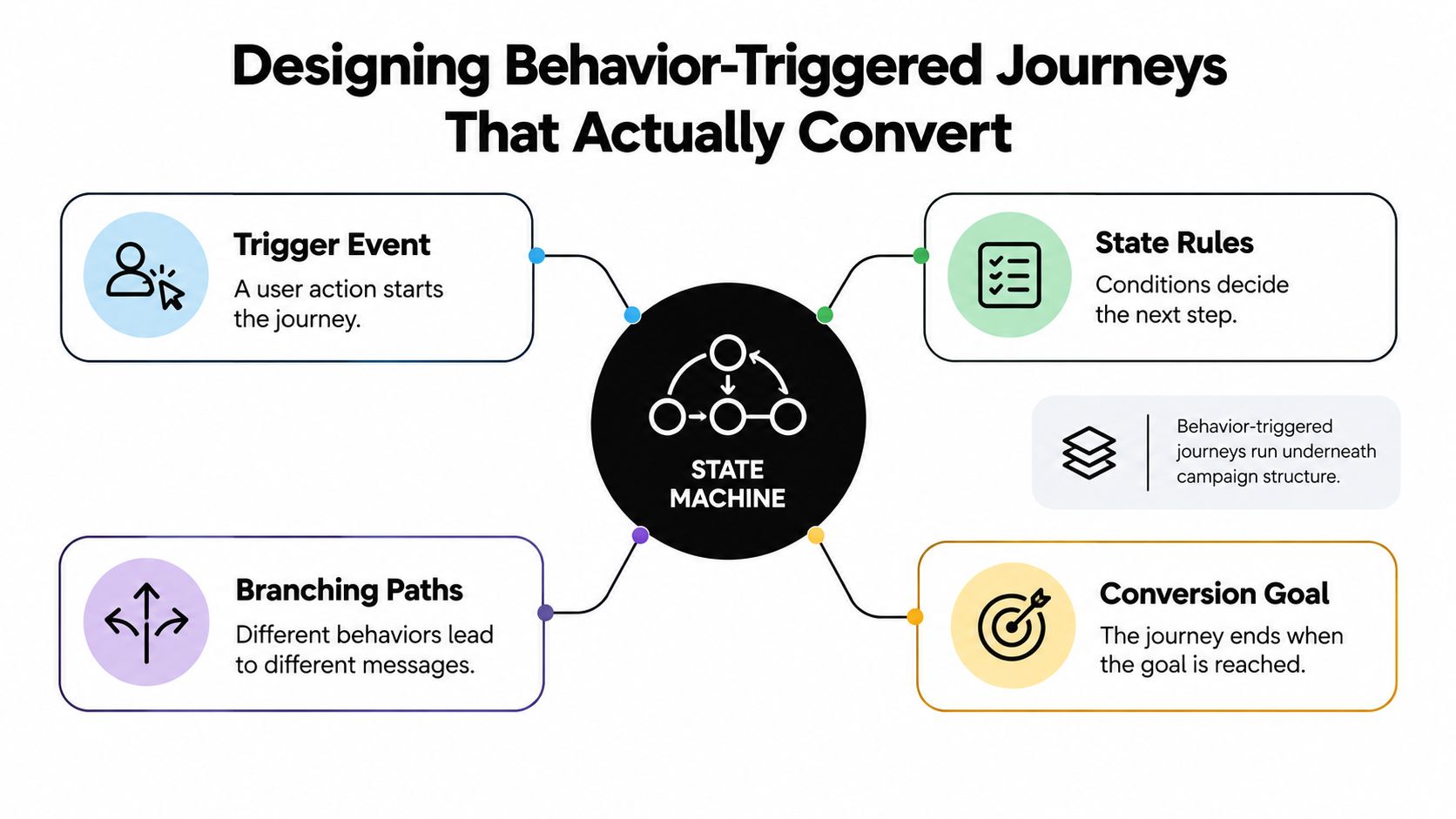
A prospect who becomes a customer shouldn't keep receiving acquisition reminders because a scheduled sequence hasn't finished. That failure is the practical difference between an email sequence and a state machine: the next action depends on the person's current status, not on elapsed time.
The journey map should show how a customer enters, changes state, and exits.
Model decisions before writing messages
Start with an entry event, then apply eligibility and consent checks. Define which suppression rules take precedence, what behavior changes the next action, and which success event ends the journey.
A product-interest event might make a contact eligible for education. A purchase should move that person out of acquisition messaging, while an unresolved support issue may justify pausing promotional communication. Treat these as proposed operating rules rather than universal prescriptions.
- Entry and eligibility. Record why the contact qualified and whether the qualifying event remains relevant.
- Branches and timing. Distinguish meaningful behavior from passive waiting.
- Exit and success. Specify the conversion, disqualification, or preference change that ends participation.
- Journey priority. Decide which communication takes precedence when a contact qualifies for overlapping programs.
- Human override. Name who can pause or rewrite a live journey and under what conditions, so automation never outranks judgment.
Useful email marketing personalization follows those state decisions. Changing a greeting won't compensate for sending the wrong offer to someone whose relationship with the business has changed.
Use benchmarks as calibration, not promises
Fenyx's marketing automation workflow guide reports directional planning ranges of 45–60% opens and 8–15% CTR for welcome sequences, 25–35% opens and 3–6% CTR for B2B nurture, 10–20% opens and 1–3% CTR for re-engagement, and roughly 10–20% MQL-to-SQL conversion for B2B nurture.
Those ranges aren't universal success rates. Industry, deliverability, list quality, privacy restrictions, offer strength, and measurement definitions affect comparisons. Opens can help diagnose messaging, but activation, pipeline, retention, and revenue are more useful business outcomes.
Start with a baseline control cohort, change one material variable at a time, and preserve a holdout large enough to estimate incremental lift. A journey that only reports platform conversions can't show whether the messages caused the purchase. A holdout can. Testing the offer, timing, channel, audience rule, and message simultaneously makes that evidence harder to read.
Every execution should log entry reason, branch decisions, message IDs, timestamps, consent state, suppression outcome, conversion event, and attributed revenue. Those records make troubleshooting possible when a contact receives an unexpected message.
Set the kill criteria before the journey ships: a frequency cap, a maximum journey length, and the condition that triggers a human review of the whole program. Persistently inactive recipients should move into suppression rather than receive repeated re-engagement attempts. Missing exits, stale segments, overlapping journeys, and uncontrolled frequency deserve attention before another round of subject-line testing.
Choosing Between Unified Platforms and Stitched Tools
Two teams can receive the same campaign brief and end up with very different workflows depending on one decision: whether execution lives in a single system or across several. I have watched stitched stacks run cleanly under a disciplined ops lead, and I have watched unified platforms stall because nobody owned the data model. The tooling matters less than whether approvals, customer identity, and measurement records remain inspectable after the campaign ships.
A connected stack can work well when specialists need deep channel functionality and the business can maintain its integrations. A unified platform earns its cost when operators repeatedly reconstruct customer context, approvals, and campaign history across separate systems. The decision should follow the operating model rather than the appeal of a longer feature list. Clear customer data integration requirements show whether systems can exchange usable identity, behavior, and permission data, and whether a holdout group survives the trip between tools.
Unified Platform vs Stitched Point Tools
| Criterion | Unified Platform | Stitched Point Tools |
|---|---|---|
| Customer data | Shared profiles can reduce reconciliation work | Teams must maintain identity and field mappings |
| Approvals | Decisions can remain beside execution | Approval evidence may live elsewhere |
| Suppression | A common sending control can enforce preferences | Every sending destination needs reliable updates |
| Reporting | Shared records can simplify investigation | Flexible analysis requires maintained joins |
| Specialization | Capabilities may vary by channel | Specialists can select deeper channel tools |
| Governance | Common permissions and logs are easier to inspect | Controls depend on each tool and integration |
A similar build-or-delegate decision applies to creator campaigns. Sup's comparison of an influencer marketing platform vs agency is a relevant resource when deciding whether internal operators or an external partner should own execution.
Evaluate the complete operating environment
The AI CMO is one AI-native option combining planning, customer profiles, creative production, messaging, support, and reporting. Its AI specialists propose weekly marketing plans, identify revenue opportunities, execute approved work, and report within business-configured limits.
Studios produces ads, personalized emails, landing pages, videos, images, and social content from briefs. Customer 360 combines identity, customer value, behavior, lifecycle stages, and consent in shared profiles with refreshed segments; Data 360 brings connected information into a warehouse. Journeys coordinates behavior-triggered communication across email, websites, SMS, push, and WhatsApp.
The vendor lists thousands of prebuilt integrations spanning ecommerce, CRM, advertising, support, and data warehouse tools, alongside configurable human approvals, send-process suppression, and an append-only ledger covering actions, decisions, sends, and spending. Published pricing puts the entry subscription in the hundreds of dollars per month for a single brand, while enterprise agreements start in the tens of thousands annually, scaled by event volume, messaging, AI usage, infrastructure, and support.
Treat any platform demonstration as a stress test, not a tour:
- Team capacity. Who maintains failed integrations and data mappings when the vendor's support queue is full?
- Brand structure. Can operators preserve separate permissions, voice, and budgets across business units?
- Governance. Can a reviewer inspect the proposed audience, the spending change, and the approval history in one place?
- Portability. Can analysts export the records needed for independent evaluation, including control-group assignments?
Unification reduces handoffs. The harder question is whether the winning architecture still lets a reviewer see who approved the audience and lets an analyst isolate an untreated control group once the campaign is live.
Measuring Whether Your Campaign Caused Revenue
Platform attribution answers which interactions received credit. Incrementality asks what would have happened without the campaign. I've watched teams shift six figures of budget on credited conversions that a modest holdout would have contradicted.
Only 8% of respondents reported using incrementality testing, while 41% said they couldn't measure marketing ROI effectively in Supermetrics' 2025 marketing data research. More channel data doesn't automatically produce a defensible counterfactual.
Treat measurement as a stage designed before launch, not an audit performed after the spend is gone. The workspace should connect experiment design with revenue analysis; a dashboard of credited conversions is a different deliverable.

Choose a test that fits the decision
Randomized audience holdouts give the cleanest read on causality when eligible customers can be assigned to treatment and control. The trade-off is real: withheld customers don't receive the treatment, so the control group carries a measurable opportunity cost. Protect it from overlapping campaigns that would contaminate the comparison.
Geo experiments are worth considering when customer-level assignment isn't practical but geographic treatment can be separated. They're noisier than user-level randomization, so inspect regional differences and potential spillover before treating markets as comparable.
Conversion-lift studies answer platform-specific exposure questions and depend on that platform's cooperation. Marketing-mix modeling supports allocation analysis across channels and time, but it needs enough spend variation and history to produce stable estimates, and its assumptions deserve scrutiny.
Whatever the design, the experiment record should define:
- Eligibility and assignment. Who qualifies, and how treatment is allocated.
- Power and thresholds. What effect the design can detect, and what evidence justifies acting on it.
- Economics. How incremental profit compares with media and operational costs.
- Contamination controls. How operators prevent unintended exposure of the control group.
Resolve disagreement before reallocating spend
When attribution and experiments disagree, inspect populations, observation windows, exposure definitions, and uncertainty. In practice the conflict is usually definitional: attributed conversions count credited events, while a holdout estimates net change. Those are different quantities, not contradictory results.
Multi-touch attribution describes observed paths well, but it doesn't replace an experiment. CRM reconciliation establishes whether recorded commercial outcomes are valid; causal testing addresses whether marketing changed them.
The video below walks through how incrementality testing works in practice.
A campaign can receive conversion credit without creating additional demand.
Budget decisions should reflect incremental profit and uncertainty, not whichever report shows the strongest number. Automation and unified reporting are useful infrastructure, but neither produces causal evidence on its own. Build the holdout, the decision thresholds, and the revenue reconciliation into the workflow before the campaign ships.
Human Governance When AI Executes Campaigns
Human-in-the-loop isn't a sufficient control specification. A reviewer who sees only finished copy can't meaningfully approve audience expansion, spending changes, or sensitive personalization.
In IAB Europe's 2025 AI study, 85% of respondents said their companies used AI for marketing, but only 43% had marketing-specific internal AI guidelines and 18% had no formal AI governance. The operating question is what the system may do, under which conditions, and who remains accountable.
Match authorization to customer and financial risk
| Action | Proposed control |
|---|---|
| Internal drafting | Automate within approved brand guidance |
| Audience changes or exclusions | Require approval of eligibility and customer impact |
| Sensitive personalization | Review data use and message context |
| Budget increases | Require explicit authorization within documented limits |
| Customer-support responses | Apply stricter review or monitoring according to risk |
Approval screens should expose the actual change, its expected impact, and the evidence supporting it. Repeated requests with little context encourage rubber-stamping; unrestricted execution can amplify biased targeting, privacy violations, and off-brand communication.
The campaign owner should remain accountable for execution errors. Logs should preserve model and prompt changes, inputs, approvals, and resulting actions so an incident can be reconstructed.
- Pause triggers. Define responses to anomalous spend, suppression failures, or complaint patterns.
- Rollback scope. Specify which audiences, assets, schedules, or configurations can be restored.
- Incident ownership. Name who stops execution, investigates customer impact, and authorizes resumption.
Make customer preferences executable
Consent and suppression checks belong immediately before sending, not only at audience creation. In the claims-management context, UK marketing and advertising guidance requires screening telephone and email databases against relevant suppression files before contact and retaining only the minimum suppression information needed.
The GDPR's consent and direct-marketing provisions give individuals a free right to object to direct marketing, including related profiling, and require specific, informed, unambiguous consent through affirmative action where consent is used. Withdrawal must be possible at any time, with affected communications stopped accordingly.
The ICO's guidance on respecting marketing preferences recommends privacy-limited suppression records rather than deleting opt-outs, which could allow re-imported contacts to re-enter audiences.
Governance performance should include approval latency, override rate, complaint rate, anomalous spend, and post-send remediation. Together, those measures help distinguish necessary safeguards from approval processes that delay work without improving decisions.
Your First Week Building the Workflow
Start narrow. Pick one live campaign with accessible customer and revenue records, commercially important enough to justify attention and small enough that you can inspect every handoff. An organization-wide redesign can wait.
Assign a concrete output to each day
- Monday. Document the primary business outcome and attribution window. Get agreement from the commercial owner before production expands.
- Tuesday. Define the audience, exclusions, and suppression register. Confirm that customer profiles carry usable consent information.
- Wednesday. Map the controlled stages to named owners. Set review scope, deadlines, and escalation rules using the approval model described earlier.
- Thursday. Instrument campaign IDs and conversion events. Run QA across creative, landing pages, permissions, suppression, and tracking before release.
- Friday. Finalize the holdout design and decision thresholds. Configure approval boundaries for AI-executed actions and assign incident ownership.
Inspect operation as well as outcomes
For the first thirty days, review the governance measures from the approval model alongside platform-to-CRM reconciliation. A campaign can look profitable in the dashboard and still need intervention if complaints go unresolved or spend drifts without explanation.
Treat the retrospective as a diagnostic. It should name the specific rule, handoff, or measurement assumption that needs changing. Adding another approval stage by default just rebuilds the bottleneck the workflow was meant to remove.
The next step is concrete: run the selected campaign through the controlled workflow with a protected holdout, then compare incremental profit against media and operational costs. Expand across the calendar only after the team can explain both the results and the decisions that produced them.
The AI CMO combines campaign planning, asset production, behavior-triggered execution, customer data, and reporting with configurable approvals and recorded actions, which suits a pilot that needs explicit launch controls and a preplanned measurement design.
Share this article