Email Marketing Personalization That Actually Converts

The AI CMO team
Oct 2, 2026
A lifecycle marketer opens the Q3 email report and sees a familiar contradiction. Opens have improved, clicks look respectable, yet revenue has barely moved. The team has added first names, product references, and a few audience rules, but personalization still feels like decoration rather than a growth system.
That gap usually isn't a copy problem. It's a measurement problem. Email marketing personalization creates value when first-party data, behavioral signals, decision rules, creative, and experimentation work together to produce incremental revenue. The sections below define that system, explain its core techniques, show how an autonomous platform operationalizes it, and provide a practical roadmap for shipping it with privacy and proof built in.
Table of Contents
- What Email Marketing Personalization Really Means Today
- From Merge Tags to Behavioral Triggers A Quick Evolution
- Core Techniques That Power Personalization
- How an Autonomous Platform Operationalizes Personalization
- Measuring Real Lift Instead of Vanity Opens
- Where Personalization Crosses the Line
- Your 30 60 90 Personalization Roadmap
What Email Marketing Personalization Really Means Today
Email marketing personalization is the systematic use of customer data and behavior to decide which message, offer, content, and timing each recipient should receive. A first name in a subject line can be part of that system, but it isn't the system itself.
Early personalization relied on merge tags such as “Dear {Name},”. Industry summaries report that personalized subject lines in early 2000s testing beat generic alternatives by about 15% to 25% in open rates, while a more recent benchmark example reported a 35.69% open rate for personalized subject lines versus 16.67% for non-personalized subject lines (EmailOctopus timeline of email personalization). Those results explain why personalization became foundational, but they don't prove that every personalized send creates additional revenue.
Surface relevance versus outcome relevance
Surface personalization changes what a recipient sees. Outcome-driven personalization changes what the business learns and earns.
A surface-level campaign might place a first name in a greeting or show a city-specific banner. An outcome-driven campaign might suppress a promotion for a recent purchaser, recommend a complementary product after confirmed usage, or delay a message until a recipient shows renewed intent. The second approach treats personalization as a decision about customer behavior, not a visual flourish.
Segmentation provides the baseline. Behavioral events add timing. Predictive models can estimate propensity, value, or churn risk. Experimentation determines whether the personalized experience caused a result that a comparable customer would not have produced otherwise.
Practical rule: Personalize the decision that affects customer action, not every visible field in the email.
A useful working definition is:
Personalization equals first-party signals, refreshed segments, decision rules, relevant creative, and causal measurement.
That definition also clarifies what a team needs to build. The operating model includes four techniques, a platform layer that connects data to execution, a measurement framework that separates correlation from lift, privacy controls that protect trust, and a staged implementation plan. The standard for success is not a more impressive preview pane. It is a documented system that can show when a personalized journey caused more revenue than the counterfactual.
Teams looking for a concise companion definition can use this overview of personalization to align marketing, product, and data stakeholders around the same language.
From Merge Tags to Behavioral Triggers A Quick Evolution
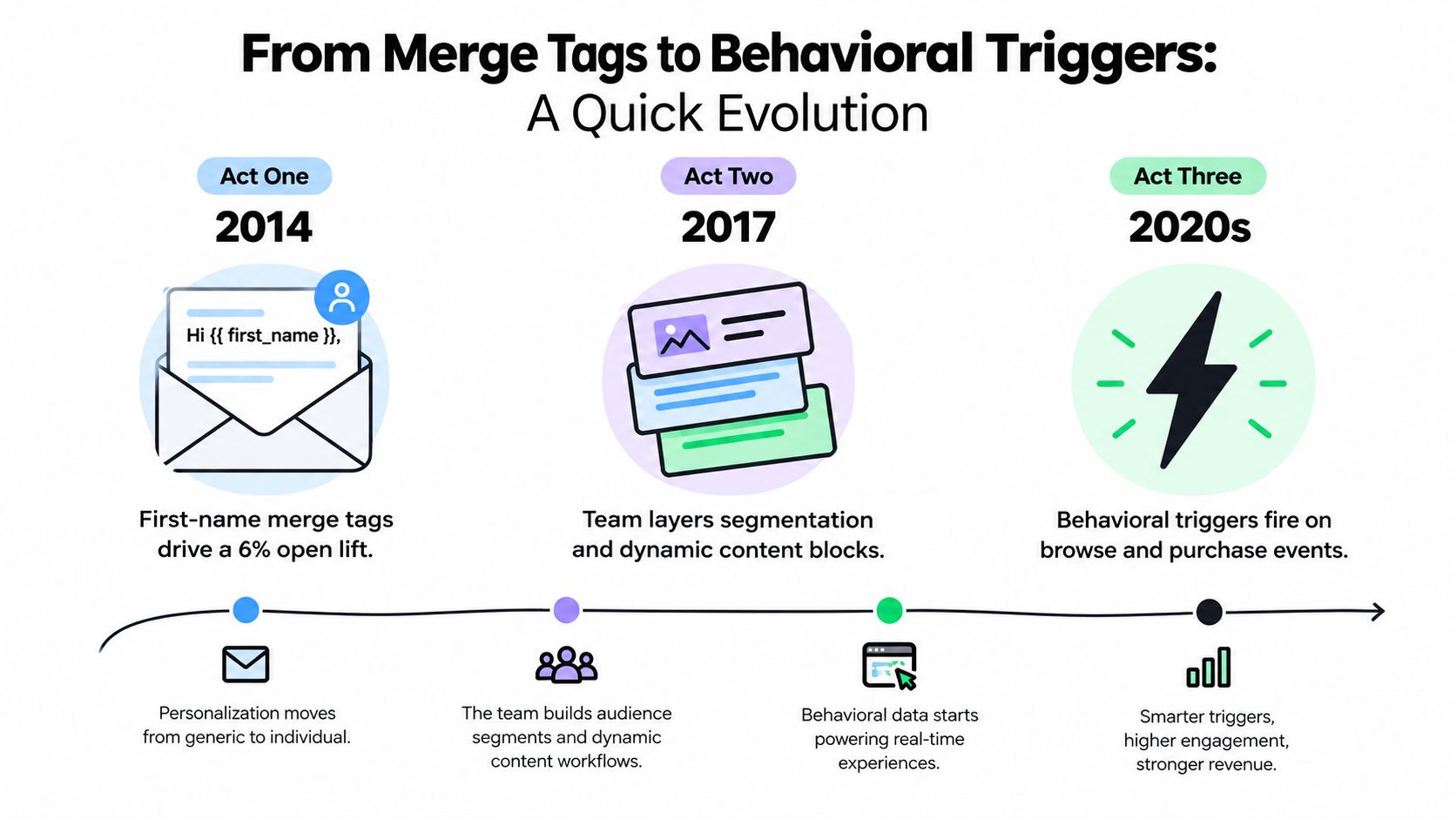
A growth team at a young company often starts with the simplest available signal. The email platform knows a subscriber's name, so the team adds a merge tag, changes the greeting, and celebrates when the report looks better. That first step matters because it teaches the team that relevance can be encoded in a campaign.
The next step changes the question. Instead of asking whether a recipient has a name, the team asks whether the recipient has bought, browsed, renewed, activated a feature, or gone quiet. Purchase-history segments and product recommendations turn a single broadcast into several versions of the same commercial idea. Dynamic blocks let one template serve different needs without forcing a marketer to build every email from scratch.
The shift from lists to signals
Behavioral triggers raise the standard again. A cart abandonment journey responds to an action. A browse recovery message responds to interest without purchase. A replenishment reminder responds to a product cycle. The team no longer needs to export a list, build a weekly send, and hope that customer intent remains unchanged until launch.
Predictive scoring and send-time optimization extend the same logic. The platform evaluates available signals and chooses a path, content variant, or timing decision for each recipient. AI-generated copy blocks can accelerate production, but they still need controls for brand voice, eligibility, suppression, and review.
The important evolution isn't the technology alone. Each stage changes the operating habit:
- Merge tags make the message feel addressed.
- Segmentation makes the offer more relevant to a group.
- Dynamic content adapts the creative inside a shared campaign.
- Behavioral triggers respond to intent while it is still useful.
- Predictive decisioning chooses among possible actions using richer signals.
A static list describes who someone was when the list was created. A signal describes what that person is doing now. Modern lifecycle teams need both, but triggers and refreshed events should govern high-intent journeys. The best program isn't the one with the most variants. It is the one that converts reliable customer signals into timely decisions without creating operational chaos.
Core Techniques That Power Personalization
Four techniques form the practical foundation of email marketing personalization. They aren't interchangeable. Each solves a different business problem, carries a different level of operational complexity, and should be introduced in an order that protects data quality.
Segmentation creates the baseline
Segmentation groups subscribers by shared attributes, lifecycle stage, value tier, or behavior. A SaaS company might separate trial users from paying accounts. An ecommerce team might distinguish first-time purchasers, repeat buyers, and dormant customers.
The technique is comparatively accessible because it can begin with CRM and transaction data. Its limitation is that a segment can become stale. A customer who moves from browsing to purchasing should leave the prospect path quickly, not remain there until a manual list refresh.
Dynamic content makes one campaign adaptable
Dynamic content swaps blocks inside a shared email template. Product recommendations, promotional language, calls to action, and imagery can change according to audience rules. This approach helps a team preserve campaign governance while serving distinct customer needs.
It works best when the data field is reliable and the fallback content is intentional. A missing preference should never produce a broken block or an irrelevant offer.
Behavioral triggers capture intent
Triggers fire after an event such as a cart addition, browse session, price change, feature activation, renewal risk signal, or support interaction. They fit moments where timing matters more than broad audience membership.
A trigger should have a clear entry event, eligibility rule, suppression rule, conversion goal, and exit condition. Without those controls, automation can create overlapping journeys and excessive frequency.
Predictive offers allocate scarce incentives
Predictive personalization uses propensity scores, lifetime value models, churn signals, or next-best-offer logic to decide who should receive a particular incentive. It can protect margin by reserving discounts for customers who need them, while offering product education or convenience to customers already likely to convert.
This technique belongs later in the sequence. Predictive outputs are only as useful as the identity resolution, event quality, and outcome labels behind them.
Teams comparing segmentation approaches can also review guidance on how to boost ROI with segmented campaigns.
| Technique | Setup Effort | Data Needed | Best Use Case | Typical Lift |
|---|---|---|---|---|
| Segmentation | Low to medium | Profile, lifecycle, purchase, or value attributes | Establishing baseline relevance | Qualitative improvement in relevance and engagement |
| Dynamic content | Medium | Reliable audience fields and content rules | Serving varied offers through one template | Qualitative improvement in content fit |
| Behavioral triggers | Medium to high | Real-time or near-real-time events | Capturing intent during a customer action | Qualitative improvement in timing and conversion efficiency |
| Predictive offers | High | Clean history, outcomes, propensity or value signals | Choosing the next-best action or incentive | Qualitative improvement in allocation and margin control |
A sensible sequence starts with segmentation and high-intent triggers, adds dynamic content once the data fields are dependable, and introduces predictive offers after the program can measure outcomes.
How an Autonomous Platform Operationalizes Personalization
A mid-market apparel brand illustrates the difference between a connected operating system and a collection of campaign tools. At the start of a monthly cycle, the customer record ingests purchases, browsing activity, loyalty status, email engagement, and support events. A customer who browsed outerwear yesterday and bought a jacket today doesn't remain in the same audience as an undecided prospect.
The segment engine refreshes membership as behavior changes. The journey layer can move a customer from browse recovery to post-purchase education, then to replenishment or cross-sell communication without a marketer rebuilding every list. Eligibility, suppression, frequency, and conversion goals remain part of the journey rather than scattered across spreadsheets.
The creative layer assembles subject lines, body copy, and product blocks for the relevant profile or segment. A recent shopper might see complementary products. A loyalty member might see a benefit-led message. A browser without a purchase might receive education or a reminder rather than a discount.
That workflow contrasts with the older pattern of CSV exports, static rules, isolated email templates, and weekly campaign pushes. The older process can still send messages, but it makes the customer record stale between exports and forces the team to manage too many handoffs.
Four moving parts keep the system coherent
- Data unification resolves events into a usable customer record.
- Segment generation updates audiences when signals change.
- Journey orchestration selects the correct lifecycle path and enforces suppression.
- Creative assembly adapts content while preserving brand and policy rules.
The platform needs a feedback loop as well. Revenue, conversion, unsubscribe behavior, and holdout results should influence future decisions. An autonomous marketing operating system such as AI for email marketing can connect customer data, journeys, content production, and approvals, but the team still needs to define acceptable actions and success criteria.
A short visual walkthrough can reinforce the operating model:
The core question is not whether the platform can produce more variants. It is whether the system can observe a customer event, make a defensible decision, send within policy, and report the resulting commercial outcome.
Measuring Real Lift Instead of Vanity Opens
A high open rate can sit beside zero incremental revenue. Open data may indicate attention, but it doesn't establish that personalization caused a purchase, renewal, activation, or expansion.
The cleanest answer is a randomized holdout at the profile level. Eligible customers are randomly assigned to a treatment journey or a control group that doesn't receive the personalized experience. Randomization helps both groups share comparable baseline behavior, so the difference in outcomes has a stronger causal interpretation.
Design the counterfactual first
The experiment needs a defined pre-period to inspect baseline behavior, a fixed treatment window, and a post-period read to identify delayed effects. The precise timing should match the purchase cycle and journey type. A replenishment program may need more observation than a cart recovery flow.
The primary metrics should reflect commercial value:
- Incremental revenue per recipient, revenue difference between treatment and control divided by eligible recipients.
- Incremental conversion, the difference in completed target actions between groups.
- Revenue per email sent, useful when message volume and eligibility vary.
Opens, clicks, and click-to-open rate remain diagnostic metrics. They can reveal whether a subject line or creative block changed attention, but they shouldn't serve as the final verdict.
| Metric Category | Vanity Metric | Incremental Metric | Why It Matters |
|---|---|---|---|
| Attention | Opens | Incremental revenue per recipient | Shows whether attention translated into value |
| Interaction | Clicks | Incremental conversion | Connects engagement with the target action |
| Efficiency | Click-to-open rate | Revenue per email sent | Accounts for commercial return and send volume |
| Attribution | Last-touch purchase | Treatment versus control difference | Separates association from causal lift |
Attribution still matters after a holdout. Last-touch reporting assigns credit to the final interaction, while a position-based model distributes credit across meaningful touches. A geo holdout can be more appropriate than a profile holdout when household behavior, store visits, or offline exposure makes individual assignment difficult.
Teams setting a broader measurement framework can use this guide to set social marketing goals, then apply the same discipline to email outcomes. A campaign measurement framework should define the business objective before the team chooses the engagement dashboard.
Measurement standard: A personalized email earns strategic budget when its treatment group outperforms a credible control group on a pre-registered commercial outcome.
A practical checklist follows:
- Define the counterfactual: Specify what the control group receives, if anything.
- Lock the holdout: Keep assignment stable during the test.
- Pre-register the hypothesis: State the expected behavior and primary metric before launch.
- Run a fixed window: Avoid stopping because an early dashboard looks promising.
- Report revenue outcomes: Include opens and clicks as diagnostics, not as proof.
Teams that need a broader campaign framework can also reference how to measure campaign success. The central discipline remains the same: measure what would have happened without the personalized intervention.
Where Personalization Crosses the Line
More personalization doesn't always create more revenue. The boundary appears when a customer feels surveilled rather than served.
A retailer referencing a one-off gift purchase in a retargeting subject line may reveal more than the customer expected. A health-related inference assembled from browsing behavior can become sensitive even when no explicit health field exists in the database. The data may be technically available, but that doesn't make every use appropriate.
Governance turns restraint into an operating rule
GDPR, CAN-SPAM, and CPRA create different obligations, but a practical program can organize its controls around consent, purpose limitation, access, and data minimization. These principles should shape the architecture, not appear only in a compliance review.
- Consent: Store permission and preference status with the customer record.
- Purpose limitation: Use an event for the purpose customers could reasonably expect.
- Data minimization: Avoid collecting or inferring sensitive attributes when they aren't needed.
- Access control: Give systems and employees only the data required for the task.
- Suppression: Enforce opt-outs, exclusions, and frequency limits at send time.
- Review: Route high-risk AI-generated copy through a human approval path.
Consumer trust remains a measurable strategic concern. One industry summary reports that 67% of consumers have little to no understanding of corporate data practices, while 64% say clear privacy information increases trust (Elastic Email trend coverage). Those figures point to a practical lesson: transparency isn't separate from performance. Customers need to understand why a brand is using a signal and how to control the relationship.
AI introduces another governance layer. A model can assemble relevant copy at scale, but human review remains important when the message references sensitive context, makes a consequential recommendation, or relies on an inference the customer never directly shared.
Trust boundary: The right question isn't “Can the brand personalize this?” It is “Would the customer understand and accept why this message was personalized?”
Proportion matters as well. A broad product reminder may suit a new subscriber, while a detailed behavioral reference may suit a loyal customer who has explicitly shared preferences. The system should match the depth of personalization to the relationship, the consent context, and the confidence of the underlying signal.
Restraint protects deliverability, list growth, and long-term engagement because customers can leave when personalization feels manipulative. The strongest programs use first-party behavior, visible controls, limited inference, and clear suppression rules. They don't chase maximum detail. They pursue useful relevance that customers can recognize as fair.
Your 30 60 90 Personalization Roadmap
A personalization program becomes manageable when the team sequences the work. The first phase establishes trustworthy inputs, the second activates high-value journeys, and the third creates a repeatable optimization loop.
Days 1 to 30 build the foundation
The team starts with an audit of the email service provider, CRM, customer data platform, event tracking, templates, consent records, and reporting definitions. The audit should identify where identity breaks, where fields go stale, and where a campaign can send despite an exclusion.
The next task is unifying first-party data around a single customer identifier. Purchase events, browsing behavior, engagement, support activity, and lifecycle status should resolve to that record. The team also defines the revenue metric of truth, such as incremental revenue per recipient or revenue per email sent.
Three to five high-intent behavioral segments provide a practical starting set. Examples include recent cart activity, repeated product browsing, post-purchase education, renewal risk, and dormant engagement. Each segment needs an entry event, exit event, suppression rule, and business outcome.
Days 31 to 60 activate the system
The second phase adds dynamic content blocks and triggered journeys to the highest-value segments. Product recommendations, complementary items, educational modules, and lifecycle-specific calls to action should come from verified fields with useful fallbacks.
The first holdout test can compare a personalized subject line, recommendation block, or journey path against a control. The weekly review should include eligibility, delivery, unsubscribes, conversions, revenue, and treatment-control differences. Opens and clicks can diagnose the creative, but they shouldn't replace the revenue read.
A team can also establish a content approval process at this stage. Brand voice, sensitive-data exclusions, offer eligibility, and frequency caps should be written into reusable rules rather than remembered by individual marketers.
Days 61 to 90 operationalize optimization
The final phase expands predictive scoring where the data foundation supports it. A churn-risk model might prioritize retention education, while a value model might protect discounts for customers who need an incentive. The team should test whether those decisions produce incremental value before scaling them.
Governance becomes part of the operating rhythm. Consent, frequency, suppression, creative QA, model review, and audit history need owners. The platform should record who approved a journey, which policy governed the send, and what outcome followed.
“Done” doesn't mean that every email contains individualized copy. It means the system can ingest trustworthy first-party events, refresh audiences, trigger journeys, assemble relevant creative, enforce customer preferences, and measure incremental outcomes without rebuilding every campaign manually.
The first action for tomorrow is concrete: export the previous quarter's purchase events, map each event to a single customer identifier, and compare that file with the current email audience. The gaps will reveal which personalization ideas can ship now and which require better data first.
The AI CMO connects first-party customer records, behavior-triggered journeys, email creation, dynamic content, holdout groups, and revenue reporting in one marketing operating system. Marketing teams can explore the platform through The AI CMO, then choose a controlled starting point such as one high-intent journey and one incremental-lift test.
Share this article