Customer Data Integration Guide for Marketing Teams

The AI CMO team
Oct 20, 2026
The campaign is ready, but the audience isn't. Marketing sees a prospect, Shopify shows a recent buyer, and the support team has an unresolved complaint under another email address. Someone has to reconcile the records before the next message goes out, usually with a spreadsheet and a deadline.
That's the practical challenge behind customer data integration. Marketing teams need more than connected applications. They need an operating model that keeps customer identity, permissions, campaign decisions, and measurement connected as information changes.
Table of Contents
- Why Marketing Customer Data Breaks
- Define the Marketing Integration Brief
- Choose Between CDP and CDW
- Design the End-to-End Data Flow
- Resolve Identities With Confidence
- Choose Ingestion and Activation Patterns
- Make Quality Privacy and Measurement Work Together
Why Marketing Customer Data Breaks
Consider a familiar customer journey. A prospect clicks an ad, browses on a phone, and later buys through Shopify using a different email address. After raising a support issue, that customer receives an acquisition offer for the product they've already purchased.
Each team may have acted reasonably on the information available. The problem is that advertising, commerce, CRM, and service records describe different pieces of the same relationship.

The Customer Experiences the Disconnect
The expectation gap is substantial: 76% of customers expect consistent interactions across departments, while 54% say sales, service, and marketing generally don't share information, according to Salesforce's customer-data fragmentation research.
For marketers, fragmented records create several different problems:
- Acquisition: Existing customers can remain in prospect audiences because purchase history hasn't reached the audience-building process.
- Retention: Teams can mistake a service problem for declining interest and send an inappropriate promotion.
- Attribution: Advertising and analytics teams can assign different identities to the same purchase.
- Reporting: Finance and marketing can disagree because their definitions of customer, order, and revenue differ.
Integration Is an Operating Responsibility
Customer data integration means connecting sources, resolving identities, standardizing fields, governing consent, and making the resulting customer context usable across business functions. Copying records into a central location addresses only part of that work.
A useful mental model separates evidence from decisions. Source systems provide evidence about purchases, interactions, and permissions. Governed rules determine which records belong together, which values should be used, and which marketing actions are allowed.
A unified profile should help a team explain a campaign decision, not merely display more customer attributes.
That distinction matters when marketers introduce automation. A fast campaign built on conflicting context is still the wrong campaign.
Define the Marketing Integration Brief
A request to unify all customer data is too broad to guide implementation. A useful integration brief names the marketing decisions that should improve and the information those decisions require.
Start with a small set of revenue-critical use cases, such as abandoned-cart recovery, churn intervention, or lifecycle measurement. Phased delivery is recommended in customer-data integration implementation guidance, rather than connecting every source simultaneously.
The planning sequence should make business intent visible before technical work begins.
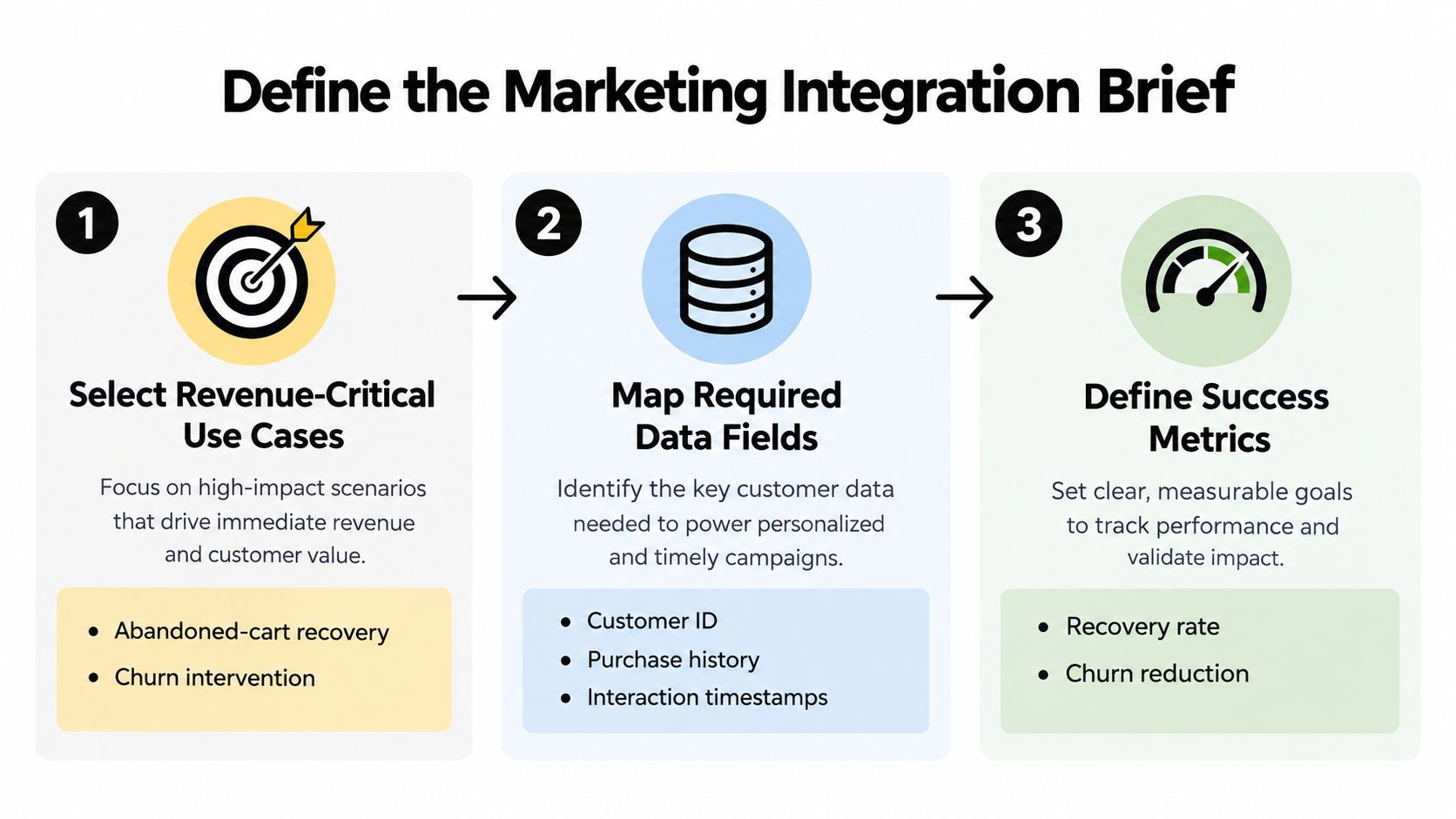
Define the Decision Before the Fields
For cart recovery, the decision isn't whether someone abandoned a cart. It's whether a recovery message remains appropriate after checking purchase completion, identity confidence, channel permission, and any relevant exclusions.
Translate each use case into a working specification:
- Business decision: State what the campaign should do differently when the information becomes available.
- Required context: Identify customer keys, events, purchase status, permission state, and reporting fields.
- Accountable owners: Assign responsibility for source accuracy, transformation rules, campaign eligibility, and incident handling.
- Success evidence: Define the commercial outcome and the operational checks needed to trust it.
A churn intervention needs different context from an acquisition audience. Treating both as generic segmentation requests hides important differences in timing and eligibility.
Create a Shared Data Contract
Inventory source systems before evaluating connectors. Record available identifiers, field meanings, update patterns, access constraints, known gaps, and the person responsible for each source.
Then establish a canonical customer and event schema, a shared contract describing how the organization represents customers and behavior. It doesn't need to anticipate every future campaign. It needs to make the initial use cases unambiguous.
For example, define whether a purchase event represents an order placed, paid, fulfilled, or retained after refunds. Those are different business states, not interchangeable event names.
| Validation gate | Question before expanding scope |
|---|---|
| Completeness and freshness | Did the expected records arrive in time? |
| Duplicates and matching | Were records counted and linked correctly? |
| Consent coverage | Can eligibility be determined reliably? |
| Activation latency | Did approved changes reach the destination soon enough? |
Launch the narrowest useful scope, validate it, and expand only after the team can explain failures as confidently as successes.
Choose Between CDP and CDW
A customer data platform and a cloud data warehouse solve different primary problems. A CDW centralizes analytical storage and transformation for querying. A CDP organizes work around customer profiles, identity, segmentation, and activation.
The distinction is useful, but product labels aren't acceptance criteria. Marketing teams should evaluate the actual workflow, ownership model, and operational requirements.
The comparison below separates their typical roles.
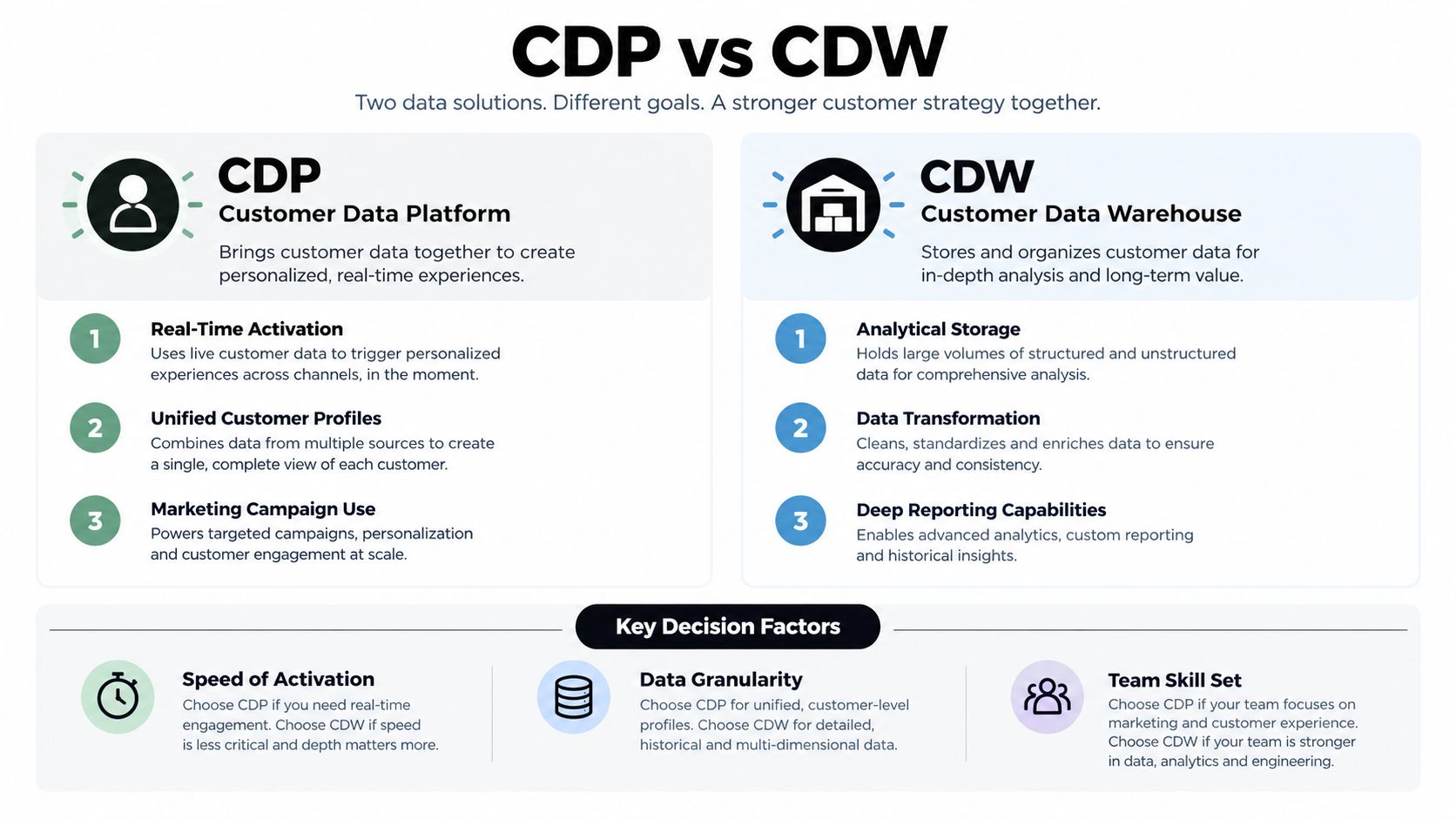
CDP and CDW Decision Guide
| Decision criterion | CDP orientation | CDW orientation | Marketing question to answer |
|---|---|---|---|
| Primary workflow | Profiles, audiences, activation | Analysis, transformation, reporting | Is the immediate need execution or investigation? |
| Team skills | Marketing operations with technical support | Data engineering and analytics | Who will maintain the logic? |
| Source volume | Evaluate profile and event processing | Evaluate storage and query workloads | Which data is operationally necessary? |
| Governance | Evaluate audience and permission controls | Evaluate access and transformation controls | Where will policy be enforced? |
| Activation | Evaluate destination workflows and latency | Evaluate outbound delivery requirements | How will a segment become a campaign? |
A customer-data-platform overview describes connecting multiple sources and matching identifiers to assemble a shared customer profile. That profile-oriented purpose is different from storing tables for broad analysis.
Choose an Operating Fit
A warehouse-centered approach can suit a team with established modeling skills and demanding analytical requirements. A CDP-oriented approach can suit marketers who need supported audience workflows and profile-based execution.
A hybrid design can place analysis in the warehouse while a customer-facing layer handles operational profiles and activation. The trade-off is coordination: duplicated logic must have explicit ownership, or marketing and analytics can recreate their disagreement inside a newer architecture.
During connector evaluation, teams can browse platform connections from NotFair to organize discovery, then verify each required direction, object, permission, and update pattern.
The accompanying video provides another reference point for the architecture discussion.
Neither architecture removes identity, consent, or quality work. The stronger choice is the one the team can operate responsibly.
Design the End-to-End Data Flow
An architecture becomes useful when marketers and engineers can trace a customer signal from its origin to a campaign decision. A Shopify order is a good example: the team should be able to explain what arrived, how it changed, which customer received it, and what action followed.
The operating model should make those handoffs visible.
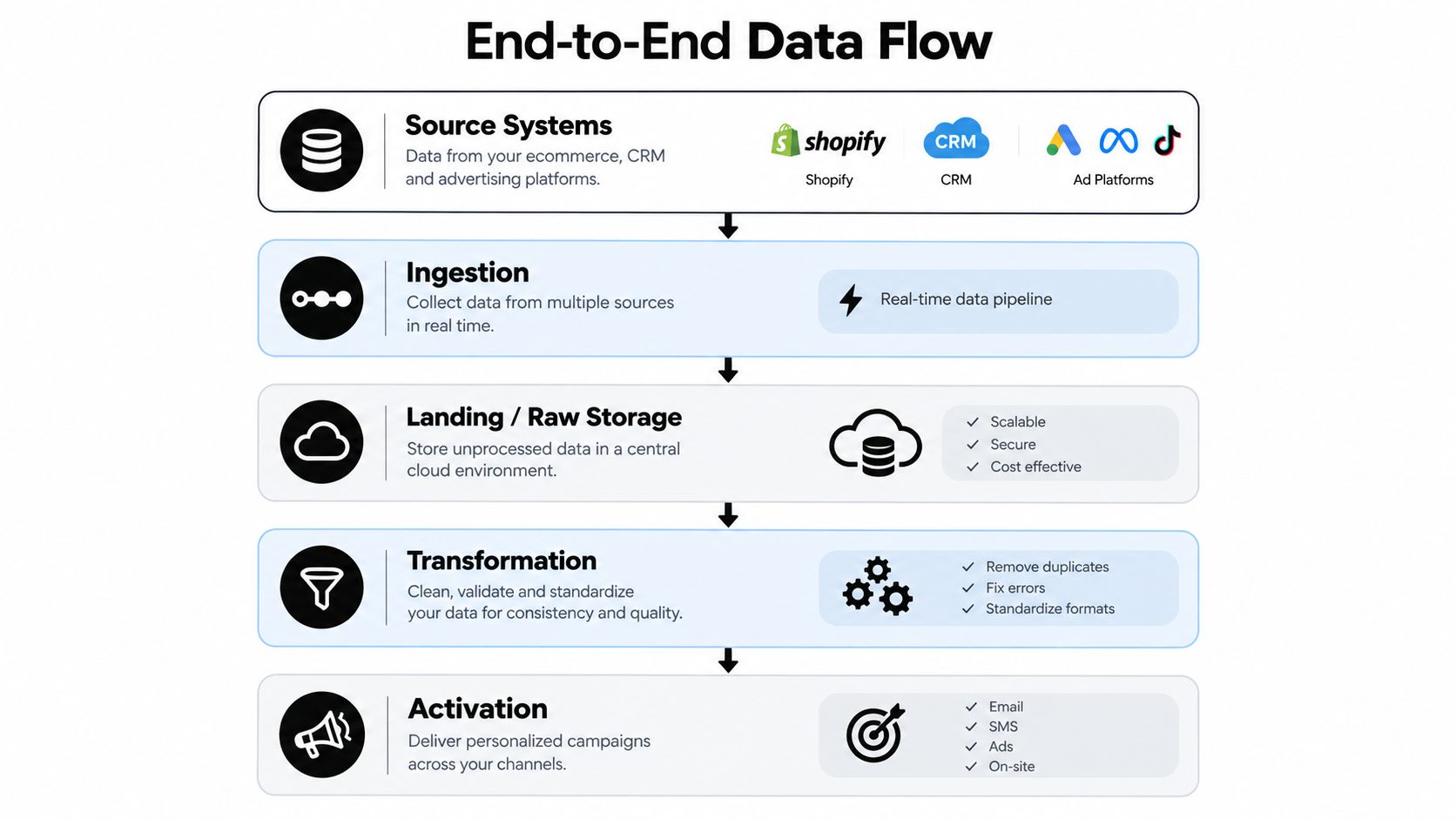
Preserve Evidence Through Each Handoff
Ingestion brings the source record into the integration environment. For the order example, retain the original order identifier, source customer identifier, source timestamp, ingestion timestamp, status, amount context, and relevant permission references.
Landing or raw storage preserves source evidence under appropriate access and retention controls. This makes it possible to investigate whether an error originated upstream or during transformation without treating a transformed profile as the only available history.
Mapping and transformation convert source-specific fields into the canonical contract. A HubSpot lifecycle event should retain its original meaning even when mapped to a shared lifecycle model. A sales qualification change shouldn't become a purchase because both advance a customer stage.
Identity resolution and profile assembly associate the signal with an appropriate customer record. Field-level survivorship rules determine which source supplies the operational value when systems disagree, rather than assuming the latest update is always correct.
Practical rule: Every activated field should have an identifiable source, transformation, owner, and intended use.
Separate Analysis From Operational Decisions
The warehouse can answer questions about cohorts, channel performance, and historical behavior. The customer-facing layer needs usable state for segmentation and journeys, such as whether a customer currently qualifies for a campaign.
Keep those responsibilities connected without making them identical. An analytical model may legitimately revise historical classifications, while an operational workflow must explain the information available when a message was approved.
Before campaigns consume integrated data, the handoff should include:
- Documented events: Agreed names, required properties, status semantics, and handling for late updates.
- Customer keys: Source identifiers retained alongside the canonical customer reference.
- Decision rules: Approved survivorship, eligibility, and exclusion logic.
- Destination behavior: Defined handling for updates, removals, delivery failures, and retries.
- Measurement references: Campaign and journey identifiers carried into reporting.
The strongest handoff isn't a diagram alone. It's a diagram backed by sample records that marketing and technical partners can interpret the same way.
Resolve Identities With Confidence
A tidy-looking profile can still be wrong. If an integration joins unrelated people, marketers may apply the wrong suppression, assign purchases incorrectly, or expose inappropriate personalization.
Identity resolution should therefore be treated as a governed business control. A CDP implementation guide addresses identity matching and recurring implementation problems such as inconsistent identifiers, duplicates, and missing information.
Start With Strong Evidence
Use deterministic matching first, based on approved relationships among stable account IDs, authenticated user IDs, and verified contact details. Consider probabilistic matching only for unresolved records and only where its uncertainty is acceptable.
The identity graph should retain source IDs, matching rules, confidence, merge history, and survivorship decisions. Teams developing a single customer view should regard those records as part of the profile's explanation, not hidden implementation detail.
Different situations require different rules:
- Anonymous-to-known transitions: Link earlier behavior only when the authentication event and permitted data use justify the association.
- Shared devices and households: Keep device, household, account, and individual relationships distinct.
- Changed contact details: Preserve identifier history without assuming an old address permanently identifies the same person.
- Deleted users: Coordinate deletion handling so later imports don't automatically reconstruct a profile.
- Uncertain matches: Route ambiguous records into review or quarantine instead of forcing a merge.
Match Confidence Should Control Use
Analytics and message eligibility don't need identical thresholds. An uncertain relationship might be explored in an explicitly labeled analysis while remaining ineligible for personalized outreach.
A false merge can apply one person's preferences to another person or distort attribution. A false split can leave purchases disconnected from the customer receiving an irrelevant acquisition message.
More matched records isn't automatically better. A useful match is one the organization can justify for the intended action.
Require reversible merges and identity lineage so teams can investigate and correct decisions. This becomes especially important when AI-driven workflows consume the profile without a person checking every case.
Validate matching against labeled records. Precision tests whether accepted matches are correct; recall tests whether valid relationships are being missed. Track false merges, false splits, and unresolved cases separately, then repeat those checks as identifiers, source schemas, and business rules change.
A launch-day matching result is a baseline, not permanent proof.
Choose Ingestion and Activation Patterns
The right connection pattern is the simplest one that meets the use case's freshness, volume, recovery, and governance requirements. Faster isn't automatically more useful, especially when the team can't reliably detect missing or duplicated events.
Marketing teams don't need to implement every pipeline themselves. They do need enough technical fluency to ask what happens when a connection fails, a record changes, or a destination rejects an update.
Match Processing to the Marketing Decision
ETL, extract, transform, load, applies transformations before data reaches the destination. It can suit tightly controlled inputs where only approved fields should enter the target environment.
ELT, extract, load, transform, brings source data into the target environment before applying downstream models. It can support revisiting business logic, provided raw-data access, retention, and traceability are governed.
Neither pattern should obscure where a field came from. If a revenue definition changes, the team should be able to distinguish the original order evidence from the reporting interpretation.
| Pattern | Useful marketing application | Operational question |
|---|---|---|
| Scheduled batch | Historical backfills and periodic customer updates | What happens between refreshes? |
| Streaming | Behavior-dependent journeys | How are late or repeated events handled? |
| API requests | Controlled retrieval or destination updates | How are access, pagination, and failures managed? |
| Webhooks | Notifications of source changes | Can missed deliveries be recovered? |
| File imports | Migrations and controlled exchanges | Who validates schema and delivery? |
A commerce-order backfill can use a different pattern from an ongoing purchase notification. A CRM lifecycle update may tolerate scheduled processing, while a web behavior trigger may require a fresher signal.
For teams comparing connection approaches, the practical distinctions between types of data connectors should be evaluated against the workflow, not connector count.
Treat Event Contracts as Shared Agreements
An event-driven connection is useful only when producers and consumers agree on the event's meaning. Define the event name, required fields, source timestamp, unique event key, schema version, and permitted uses.
For a commerce order, distinguish placement, payment, cancellation, and refund. For a CRM update, specify whether the payload contains the changed field or the current record. For web behavior, separate page activity from authenticated customer actions.
Also document retry behavior and deduplication. A repeated purchase notification shouldn't create another purchase merely because the receiving system processed it again.
Map the Named Platforms to Responsibilities
Google, Meta, LinkedIn, HubSpot, Shopify, and Slack shouldn't be treated as one database. Each connection should supply an explicitly defined part of the operating model, subject to available permissions and interfaces.
- Google: Define which acquisition or analytics product is in scope. Preserve relevant account and campaign identifiers, reporting definitions, conversion context, and timezone.
- Meta: Specify campaign and audience references, ownership, reporting cadence, and approved audience uses. Don't assume platform reporting can identify every individual purchaser.
- LinkedIn: Distinguish advertising, lead, and account context. Define how an acquired lead relates to a CRM contact without treating campaign engagement as verified identity.
- HubSpot: Establish ownership of contact, company, lifecycle, and sales-status fields. Decide how lifecycle corrections should affect marketing eligibility.
- Shopify: Retain customer and order identifiers, transaction status, and refund context. Keep an order separate from the person or account associated with it.
- Slack: Use defined team-action workflows, such as routing an integration exception to its owner. Specify what customer information may appear in a notification.
Retain platform-native identifiers alongside canonical keys so teams can reconcile records and investigate destination failures. Normalize campaign naming where useful, but preserve original names and identifiers for evidence.
Finally, agree on attribution windows, reporting ownership, and update cadence before comparing results. Different platforms can legitimately report different views of an interaction. Integration should make those differences explainable, not hide them behind a single unexplained total.
Make Quality Privacy and Measurement Work Together
Integrated customer data becomes dependable through operating controls, not a final cleanup exercise. Marketing, engineering, privacy, and analytics owners need a shared way to detect problems and stop inappropriate actions.
The dashboard should cover ingestion completeness, freshness, duplicates, missing fields, identity confidence, consent coverage, suppression accuracy, and activation latency. Each measure needs an owner and a response, not just a chart.
Enforce Permission Where Action Happens
The European Commission states that consent must be freely given, informed, specific, clear, and based on affirmative action, and that withdrawal must be as easy as giving consent through mechanisms such as unsubscribe controls, as explained in its guidance on legal grounds for processing personal data.
The operational implication is direct: recording permission isn't enough. Relevant consent and withdrawal changes need to reach the point where marketing actions are evaluated and sent.
Test failure behavior explicitly. If the sending process can't determine suppression status, the launch plan should specify a safe response rather than treating uncertainty as permission.
Test the Complete Decision
Use sample records covering ordinary customers, uncertain identities, withdrawals, cancellations, and late-arriving updates. Run journeys without sending, reconcile expected audiences against actual outputs, and verify that failure alerts reach someone authorized to respond.
A launch checklist should include:
- Source reconciliation: Expected events and records match the processed results.
- Eligibility checks: Identity, permission, and exclusion rules produce the intended audience.
- Recovery readiness: Retries, rollback paths, and incident ownership have been tested.
- Measurement design: Campaign definitions, outcomes, comparison groups, and reporting responsibilities are approved.
AI-driven personalization should pass the same controls. An automation's ability to produce a recommendation doesn't establish that the organization should execute it.
Connect Execution to Evidence
As one implementation option, The AI CMO combines a built-in customer data layer with marketing execution. A proposed cart-recovery workflow could use Data 360 for source evidence, Customer 360 for the rule-resolved profile, journeys for eligible outreach, Insights for analysis, and The Record for the decision and send history.
That's an operating-model example, not a claimed customer result. The team would still need to approve field mappings, eligibility rules, content, and launch conditions before enabling the workflow.
Measurement should distinguish observed outcomes from outcomes caused by marketing. A customer buying after a message establishes sequence, not necessarily incrementality. Holdouts and experiments provide a more defensible basis for marketing ROI measurement, while revenue, retention, campaign, and journey reporting describe the broader performance context.
Reliable customer data integration gives marketers a practical advantage: they can explain who qualified, why an action happened, and how its effect was evaluated. That's a stronger foundation for growth than either a larger database or a faster campaign queue alone.
For teams connecting acquisition and retention, The AI CMO offers a marketing operating system with a built-in customer data platform, journeys, measurement, and approval controls. Marketing leaders can visit the platform to assess a focused use case, such as cart recovery or churn intervention, against their source data, permission requirements, and launch criteria.
Share this article