The growth team loves the new landing page. The headline sounds confident, the design looks sharp, and everyone approves the launch. Then demo requests stay flat, and the next meeting becomes another debate about adjectives.
The problem isn't necessarily weak writing. It's that nobody agreed on which customer behavior the writing needed to change. A useful copywriting how-to starts there: define the decision, build the message around evidence, and let AI draft within boundaries a human owns.
Table of Contents
- Five Gates Before a Single Line Ships
- How to Write the Asset From the Brief
- Structures That Survive a Fast Scan
- Let AI Draft and Keep a Human Accountable
- Checks That Keep Persuasion Honest
- Run the Next Brief Before You Write
Five Gates Before a Single Line Ships
Say a SaaS team has a polished page that attracts visitors but produces few qualified demos. The marketing lead wants a stronger headline, sales wants more detail, and the founder wants a bigger promise. Each suggestion could help, but none explains why a visitor would take the next step.
The team needs an approval process that separates completeness from preference. A page, lifecycle email, or ad can pass through the same gates, with a named owner responsible for closing each one.
Five gates for marketing copy
| Gate | Done when | Do not advance if |
|---|---|---|
| Brief | Audience, job, verifiable proof, one CTA, and one success event are written | The team is still debating taste |
| Draft | A rough version exists from the brief, human or AI | New claims were invented during drafting |
| Structure | Outcome, proof, and action are visible in headings a scanner can use | The offer appears only after a long story |
| Human edit | A person has checked facts, voice, disclosure, and clarity | Generated text is scheduled as finished |
| Behavior test | Two messages are compared with a baseline on the success event | The winner was chosen in a meeting |
The brief gate exposes missing decisions before they become expensive revisions. A qualified demo, trial start, or replied sales email gives the team a concrete success event. Approval comments such as more exciting or more premium don't.
A shared content briefing template gives the marketing lead somewhere to record those decisions. The draft can then explore different ways to communicate the offer without changing it.
Keep creativity inside the gates
Storytelling still has a place: in SolidGigs' 2025 survey of 357 professionals, 67% said storytelling consistently produced the strongest engagement and trust. A story earns its space when it helps the intended buyer recognize a problem or understand the evidence, not when it postpones the offer.
For the flat demo page, that might mean opening with a recognizable workflow problem rather than the company's founding story. The human editor then checks whether the promise matches the actual product, while the test owner checks whether qualified demo requests change.
Release rule: An attractive draft isn't a finished marketing asset. Each gate needs evidence of completion.
Smaller teams building an AI workflow can explore AI tips for small businesses from 1chat alongside their own approval checklist. Practical tool guidance is most useful when the team has already decided what automation may do.
The immediate assignment is simple: the marketing lead picks a live asset and refuses to open a draft until its brief row is complete.
How to Write the Asset From the Brief
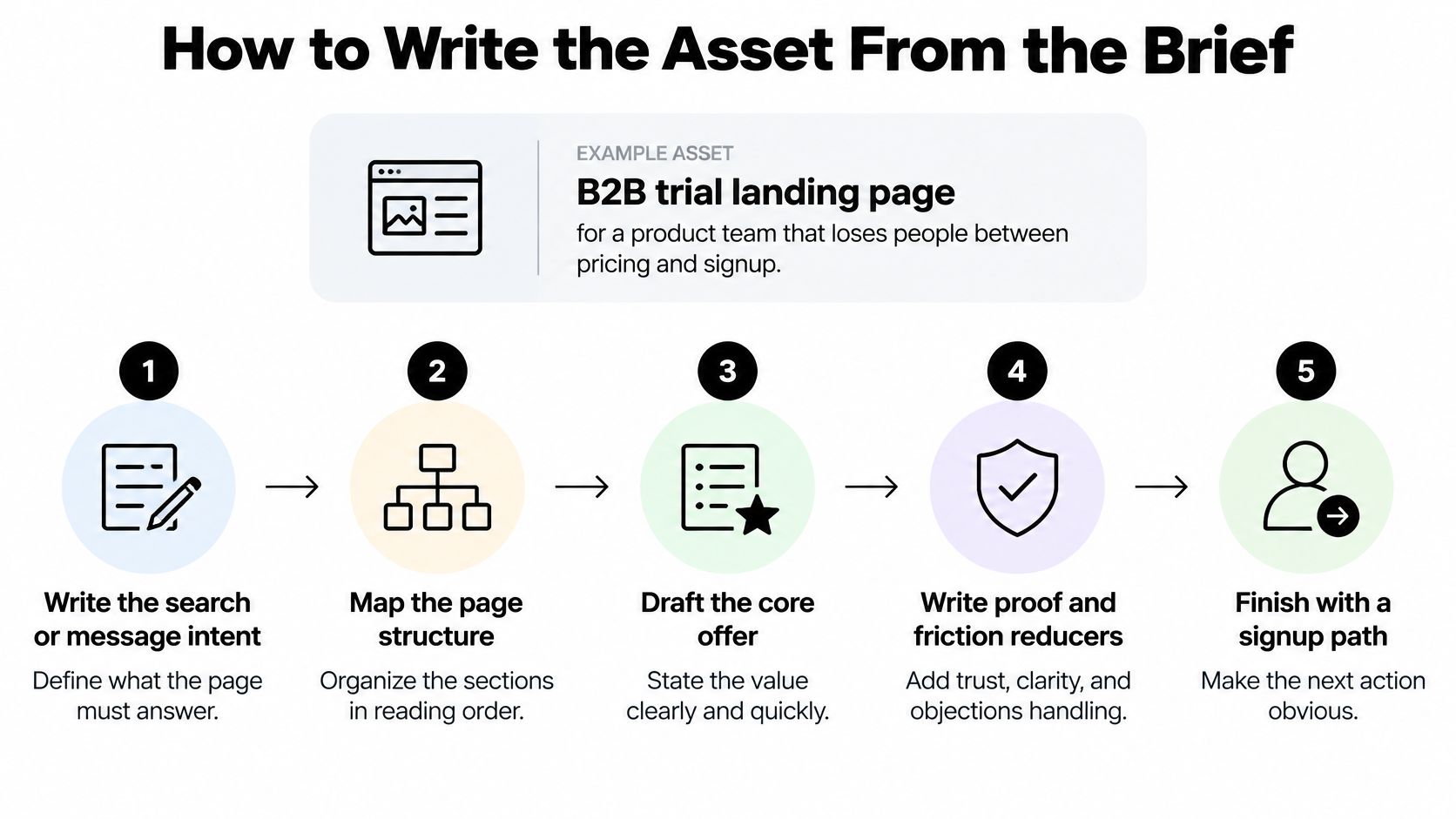
Consider a B2B trial landing page for a product team that loses people between pricing and signup. Prospects have reached the offer, but they still can't judge whether trying the product will answer their questions.
The page should resolve that uncertainty, not deliver a second homepage. Google's SEO Starter Guide recommends people-first, organized content, accurate titles, and short, page-specific meta descriptions rather than keyword strings.
Establish the decision and the evidence
Write the search or message intent in a line. For this page, the intent might be comparing workflow tools before starting a trial. Recruitment, investor information, and broad category education belong elsewhere; adding them gives the prospect competing paths.
The writer fills a page-specific brief with the audience, intent, available evidence, prohibited claims, primary CTA, and measurable success event. Here, the audience is a product lead evaluating a workflow tool, and the action is starting a trial. The evidence might include an approved product walkthrough and documented feature availability; the restriction might prohibit claims about guaranteed productivity gains.
Draft an accurate title and descriptive headings. A hypothetical title could be Workflow Software Trial for Product Teams, provided that describes the product. Headings such as What the trial includes and How setup works tell prospects where answers live; clever teasers force them to investigate.
The first screen states the value proposition in language the audience recognizes. If the product supports task assignment and progress tracking, the draft can explain those capabilities directly. The primary action also belongs beside the information that resolves a decision, such as setup requirements, rather than only at the top and bottom.
The difference between a benefit and a claim often confuses new writers. A benefit explains why a capability matters; it doesn't authorize an invented result. Wojo Media's explanation of how advertising copywriting works offers useful context for connecting an offer to an audience's motivation.
Finish the page and prepare the comparison
Place proof beside the supported claim. A screenshot can demonstrate an available interface; a documented customer result can support a carefully scoped outcome. Neither automatically proves that every trial user will achieve the same result. Product limits belong near the relevant promise, not hidden in an unrelated FAQ.
Write a short meta description that summarizes this specific page. For the hypothetical offer, it could describe trial access, available capabilities, and setup expectations without adding unsupported terms. Copying the description onto every sibling URL or repeating the target keyword makes the snippet less informative.
Review the rendered page on a phone and desktop. The writer checks whether the CTA label wraps awkwardly, a heading becomes detached from its explanation, or important conditions disappear below a collapsed panel. Reading a Google Doc isn't enough because layout changes the order in which a prospect encounters information.
Before publishing a variant, the analyst records impressions, clicks, qualified-action rate, and assisted conversions. The event definition should specify what counts as a qualified trial start, rather than treating every button click as completed signup. Changes to traffic source, offer, or form behavior also need recording so the team doesn't credit the wording for unrelated movement.
A page earns the click by setting an accurate expectation. It earns the signup by fulfilling that expectation.
Search engines may rewrite snippets. The team should therefore judge the page through its recorded outcomes, not assume that the authored description will always appear or that a more appealing snippet guarantees a better trial prospect.
Structures That Survive a Fast Scan
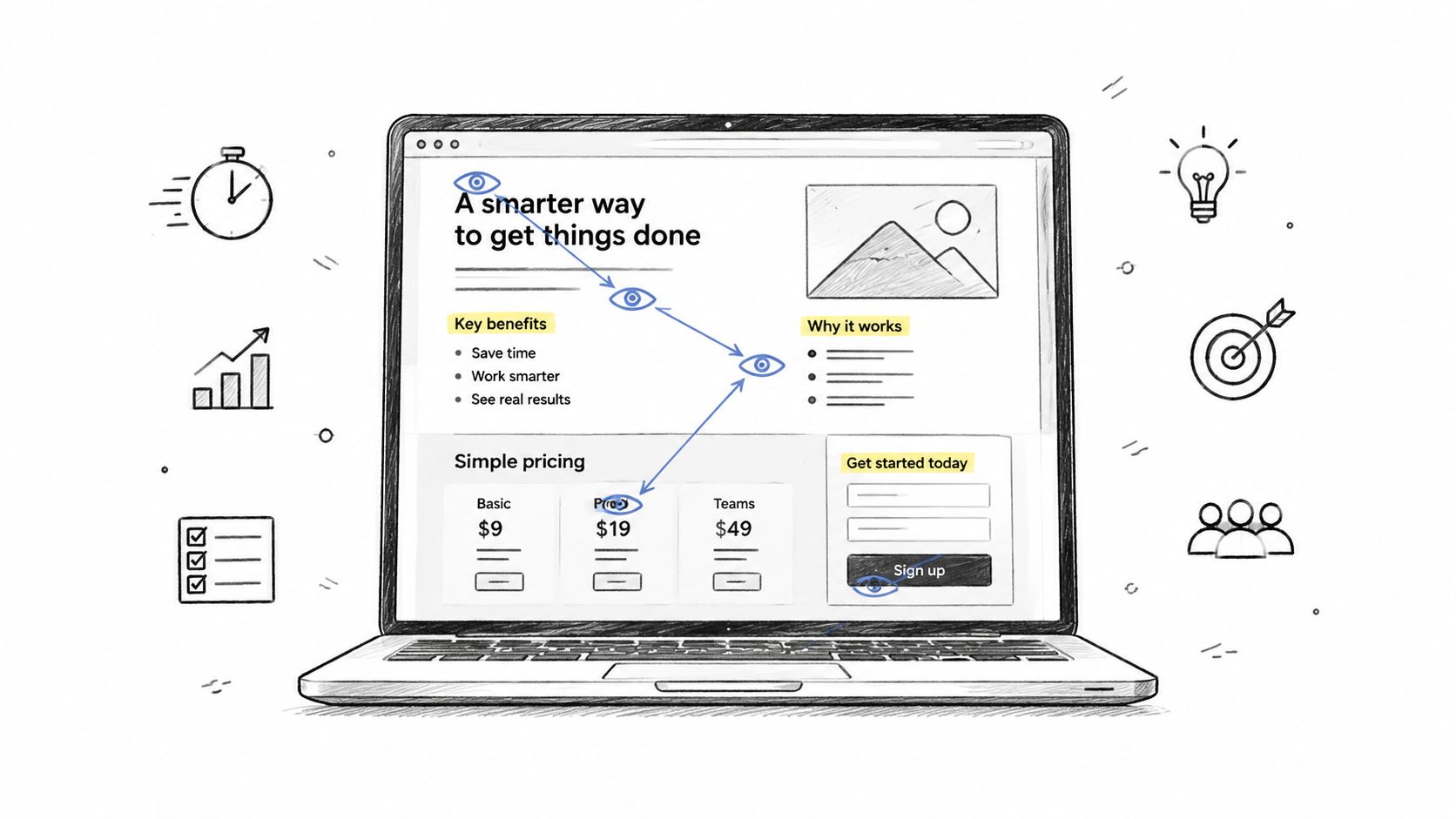
In Nielsen Norman Group's web-reading testing, users scanned 79% of newly encountered pages, while 16% read word by word; concise, scannable, and objective versions improved measured usability by 58%, 47%, and 27%, respectively, and combining those changes produced a 124% usability increase. These are usability benchmarks, not promised conversion or revenue lifts.
For the trial page, the implication is practical. A prospect shouldn't need to read every paragraph to discover what the product does, what the trial includes, and what happens after signup.
Give each asset a recognizable reading path
Landing page. The sequence is outcome, audience, proof, how it works, objection, and a primary action. A weak hypothetical headline is Unlock growth. A stronger line is Evaluate task assignment and progress tracking in a trial workspace, assuming those capabilities are included.
The stronger version names what the prospect can evaluate rather than promising a vague business transformation. Its supporting sections should demonstrate those capabilities and explain setup, trial boundaries, and the signup process.
Lifecycle email. The sequence is trigger in the first line, next step, and a subject that matches the body. A weak opening is The future of teamwork starts today. A stronger hypothetical opening is The trial workspace is ready; importing a project is the next setup step, provided the workspace exists and importing is supported.
A matching subject could be Next step for trial setup. The email shouldn't announce a ready workspace if the recipient still has to create one.
Ad. The sequence is a claim, a proof point, and a click promise. Instead of Transform productivity instantly, a hypothetical ad could describe assigning tasks and viewing progress, show the relevant interface, and offer a link to trial details. The destination must contain those details rather than opening with a sales-contact form.
Fill the pattern before adding personality
These templates make omissions visible:
- Landing page: [outcome] for [audience], [proof], [how it works], [objection answered], [one action].
- Lifecycle email: [trigger in the first line], [next step], [subject that names the body's point].
- Ad: [one claim], [one proof point], [one click promise].
Each filled template needs testing against the actual trial offer. If the proof slot contains only an adjective, or the objection answer promises a feature the trial excludes, the writer hasn't finished the structure.
The team can consult call-to-action examples to sharpen labels without changing the destination. View trial details and Start trial describe different commitments; swapping them isn't merely a style choice.
Shorter isn't always clearer. Removing a billing condition, setup requirement, or eligibility restriction can make the offer easier to scan but harder to understand accurately.
A practical five-second check asks a reviewer to locate the audience, promised outcome, proof, next action, and key limitation. Any answer that requires decoding internal jargon needs another editing pass.
Let AI Draft and Keep a Human Accountable
Making AI copy undetectable is the wrong target. The marketing team needs writing that accurately represents the offer and remains defensible when a customer asks how a claim was produced.
In HubSpot's reporting on its 2025 State of AI survey, content creation was the most common marketing AI use case, cited by 55% of respondents, yet only 7% said they create entire pieces without editing, while 56% significantly revise or completely change generated text and 38% make minor tweaks. Assisted production isn't the same as autonomous publication.
Assign risk before prompting
The owner gives AI the approved audience, evidence, restrictions, CTA, and event definition. The prompt can ask for different approaches to the same decision, such as a capability-led draft and an objection-led draft, while requiring unsupported assertions to be flagged rather than completed.
Three-level AI risk policy
| Risk level | Typical copy | Required before publishing |
|---|---|---|
| Low | Internal outlines and subject-line variants | Light edit by the owner |
| Medium | Landing pages and lifecycle emails | Human rewrite for audience fit, brand voice, and proof |
| High | Pricing, health, financial, review, or emotionally sensitive claims | Named owner, source checks, and disclosure of material connections or AI-created claims |
Risk follows the assertion, not just the format. A subject-line variant becomes high risk if it invents a discount or implies a health outcome. A landing page with sensitive financial promises shouldn't remain in the medium category because landing pages usually sit there.
The high-risk disclosure requirement is an editorial safeguard. It shouldn't be mistaken for a claim that every form of AI assistance carries an identical legal disclosure duty.
Preserve trust and test the economics
According to the SurveyMonkey marketing trends report, 46% of U.S. consumers surveyed in January 2025 said they would have a negative perception of companies using AI-generated content, 43% would be less likely to buy, and only 12% said AI-generated marketing would make them more likely to purchase; across 14 markets, more than 80% wanted AI-created material clearly labeled. Concealing automation isn't a reliable substitute for earning confidence.
Nor should the team assume that generated copy will be cheaper after media spend. In a 2025 Journal of Business Strategy study, human-written advertising copy outperformed AI-generated copy for cost-effectiveness in 9 of 12 A/B-tested cases.
Tool selection should follow the production task. Google Docs can hold an approved draft, while Landra's AI-powered listicle builder for Shopify is an option for generating that specific commerce format. Neither removes the need to inspect claims before publication.
Accountability check: The approving person should be able to identify the evidence behind every consequential promise.
For the trial campaign, the editor compares generated wording with product documentation, removes invented convenience claims, and rewrites generic benefits around the product lead's evaluation task. The owner also records approval and retains the final version with its supporting evidence.
AI saves drafting effort when the assignment is clear. A human remains responsible for what reaches the customer.
Checks That Keep Persuasion Honest
A team can enjoy a headline that customers ignore. Likability is useful feedback about execution, but it isn't a commercial verdict.
The Advertising Research Foundation's Copy Research Validity Project report, published in 1991, examined 35 television copy-testing measures; a later reanalysis found that most failed a demanding standard of at least 90% correct predictions with statistical significance at the 10% level and challenged likability as a universally reliable predictor. That history supports caution, not a universal formula for modern landing pages.
What each copy metric actually tells you
| Measure | It answers | It does not prove | Use it when |
|---|---|---|---|
| Recall | Did people notice or remember the message | That they will buy | The job is attention on a new offer |
| Likability | Did people enjoy the execution | A sales lift in every market | The team needs a creative screen, not a winner |
| Pre/post persuasion | Did preference shift after exposure | Revenue without a large enough sample | The team can field a proper test |
| Spam complaint rate | Are recipients reporting the email | That the offer converted | Volume is at or above Gmail's high-sender bar |
| Qualified action or revenue | Did the named success event move | Why the words worked | The team is choosing what stays live |
Preference movement can help explain audience response, but even an adequately sampled persuasion test isn't direct revenue evidence. For the trial page, qualified signup behavior answers the commercial question more closely than an internal vote on the headline.
The analyst should compare messages under comparable traffic conditions and avoid declaring a winner from sparse results. The editor can use brand voice guidance to evaluate consistency, while keeping that judgment separate from performance measurement.
Check delivery, disclosure, and comprehension
For promotional email, Gmail's sender requirements apply bulk-sender rules to senders delivering 5,000 or more messages per day to Gmail accounts, requiring authentication, avoidance of unwanted or unsolicited messages, and easy unsubscribe; Google recommends user-reported spam rates below 0.1% and preventing rates from reaching 0.3% or higher, where senders can lose delivery support or mitigation. The campaign owner needs technical confirmation of authentication as well as accurate subject lines and a clear, usable unsubscribe option.
The FTC's Disclosures 101 guidance requires clear disclosure of material connections alongside endorsements and prohibits claims requiring proof the advertiser doesn't possess. Payment, employment, personal relationships, and free products can affect how an audience evaluates a recommendation; disclosure shouldn't sit on a distant policy page.
WebAIM's 2025 analysis found detectable WCAG accessibility failures on 94.8% of the top one million homepages, as reported in Figma's web design statistics overview. An accessibility copy pass doesn't replace technical testing, but it addresses avoidable comprehension barriers.
- Links and headings: Labels describe destinations, and headings make sense without nearby body text.
- Forms and errors: Instructions name the required input; errors explain how to correct it.
- Meaning across contexts: Conditions don't rely on color, and the offer remains understandable when read aloud or translated.
These checks protect the customer's ability to make an informed decision. Persuasion that depends on confusion isn't a sound conversion strategy.
Run the Next Brief Before You Write
The next useful assignment isn't a brand-wide rewrite. It's an asset already on the campaign calendar: a trial page, an onboarding email, or an ad with a clear destination.
The marketing lead names the behavior that asset must change and blocks an hour for preparation before anyone prompts a model. That session produces an audience definition, defensible proof, a prohibited claim, a primary action, and the baseline the team intends to improve.
Make the test small enough to explain
A modest first comparison keeps the learning interpretable. For the trial campaign, the team might compare a capability-led message with a setup-clarity message while keeping the offer, audience, and signup path consistent.
The editor preserves the human review, and the analyst sets the review date before launch. If the available audience is too small for a useful conclusion, the result remains inconclusive rather than becoming a convenient win.
- Campaign owner: Selects the asset and records the customer decision it supports.
- Writer and editor: Produce alternative drafts and document approval of the final claims.
- Analyst: Confirms event tracking, records the baseline, and schedules the result review.
Keep a decision record
The review should produce a short explanation of what changed in the customer's next step. A useful note distinguishes more CTA clicks from more completed, qualified trials and records any changes in traffic or product behavior that complicate interpretation.
If clearer setup expectations produce better-qualified starts, the team can apply that learning to related messages without copying the winning headline everywhere. If neither version improves the outcome, the next investigation may concern the offer, signup friction, or audience rather than another round of wordsmithing.
The team doesn't need a dramatic promise to make progress. It needs a manageable test, enough evidence to interpret it, and permission to reject a favorite.
Better copy isn't louder copy. It's a clear promise a real customer can verify, supported by a team willing to let the result overrule the meeting.
The AI CMO combines marketing planning, content production, campaign execution, customer context, and performance reporting with configurable human approvals. Teams seeking a connected workflow for accountable AI drafting and behavior-based campaign review can visit The AI CMO to explore how those capabilities fit their marketing process.
Share this article