
A customer receives a punchy advertisement, a stiff renewal email, and a cheerful support reply about a frustrating billing problem. Each message carries the same logo, yet each sounds like a different company. The marketing team approved the individual assets, but nobody approved the experience connecting them.
For teams using AI across campaigns and customer journeys, that disconnect is an operational problem. Faster production needs a shared basis for deciding what the brand says, how it responds, and when a message shouldn't be sent.
Table of Contents
- What Brand Voice Actually Means
- How Brand Voice Differs from Tone and Identity
- The Measurable Dimensions of Brand Voice
- Brand Voice Examples Across Channels
- How to Build Your Brand Voice From Scratch
- The Trust Problem With AI Brand Voice
- Governing Brand Voice Across Channels and Platforms
- Why Brand Voice Pays You Back
What Brand Voice Actually Means
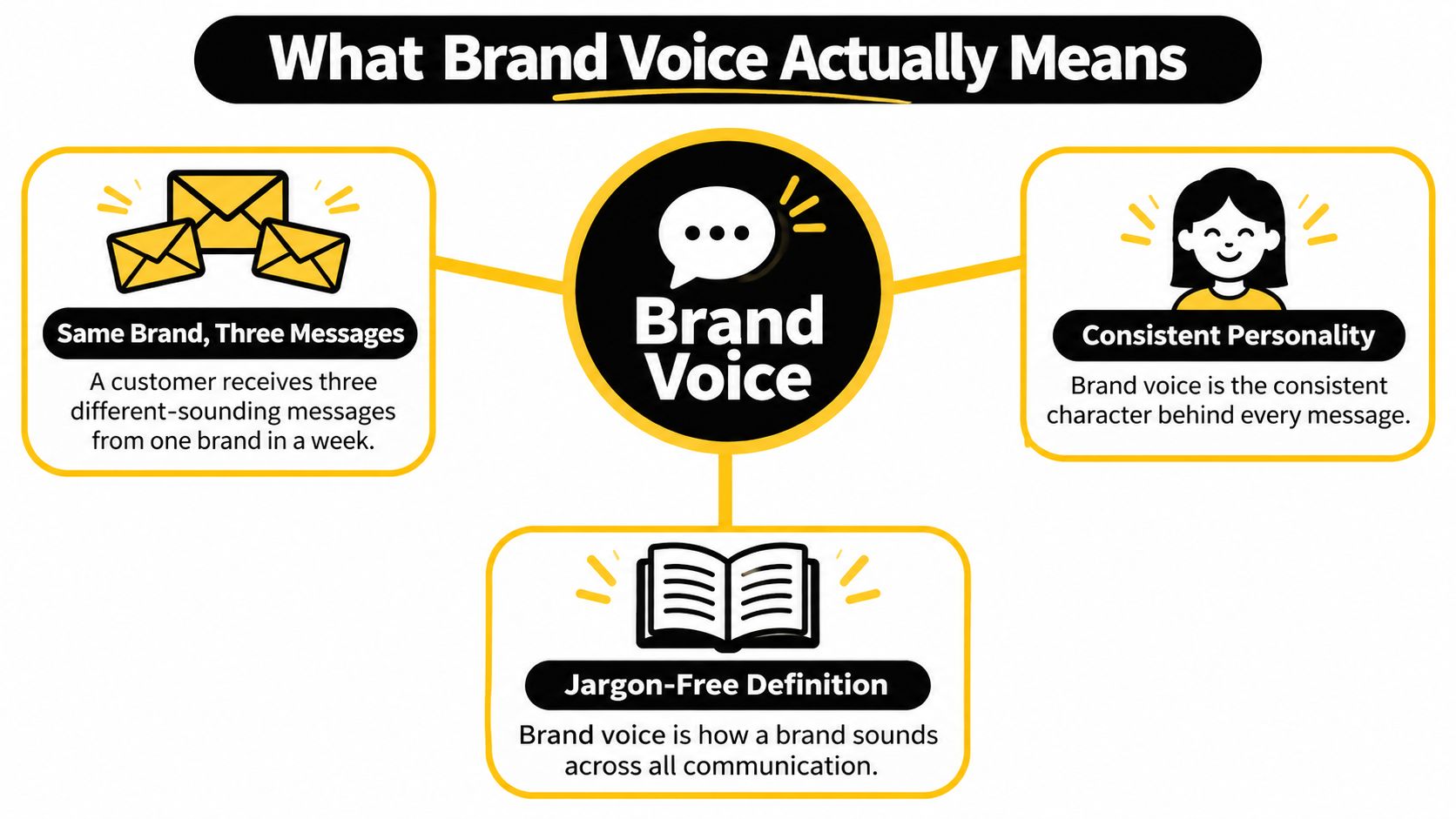
Brand voice is the consistent personality, vocabulary, and communication style a company uses across customer interactions. It makes positioning recognizable in ordinary language, from an acquisition headline to a cancellation confirmation.
A useful answer to “what is brand voice?” goes beyond adjectives. It describes the choices behind the writing: whether explanations begin with an answer or background, whether technical terms receive definitions, and whether confidence comes from evidence or enthusiastic claims.
The connection between strategy and sentences
A mission statement describes purpose. A copywriter turns that purpose into individual messages. Voice sits between them, giving writers and marketing systems a repeatable way to make language decisions.
For example, a brand positioned around practical expertise might explain limitations plainly, name the next action, and avoid inflated promises. Those behaviors express the positioning more concretely than calling the company “helpful.”
The distinction becomes clearer when familiar brand assets are separated:
- A tagline compresses a positioning idea into a memorable phrase.
- Visual identity establishes appearance through elements such as typography, imagery, and color.
- Brand voice governs language even when neither the tagline nor the logo appears.
The relationship is easier to recognize as a connected system.
Recognition without repetition
Consistency doesn't require identical sentences. It requires recognizable judgment: similar standards of clarity, respect, evidence, and expression across different situations.
Research in the International Journal of Communication on human and corporate tone found that a casual, human tone was more likely than distant corporate language to create perceptions of social presence. That finding supports treating language as part of the relationship, rather than surface decoration.
For teams translating those judgments into documentation, Sift AI's brand voice playbook for teams provides a relevant resource.
Practical rule: A voice definition should help a marketer choose between competing drafts, not merely describe the company approvingly.
How Brand Voice Differs from Tone and Identity
A familiar friend remains recognizable during a job interview, a wedding toast, and a late-night text. Their personality persists, but their delivery changes. The same distinction helps marketers separate brand identity, voice, and tone.
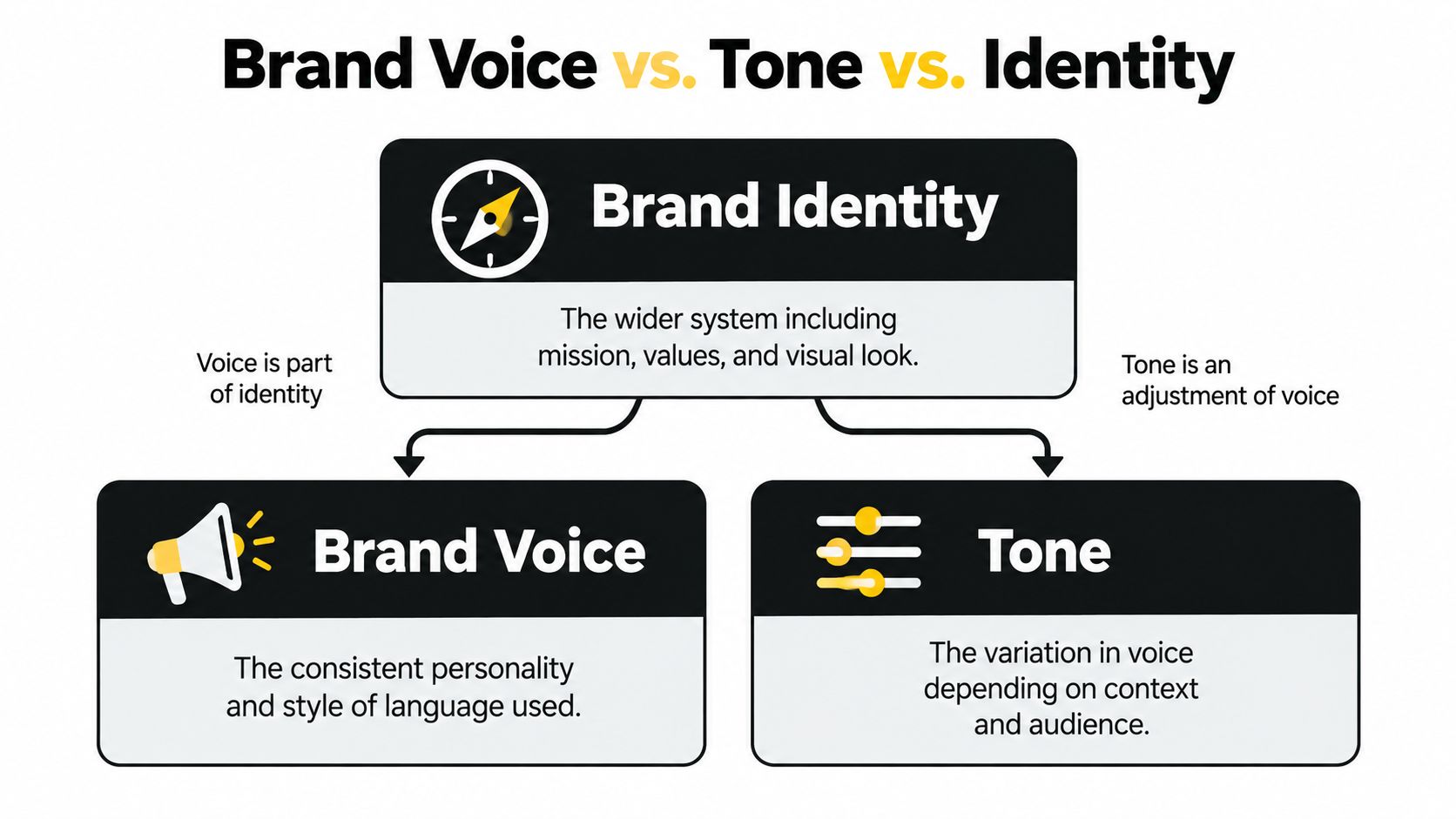
Identity is the wider system of purpose, values, positioning, and visual expression. Voice is its linguistic personality. Tone is the adjustment that personality makes for a particular audience, situation, and emotional context.
The hierarchy helps teams assign decisions to the right layer.
Context changes the delivery
Consider a software company whose voice is clear, capable, and considerate. Its launch announcement can sound optimistic, while an outage notice should become restrained and transparent.
| Situation | Appropriate tonal adjustment | Unchanged commitment |
|---|---|---|
| Product announcement | Confident and energetic | Specific, supportable language |
| Service outage | Direct and apologetic | Honest explanation |
| Support conversation | Patient and reassuring | Useful next action |
| Renewal reminder | Calm and commercially clear | Respect for the customer's decision |
The mistake isn't changing tone. It's allowing a temporary campaign mood to replace the underlying brand character, such as carrying launch-day excitement into a complaint response.
Adaptation isn't inconsistency
A corpus-based study of marketing language across channels found systematic differences: advertisements were more involved and persuasive, social posts more informational, and website copy occupied an intermediate position. Channel variation therefore deserves explicit treatment rather than blanket prohibition.
Marketers refining those differences can use Pure Write's guidance to improve clarity and tone as a companion resource.
The operational consequence is straightforward: brand teams should own the enduring principles, while channel owners define appropriate adaptations. A support manager shouldn't need permission to sound serious during a serious incident, but shouldn't invent a different brand personality either.
The Measurable Dimensions of Brand Voice
“Professional but friendly” leaves too much room for interpretation. A marketing operations team needs observable features that reviewers, writers, and automated checks can inspect.
A measurable voice profile describes behavior rather than aspiration. It also distinguishes a stylistic preference from a nonnegotiable rule, so a long sentence doesn't receive the same treatment as an unsupported product promise.
From adjectives to observable choices
| Dimension | What a reviewer can inspect |
|---|---|
| Vocabulary and terminology | Preferred product names, jargon, prohibited expressions |
| Sentence complexity | Clause structure, sentence length, explanation depth |
| Formality | Contractions, salutations, institutional phrasing |
| Conversationality | Direct address, questions, everyday expressions |
| Emotional intensity | Enthusiasm, reassurance, urgency, restraint |
| Point of view | Customer-centered, company-centered, or impersonal framing |
| Rhetorical structure | Answer first, problem first, evidence first, or narrative opening |
These dimensions make differences diagnosable. A draft may contain approved terminology yet feel wrong because it exaggerates urgency, assumes too much expertise, or delays the answer behind a grand introduction.
Research on brand voice dimensions and perception connects vocabulary, tone, communication style, emotional expression, and cross-platform consistency with perceived personality. Repeated linguistic cues give audiences a basis for recognizing the speaker; contradictory cues require additional interpretation.
Building a machine-readable profile
The practical output is a structured record, not a paragraph of flattering adjectives.
- Stable fields contain approved terminology, grammatical preferences, evidence standards, and prohibited constructions.
- Context fields specify audience knowledge, communication intent, emotional conditions, and channel adaptations.
- Reference fields hold approved examples with annotations explaining the relevant choices.
A useful voice profile makes disagreement specific: the problem becomes excessive urgency or misplaced humor, rather than a vague feeling that the copy sounds wrong.
Teams should resist measuring everything because it can be counted. Sentence length can flag a review need, but it cannot determine whether an explanation respects a worried customer. Measurement should support judgment, not impersonate it.
Brand Voice Examples Across Channels
Consider a fictional marketing software product introducing a campaign-review workspace. Its approved capabilities remain unchanged, but different voice archetypes would frame the same capability differently.
The examples below are illustrative copy, not customer evidence or claims about real companies. They show how language choices persist across acquisition, retention, support, and social communication.
Three Brand Voice Archetypes Compared
| Dimension | Authoritative Expert | Conversational Helper | Playful Disruptor |
|---|---|---|---|
| Formality | Structured and precise | Relaxed and accessible | Informal and distinctive |
| Vocabulary | Specific, carefully defined | Familiar, practical | Vivid, occasionally surprising |
| Emotional intensity | Restrained | Warm | Energetic |
| Typical structure | Finding, explanation, action | Need, guidance, next step | Tension, twist, action |
| Main risk | Sounding distant | Sounding generic | Sounding flippant |
The same product through different personalities
Authoritative Expert
- Paid advertisement: “Review campaign assets in a shared workspace before publication.”
- Lifecycle email: “The campaign draft is ready for review. The approval panel contains the outstanding decisions.”
- Support reply: “The approval status requires investigation. The support team will confirm the affected campaign before recommending changes.”
- Social post: “Campaign review should distinguish factual approval from creative preference.”
Conversational Helper
- Paid advertisement: “Campaign feedback belongs together, not scattered across conversations.”
- Lifecycle email: “The draft's ready. The remaining feedback is collected in the approval panel.”
- Support reply: “That approval status looks confusing. A support specialist can check the campaign and explain the next step.”
- Social post: “A useful review comment names the problem and suggests a direction.”
Playful Disruptor
- Paid advertisement: “Less feedback hide-and-seek. More campaigns ready for review.”
- Lifecycle email: “The draft's ready for its close-up. Feedback is waiting in the approval panel.”
- Support reply: “The approval status isn't clear. The support team needs to check what happened before suggesting a fix.”
- Social post: “Another mystery comment has entered the chat. Specific feedback makes a better guest.”
The playful support response deliberately drops the joke. Distinctiveness isn't permission to treat customer frustration as entertainment.
A team working to create brand consistency across customer touchpoints should compare these patterns with its own positioning and audience expectations. The right archetype is the one the organization can sustain credibly, especially when the interaction becomes difficult.
How to Build Your Brand Voice From Scratch
A blank document isn't the best starting point. Existing customer conversations, sales explanations, and support responses contain useful evidence about how the organization already communicates.
A language audit should distinguish authentic strengths from habits worth retiring. Frequently used language isn't automatically good language.
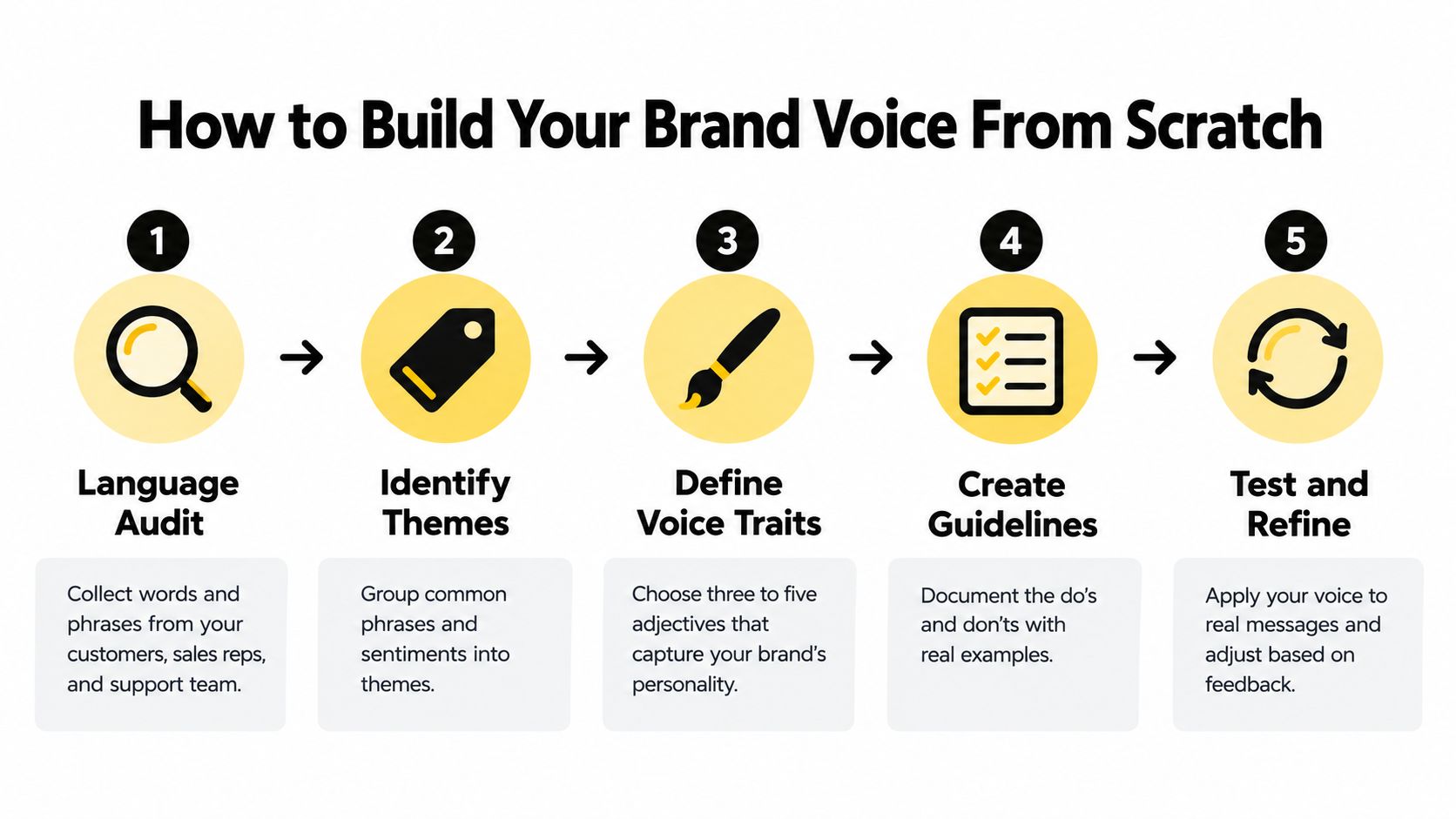
The process below connects discovery with a testable specification.
Gather evidence and make choices
Start with a language audit. The marketing lead gathers approved pages, sales correspondence, customer reviews, and support exchanges, using material the organization is permitted to process. The deliverable is an annotated collection showing clear explanations, useful terminology, recurring misunderstandings, and off-brand habits.
Next, group the findings into themes. Customer language should inform audience assumptions, while positioning determines which themes the brand should reinforce. A messaging framework template can help connect those choices to value propositions and proof.
Define three to five voice traits, then translate each into behavior. “Practical” might mean naming the next action before explaining the broader philosophy; “confident” might mean stating verified capabilities without inflated adjectives.
The deliverable is a compact profile containing preferred behavior, counterexamples, and the reasoning behind each decision.
Turn the profile into working guidance
- Document boundaries. Include prohibited claims, constructions, humor contexts, and assumptions about customer knowledge.
- Write channel transformations. Show how an approved message changes for an advertisement, lifecycle email, and support exchange.
- Test difficult situations. Include a cancellation, an uncertain product answer, and an upset customer, not only polished launch copy.
A supplementary video can support a team discussion about the process.
The final deliverable should be a version-controlled specification with an owner, approved examples, scope, and change history. Writers and AI systems need access to the current rules at the point of creation.
Testing should produce amendments, not just scores. If reviewers repeatedly disagree, the team should clarify the rule or improve the example before increasing production.
The Trust Problem With AI Brand Voice
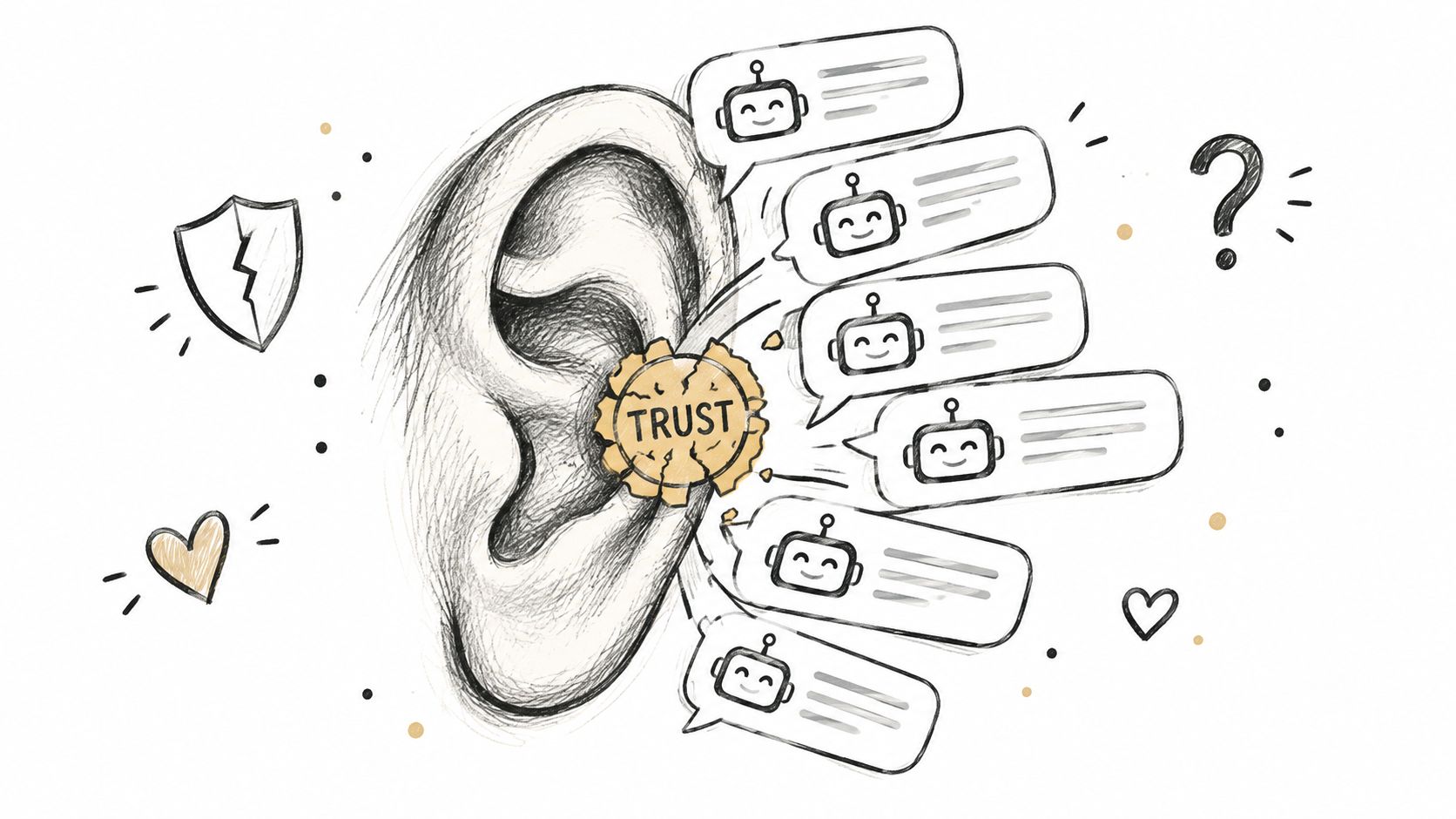
A message can sound perfectly on-brand and still undermine trust. Style matching doesn't settle whether automation is appropriate, whether a customer understands the interaction, or whether anyone is accountable for an error.
AI brand voice is therefore a trust problem before it's a production problem. The important question isn't merely whether a system can imitate the brand, but whether the resulting interaction deserves the customer's confidence.
Synthetic audio makes that tension especially visible.
Separate linguistic voice from synthetic speech
Adobe Express's survey of AI audio and consumer trust found that 77% of consumers trusted human voices most, while 58% said AI-generated voices in advertisements would reduce their trust in a brand. Those findings concern audio, not every form of AI-written copy.
That distinction matters. A marketer shouldn't extrapolate an audio survey into a universal rejection of automated email, but should question the assumption that a convincing imitation automatically creates credibility.
Scholarship on AI voice and transparency also describes potential tensions around authenticity and manipulation. Limited field evidence calls for context-sensitive decisions rather than universal promises.
Test appropriateness, not just resemblance
A sensible editorial policy should distinguish routine drafting from sensitive interaction.
- Disclose meaningfully. In sensitive automated exchanges, customers should understand the system's role and the route to human assistance.
- Require accountable approval. Regulated claims, complaints, and high-emotion messages deserve qualified human review.
- Suppress unsupported certainty. An unverified reassurance shouldn't be sent merely because it sounds calm and polished.
Situation test: An on-brand message must fit the customer's circumstances, respect the available evidence, and offer a responsible next step.
When facts are unresolved, the system should withhold the invented answer, not abandon the customer. A factual holding response and a clear escalation are preferable to synthetic confidence.
Governing Brand Voice Across Channels and Platforms
Governance begins where drafting ends: the decision to approve, publish, send, or stop. A voice specification becomes operational only when those decisions are attached to permissions, customer context, and records.
Research on brand voice in the generative AI context describes voice as partly an algorithmic-design problem. For marketing operations, that means rules must travel with the workflow rather than remain in a separate presentation.
A publication checklist
- Score conformance. Compare semantic similarity with approved reference text, forbidden-term incidence, reading-level variance, emotional deviation, and cross-channel drift. Calibrate thresholds against human judgments.
- Separate style from safety. Strong voice alignment must never override factual, privacy, or claims-compliance failures.
- Route exceptions. Low-confidence drafts and sensitive subjects should trigger review by an identified owner.
- Check permission before sending. Workflows should inspect consent status, objections, and suppression records using the customer's current profile.
- Preserve an append-only record. Retain the generated draft, applicable rule version, reviewer decision, final message, and sending action so the team can investigate without overwriting history.
Teams can map these controls into operational brand guidelines, assigning ownership to brand, legal, lifecycle marketing, and support as appropriate.
Data governance belongs in the same workflow
Under ICO guidance on consent and direct marketing, consent, when relied upon, must be freely given, specific, informed, and unambiguous; organizations must keep evidence, enable easy withdrawal, and respect the right to object to direct marketing without charge. Consent shouldn't be treated as a decorative field attached to a segment.
Disconnected systems create another failure mode. An email writer may use the correct language while missing a recent cancellation or unresolved complaint held in another system.
Useful tooling therefore connects customer records, creation, approval, and delivery. A shared operating environment helps teams apply those controls together, but responsibility still belongs to named people. An automated score can recommend a decision; the organization remains responsible for the communication.
Why Brand Voice Pays You Back
Brand voice deserves commercial attention, but not exaggerated revenue promises. The frequently cited 23% revenue estimate came from marketers' expectations in the Lucidpress–Demand Metric survey, not a controlled demonstration that consistency caused that increase, as explained in this review of the consistent-branding revenue statistic.
The stronger business case connects recognizable communication with relevant customer experiences. McKinsey's personalization research found that 71% of consumers expected personalized interactions, while 76% became frustrated when brands failed to provide them. Those findings support contextual relevance, not a standalone financial claim for voice.
A practical starting point
- Choose a live workflow. An onboarding sequence or renewal journey gives the team real situations to evaluate.
- Define acceptable decisions. Approved examples should demonstrate clarity, appropriate emotion, and evidence boundaries.
- Review outcomes together. Brand reviewers and lifecycle owners should examine customer responses alongside content quality.
The opportunity isn't more consistent copy. It's a marketing operation in which relevance, responsibility, and recognizable character survive automation.
This week's useful deliverable is a tested voice profile attached to an actual workflow, with an owner authorized to stop unsuitable messages.
For teams evaluating connected marketing software, The AI CMO offers planning, content production, campaign execution, customer profiles, support, and reporting in a shared operating environment, with configurable approvals and recorded actions. Marketing leaders can visit the platform to explore how those capabilities could support governed brand communication across acquisition, retention, and support.
Share this article