
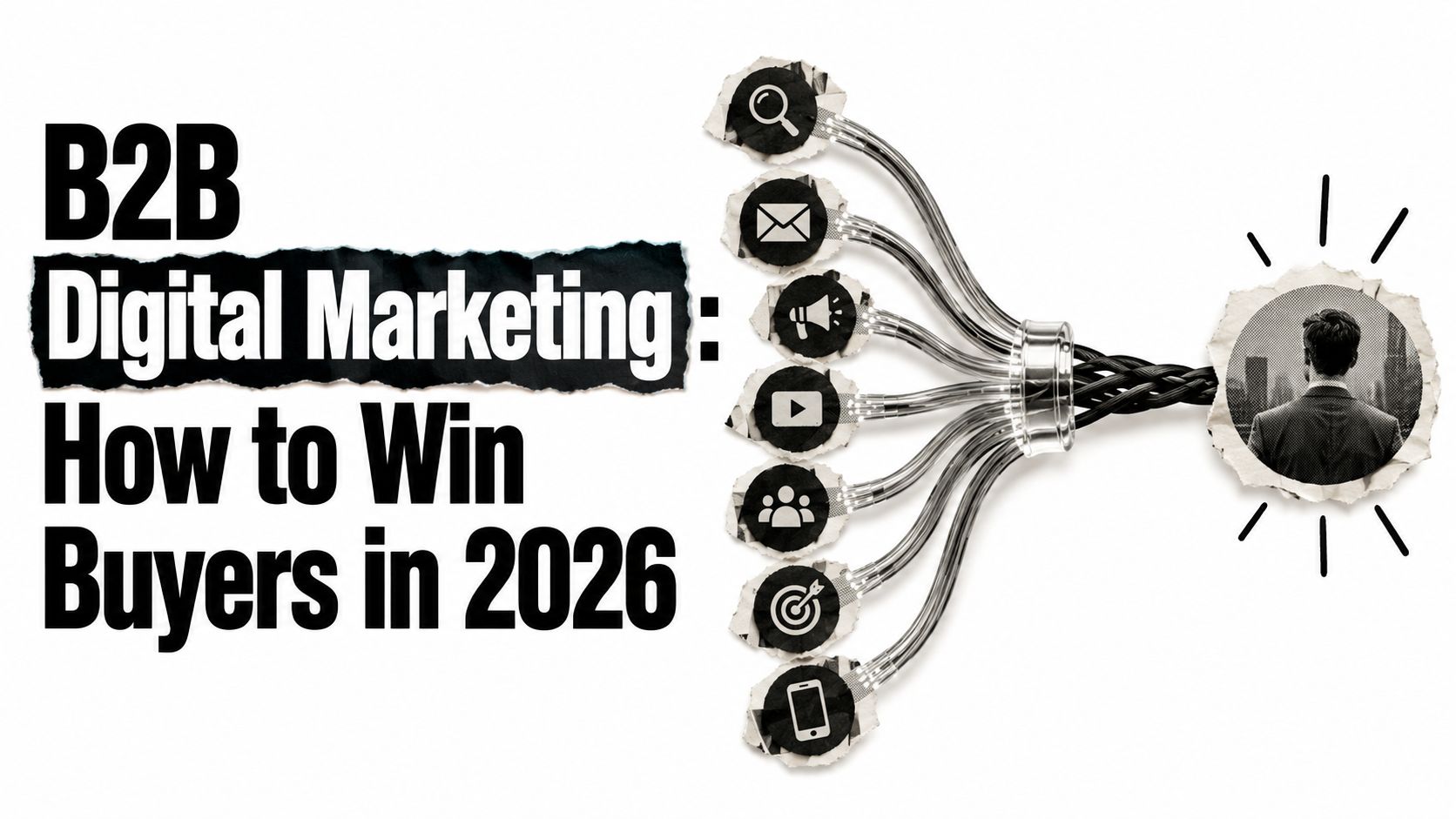
A B2B buyer now uses an average of 10 interaction channels during a purchase journey, compared with five in 2016, according to McKinsey's 2024 B2B Pulse Survey. That change reframes b2b digital marketing: the challenge isn't just to publish more content or collect more leads. It's to help an entire buying group move between research, conversations and evaluation without encountering a different story at every turn.
Consider a marketing director comparing workflow software. She might discover a vendor through search, share a case study with operations, ask an AI tool for alternatives, check a review site and later join a sales call. Each touchpoint can build confidence, or introduce a new reason to hesitate.
The practical starting point is an account-level system: know which channels serve which buyer needs, provide useful proof at every stage and test whether marketing creates business impact beyond what would have happened anyway. The work is manageable when teams connect those pieces one decision at a time.
Table of Contents
- What B2B Digital Marketing Covers in 2026
- How Buyers Move Through a Digital Journey
- Building Preference Before the First Click
- How to Build a B2B Digital Strategy in Six Steps
- Data and Personalization That Earn Revenue
- Orchestrating Campaigns Without Losing the Thread
- Measuring Pipeline and Proving ROI Beyond Clicks
- Decide Whether an Autonomous Platform Fits Your Stage
What B2B Digital Marketing Covers in 2026
B2B digital marketing is every digital touchpoint that helps a buying group understand, trust and choose a business, from a benchmark report read before first contact to a portal used after signing. That definition includes more than lead generation. It covers the connected experience that makes it possible for buyers to research independently, get help when they need it and continue a conversation without starting from scratch.
The channel mix matters because buyers move between modes. In the same 2024 survey, roughly one-third of buyers preferred in-person interaction, one-third remote contact and one-third digital self-service at each stage. More than half wanted an omnichannel experience that lets them switch between channels without losing context. The takeaway isn't that every company needs to invest equally in every channel. It's that each channel the company does use should have a clear job and a way to judge whether it's doing that job.
Map channels to buyer needs
| Channel | Job in the buying journey | Metric to track |
|---|---|---|
| Website and content hub | Self-service research and proof | Engaged accounts per month |
| Email nurture | Ongoing education tied to buying stage | Stage progression after each sequence |
| Paid search and LinkedIn ads | Reaching the wider buying group | Account reach and pipeline influenced |
| Webinars and video meetings | Building evaluation confidence | Pipeline per session attended |
| Self-service tools (calculators, trials, portals) | Low-context evaluation without a rep | Trial-to-opportunity rate |
| Chat and messaging | Answering questions at decision points | Conversations-to-meeting rate |
| Partner and review sites | Third-party validation | Referral-sourced pipeline |
A team can use the table as a working inventory. A website visit may signal account interest, but the site's deeper job is to answer questions and provide proof. A webinar may attract a promising account, yet attendance alone doesn't show whether it helped that group evaluate a solution. Metrics should connect channel activity with account engagement and movement through the buying process.
Practical rule: Write down one job and one meaningful metric for every channel already in use. If a channel has no defined purpose, the team can't tell whether to improve it, change its role or stop investing in it.
The trap is running channels as separate campaigns. The ad promises simplicity, the landing page hides the pricing context and the follow-up email pushes for a meeting before the buyer has finished researching. Treating channels as one connected system helps prevent those contradictions and gives every touchpoint a reason to exist.
How Buyers Move Through a Digital Journey
A home renovation makes the shape of a B2B buying journey easier to see. A homeowner who notices a leak doesn't call a contractor first. They ask whether the problem needs attention now, read up on possible fixes, talk to neighbors who have been through it and compare quotes. Only then do they want confidence the repair will hold. Business buyers run the same sequence, with more stakeholders weighing in and more of it happening on screens before anyone talks to a seller.
Those screens now carry real money. In McKinsey's 2021 B2B Pulse survey, 70% of B2B decision-makers said they were open to making new, fully self-service or remote purchases worth more than $50,000. The shift had been building for a while. Back in 2023, a Digital Commerce 360 and Forrester Research survey found 70% of B2B buyers expected to increase their online purchasing of goods and services, a forecast that reads today less like a prediction and more like a description of how buying already works.
Match the asset to the question
| Buying stage | Buyer's question | Digital asset that answers it |
|---|---|---|
| Problem recognition | Is this problem worth solving now? | Benchmark report or short diagnostic |
| Solution exploration | What approaches exist and which fit us? | Category explainer and comparison guide |
| Vendor shortlisting | Who has done this for companies like ours? | Case studies and industry pages |
| Evaluation | Will it work here, and what will it cost? | Demo, ROI calculator, public pricing and security page |
| Purchase and expansion | Can we roll it out and grow with it? | Onboarding portal and customer education hub |
Each row of that table is a place where deals stall without warning. Take an industrial components supplier (a composite example, though a familiar one). Its marketing team publishes sharp category education and strong customer stories, yet its evaluation-stage buyers hit a wall: no public pricing band, a security page last updated two years ago, implementation details locked behind a demo request. The earlier content still does its job, but the account goes quiet at the exact moment it was closest to a decision. One missing answer can undo several good ones.
For teams in manufacturing, a journey mapping guide for machine shops shows how operational buyers move from an initial need to a vendor decision. The discipline transfers across B2B: write down the question a buyer asks at each stage, confirm a useful answer exists, then make sure that answer is reachable in the channel the buyer prefers. A customer journey optimization approach helps connect those answers into one continuous experience instead of a chain of disconnected pages.
The pricing page, the sales proposal and the follow-up email also need to tell the same story. Buyers switch channels mid-decision, and the CFO who reads the proposal on Tuesday may be the same person who skimmed the calculator on Friday. When the numbers or the framing change between touches, the buying group has to rebuild trust at the point the team most wants momentum.
Building Preference Before the First Click
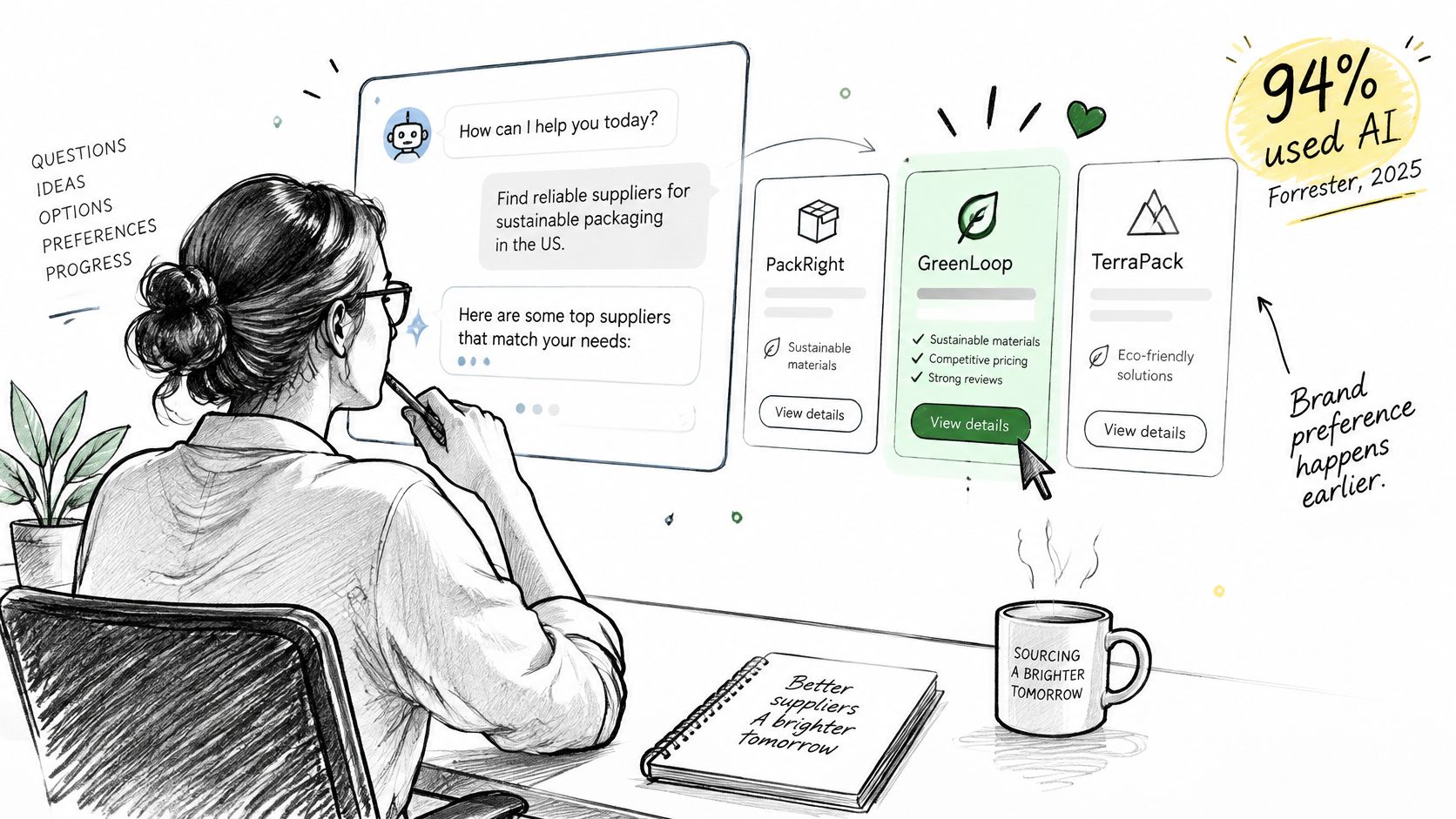
Forrester's 2025 research on business buyers found AI tools woven throughout the purchasing process, with generative AI and conversational search among the sources buyers consult when identifying potential vendors. That finding unsettles an old marketing assumption: a buyer can form an opinion before ever visiting a vendor's website, clicking an ad or completing a form.
Restaurants build their reputations on the street. Reviews and word of mouth decide whether someone considers a place before they ever read the menu. B2B buyers now work in much the same way when they ask an AI assistant to shortlist vendors, because the answer draws on whatever public evidence the tool can find and compare, which reaches well beyond a company's own campaigns.
Make the evidence easy to verify
The practical response is to give buyers, and the tools they consult, clear and consistent evidence.
Three habits do most of the work. First, make claims specific and checkable. If a company says its product supports a particular workflow, it should explain how, and publish customer examples alongside pricing ranges, security documentation and integration details buyers can verify on their own.
Second, keep the same proof across the website, email, sales decks and partner listings. A buyer should never meet a different product description depending on which channel they happen to open. Consistency helps human reviewers assess a claim and helps AI-generated summaries reflect it accurately.
Third, leave useful evidence in the open. A gated report can start a conversation, but public proof is easier for buyers to assess independently and for external tools to reference. When teams balance demand creation with intent capture, it becomes clearer which content should stay openly available and which experiences support direct follow-up.
A simple audit shows where credibility is hard to establish. List the claims buyers verify most often, such as compatibility, security, implementation support and measurable customer outcomes. Then confirm each one has a public, citable source and that the wording matches across key channels.
When a buyer can validate the story before a sales conversation, the first click matters less than the confidence built beforehand.
How to Build a B2B Digital Strategy in Six Steps
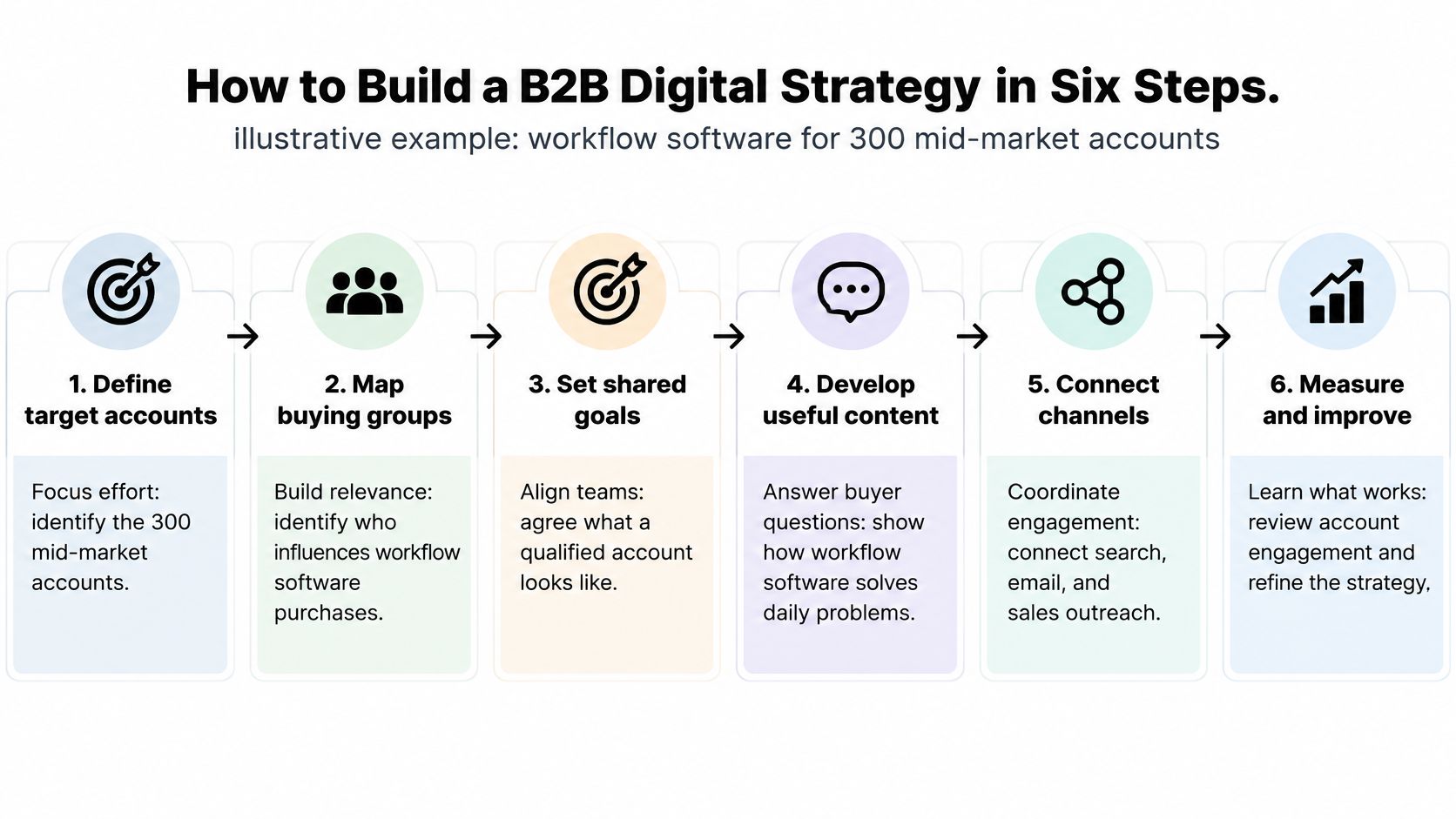
A mid-market SaaS company selling workflow software has a list of 300 target accounts. Buying groups at those accounts include roles such as an economic buyer, an operations champion, a technical evaluator, an end user and procurement. The following six steps turn that list into a working strategy rather than a loose collection of campaigns.
Define target accounts and buying groups. Write down the firmographic traits that make an account a good fit, then list the roles likely to influence a purchase. In this example, the team sees that the champion is usually an operations lead, so it builds messaging around everyday workflow problems rather than beginning with an executive-level feature pitch.
Map the journey. Attach each buyer question and asset to the role that is likely to ask for it. The operations champion may want a workflow example, while the technical evaluator needs integration and security details; mapping these needs makes gaps visible before a campaign launches.
Audit channels. Keep the channels the buying group uses, based on evidence such as where engaged accounts first appeared, and question channels without evidence behind them. If the team sees meaningful account engagement through search, email and sales outreach, it can prioritize those paths rather than spreading effort across every available platform.
Set account-level goals. Track engaged accounts, buying-group coverage, stage velocity, win rate and sales-cycle length instead of treating raw lead counts as the main outcome. For the workflow company, reaching several relevant roles within one account is more informative than collecting isolated form fills from people who don't shape a buying decision.
Assign owners and data rules. Name an owner for each stage, agree how account and contact identities will be resolved, and record consent and suppression rules before activation. For example, marketing and sales can agree that one owner will review whether an account is ready for a seller conversation, while the marketing system checks contact preferences before sending.
Plan a 90-day test. Choose a segment, set aside a comparable group of accounts as a holdout and agree on the success threshold before launch. Use the lift-test method described in the measurement section to define how the company will distinguish incremental impact from activity that would have happened anyway.
The steps lead to a useful one-page strategy: target accounts and roles, the mapped journey, selected channels, shared goals, named owners, data rules and a test design. For the workflow company, that page makes it possible to coordinate marketing and sales around the same accounts without mistaking more activity for progress.
The strategy also needs a shared view of the work. This video offers a visual prompt for thinking through how marketing planning, execution and measurement fit together.
Data and Personalization That Earn Revenue
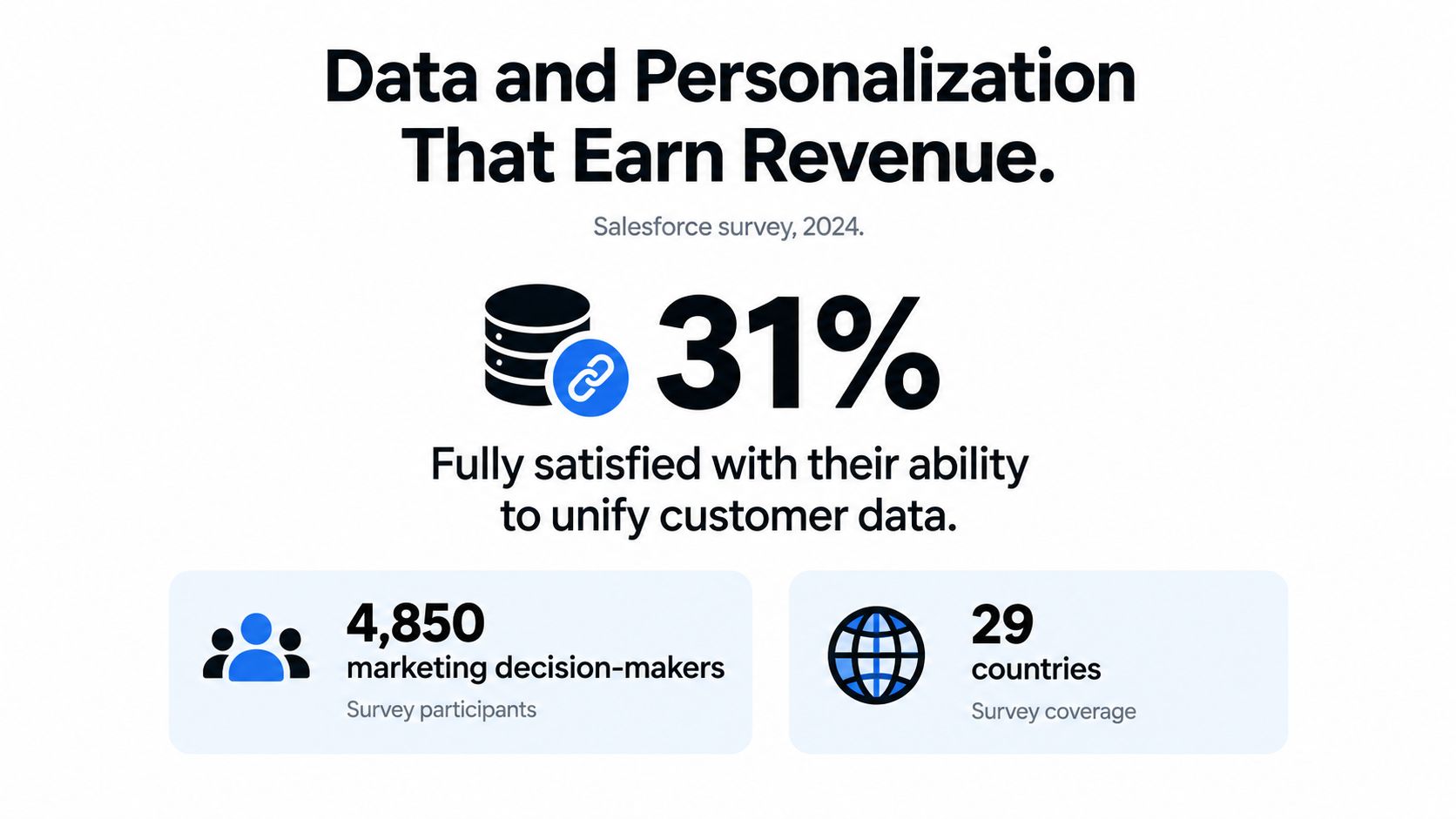
A tailor does not cut fabric from a guessed measurement. A B2B marketing team runs the same risk when it shapes an account's experience from a guessed profile. And guessed profiles are common. In Salesforce's 2024 State of Marketing survey of 4,850 marketers across 29 countries, only 31% of marketing decision-makers were fully satisfied with their ability to unify customer data. The same survey found that 57% had access to real-time data for campaign execution, while 59% still needed IT assistance to use it, and that only 48% tracked customer lifetime value. Data can exist inside a company without being ready for the people making marketing decisions.
Connect signals to customer outcomes
When a business does build the foundation, personalization can be more than a messaging preference. McKinsey's Next in Personalization research found that personalization most commonly produces a 10% to 15% revenue lift, with company-specific results ranging from 5% to 25%; faster-growing companies generated 40% more revenue from personalization than slower-growing counterparts, according to McKinsey's personalization research.
For a B2B team, the useful signals include content consumption, product usage, account expansion activity, support interactions and changes in buying stage. Instead of sending the same monthly message to every contact, the team can refresh segments and trigger lifecycle communications when a meaningful change occurs. Done well, personalization works at the account level: the champion, the finance reviewer and the technical evaluator each see context matched to their role in the same deal. For more ideas on turning live customer signals into relevant experiences, see a personalization guide for SaaS marketers.
That approach depends on identity resolution, current consent status and timely activation. A team should confirm the applicable consent requirements for each region, record the lawful basis for each contact, honor opt-outs across channels and make consent status visible to the journey engine before activation. A suppressed contact should never receive a message just because one system has not caught up with another.
Finally, measure personalization through revenue and account outcomes rather than opens alone. A personalized subject line might earn attention, but it does not prove the message helped an account evaluate, buy or expand. Opens are not outcomes. Customer data earns its keep when it helps a team make a more relevant decision and then shows whether that decision mattered.
Orchestrating Campaigns Without Losing the Thread
Buyers want the freedom to research on their own, yet irrelevant outreach can drive them away. Gartner reported that 61% of B2B buyers prefer an overall rep-free buying experience, while 73% actively avoid suppliers that send irrelevant outreach, based on a survey of 632 buyers in August–September 2024. The research also found that buyers still prefer seller input when they need contextual help, such as deciding whether a solution fits their organization. The design challenge is to automate general education and qualification while making expert help available at moments of real complexity.
An orchestra can have accomplished musicians and still sound disjointed without a score. In marketing, the score is the set of signals, rules and permissions that determines who receives what and when. A useful model considers firmographic fit, role, product-usage signals, content depth, recency and buying stage, while treating inactivity or repeated message dismissal as reasons to reduce contact.
Make the response match the signal
| Buyer signal | Automated response | Human escalation |
|---|---|---|
| Pricing page viewed twice in one week | Send an ROI case study by email | Account executive contacts the account when a second role also visits |
| Trial activated but integration stalled for 7 days | In-app setup guide and short video | Solutions engineer offers a 20-minute call |
| Contact unsubscribes from a webinar series | Suppress that series across all channels | None; respect the stated preference |
The table illustrates the difference between a signal and a reason to interrupt. A second role from the same account visiting pricing may justify a seller's attention because buying-group interest is emerging. An unsubscribe means the opposite: the team should respect the preference, not try to recover engagement through a different channel.
Teams can prevent chaotic handoffs by setting score thresholds with a buffer, so small changes don't bounce a contact between journey branches. Frequency caps should apply at both the person and account level, and suppression must be checked before any message goes out. A coordinated marketing campaign workflow helps make those responsibilities and checks visible across teams.
Every send should be traceable to its triggering event, score, eligibility rule, consent state and suppression decision. That record lets the team audit why a message went out and fix the logic if the experience feels wrong to the buyer. The operating rule is straightforward: reduce outreach when signals weaken, offer more self-service education when research rises and escalate to contextual assistance when several people from one account show coordinated intent.
Measuring Pipeline and Proving ROI Beyond Clicks
B2B organizations report real difficulty connecting AI programs to financial returns. Adobe's B2B digital trends report, which surveyed B2B marketing leaders about AI adoption, returns and measurement practice, found that 71% identify unclear ROI or business cases as a major barrier to AI implementation, 57% struggle to demonstrate measurable returns from customer-experience AI investments, and only 39% have a measurement framework for generative AI, falling to 30% for agentic AI, according to Adobe's B2B digital trends research. Gaps that wide make measurement design a strategic requirement, something to build into the program rather than a report assembled after it ends.
A farmer can't tell what fertilizer contributed to a harvest by comparing this year's crops with last year's, because the weather and other conditions may have changed. A control plot offers a better comparison. Marketing faces the same problem: a pipeline increase after a campaign might reflect the campaign, another sales effort or a shift in market conditions. A holdout group helps estimate what would have happened without the program.
Choose the method for the question
| Approach | What it tells you | Blind spot | Best use |
|---|---|---|---|
| First-touch attribution | Which channel first created the account | Ignores everything that built the deal | Reporting on sources of new accounts |
| Last-touch attribution | Which interaction came right before conversion | Overcredits branded search and direct visits | Quick tactical reporting only |
| Multi-touch attribution | Share of credit across many touches | Weights are assumptions; results remain correlational | Comparing channel mix over time |
| Holdout or geo/account lift test | Incremental effect against a control group | Needs sample size and patience | Proving a program caused revenue |
| Win-loss interviews | Why buyers chose or rejected you | Anecdotal and sales-biased | Explaining lift results and fixing messaging |
A lift test has a fixed shape. Before launch, take the account list, or a set of comparable regions, and randomly assign each account to treatment or control, matching the groups on size, industry and existing pipeline so the comparison stays fair. Write down the sample size, the test duration and the success threshold before the first send, because a threshold chosen after results arrive proves nothing. For the 90-day test in step 6 of the strategy, that might mean committing to a defined lift in engaged accounts, then continuing to observe the two groups until their opportunities have had time to close. On long sales cycles, plan for roughly six to 12 months of follow-up, treating that span as a working assumption to agree on with sales and adjust to your own cycle length. The control group runs without the program, so the gap between the two groups estimates what the campaign added.
The measurement ladder should move from engaged accounts to opportunities, then to win rate, sales-cycle length and contribution margin. Each step gets closer to the commercial result, while helping teams diagnose where a program is or isn't influencing progress. Opens and clicks can still help marketers understand delivery and content interaction, but they're weak proxies for buying progress.
A deal can involve many touches, so attribution is a model for assigning credit, not a fact about what caused revenue. Multi-touch analysis can help compare channel mixes, while a well-designed holdout estimates whether the activity produced an incremental effect. Teams can use a multi-touch attribution framework to clarify how touchpoint credit is assigned, but they should keep that view separate from causal evidence.
The reporting standard should be incremental pipeline, revenue and margin, not hours saved or content volume. Efficiency explains how a team delivered the work. It can't establish whether the work created business value.
Decide Whether an Autonomous Platform Fits Your Stage
Take a revenue team running campaigns across six channels with a lean ops function. Every launch means exporting lists, rebuilding audiences and reconciling results in spreadsheets. An autonomous marketing platform aims to close those gaps by unifying planning, production, customer data, journey orchestration and reporting in a single workspace. The catch is that automation amplifies whatever foundation it sits on. Weak identity resolution or patchy consent records will spread through every journey the system touches.
The AI CMO is one example of this category. Its AI specialists propose weekly plans and execute approved work within configured limits; Studios produces ads, emails and landing pages from briefs; Customer 360 and Data 360 support shared customer profiles and connected data; and Journeys coordinates behavior-triggered messages across channels. The company lists more than 3,400 integrations on its website. Approval settings, suppression controls and an append-only activity ledger give teams oversight of what ships. Its SOC 2 Type II and GDPR programs are, by the company's own account, still underway, so buyers should review the Trust Center for current attestations rather than relying on a sales conversation.

Check readiness before adopting
Start with operating needs, not a product demo. Can the team resolve accounts and contacts to a stable identity model? Does it enforce consent and suppression rules before any send? Has it agreed which outcomes matter and designed a holdout test to prove incremental impact? Uncertain answers mean foundation work comes first, before any system earns more execution responsibility.
A practical readiness audit covers three areas: available data sources, the target account list and one planned holdout test. Document each gap, name an owner, and assess whether a unified platform solves a real coordination problem or adds another layer of tooling. The right fit supports controlled execution and transparent measurement at the organization's current stage.
For teams working toward one account-level system, The AI CMO belongs on the evaluation shortlist. Two concrete next steps: run the three-part readiness audit above this week, then pull the current SOC 2 and GDPR documents from its Trust Center and check them against your security and consent requirements before committing to a pilot.
Share this article