Strategy to Execution Gap: How to Diagnose and Close It

The AI CMO team
Oct 27, 2026
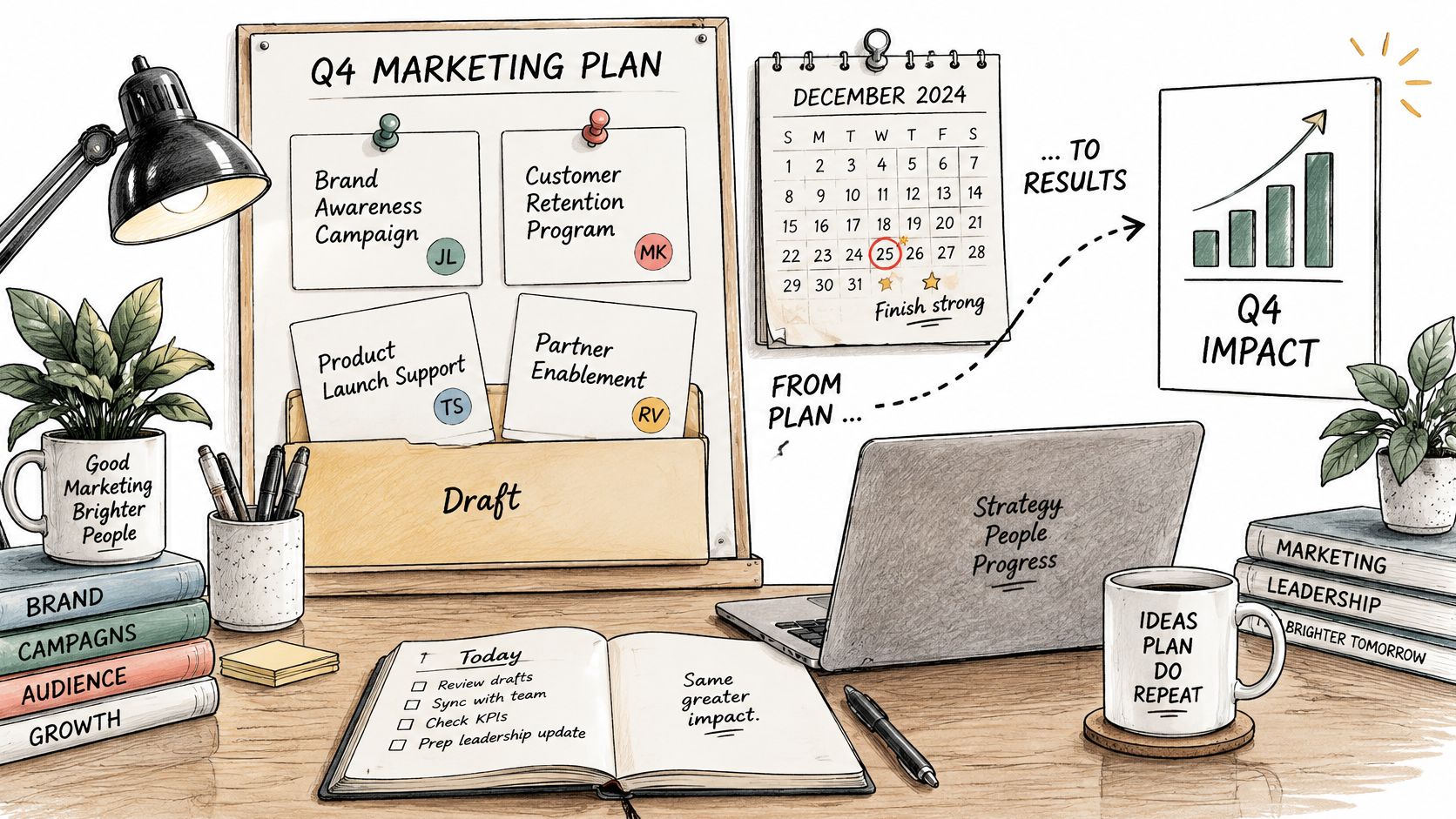
A marketing director presents a clean quarterly plan in January. The priorities fit on one slide, the owners are named, and the budget adds up. By December, two priorities are still in draft folders, one campaign launched six weeks late, and nobody can prove which activity moved revenue. That's the strategy to execution gap, and it's rarely caused by a weak idea.
Table of Contents
- Why Good Strategies Still Stall in Execution
- Diagnosing the Gap by Symptom and Cause
- Governance That Speeds Execution Instead of Slowing It
- How to Build the Objective-to-Outcome Chain
- KPIs and Thresholds That Reveal Execution Health
- Case Patterns Where the Gap Closed
- Confirm the Chain on One Objective This Quarter
Why Good Strategies Still Stall in Execution
Say a marketing director builds a quarterly plan with four priorities. Each priority has a named owner in the deck. Each one sounds achievable. By December, two of the four still sit in a draft folder while the team spent its energy on urgent requests, last minute sales support, and campaigns nobody formally approved.
That outcome defines the strategy to execution gap. It's the distance between what leadership decided and what the organization did. Think of strategy as a bridge blueprint. The design can be excellent, but missing planks between the plan and the far bank still stop anyone from crossing.
A conversion problem, not an ideas problem
The Project Management Institute report on why good strategies fail found that 61% of respondents acknowledged that their firms often struggled to bridge strategy formulation and day-to-day implementation. The same research found 88% considered successful execution of strategic initiatives essential or very important to competitiveness over the following three years, yet only 56% of strategic initiatives had been successful on average during the preceding three years.
Go-to-market work shows the same split. In the Dynata study for Highspot among 463 leaders, only 10% of surveyed senior leaders said they were very effective at driving successful go-to-market initiatives, despite 98% saying their strategy was being executed. Activity is happening. Delivered outcomes aren't keeping pace.
Leaders don't close this gap by writing a better deck. They close it by making every priority traceable to an owner, a budget, an approval rule, and a measured result.
Leaders under time pressure can sharpen that translation work with structured reflection, including coaching prompts for busy executives that force clearer choices before work reaches the team. The practical path forward has five parts, a symptom diagnosis, a decision rights split, an objective to outcome chain, KPI thresholds, and a 30 day pilot on one objective.
Diagnosing the Gap by Symptom and Cause
Start with observable symptoms, not opinions about effort. Find the row that matches the team's current quarter, read the likely root cause, then run the check on the right. One symptom can be a bad month. A cluster points to structure.
| Symptom | Likely root cause | First check this week |
|---|---|---|
| Teams cannot name the top priorities | Translation failure at execution layers | Ask five people in one function to name the top three; count matches |
| Plans finish on time but results stay flat | Activity tracked instead of outcomes | Trace each initiative to one revenue, retention or service metric |
| Approvals take longer than production | Governance built as a queue | Measure approval latency for each decision type |
| Budget moves without a recorded decision | Spend not tied to objectives | Compare the spend log with the plan for the month |
| Teams quote different customer numbers | Fragmented customer data | Count the systems that feed each live campaign |
| Reports describe activity, not progress | No exception thresholds | Check whether a missed target would have triggered a flag this week |
| Objectives change every quarter | No named owner or review date | Confirm each objective has an owner and a fixed review date |
The translation failure behind the first row
The MIT Sloan Management Review analysis of 124 organizations covering 4,012 respondents found that only 28% of executives and middle managers responsible for execution could identify three corporate strategic priorities. That isn't a communication style issue. It's a measurable break between intent and daily choice.
When managers can't name the priorities, they substitute local objectives. A demand generation manager protects lead volume. A lifecycle manager protects send volume. A paid media manager protects channel efficiency. Each decision looks reasonable inside its function, and the combined result drifts away from the strategy leadership approved.
Urgent work also wins by default. A sales request with a Friday deadline feels concrete, while a strategic segment build with a quarterly payoff feels movable. Without a written chain and a review rule, teams keep choosing the concrete task and postponing the strategic one.
Fragmented data creates the same drift
Disconnected systems produce a quieter version of the problem. Planning sits in slides, creative sits in a design tool, audiences sit in a CRM, and results sit in channel dashboards. Each handoff loses context, so a campaign designed for lapsed high value customers can end up reaching a broad list because that's the segment the sending tool can build quickly.
Conflicting customer numbers are the tell. If email, paid social, and sales each quote a different count for the same segment, execution decisions can't be consistent. The fix starts with counting the systems feeding each live campaign and naming one shared record for audience, consent, spend, and result.
Verdict rule: If three or more symptoms appear in the same quarter, the gap is structural. Another planning workshop won't fix it.
Structural gaps need operating changes. Decision rights have to be explicit, each objective needs a chain to a financial outcome, and reviews need thresholds that flag problems without waiting for a narrative update. Teams showing only one symptom can run the single check in that row and correct course within the existing system.
Governance That Speeds Execution Instead of Slowing It
Governance has a paradox at its center. Too much creates queues where finished work waits for permission. Too little creates uncontrolled work, inconsistent decisions, and weak accountability. Both widen the gap, just through different mechanics.
The 2025 global benchmark of 800 business professionals from Planview identified complex governance and approval processes as the leading barrier to strategy execution at 39%, ahead of lack of alignment between strategy and execution at 33% and slow decision-making at 32%. Treating every approval identically produces that result. Routine work waits in the same line as high risk work.
Split decisions by risk, not by habit
| Decision type | Who decides | Control mechanism | Example |
|---|---|---|---|
| Strategic priorities | Leadership team | Quarterly review against the objective list | Choosing a new customer segment to enter |
| Routine campaign variants | Platform within limits | Pre-approved spend and brand rules | Weekly email subject line tests |
| Sensitive claims or audiences | Named human approver | Escalation rule before send | Health or financial product claims |
| Suppression and consent | System, before send | Hard block, not a review step | Opted-out contacts never receive a message |
| Budget increases above ceiling | Budget owner | Spend ceiling with approval request | Raising paid social spend mid-week |
| Post-campaign learning | Campaign owner | Scheduled review against holdout | Monthly incrementality read-out |
Routine variants should run inside pre-approved spend and brand boundaries. A subject line test that stays within approved claims, approved segments, and the weekly budget doesn't need a senior reviewer. It needs rules the system can check automatically, which is where disciplined marketing workflow management turns governance from a queue into a set of guardrails.
Sensitive claims work the opposite way. Health claims, financial claims, vulnerable audiences, and regulated offers escalate to a named human approver before anything sends. That row also needs written AI rules, since the Brafton marketing AI report summarizing a 2025 survey found 81% of marketers used AI in their marketing processes, but only 42% reported having a formal AI policy. Speed without permitted input rules, output review expectations, and disclosure requirements just produces risk faster.
Suppression and consent don't belong in a review queue at all. They're hard blocks enforced before send. An opted out contact should be technically unable to receive the message, not dependent on a reviewer remembering to check a list.
Measure the queue itself
Track approval latency for each decision type, from submission to decision. If routine approvals sit open for days, governance is costing more than it's controlling. If a category gets reviewed repeatedly and the reviewer never changes the outcome, move its boundary into pre-approved rules and reserve human attention for exceptions.
How to Build the Objective-to-Outcome Chain
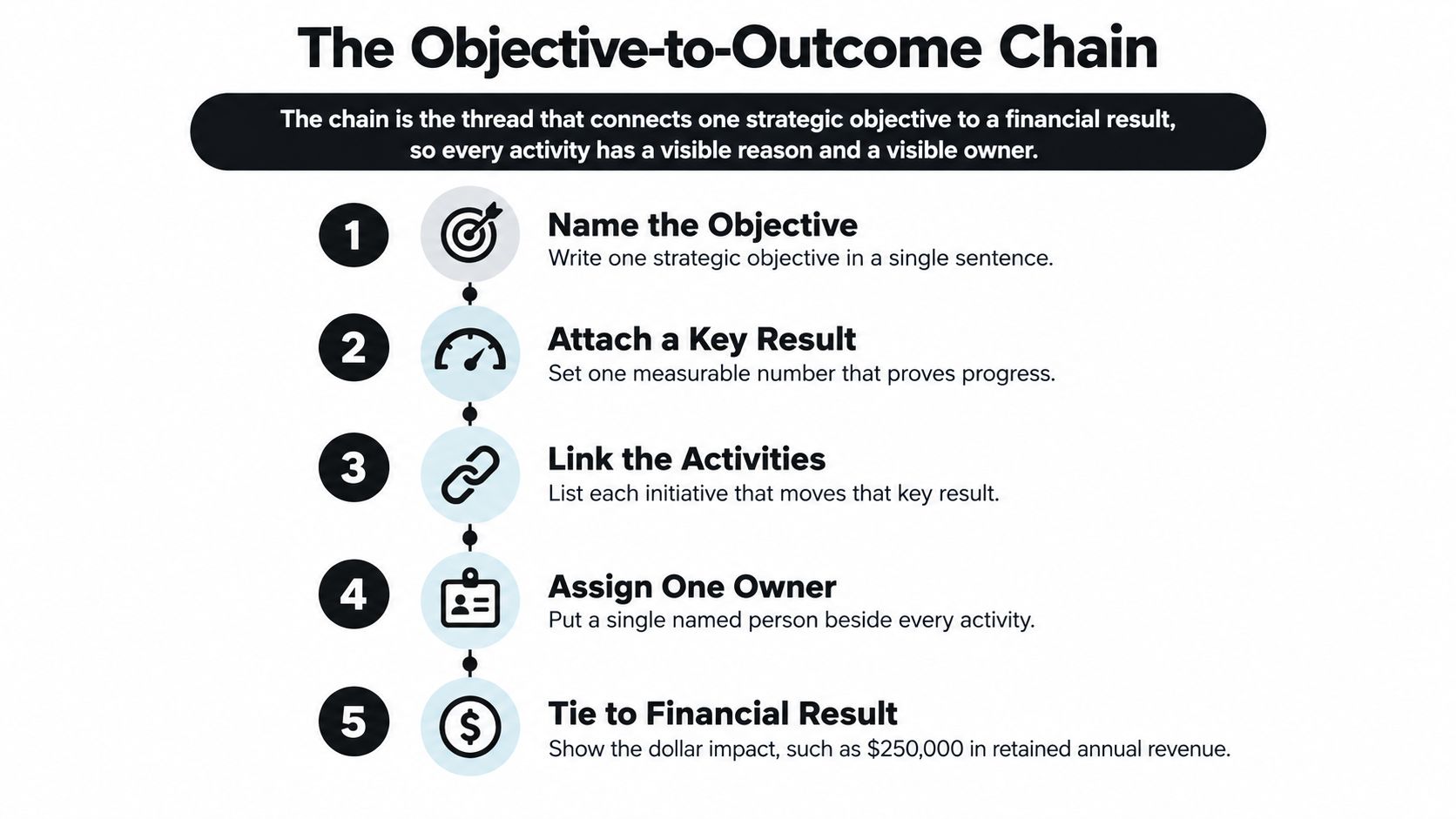
The chain is the thread that connects one strategic objective to a financial result, so every activity has a visible reason and a visible owner. Build one chain per objective. Don't build a master diagram for the whole department, since that usually becomes too abstract for anyone to run.
The visual below shows the chain in its simplest five step form.
The nine step build
- Write one objective with a number and a deadline. A target without a date can't be reviewed, and a date without a number can't be judged.
- Attach the audience or lifecycle segment and its consent basis. The segment defines who can receive work, and the consent basis defines who must be excluded.
- List approved activities by channel. Each activity carries its approval level, automated, pre-approved, or human reviewed.
- Name one owner and one budget ceiling. Shared ownership means nobody can be asked why the chain stalled.
- Choose one leading KPI and one financial outcome. The leading KPI moves early, while the financial outcome proves the work mattered commercially.
- Set invariants enforced before sending. Suppression, authorization, spend ceilings, and required approvals don't flex during a busy week.
- Set adjustable variables for learning cycles. Audience, message, channel, and cadence can change inside two week cycles with a predefined success metric and a holdout where feasible.
- Log every decision in an append-only ledger. Record the decision, approver, asset, audience, send, spend, and result so misses can be traced to a cause.
- Review weekly by exception thresholds. Narrative updates hide drift, while thresholds surface it while there's still time to act.
Founders and small teams setting that first objective can borrow phrasing discipline from concrete business goal examples for ADHD founders, since a vague objective breaks the chain at step one. Teams formalizing the document itself can adapt a structured marketing strategy template rather than starting from a blank slide.
The short walkthrough below shows how the chain logic plays out when a team connects planning to day to day execution.
Control and adaptation belong together
A study of 304 employees published in the Asia Pacific Journal used ordinal logistic regression and found that capability and internal processes significantly improved organizational performance, while incremental implementation had a stronger positive effect than purely rational implementation, with excessive flexibility eventually becoming harmful. That balance is exactly what steps six and seven encode.
Fixed guardrails protect budget, consent, brand rules, and measurement. Controlled experimentation handles everything else. A team that locks every variable learns nothing, and a team that changes every variable can't tell what worked. The ledger keeps both honest, because activity volume stops masquerading as strategic progress once every send connects to a decision and a result.
Separate what must never change from what should change on a schedule. Most execution systems fail by mixing the two lists together.
KPIs and Thresholds That Reveal Execution Health
An initiative delivered on time can still be failed execution. It might consume scarce specialist hours, reach the wrong customers, or produce activity that can't be tied to incremental revenue. On-time delivery measures effort, not effect.
Capacity makes that distinction expensive. PwC's 2025 survey of 678 executives and board members found resource constraints were a top-three obstacle to achieving corporate vision for 42% of respondents, while its COO survey found talent retention and skill shortages were the most common top-three obstacle at 46%. Scarce skills spent on unmeasured work aren't available for work that compounds.
Execution health KPIs with flag thresholds
| KPI | What it reveals | Example flag threshold | Cadence |
|---|---|---|---|
| Objective-to-owner coverage | Whether every objective has a named owner | Any objective without an owner | Weekly |
| Approval latency | The queue cost of governance | Routine approvals open beyond 48 hours | Weekly |
| Spend versus plan | Budget discipline | Variance above 10% of planned spend | Weekly |
| Leading indicator divergence | Early drift from target | Off target for two consecutive periods | Weekly |
| Consent coverage | Whether audiences are eligible to receive sends | Any send batch with incomplete consent checks | Every send batch |
| Incremental revenue or retention lift | Real commercial effect against holdout | No lift against holdout after one full cycle | Monthly |
| Initiatives closed with a measured outcome | Share of work that ends in a reviewed result | Below 80% of initiatives reviewed | Quarterly |
Treat these thresholds as illustrative starting points to calibrate, not universal standards. A team spending heavily on paid acquisition may set a tighter spend variance. A team in a regulated category may review consent coverage even more aggressively. The value sits in having a flag at all, especially since AchieveIt's State of Strategy Execution research involving more than 250 leaders found only 56% used KPIs or metrics to keep plans on track.
The minimum trustworthy measurement system
Dashboards alone don't prove execution changed an outcome. Five elements make the numbers decision worthy, and disciplined marketing ROI measurement depends on all five working together.
- Identity resolution: The same customer must be recognizable across email, web, and purchase records, or lift calculations double count people.
- Consent coverage: Every audience count should reflect who is actually eligible to receive a send, not who exists in a database.
- A baseline before launch: Record the pre-campaign rate for the target segment so change has a reference point.
- A holdout for incrementality: A comparable group that doesn't receive the activity shows what would have happened anyway.
- Honest attribution uncertainty: Report ranges and known blind spots instead of single numbers that imply false precision.
Continue, stop, or reallocate
End every cycle with a decision, not a summary. Continue when lift holds against the holdout for a full cycle. Stop when spend rises without lift for two consecutive cycles. Reallocate when one channel beats the baseline by a margin the team set in advance. Writing the rule before launch prevents sunk cost arguments from deciding the budget later.
Case Patterns Where the Gap Closed
The three patterns below are illustrative composites, not client results. Each one pairs a common marketing failure mode with the specific structural fix that addressed it. The details differ, but the mechanics repeat across team sizes.
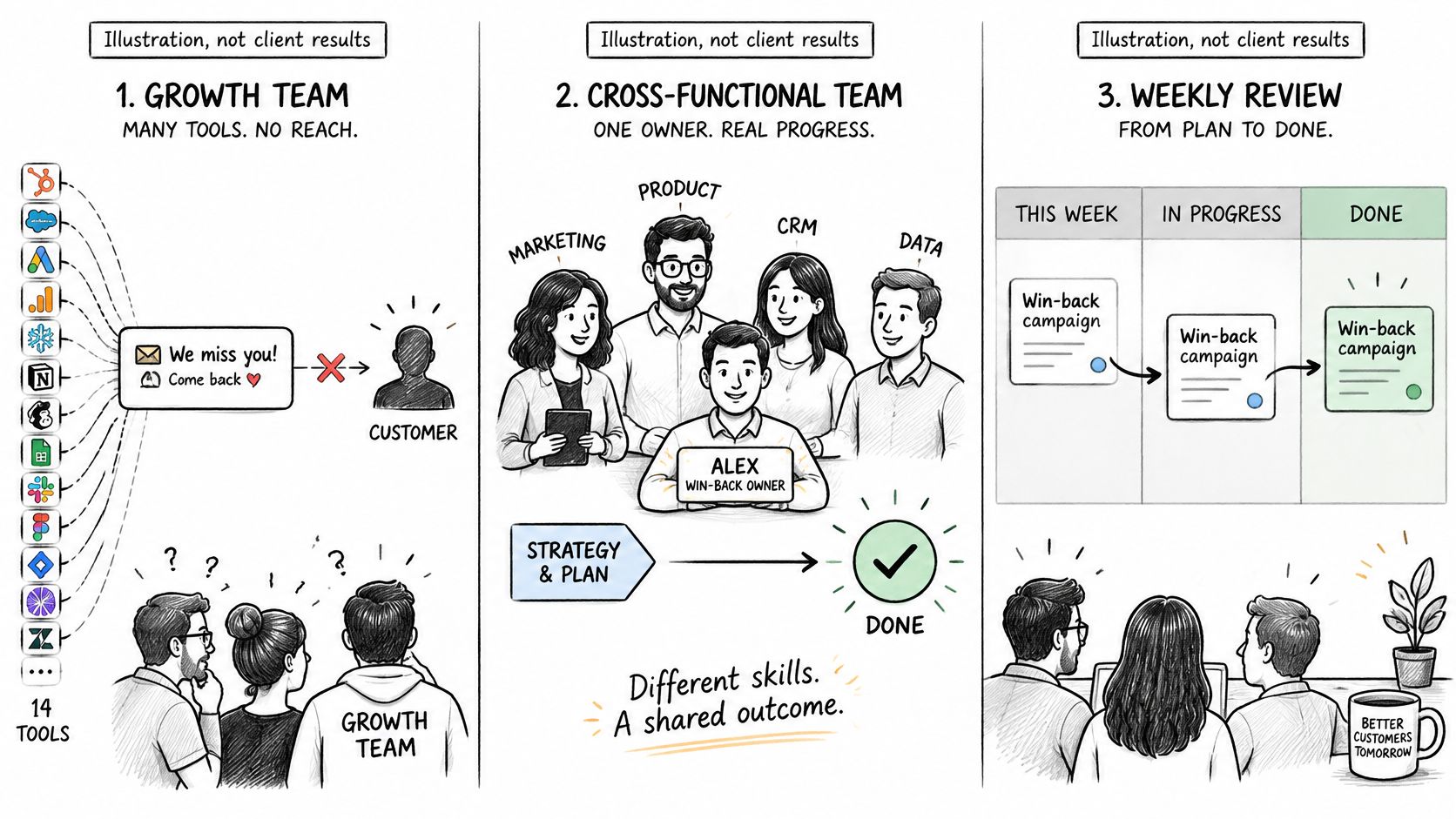
The diagram shows the shift from fragmented ownership to one coordinated operating picture.
Data fragmentation sits underneath the first pattern. Salesforce research on marketers and AI data foundations reports that 98% of marketing teams encounter at least one data-related obstacle to personalization, while 51% of marketers still consider their campaigns generic and 69% say they cannot respond quickly enough to customer demand. Strategy promises timely personalization. Disconnected data makes timely anything impossible.
Pattern one, the late win-back
Say a growth team runs fourteen tools and plans real-time win-back campaigns for customers who stop purchasing. Customer data sits in three systems, so the lapsed segment refreshes weekly and messages go out a week after the behavior that should have triggered them. The strategy was sound. The timing destroyed it.
The fix is architectural, not creative. Shared customer profiles and warehouse ingestion consolidate behavior, value, and consent into one record the sending system can act on. Once the segment refreshes from current behavior, the win-back message lands while the customer still remembers the brand.
Pattern two, the generic enterprise push
Say a B2B SaaS founder sets a strategy targeting enterprise accounts, then execution runs through generic newsletters sent to the entire list. Nobody made a bad decision on purpose. The newsletter had an owner and a deadline, while the enterprise motion had neither.
The fix gives the enterprise objective its own chain. One named owner, one defined enterprise segment, approved activities built for that segment, and a weekly exception review replace the generic send. The newsletter continues for the broader list, but it stops pretending to be the enterprise strategy.
Pattern three, the multi brand agency
Say a marketing agency runs several client brands through one team. Each brand needs separate voice, budgets, and approval rules, but shared inboxes and spreadsheets blur which rules apply where. Work either waits for manual checks or ships under the wrong brand's standards.
The fix is configurable control per brand. Separate approval levels, separate budget ceilings, and recorded actions per brand let routine work move quickly while client specific rules stay enforced. Platforms built for this shape of problem, including The AI CMO with planning, customer profiles, creative production, messaging, support, and reporting in one operating environment, more than 3,400 listed integrations, and an append-only ledger, give that structure a single home. The tool doesn't close the gap by itself. The operating rules do, and the tool makes them enforceable.
Confirm the Chain on One Objective This Quarter
Don't announce a transformation. Pick one objective with a deadline and a visible revenue or retention link, then run it properly for 30 days. One working chain teaches a team more than a department wide rollout that collapses under its own coordination cost.
- Pick the objective. Choose one with a number, a deadline, and a segment the team can reach this quarter.
- Write the chain on one page. Cover segment, approved activities, owner, budget ceiling, leading KPI, and financial outcome.
- Apply the decision rights split. Mark every activity as automated, pre-approved, or human reviewed before production starts.
- Choose three health KPIs. Set flag thresholds and agree one fixed weekly review day that doesn't move.
- Run the exception review for 30 days. Log every decision, approver, and send in the ledger as work happens.
- Decide on day 30. Apply the continue, stop, or reallocate rule to results measured against the holdout.
Teams that want the pilot run inside one system can keep planning, audience data, creative production, activation, and reporting on one shared record, so the test measures the operating model rather than the tool stack. Whichever route gets chosen, the first 30 days should produce a decision record leadership can inspect line by line. That's how the gap closes, one objective at a time, with evidence.
Close the distance between the plan on the slide and the campaigns customers receive by running objectives, approvals, customer data, creative production, activation, and reporting on one shared record with configurable human oversight and a full action ledger. Start with a single objective, set the decision rights and thresholds from this guide, and visit The AI CMO to see how an AI native marketing platform supports that operating model.
Share this article