Marketing Workflow Management: A 2026 Operating Guide

The AI CMO team
Oct 18, 2026
Monday morning starts with a Slack approval queue, a campaign brief that no longer matches the launch plan, a customer-data-platform export in one tab, and a dashboard whose revenue total disagrees with finance. The team has plenty of tools. What it lacks is a reliable way to move work, data, and decisions between them.
Marketing workflow management is the operating discipline that fixes that gap. It connects people and platforms through defined ownership, data rules, approvals, and measurement. The goal isn't to automate every task. It's to make execution dependable, give AI clear boundaries, and require evidence before a workflow earns more autonomy.
Table of Contents
- The Monday Morning Most Marketing Teams Actually Live
- What Marketing Workflow Management Actually Means
- The Five Components Every Managed Workflow Needs
- How to Implement Marketing Workflow Management Step by Step
- Why Bounded Delegation Is the Real AI Workflow Question
- Measuring Workflows by Incremental Lift, Not Activity
- Three Example Workflows That Put It Together
- Choosing Tools and the Decision You Should Make This Week
The Monday Morning Most Marketing Teams Actually Live
By the time a marketing director opens the laptop, a social post may be waiting on brand approval, a lifecycle email may be built from last week's audience export, and a paid campaign may be using a budget spreadsheet no one has reconciled with the ad platform. None of those problems begins with a lack of effort. They begin when each handoff depends on a person remembering what happens next.

A team can buy another project board or connect another automation, but neither choice resolves the underlying questions: Which record is authoritative? Who can approve a spend change? What happens when consent is missing? What evidence should let a journey run again?
Those are workflow and governance questions. A campaign calendar can show a launch date without ensuring the audience is valid. An automation platform can send a message quickly without proving that the message caused a sale. And adding headcount can create more activity without fixing an unclear approval path.
The operating rule: Define how work moves before deciding which tool should move it.
The technology environment makes that discipline more important, not less. The University of Hamburg's 2023 Marketing Technology Report says the marketing-automation sector grew by 24% between 2020 and 2023, reaching 9,932 solutions worldwide. Yet its representative German survey found that more than half of participating companies had not deployed marketing automation in any marketing process (University of Hamburg Marketing Technology Report). More tools don't automatically create a mature operating model.
A useful system has three qualities: people know their responsibilities, AI acts only within explicit limits, and measurement can distinguish activity from impact. That's the standard against which every workflow, integration, and vendor should be judged.
What Marketing Workflow Management Actually Means
Marketing workflow management is the operating layer that turns a marketing process into a controlled path from request to result. It standardizes how work enters the system, automates repeatable steps, connects platforms, and makes delays or failures visible. It isn't the same as project management, a campaign calendar, or a single automation tool.
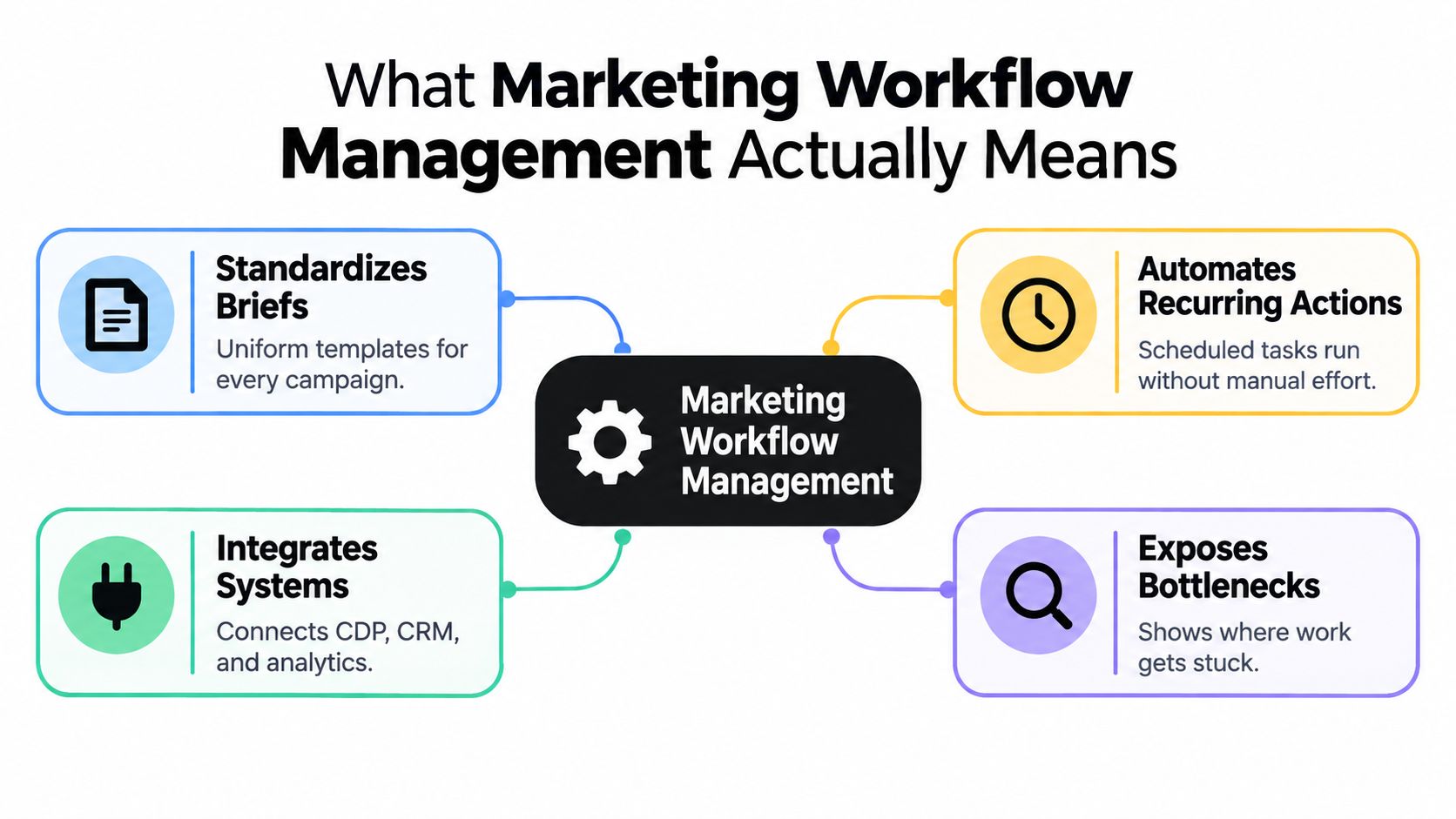
The University of Hamburg report provides a practical foundation: process standardization, recurring-action automation, system integration, and visibility into delays. Each capability solves a different operational problem.
- Standardization gives every campaign a consistent brief, required fields, owners, and decision points. A launch shouldn't depend on whether the requester remembered to include the audience, objective, or legal review.
- Automation handles repeatable tasks such as routing a draft, updating a status, or notifying an approver. It should execute a defined process, not invent one.
- Integration moves usable information across systems. A customer segment in a CDP, a campaign in an email platform, and a result in analytics need shared definitions and traceable handoffs.
- Visibility shows who owns the next action, what's blocked, and why. A workflow that hides its delays merely shifts the work into Slack.
A project-management platform tracks assignments and due dates. A workflow defines the conditions under which work advances, who has authority to approve it, and what data must be present first. A campaign calendar schedules activity, but doesn't establish whether an audience is eligible or whether the campaign produced incremental value.
That distinction matters when leaders assess technology. A tool may offer triggers, actions, and conditional logic, but those features aren't a management system by themselves. The team still has to define the business rules and decide where human judgment belongs.
The historical shift is from manually coordinated marketing to repeatable, measurable operating processes. In plain terms, marketing workflow management governs how work gets done and how the team knows whether it worked. It doesn't replace strategy, creative judgment, or accountability. It makes them executable.
The Five Components Every Managed Workflow Needs
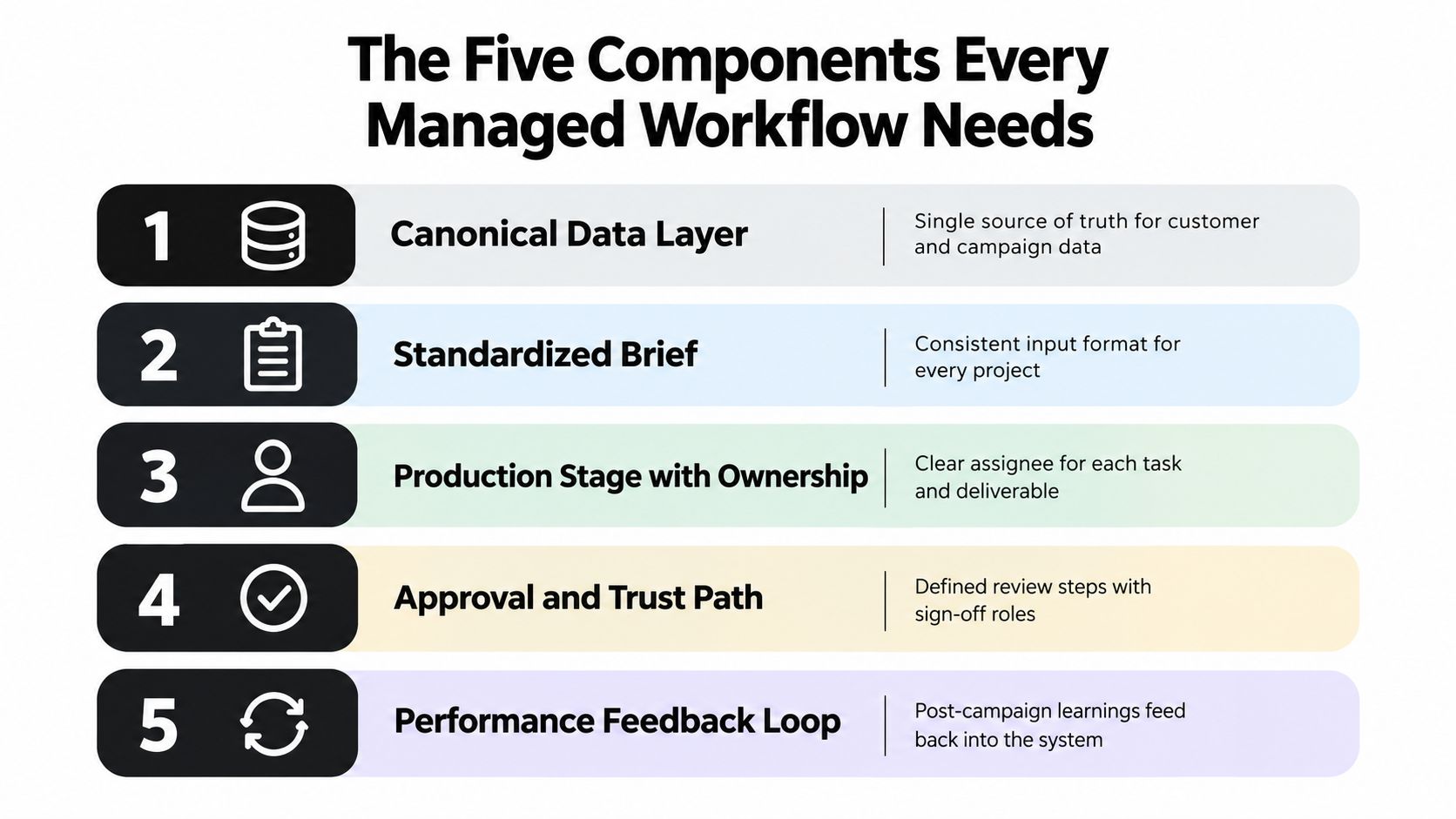
A workflow isn't trustworthy just because it moves from “draft” to “approved.” It needs a data foundation, a clear request, accountable production, controlled authority, and feedback tied to outcomes.
MarTech reported findings from 104 chief marketing and growth executives in consumer and retail businesses: only 27% considered their organizations mature in marketing operating models for advanced use cases, 37% reported successful collaboration within marketing and with functions such as ecommerce, product, and sales, and 12% identified clear and effective governance as a distinctive feature (MarTech's analysis of marketing operating models). Those gaps point to the parts a workflow must make explicit.
Build the control plane before the production line
Canonical data layer. Establish the customer and campaign records that downstream tools are expected to use. Without shared definitions, separate teams can report different audiences, outcomes, or revenue for the same activity.
Standardized brief. Require the information needed to make a decision: objective, audience, channel, offer, owner, budget authority, intended outcome, and applicable consent basis. A brief that leaves these open creates rework later.
Production with ownership. Assign an accountable person to each deliverable and define its state, deadline, and handoff. Shared responsibility without a named owner is usually nobody's responsibility.
Approval and trust path. Specify who may approve creative, audience, spend, and deployment. The approval path should vary by risk. A routine copy adjustment shouldn't follow the same route as a new audience use or a material budget change.
Performance feedback loop. Return results to the system that planned the work. Record whether the activity met its stated objective and whether the measurement design supports a causal conclusion.
The governance finding is the one directors should take personally. A workflow without clear approval authority, budget limits, or escalation rules is decoration. It can display progress while leaving the actual decisions to informal messages and undocumented exceptions.
For teams mapping handoffs, this practical guide to methods to avoid manual handoffs can help identify where work still depends on people moving information by hand. For content-specific routing, a content approval workflow framework can help make review roles and decision stages explicit. The principle is the same: design responsibility and evidence into the process, rather than assuming a status label equals control.
How to Implement Marketing Workflow Management Step by Step
Implementation should follow the order of operational risk. Start by understanding the current process, fix the data and consent foundations, then automate only the steps the team can govern.
Sequence the work
1. Audit the workflow people use. Choose one recurring process, such as an email launch or paid campaign. Map its real entry point, handoffs, tools, owners, approval decisions, exceptions, and points where work waits. Don't begin with a polished process document that no one follows.
2. Define the canonical data and consent model. Name the authoritative customer, campaign, and event records. Set rules for identity, timestamps, consent purpose, and measurement definitions before connecting systems. An Aberdeen analysis found 39% of organizations identified data silos as a top-three data-driven-marketing challenge, while 62% cited poor data quality or difficulty collecting or accessing data needed for segmentation and analytics (Aberdeen's data-driven marketing analysis). Those aren't problems an automation rule can repair.
3. Standardize the brief and approval path. Make required fields visible at intake. Separate approvals for content, audience, budget, and legal or compliance review where needed. Assign a decision-maker and an escalation route to every consequential stage.
4. Automate recurring stages. Start with predictable actions: task assignment, status updates, reminders, or moving an approved asset to the next step. Keep judgment-heavy decisions with a person until the team has evidence and controls for delegation.
5. Instrument the measurement plan. Before launch, define the outcome, comparison method, observation window, and owner of the final verdict. Capture the fields needed to connect exposure to customer and business outcomes.
6. Expand trust levels deliberately. Once the workflow runs reliably, identify which actions can move from human approval to supervised execution or bounded autonomy. Set conditions for escalation, suppression, and rollback before widening access.
Activation gate: If audience, consent, or measurement fields fail validation, block the send. Repairing the record after an incorrect activation is too late.
A director can adapt this sequence to a 30-, 60-, or 90-day rollout without treating those timelines as promises. Start with one workflow and its dependencies; add automation only after the inputs and authorities are clear. The six steps also reveal a common trap: selecting software before deciding what data must pass between systems and what evidence should stop execution.
A visual process map can help teams make the handoffs concrete. The following video offers a useful companion to that design work.
Why Bounded Delegation Is the Real AI Workflow Question
AI's marketing value isn't the ability to produce more copy. The more consequential question is what the system is authorized to decide and execute without waiting for a person.
The State of Marketing AI research reports that 75% of surveyed marketers lack a one- to two-year AI roadmap, 63% lack or are unsure whether they have a generative-AI policy, and 67% lack or are unsure whether they have an AI council. Another 2025 study found that approval and decision delays were marketing teams' leading impediment, while fewer than one-quarter allowed AI to operate autonomously for common tasks (2025 State of Marketing AI Report). The constraint is often not model capability. It's bounded delegation.
Assign authority by risk
A practical trust model gives each action a defined level of authority:
- Ask first: AI prepares work or proposes an action, but a person approves it before execution.
- Review on a schedule: AI executes within a known policy, while a person checks the activity on a defined cadence.
- Act within limits: AI can execute only within set audience, budget, brand, and compliance boundaries, with escalation outside them.
The labels matter less than the controls attached to them. Define spending ceilings, permitted audience criteria, allowed send windows, mandatory evidence, escalation triggers, and a rollback or suppression procedure. Keep an immutable activity log that records the action, the policy applied, and the authority level.
Separate asset approval from decision-logic approval. A person may approve a particular email while also approving a reusable rule that generates and sends many versions. Those aren't the same decision and shouldn't share one checkbox.
Consent and automated decisions add another control layer. The European Commission's GDPR guidance for businesses says consent must be freely given, specific, informed, and unambiguous, and that processing must remain within the purposes communicated when consent was collected. It also recognizes protections related to decisions based solely on automated processing, subject to exceptions. Teams should make the relevant review, explanation, and contest routes part of the workflow design, not an afterthought. A practical enterprise governance approach can help formalize those decision rights.
The director's decision isn't whether AI should be trusted in the abstract. It's which action can run at which trust level, under which policy, with what evidence, and who steps in when the system reaches its boundary.
Measuring Workflows by Incremental Lift, Not Activity
A workflow can launch on time, deliver every message, and still fail as marketing. Sends, clicks, and last-touch conversions describe activity or attribution. They don't, by themselves, show whether the intervention changed customer behavior.
BCG recommends randomized holdout groups, structured A/B tests, and program-level measurement to assess whether an intervention changed behavior relative to doing nothing. For a next-best-action program, a global holdout can establish the counterfactual; modeling alone can't guarantee causal evidence (BCG's guidance on incrementality in next-best-action programs).
The operational requirement is simple to state and easy to neglect: assign treatment and control before outcomes are observed, keep the groups comparable, prevent equivalent offers from contaminating the comparison, and set the observation window in advance. Then judge the workflow on incremental conversion, revenue, margin, retention, or churn, with confidence intervals and costs included in the decision.
| Metric | What it tells you | What it misses |
|---|---|---|
| Sends and delivered messages | Whether the workflow executed and reached an audience | Whether the audience acted because of the message |
| Clicks and opens | Whether recipients engaged with an asset | Whether engagement became incremental business value |
| Last-touch revenue | Which channel received attribution under the chosen model | What would have happened without the campaign |
| Holdout-based incremental lift | Whether treatment changed outcomes relative to a comparison group | Results outside the defined audience and observation window |
A reported retail example makes the distinction concrete: one campaign received $50,000 in last-click revenue attribution but generated only $12,000 in incremental lift after a control group was considered. The same source reports that some nurture programs with no last-click revenue showed a 30% increase in downstream conversion (Growth Vector's email marketing overview). Those figures are a reason to test the counterfactual, not a forecast for another business.
Set a decision rule before launch: scale when the evidence clears the agreed threshold, pause when incremental value is absent or costs overwhelm it, and revise when the result is uncertain or the workflow shows contamination. Teams refining their measurement model can use this marketing ROI measurement framework to align reporting with the decision the business needs to make.
Three Example Workflows That Put It Together
The same governance principles look different by channel. A workflow should name its data, authority, approval route, and measurement rule, rather than copy a platform's feature list.
| Workflow | Data and trust boundary | Approval and measurement |
|---|---|---|
| Weekly email nurture | Use customer identity, lifecycle stage, consent scope, and campaign exposure. Keep a persistent holdout and allow AI to propose content or timing within approved limits. | Marketing approves the journey logic; the holdout compares downstream outcomes over a defined window. |
| Paid-social acquisition | Use campaign, audience, spend, and frequency data. Allow execution only within approved budget and frequency caps; escalate exceptions. | A media owner approves the initial plan and material changes; judge performance with a control or structured experiment, not platform-reported conversions alone. |
| Lifecycle retention | Use identity, lifecycle stage, recent behavior, and channel-specific consent. Suppress execution if consent or required stage fields fail validation. | Route uncertain or high-risk cases for human review; measure retained value against a suitable comparison group. |
A team building a channel calendar can use this social media campaign planning guide to organize production and launch details, then add its own data and approval gates. The workflow's purpose and authority should still be explicit.
GDPR consent can't be treated as one universal permission attached to a customer record. The European Data Protection Board says consent requires a clear affirmative act and, when consent is the applicable legal basis, must be obtained before processing begins. People must be informed about the purpose of each processing operation and the types of data collected and used (EDPB consent guidelines). That means the send decision should check whether the person authorized the intended channel and purpose. A trigger doesn't create permission.
Choosing Tools and the Decision You Should Make This Week
Evaluate platforms against the controls the team has designed, not the size of their automation menu. Require a usable data layer, consent and suppression checks at the send path, approval queues that can handle the organization's workload, and an immutable record of decisions and execution.
The EDPB's guidance makes consent capture operational data: the workflow needs to read its purpose, timestamp, and scope before processing. If a platform can't enforce suppression when it can't verify the relevant list or permission, it doesn't meet the requirement. For a narrow scheduling use case, a LinkedIn post scheduler can be one component, but it shouldn't be mistaken for the governed system around the post.
The AI CMO is one option for teams evaluating a broader operating layer; its product materials describe a built-in customer data platform, workflow automation, approval controls, holdout groups, and send-path suppression. Any vendor should be assessed against the same practical tests: can the team define its trust levels, validate data before activation, prove incremental impact, and reconstruct what happened?
This week, choose one workflow to automate. Define its trust level, required data and consent fields, approval path, and holdout before evaluating a vendor.
The AI CMO offers a marketing operating system that connects customer data, AI-assisted execution, approval limits, and holdout-based measurement. If the team is redesigning marketing workflow management around governed delegation and evidence, visit The AI CMO to see how those capabilities fit together.
Share this article