
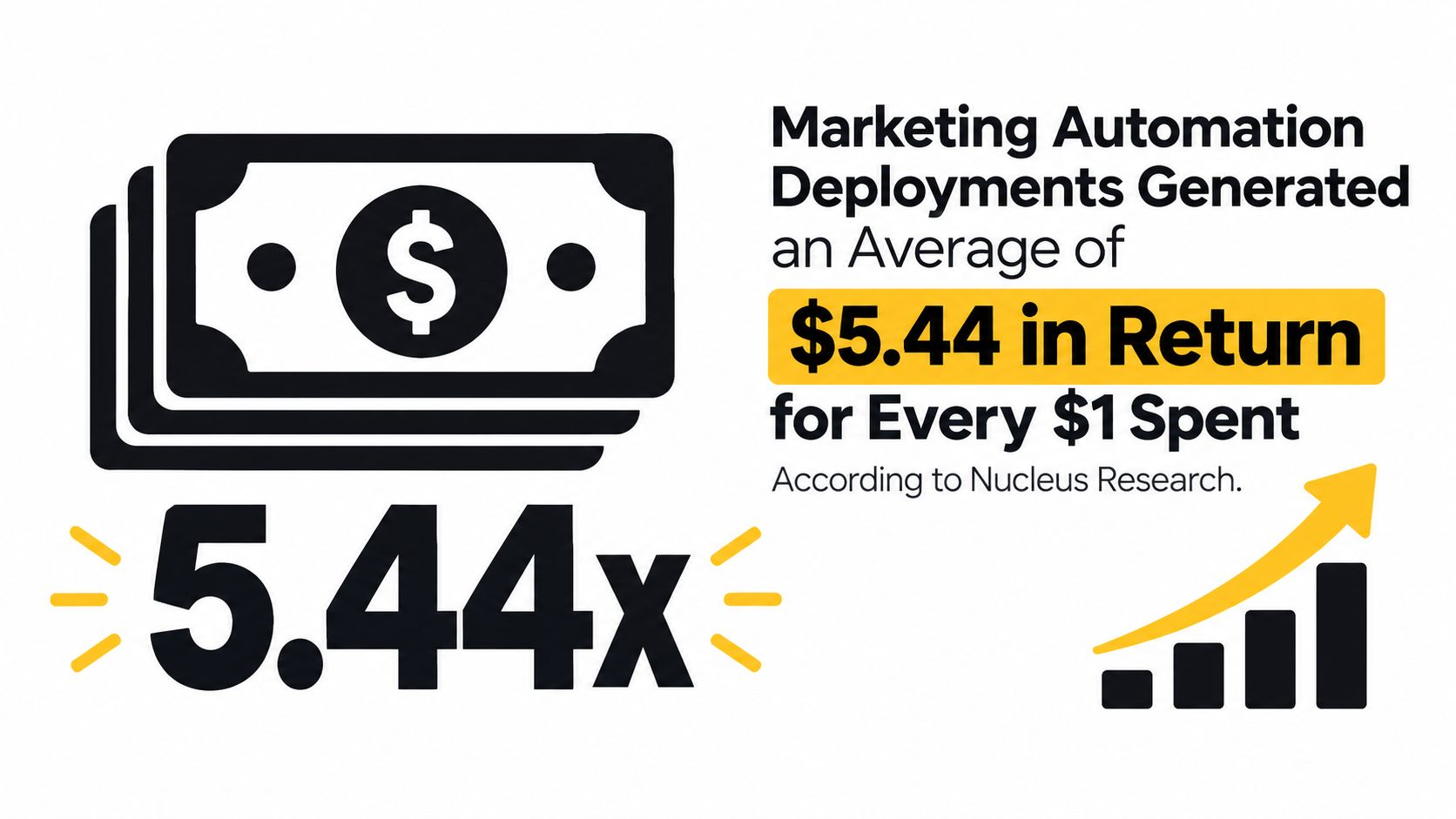
Marketing automation deployments generate an average of $5.44 in revenue for every $1 invested over the first three years, which equals a reported 544% return on investment. That return still varies a lot with implementation quality, so the software alone doesn't decide the outcome.
The reason most B2B teams miss the upside is simple: they buy a platform before they build an operating model. The market is full of feature lists and campaign templates, but the key gap is between adoption and daily execution, especially when customer data, routing logic, approvals, and measurement all have to work together.
Table of Contents
- Why Most B2B Marketing Automation Fail to Deliver ROI
- The Evolution of Marketing Automation for B2B
- Measuring the Business Value of B2B Automation
- B2B Automation Workflows That Protect Buyer Intent
- Proving Incremental Revenue from Marketing Automation
- Traditional Platforms vs AI-Native Marketing Systems
- Building Your B2B Marketing Automation Roadmap
Why Most B2B Marketing Automation Fail to Deliver ROI
Buying software is not the same as building a marketing automation strategy. That mistake shows up fast in B2B teams because the work is rarely just “send an email later.” It includes data hygiene, consent checks, sales handoff logic, exception handling, and proof that the program moved revenue, not just activity.
A useful warning sign is the gap between experimentation and operational use. In one industry survey, 81% of B2B marketers said they use generative AI, but only 19% said it's integrated into daily processes, while 54% described their approach as ad hoc. Those numbers point to the same issue teams hit with automation: the tool is present, but the workflow is not governed well enough to produce reliable output Adobe B2B marketing digital trends.
The real bottleneck is readiness, not capability
Most failures don't come from a missing feature. They come from weak data standards, unclear ownership, and too many disconnected systems trying to act like one journey. If CRM fields are inconsistent, if consent is messy, or if sales ignores the handoff, the platform becomes a very expensive message scheduler.
Practical rule: automate the process that already works by hand, not the process the team hopes will work after software arrives.
That's why governance matters before scale. A good operating model defines what gets automated, what stays human-approved, what gets escalated, and what counts as success. For teams that need outside support, a B2B marketing automation agency can be useful when the main work is process design rather than button-pushing.
The hard truth is that workflow volume can hide bad economics. A lot of teams celebrate launches, trigger counts, or email volume while the sales team still waits on clean routing and qualified conversations. Automation only becomes valuable when it reduces manual effort, improves customer coordination, and produces revenue-linked evidence.

The Evolution of Marketing Automation for B2B
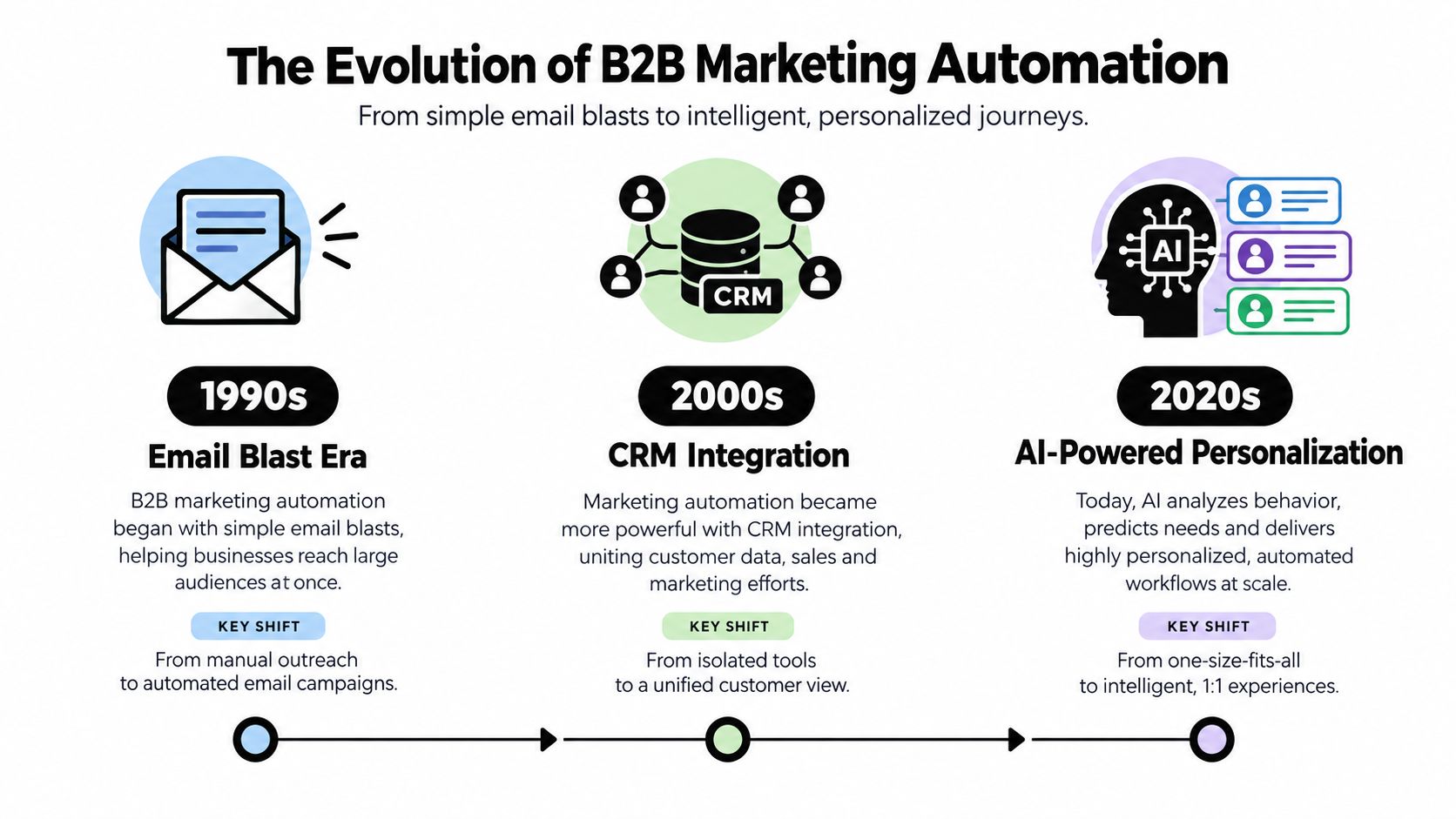
Marketing automation for B2B started as an operational discipline, not a polished growth stack. Historical research traces automation work back to the 1960s, and by 1989 it was already being used to cut administrative work for sales teams ecojoin.org study.
From operational control to customer orchestration
The next shift came with CRM systems in the 1990s, which gave companies a structured place to store customer information at scale. That made lead nurturing, segmentation, scoring, and lifecycle campaigns possible in a repeatable way. The bigger change was not the channel, it was the ability to recognize the same customer consistently across systems.
Email automation later became a common use case for recurring subscription and relationship communication. That adoption matters because many B2B teams still treat automation like a message scheduler. It only works when customer data, workflow rules, communication, and sales-support processes are connected well enough to act on the same record.
What the timeline means for modern teams
The timeline from data processing to CRM to email workflows explains why isolated campaign tools fall short in B2B. A disconnected sequence can send messages, but it cannot reliably manage a buyer journey across accounts, roles, and stages. Modern programs need the data layer and the execution layer to cooperate, or every automation still depends on manual cleanup.
The same pattern now shows up in AI adoption. Many B2B marketers are testing generative tools, but the blocker is usually organizational readiness and data reliability, not tool capability. That is why the next generation of systems will be judged less by feature lists and more by how well they fit into existing workflows, permissions, and reporting.
Automation matured from back-office efficiency into customer lifecycle control, and the next step is AI-native systems that can adapt to messy data, complex buying groups, and real operating constraints instead of assuming perfect inputs.
Measuring the Business Value of B2B Automation
The business case gets stronger when teams stop asking whether automation is “worth it” in the abstract and start measuring what it changes. Industry compilations citing Nucleus Research report that marketing automation generated $5.44 in revenue for every $1 invested over the first three years, with a reported 544% ROI, plus an average 12.2% reduction in operational costs and a payback period of less than six months marketing automation ROI statistics.
Read the numbers as benchmarks, not promises
Those figures are useful, but they are not guarantees. ROI shifts with database quality, sales-cycle length, media mix, implementation discipline, and attribution design. A team with weak CRM hygiene will not see the same result as a team with clean routing, clear scoring rules, and a measured handoff to sales.
A 2024 study of 105 B2B MSMEs found a strong positive relationship (r = 0.656) between message reach and B2B CRM outcomes ecojoin.org study. The practical takeaway is straightforward: coordinated customer data and repeatable communication work together to create value. If either side is missing, the business impact drops fast.
What to measure instead of vanity activity
Campaign volume does not prove business impact. Open rates do not prove revenue either. The cleaner approach is to compare incremental revenue, conversion, retention, and operating cost against a defined baseline, then separate what automation caused from what would have happened anyway.
A simple measurement set usually works better than a noisy dashboard:
- Incremental revenue: compare exposed audiences with a control group.
- Operating cost: track manual steps removed, not just campaign launches.
- Retention and expansion: measure whether automation improved lifecycle performance.
- Pipeline progression: check whether automated journeys moved accounts forward faster.
That frame keeps the finance conversation honest. It also stops teams from overvaluing activity that looks productive but does not change the business.
B2B Automation Workflows That Protect Buyer Intent
The workflows that drive the most value are the ones that keep buyer intent from cooling off. Lead-response automation is the clearest example. A benchmark covering 939 B2B companies found an average response time of 47 hours, with only 23% responding within five minutes and 42% taking more than 24 hours speed to lead research.
Lead response has to happen at the event boundary
A request should trigger immediately, not after a batch sync. Identity resolution, routing, enrichment, notification, and the first useful reply need to sit in the same workflow. If those steps are split across tools and teams, the lead cools before a rep even sees it.
MIT and InsideSales research reported that contacting an inbound lead within five minutes made firms 100 times more likely to reach the prospect and 21 times more likely to qualify the lead than waiting 30 minutes InsideSales response-time research. The operational lesson is direct, speed is a conversion control, not a courtesy.
Nurture should adapt to stage, not repeat a sequence
Many leads are not ready to buy, and structured nurture earns its keep there. Benchmark summaries tied to Forrester say nurtured leads produce 50% more sales-ready opportunities at 33% lower cost, while other aggregated research reports up to a 451% increase in qualified leads from marketing-automation nurturing lead generation statistics. The exact lift depends on methodology, but the design principle holds, nurture has to match buyer stage.
A solid B2B nurture system does a few things well:
- Tracks lifecycle state: the path should differ for new inquiries, active opportunities, and dormant accounts.
- Branches on behavior: pricing-page visits, webinar attendance, and email replies should change the next step.
- Suppresses when sales is active: automation should stop talking over a live opportunity.
- Uses holdout groups: withheld contacts show whether the journey caused pipeline.
For teams mapping these workflows in more detail, a practical overview is available in the marketing automation workflows guide.
The best workflow gets the right response to the right person without a human chasing every next step. That usually means fewer clever campaigns and more disciplined routing, suppression, and escalation.
Proving Incremental Revenue from Marketing Automation
The hard part in B2B is separating revenue automation caused from revenue automation merely touched. Attribution dashboards help, but they do not answer the deeper question: did the workflow create the opportunity, or just appear somewhere in the path? That distinction matters because only 45% of surveyed B2B marketers feel very confident connecting data across teams, according to the Act-On and Ascend2 research release.
Build evidence with controls, not just reports
The cleanest proof uses identity resolution, cohort analysis, randomized holdout groups, journey-level conversion goals, and incrementality testing. In practice, attribution becomes directional evidence, not causal proof. That is a healthier standard for long buying cycles, where several touches can contribute to a sale without any one of them earning full credit.
A measurement stack also needs suppression analysis. Preventing duplicate contact, delaying outreach, or removing a contact from a noisy sequence can create value even when no click happens. Those effects disappear if the team only watches engagement metrics.
The operational lesson is blunt: speed is a conversion control, not a courtesy. If a fast follow-up or a cleaner handoff moves pipeline, measure that change against a group that did not get the same treatment.
Agentic orchestration needs governance before trust
The next wave of automation is moving toward coordinated journeys across sales, marketing, and service. In the same research release, 56% of B2B organizations expected agentic AI to coordinate those journeys in real time, while 59% identified personalized customer experiences as a leading AI investment goal. That direction makes sense, but trust depends on measurement architecture more than tool capability.
For teams working through multi-touch environments, the multi-touch attribution guide is a useful starting point. The goal is not to defend every automated touch. It is to show, with enough rigor, which journeys changed revenue and which ones only added noise.
Traditional Platforms vs AI-Native Marketing Systems
Many traditional marketing automation suites still treat AI as an added layer. That creates a familiar problem, the data lives in one place, the workflows live somewhere else, and the approval logic sits on top as a patch. AI-native systems are different because the data, orchestration, and governance are designed to work together from the start.
Where the architecture diverges
Traditional stacks usually depend on several connected products to do one job. That can work for simple campaigns, but it becomes fragile when the organization needs one approval path, one suppression logic, and one shared view of customer activity. In contrast, AI-native systems are built to execute across channels with the data layer already inside the platform.
That difference matters in B2B because multiple stakeholders, long sales cycles, and account-level decisions create complexity fast. A platform comparison guide like the LLMrefs comparison guide is useful for checking whether a vendor's AI is embedded or just layered on.
What to look for before adopting a platform
A serious evaluation should focus on workflow governance, not marketing language. If the system can't enforce suppression in the send path, preserve audit history, or support multiple brands with separate voices and budgets, it will eventually force manual work back onto the team.
For a deeper view of platform capabilities, the marketing automation capabilities guide is a good companion read. One option in this category is The AI CMO, which combines campaign production, sending, customer records, and journey measurement in one system, so teams can run acquisition and retention from the same operating layer. That kind of setup matters when the goal is coordination, not just output.
Building Your B2B Marketing Automation Roadmap
A workable roadmap starts with governance, not workflows. The first step is mapping processes by business risk and repeatability, then defining approval thresholds, audit trails, and the metrics that matter, revenue impact, error rates, time saved, and customer outcomes. If the team cannot explain who owns a workflow and why it exists, it isn't ready to automate.
Put compliance and records at the center
UK PECR rules require current eligibility checks for electronic marketing, and withdrawal of consent has to stop future direct marketing ICO PECR guidance. The ICO also requires valid consent to be freely given, specific, informed, and based on a clear affirmative action, with objections respected through suppression lists ICO consent guidance. That means consent and suppression can't sit as static settings in a campaign tool.
A durable B2B setup keeps an append-only Record of every decision, send, and dollar, so the team can prove what happened and why. That record becomes the basis for auditability, better routing, and cleaner learning across future journeys.
Sequence the rollout by data, then orchestration
The most practical rollout is usually boring at the start. Clean the customer data, define lifecycle stages, connect CRM and marketing records, and only then launch automated journeys that can be measured against a baseline. For outbound teams, a related perspective is the outbound sales automation guide, which helps connect automation to the realities of prospecting and follow-up.
Once the foundations are in place, the next layer is simple, real-time orchestration that responds when behavior changes, not days later. That's how B2B teams move from isolated automation experiments to a system that supports growth without losing control.
If B2B automation is still being treated as a stack of disconnected tools, The AI CMO is built to replace that fragmentation with one operating system for planning, production, sending, and proof. Visit The AI CMO to see how it handles customer data, journeys, governance, and measurement in one place.
Share this article