What Is End to End Marketing: A Complete Guide for 2026

The AI CMO team
Oct 6, 2026
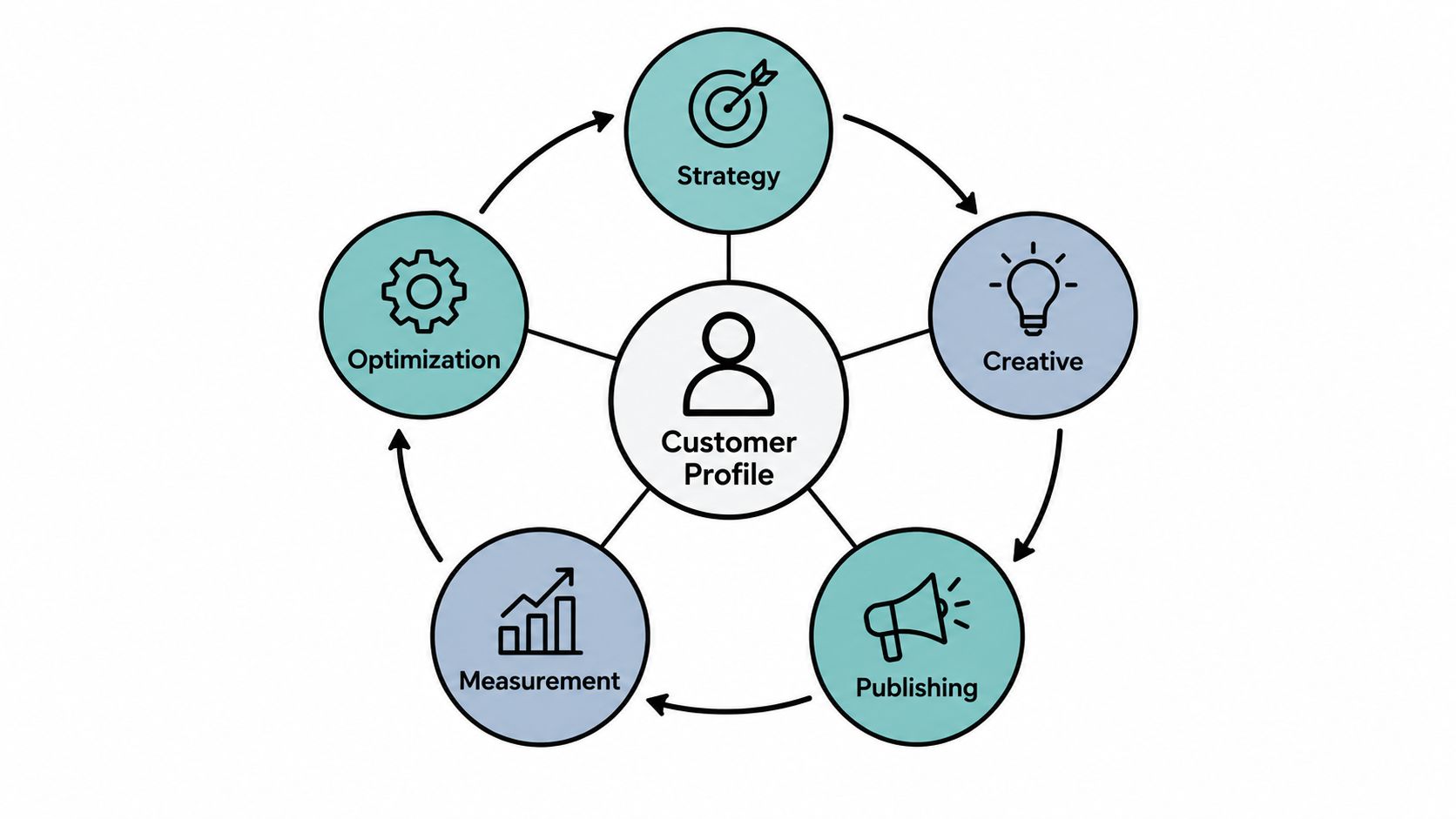
End-to-end marketing is a closed-loop system linking strategy, creative, publishing, measurement, and optimization on one customer record. It responds to a martech environment that grew from approximately 150 solutions in 2011 to 15,384 solutions across 49 categories in 2025, according to Chief Martec's 2025 marketing technology landscape.
But does a campaign deserve credit for a renewal just because a retargeting ad appeared before the customer signed the contract? That question exposes the gap between channel coverage and end-to-end marketing. A team can run paid media, email, social, content, CRM, and customer success programs while still lacking a connected view of what caused revenue.
Table of Contents
- Defining End to End Marketing and Why It Matters Now
- The Five Components of an End to End Marketing Loop
- How End to End Marketing Differs From Adjacent Approaches
- Real World Examples of End to End Marketing in Action
- Implementation Steps and a KPI Framework That Proves Incrementality
- Common Misconceptions That Block End to End Marketing
- How Agentic AI Platforms Operationalize the End to End Loop
- Your End to End Marketing Checklist and What Comes Next
Defining End to End Marketing and Why It Matters Now
End-to-end marketing is a closed-loop system that connects strategy, creative, publishing, measurement, and optimization to a single customer record. The system starts with audience understanding, turns insight into a campaign hypothesis, produces relevant assets, distributes them across channels, measures business outcomes, and feeds validated learning back into the next decision.
The idea has a longer history than the latest marketing platform. It developed from integrated marketing communications, a discipline that emerged during the 1970s and 1980s as companies began coordinating advertising, public relations, direct marketing, and sales promotion rather than managing each activity separately. Academic research in the 1990s increasingly described IMC as a business process linked to measurable objectives. In 1989, the American Association of Advertising Agencies defined IMC as a planning concept that evaluates the strategic roles of several communication disciplines and combines them to improve clarity, consistency, and impact, as documented in this academic history of integrated marketing communication.
From coordinated messages to connected outcomes
Modern end-to-end marketing extends IMC beyond message consistency. It connects stakeholders, content, channels, and results around the customer relationship. Acquisition data should therefore remain available when a customer enters onboarding, renews, expands, or shows signs of churn.
A B2B SaaS team might launch a paid campaign, capture a lead, send a nurture sequence, and hand the account to sales. Months later, the account renews. If the advertising platform, CRM, marketing automation system, and revenue database use different identifiers, the team may know that every stage happened but still not know which intervention changed the outcome. Last-touch reporting may award the renewal to a late-stage email, even when the email reached an account already likely to renew.
The promise of end-to-end marketing is not a dashboard containing every channel. It is an evidence loop that preserves the customer record from first interaction through retention and tests whether activity created incremental business value. That distinction matters more as point solutions multiply and each additional tool can introduce another identity conflict, workflow boundary, or reporting definition.
The Five Components of an End to End Marketing Loop
The loop operates as five connected stages. Each stage creates an input for the next, and the final stage changes the next version of strategy.
Strategy turns business questions into hypotheses
Strategy defines the audience, commercial objective, positioning, offer, channel mix, and test design. A strong strategy document doesn't stop at “increase conversions.” It states a question that can be evaluated, such as whether a retention message reduces churn among customers showing a specific behavioral signal.
The strategy layer also establishes exclusions. Recent purchasers may be suppressed from acquisition campaigns, existing customers may receive an expansion offer instead of a first-order discount, and high-risk accounts may enter a service-led journey rather than a promotional sequence.
Example: A lifecycle team hypothesizes that an onboarding message focused on setup completion will increase activation among new accounts, with a holdout group reserved for comparison.
Creative makes the hypothesis executable
Creative turns the strategy into messages, offers, landing pages, emails, videos, ads, and other experiences. It should encode the audience, lifecycle stage, proposition, format, and test variable so that later measurement can connect an asset to an outcome.
This approach changes the creative brief. Instead of asking for “a campaign concept,” the brief identifies the customer state, the intended action, the control version, and the variation. Creative teams still protect brand voice and quality, but each asset becomes a measurable intervention rather than an isolated deliverable.
Example: The same onboarding hypothesis produces two email variants, one emphasizing speed and another emphasizing guided support.
Publishing coordinates the customer experience
Publishing is the orchestration layer across paid, owned, and direct channels. It determines when an audience receives an ad, email, SMS, web message, or sales prompt, while applying consent, suppression, frequency, and lifecycle rules.
A shared customer key matters here. Without one, a buyer can receive a prospecting ad after purchase, a discount email after paying full price, or a win-back message while already speaking with support. A first-party data program provides the foundation for these decisions, and this first-party data strategy guide offers additional context on organizing customer information for activation.
Example: A recent purchaser leaves the acquisition audience, enters onboarding, and receives a product education sequence instead of a conversion discount.
Measurement joins activity to outcomes
Measurement links exposure, engagement, conversion, repeat purchase, retention, churn, and revenue at the same entity level. The resulting record can support operational reporting, but it must also preserve the fields required for experimentation, including treatment status, event time, consent state, and outcome definition.
A connected data architecture can create material business value. BCG reported that companies linking all first-party data sources generated twice the incremental revenue from a single placement or outreach and achieved 1.5 times greater improvement in cost efficiency than organizations with limited integration, as described in McKinsey's customer analytics reference document.
Example: A campaign report connects an ad impression and a nurture email to account-level pipeline, closed revenue, and later renewal behavior.
Optimization closes the loop
Optimization turns evidence into a new decision. The team may change the audience, offer, creative, channel allocation, timing, or suppression rule. The change should follow validated learning, not only a platform dashboard's preferred attribution model.
Example: A holdout test shows that an onboarding email changes activation for one segment but not another, so the next sprint keeps the message for the responsive segment and tests a different intervention elsewhere.
How End to End Marketing Differs From Adjacent Approaches
Several marketing approaches cover part of the same territory. The difference lies in what gets connected, who owns the feedback, and whether the system can distinguish correlation from causation.
| Criterion | End to End | Omnichannel | Full Funnel | Point Solutions |
|---|---|---|---|---|
| Scope of customer data unified | A shared identity, lifecycle history, activity record, and revenue view | Channel activity may be coordinated, but identity can remain fragmented | Funnel stages are connected conceptually, with uneven data integration | Data is optimized within each specialist tool |
| Feedback loop | Closed from insight to intervention to measured outcome | Often focused on experience consistency | Often ends at reporting across stages | Usually local to the tool or channel |
| Success measurement | Incremental revenue, retention, customer value, and validated lift | Reach, engagement, conversion, and experience consistency | Stage progression, CAC, ROAS, conversion, and churn | Platform-specific efficiency and activity metrics |
| Typical ownership | Cross-functional marketing, data, revenue, and customer teams | Channel, brand, and customer experience teams | Demand generation or growth teams | Separate channel or specialist owners |
| Where it breaks down | Weak governance, poor identity resolution, or untested assumptions | Presence everywhere without a joined customer record | Funnel coverage without causal evidence | Integration debt, duplicated audiences, and disconnected outcomes |
Omnichannel marketing focuses on coordinated presence and experience. A retailer can publish consistent messages across email, mobile, store, and social while still failing to connect the customer's history. A practical omnichannel marketing strategy becomes end-to-end only when the shared experience is tied to identity, outcomes, and learning.
Full-funnel marketing is broader than a single channel, but funnel coverage alone doesn't prove that an intervention caused a result. Point solutions can provide valuable depth, especially in advertising automation, CRM, analytics, or content production. An automation model such as the LeadBeast automation approach can improve execution within a defined workflow, while end-to-end marketing supplies the connective tissue across workflows.
The approaches aren't replacements for one another. End-to-end marketing is the integrative operating layer that makes omnichannel activity, funnel planning, and specialist tools measurable and improvable.
Real World Examples of End to End Marketing in Action
Consider two illustrative brands with the same basic objective, improve customer growth without damaging retention.
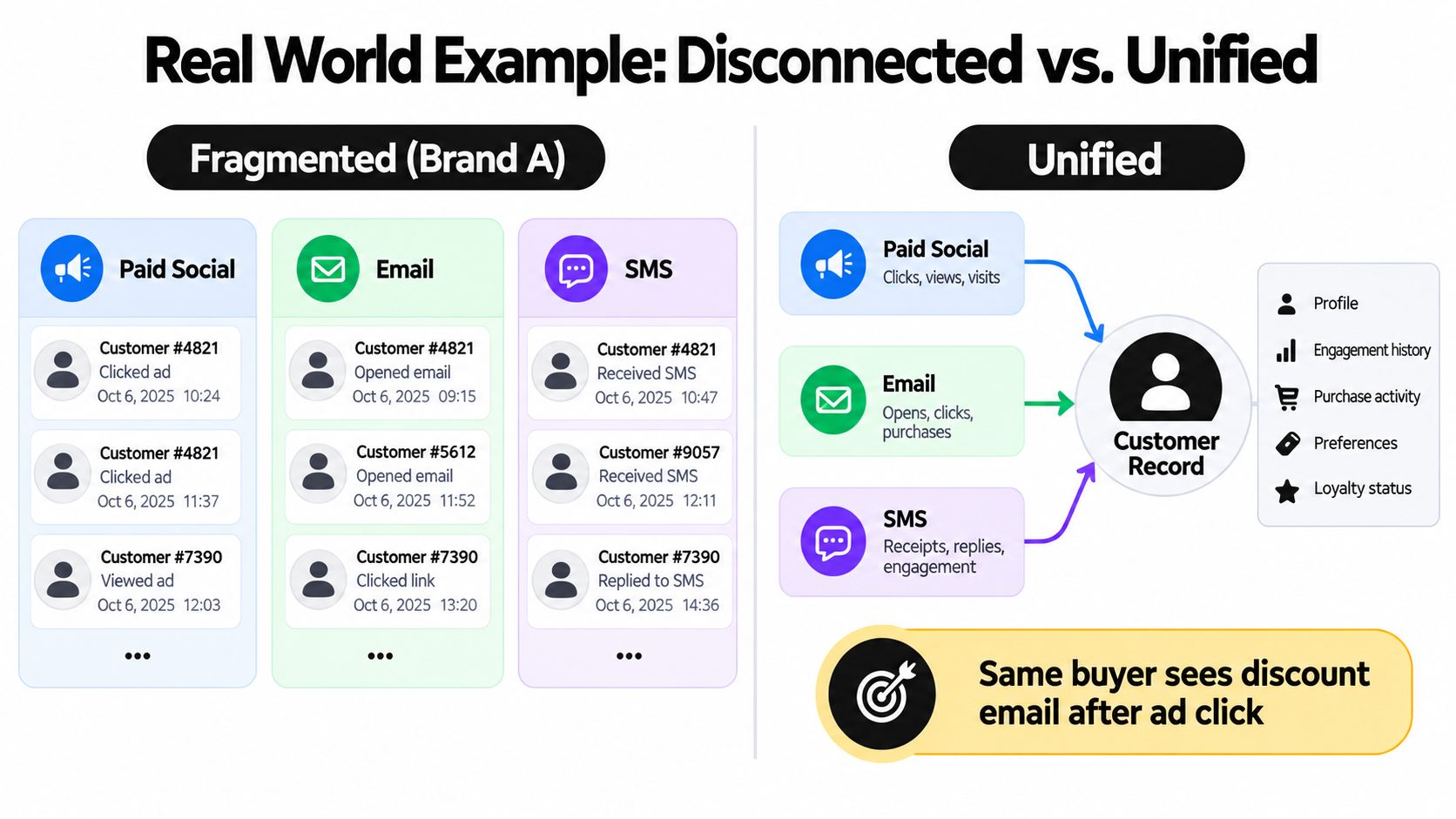
Brand A is a mid-market DTC skincare company using separate vendors for paid social, email, and SMS. The vendors don't share a customer record. A buyer clicks a retargeting ad, completes a purchase, and receives a discount email the next day because the email platform still classifies the buyer as an active prospect.
The symptoms spread beyond one awkward message. Acquisition and retention teams rebuild the same audience segments in separate tools. Marketing-qualified lead counts become inflated because each system applies its own definition. Attribution reports disagree, and retention metrics remain trapped in a CRM that never receives the acquisition signals that preceded the customer relationship.
Brand B changes the operating rhythm
Brand B is a B2B SaaS company that connects planning, creative production, publishing, and measurement to one customer record. Churn data generates a hypothesis. The creative team produces a message for the relevant lifecycle segment. The campaign launches with a holdout group, and the outcome appears in the same reporting environment used to plan the next sprint.
The weekly rhythm is straightforward:
- Signal: Churn behavior identifies an at-risk account segment.
- Hypothesis: A guided implementation message may reduce expected loss.
- Intervention: The team launches the message to the treatment group while retaining a holdout.
- Readout: Account behavior and revenue outcomes are compared between groups.
- Decision: The next sprint expands, revises, or stops the intervention.
The difference isn't the presence of email, advertising, CRM, or analytics. Both brands can use the same channels. The operational difference is that Brand B preserves the relationship between customer state, marketing action, and outcome.
Brand A asks which platform received credit. Brand B asks whether the intervention changed the customer's behavior. That question leads directly to identity design, event governance, experiment selection, and KPI architecture.
Implementation Steps and a KPI Framework That Proves Incrementality
Implementation works best when the operating model comes before a platform migration. The sequence below gives marketing leaders a practical order.
Audit the existing stack. List every system that stores customer identifiers, campaign exposure, conversion events, consent states, costs, and revenue. Map each field to a canonical customer and campaign record, then document conflicts.
Define the business question. Each stage should answer a decision question. “Which customers need intervention?” is more useful than “What open rate should email achieve?” The question determines the data, test design, and decision owner.
Create a tagged creative system. Attach every asset to an audience, lifecycle stage, proposition, format, and test variable. This gives creative production a usable relationship with measurement without reducing the work to a single performance number.
Unify publishing. Use APIs, a customer data platform, or a warehouse activation layer so channels share audience definitions, suppression rules, consent states, and lifecycle status. Google's Consent Mode documentation shows how consent states can dynamically adjust tag behavior. When visitors deny consent, tags don't store cookies, while advanced implementations may send cookieless pings for future measurement.
Build a causal measurement stack. Use user-level attribution for operational signals, marketing-mix modeling for aggregate allocation, and randomized holdouts or geo tests for causal validation. Google's measurement guidance distinguishes attribution, which analyzes observed paths, from causal inference, which estimates the effect of an intervention.
Return learning to strategy. Experiment results should change future briefs, audience rules, budget decisions, and lifecycle journeys. A test that never affects a later decision is reporting, not a loop.
| KPI Tier | Example Metrics | Question It Answers |
|---|---|---|
| Business | Revenue, retention, customer value, LTV/CAC | Did marketing improve the economics of the customer relationship? |
| Loop health | Time from insight to live experiment, share of decisions backed by an experiment | Can the organization turn evidence into action? |
| Channel diagnostic | CPM, CTR, conversion rate | What happened inside a channel, and where might investigation be needed? |
Channel metrics are useful diagnostics, but they shouldn't serve as the definition of success. A guide such as Social Cloud's attribution resource can help teams organize attribution metrics, while the broader operating model must still reconcile those signals with finance, CRM revenue, retention, and experiment results.
Governance rule: The hardest implementation problem usually isn't connecting another tool. It is agreeing on identity, consent, revenue definitions, decision rights, and the evidence required before budget changes.
Common Misconceptions That Block End to End Marketing
“Being on every channel equals end-to-end.” Channel coverage creates an omnichannel presence, not a connected system. The warning sign is a buyer receiving acquisition messaging after purchase because each channel owns a different audience file.
“More tools create more integration.” More tools can expand capability, but each new point solution may add an identity boundary, duplicated event, or conflicting definition. The symptom is a reporting meeting spent reconciling numbers rather than deciding what action to take.
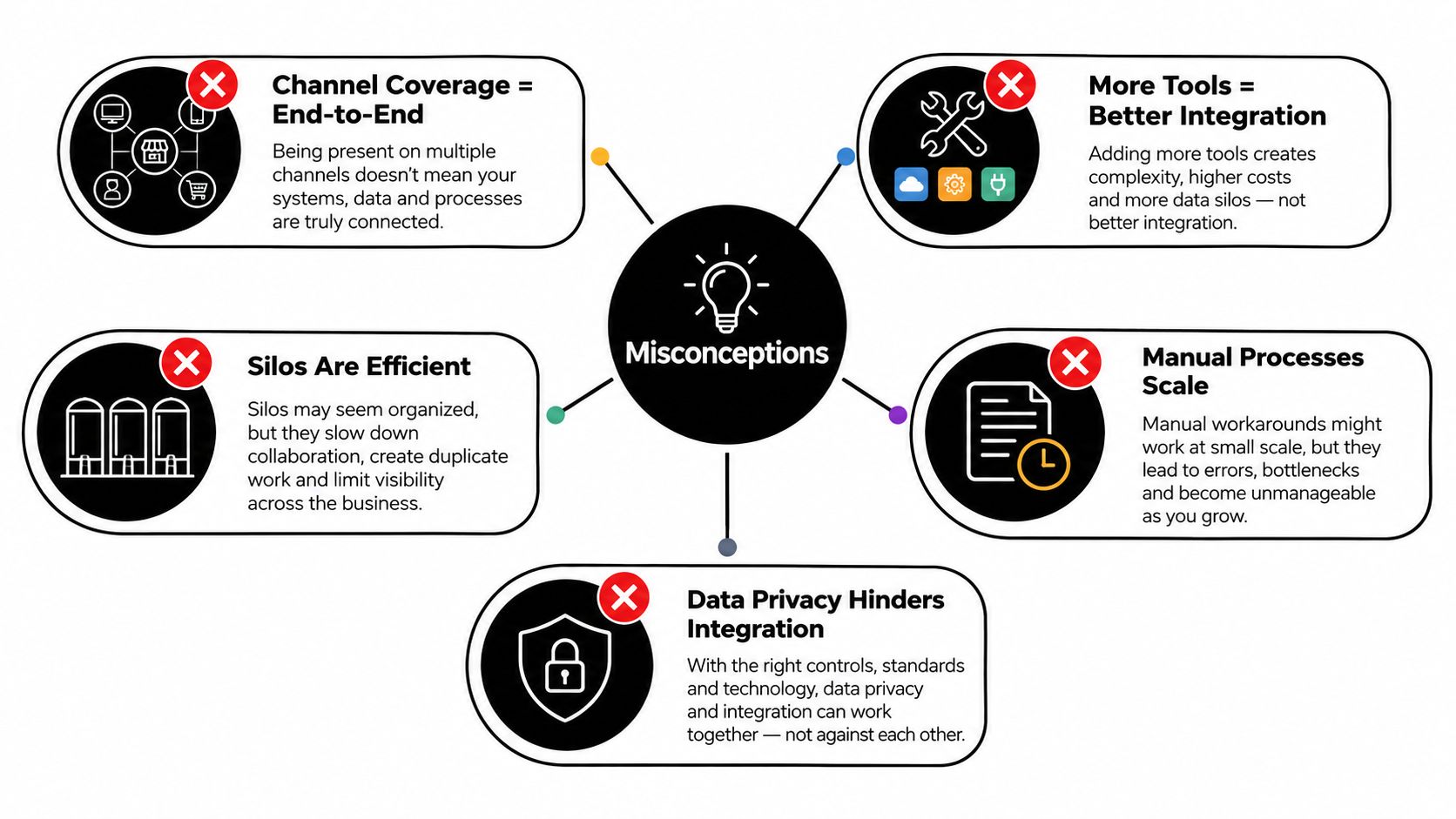
“Attribution can settle the argument.” Attribution assigns credit along an observed path. It doesn't automatically show whether a customer would have converted without exposure. The stronger business question is whether the intervention created incremental revenue, retention, or profit.
“Creative sits outside the operating model.” Creative is one of the most testable variables in the system. A message, offer, visual, landing page, or format can be changed while audience, channel, and control conditions remain stable. When creative teams don't receive outcome feedback, they keep producing assets without knowing which customer problem each asset solved.
“A perfect single platform must come first.” A functioning customer record and one well-designed experiment can create more learning than a stalled replatforming program. A team should start with a narrow journey, document the rules, and expand only after the data and governance work.
Privacy doesn't prevent integration. It changes the rules for collection and activation. Consent-aware measurement, first-party data, event governance, and experiments that don't depend entirely on a persistent identifier create a more durable foundation than unrestricted tracking ever did.
How Agentic AI Platforms Operationalize the End to End Loop
Agentic AI changes the loop by reducing the number of manual handoffs between insight, production, activation, and evaluation. The system can assemble evidence, draft a strategy, produce variants, coordinate publishing, aggregate results, and recommend the next intervention. Human judgment still controls the boundaries.
A useful architecture has three layers:
- Brand context layer: Brand voice, positioning, audience definitions, product information, approved claims, exclusions, and governance rules.
- Execution agent layer: Specialist agents for paid media, SEO, content, CRM, social, analytics, and customer support act on approved tasks.
- Outcome feedback layer: Customer events, campaign exposure, revenue, retention, experiments, and model outputs return to the same operating record.
What agents can handle
An agent can synthesize churn signals into a brief, generate email and landing page variants, apply audience and suppression rules, and prepare a holdout test. During execution, it can monitor response curves, identify a weak variant, recommend a pause, and route the result into the next planning cycle. This is a shift from analytics after the campaign to learning during the campaign.
Agentic workflows can also coordinate behavior-triggered journeys across email, SMS, WhatsApp, push, and website experiences. A customer moving from consideration to purchase can leave acquisition audiences, enter onboarding, and receive a retention intervention based on the same lifecycle state rather than on separate channel assumptions. An overview of automated marketing solutions provides related context for connecting these workflows.
The system shouldn't independently decide brand ethics, sensitive audience treatment, claims that require legal review, or budget governance. Marketing leaders should set approval levels, spending limits, publishing permissions, escalation conditions, and suppression policies. The agent can execute within those boundaries, while people remain accountable for the boundaries themselves.
The operational test is simple. If an AI system produces more assets but leaves identity, consent, measurement, and approval rules fragmented, it has accelerated output without creating end-to-end marketing. If it connects customer state to intervention and validated outcome, it has made the loop more responsive.
Your End to End Marketing Checklist and What Comes Next
A marketing leader can move from fragmented execution to a closed-loop system through a staged plan.
First 30 days
- Unify the record: Choose a canonical customer ID and document the fields, events, consent states, and revenue definitions that support it.
- Map the journey: Connect acquisition, conversion, onboarding, retention, expansion, and churn signals.
- Select one test: Choose a journey where a treatment and holdout can be implemented without waiting for a full replatform.
By 60 days
- Build the scorecard: Separate business outcomes, loop-health measures, and channel diagnostics.
- Run the experiment: Compare treatment and holdout outcomes using a defined business metric.
- Resolve governance: Assign owners for identity, consent, budgets, creative approval, and measurement.
By 90 days
- Operationalize the loop: Feed experiment findings into the next strategy and creative brief.
- Automate one stage: Pilot an agentic workflow for a bounded task such as variant production, audience refresh, journey monitoring, or reporting.
- Review the operating model: Keep the tools that preserve reliable data and remove workflows that create duplicated decisions.
The discipline is moving toward a convergence of generative creative, autonomous execution, and experimental measurement. The durable advantage won't come from running more campaigns. It will come from treating marketing as a continuous learning system that grows with the customer relationship.
The AI CMO provides a marketing operating system with customer data, AI specialists, content and campaign studios, cross-channel journeys, holdout groups, and first-party measurement in one environment. Marketing leaders can use The AI CMO to connect acquisition and retention, set approval limits, and turn campaign outcomes into the next operating decision.
Share this article