Marketing Strategy Frameworks That Actually Work in 2026

The AI CMO team
Oct 3, 2026
A marketing director starts the morning with fourteen dashboards open and no shared answer to a simple question: what should the team ship next? Paid media reports one story, the CRM another, product analytics a third, and the content calendar is already full. Automation keeps producing more campaigns, but nobody can explain which decision each campaign supports.
That's the practical value of marketing strategy frameworks. They create an operating layer between scattered tools and repeatable decisions. AI hasn't removed the need for structure. It has increased the cost of operating without one, because automation scales the assumptions already guiding the team.
Table of Contents
- Why Marketing Strategy Frameworks Still Matter in 2026
- How Marketing Frameworks Evolved From the 4Ps to Today
- Planning Frameworks That Set Direction
- Execution Frameworks That Run the Funnel
- How to Choose the Right Framework for Your Stage
- Two Mini Case Studies of Frameworks in Action
- Operationalizing Frameworks Inside The AI CMO
- The One-Framework Rule and Your Next Move
Why Marketing Strategy Frameworks Still Matter in 2026
A framework earns its place when it helps a team make a better decision repeatedly. It should clarify priorities under budget pressure, align paid media with content and lifecycle activity, and give executives a report they can understand without opening every platform.
The first step is to define the decision, not to choose a model.
- Prioritization: Decide which audience, offer, channel, or lifecycle problem deserves attention first.
- Alignment: Give paid, content, sales, product, and CRM teams a shared sequence of work.
- Measurement: Separate activity from outcomes and choose metrics that match the decision being made.
- Governance: Set the approvals, data boundaries, and operating cadence before automation starts.
A framework also protects teams from channel bias. Without one, a paid media manager optimizes campaigns, a content team fills a calendar, and a lifecycle manager builds journeys. Each person may perform well locally while the business loses sight of the customer journey.
Practical rule: If a framework can't tell the team what to stop doing, it isn't operating as a strategy.
The measurement layer matters more as privacy changes reduce the reliability of simple touchpoint reporting. A holdout test withholds a campaign or channel from a representative control group and compares the result with an exposed group, helping teams estimate incremental lift instead of merely counting attributed conversions (Measured explains how holdout tests work). Incrementality is causal measurement, while attribution assigns credit across touchpoints and remains correlational (eMarketer distinguishes incrementality from attribution).
The frameworks below serve different jobs. SOSTAC, 5Cs, STP, and Porter's Five Forces set direction. RACE, AARRR, AIDA, and Ansoff help teams execute, diagnose, and choose growth paths. The objective isn't to collect all eight. It's to select the one that matches the business stage, available evidence, and decision at hand.
How Marketing Frameworks Evolved From the 4Ps to Today
Marketing frameworks changed because business problems changed. In the late 1940s and 1950s, Neil Borden described a marketing mix with 12 elements, giving managers a vocabulary for the many decisions surrounding an offer. E. Jerome McCarthy later codified the familiar 4Ps in 1960, reducing that complexity to Product, Price, Place, and Promotion (the history of the marketing mix is documented here).
That simplification mattered. A manufacturing-era brand could use the 4Ps to turn a broad commercial problem into a manageable planning conversation. Teams could ask whether the product met demand, whether the price supported the position, whether distribution reached the market, and whether promotion made the value clear. A practical four Ps of marketing explained reference remains useful for that baseline diagnosis.
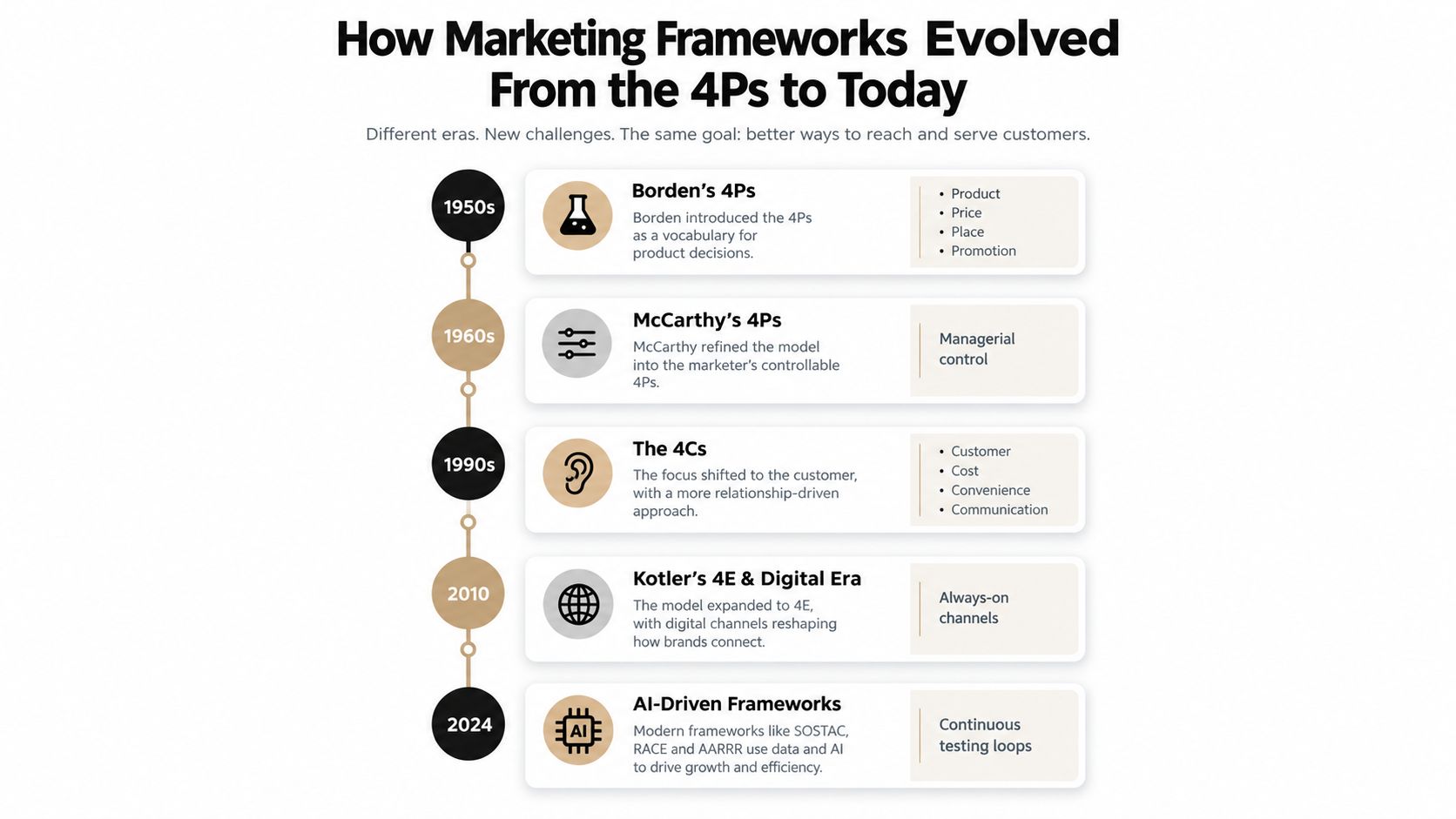
Services exposed the limits of a product-and-price lens. Booms and Bitner introduced the 7Ps in 1981, adding People, Process, and Physical Evidence to address intangible offerings (Canva outlines the evolution of the marketing mix). Robert F. Lauterborn proposed the 4Cs in 1990, shifting attention toward customer needs, cost, convenience, and communication.
Later models focused less on what a company controls and more on how people move through a decision. STP helped teams choose segments and positions in crowded markets. AIDA gave creative teams a sequence from Attention to Interest, Desire, and Action. RACE and AARRR made digital journeys and product behavior easier to organize.
Each generation solved a constraint. The 4Ps created managerial control. The 7Ps addressed services. The 4Cs made customer perspective explicit. Digital frameworks made journeys measurable and testable. AI now creates a new constraint: teams need models simple enough for machines to execute, but precise enough for humans to govern.
Planning Frameworks That Set Direction
Planning frameworks answer different strategic questions, so substituting one for another creates confusion. Porter's Five Forces examines competitive structure. STP turns market understanding into a target and position. 5Cs organizes situation analysis. SOSTAC connects the full plan from diagnosis to action.
| Framework | Central question | Core components | Best use case | Common failure |
|---|---|---|---|---|
| SOSTAC | What should the business do next? | Situation, Objectives, Strategy, Tactics, Action, Control | Full lifecycle planning | Situation and action never connect |
| 5Cs | What conditions shape the opportunity? | Company, Customers, Competitors, Collaborators, Context | Situation analysis | Generic research replaces customer insight |
| STP | Who should the brand serve and what should it mean? | Segmentation, Targeting, Positioning | Audience and message decisions | Segments remain descriptive instead of actionable |
| Porter's Five Forces | How attractive and defensible is the market? | Rivalry, entrants, substitutes, buyers, suppliers | Competitive structure and investment choices | Structural analysis ignores execution reality |
SOSTAC works best when a team needs one operating plan. Its weakness appears when it becomes a presentation ritual. A Situation slide doesn't create strategy unless it changes the Objective, and an Objective doesn't create action unless an owner and control metric are attached.
5Cs is valuable before campaign planning, especially when teams have conflicting views of the customer or market. It fails when analysts fill each category with copied competitor language and untested assumptions.
STP is the operational bridge. It forces a decision about whom to prioritize and what promise should distinguish the brand. Teams can then translate the position into landing pages, sales enablement, content, and lifecycle messaging. A structured marketing strategy development process helps connect audience truth, value claims, proof language, and distinctive voice to practical execution.
Porter sits at the strategic ceiling because it frames the economics and defensibility of a market. STP sits closer to the ground because it tells teams where to aim. SOSTAC can hold the plan together, but only if the diagnosis changes what gets funded and shipped.
Execution Frameworks That Run the Funnel
Execution frameworks are not substitutes for strategy. They are operating lenses for campaigns, journeys, product loops, and portfolio decisions.
| Framework | Lifecycle stage | Key question | Switch signal |
|---|---|---|---|
| RACE | Reach, Act, Convert, Engage | How does the brand move people through the customer lifecycle? | Reporting cannot connect stages |
| AARRR | Acquisition, Activation, Retention, Revenue, Referral | Where does product-led growth leak? | Retention plateaus or brand demand weakens |
| AIDA | Attention, Interest, Desire, Action | Does this message move a prospect toward action? | The buying process becomes multi-threaded |
| Ansoff | Market and product expansion | Should growth come from existing or new markets and offers? | Leadership must choose an expansion path |
RACE suits a brand with an established funnel and multiple channels. It gives paid, owned, and lifecycle teams a common sequence, but it breaks down when attribution is too fragmented to connect Reach with Engage.
AARRR is sharp for an early-stage SaaS team investigating activation leaks. Product analytics can show where acquisition becomes activation, where users return, and whether usage turns into revenue. The framework's blind spot is brand building. A product can improve its funnel while remaining unknown to the market.
AIDA belongs in creative briefs, landing-page reviews, and short-form campaigns. It gives a writer or designer a useful test: does the asset earn attention, create interest, build desire, and make action clear? It becomes too linear for complex B2B buying groups with long evaluation paths.
Ansoff operates above the campaign. It helps leadership compare market penetration, product development, market development, and diversification as investment choices. It shouldn't be used to justify a launch before the team understands customer demand and operational capacity.
Creative testing still needs discipline inside any of these models. A practical guide for high-growth media buyers is useful when a team must turn a framework into testable variations rather than a collection of slogans.
The switch signal matters more than loyalty to a model. When retention stalls, AARRR needs a loyalty layer. When RACE reporting becomes a channel spreadsheet, the team needs a stronger measurement design. When AIDA cannot represent multiple decision-makers, STP and account-level journey mapping should take over.
How to Choose the Right Framework for Your Stage
Framework selection should use four inputs, not personal preference.
Start with the business stage
A pre-product-market-fit business needs evidence about customers and activation. A scaling company needs repeatable acquisition and lifecycle control. A mature company needs efficiency, defensibility, and portfolio choices. A declining business needs sharper customer and context analysis before it adds more execution.
Name the dominant question
The question usually falls into one of three categories:
- Where to play: Which audience, market, or position deserves investment?
- How to grow: Which journey, channel, offer, or product loop should improve?
- How to retain: Which customers are at risk, and which experience should change?
Match the team and data
A small team with strong product analytics can run AARRR effectively. A large brand team may need SOSTAC to coordinate specialists. Data maturity determines how far quantitative frameworks can be trusted. If CRM identity, product events, or conversion definitions are unreliable, a detailed dashboard only gives unreliable answers faster.
Choose the shortlist
| Situation | Starting combination |
|---|---|
| Pre-product-market fit | AARRR plus 5Cs |
| Scaling brand | SOSTAC plus RACE |
| Mature business | Porter plus Ansoff |
| Brand-led business | AIDA plus SOSTAC |
| Weak data maturity | STP before quantitative optimization |
Team size and skill mix still matter. A framework that requires daily analysis won't work if nobody owns the data, while a detailed planning model becomes bureaucracy when the team needs to learn through rapid experiments.
Decision rule: If the team can't name the one metric each framework should move, it isn't ready to run that framework.
Low data maturity is not a reason to wait. Start with STP, customer interviews, sales-call evidence, and explicit positioning. Build measurement definitions before layering on optimization models.
Two Mini Case Studies of Frameworks in Action
Frameworks become useful when they change weekly behavior. The following examples are operating patterns, not claims about measured company results. They show how a team might apply each model without pretending that an unverified performance number proves the framework works.
A Series A SaaS team can use AARRR to isolate an activation leak. Instead of asking the acquisition team for more traffic, the team defines the first meaningful product experience, maps the steps required to reach it, and reviews the movement from Acquisition to Activation each week. Product, lifecycle, and growth owners then commit to one shipped experiment per loop.
The KPI stack should include acquisition source quality, activation completion, return behavior, revenue progression, and referral activity. The operating change is more important than the dashboard. Each review ends with a decision to scale, replicate, or roll back the experiment.
A mid-market DTC brand can use SOSTAC for a new-market launch. The team starts with one objective, uses an STP cut to define priority segments, maps channels through RACE, and creates a control phase before increasing investment. The control design should include a holdout or comparable baseline so the team can estimate incremental contribution rather than relying only on platform-reported conversions.
| Case | Framework | KPI moved | Baseline | Result | Cadence change |
|---|---|---|---|---|---|
| Series A SaaS activation review | AARRR | Activation and retention progression | Defined before testing | Use measured movement, not an invented lift | Weekly experiment review |
| Mid-market DTC market launch | SOSTAC, STP, RACE | Contribution and incremental demand | Defined before launch | Scale, replicate, or roll back from control evidence | Weekly control review |
The measurement principle is consistent across both examples. MMM estimates how business drivers jointly influence demand and helps teams identify actionable changes to the marketing mix, while incrementality tests can strengthen the causal interpretation of those models (the ARF MSI panel report describes MMM). Teams should normalize currency, seasonality, channel mix, and metric definitions before comparing performance across markets, as emphasized in the WFA EMEA MMM benchmark-partners-in-emea).
A useful collection of marketing strategy examples can supply patterns, but no example should replace a local baseline and a defined decision rule.
Operationalizing Frameworks Inside The AI CMO
A framework should produce work, not remain trapped in a planning deck. The operating design is a loop with four stages: planning, production, sending, and measurement.
Planning creates the brief
SOSTAC supplies the spine. The Situation input combines customer, market, channel, and business evidence. Objectives become measurable decisions. Strategy defines the priority audience and route to growth. The output is a brief with an owner, budget boundary, audience rule, approval level, and success metric.
5Cs improves the input quality. Customer evidence and context prevent the team from treating a channel report as a market strategy. STP then turns that evidence into segment definitions, positioning, and message variants.
Production turns strategy into assets
The content module consumes the segment, position, proof language, and voice. It can produce ad concepts, email sequences, landing pages, social posts, and sales assets from the same brief. Human reviewers still decide whether the claim is defensible, whether the message fits the brand, and whether the asset is appropriate for the audience.
Sending applies the execution model
RACE governs the movement from Reach to Act, Convert, and Engage. AARRR adds the product and revenue loop when activation and retention matter more than campaign volume. Customer data determines eligibility, while journeys respond to behavior and lifecycle changes.
Sending controls should include consent, suppression, frequency, ownership, and approval limits. A campaign shouldn't move forward just because an AI system can produce it.
Measurement closes the loop
The measurement stage compares results with the defined baseline, experiment design, and business KPI. Attribution can describe touchpoint participation, while holdouts and treatment-control comparisons help estimate causal impact. Modern measurement practice also integrates incrementality results into MMM to improve causal accuracy (current modeling research discusses this connection).
A weekly review can trigger a change in audience, message, channel, offer, or budget. Automated quality checks can run before every send instead of waiting for a quarterly framework review. The marketing governance framework provides a useful reference for defining ownership, approvals, and decision rights.
A single campaign might begin with a 5Cs situation review, use STP to define the priority segment, use SOSTAC to set the objective, and use RACE to map the journey. Production generates the assets, sending applies consent and eligibility rules, and measurement compares exposed and holdout groups. Manual work disappears from repetitive assembly and reporting. Human oversight remains essential for positioning, claims, risk, budget, and the decision to scale.
The One-Framework Rule and Your Next Move
Teams rarely suffer from a shortage of frameworks. They suffer from too many competing owners. A plan that contains SOSTAC, STP, SWOT, AIDA, RACE, AARRR, and Porter can sound polished while leaving nobody responsible for the next decision.
Choose one primary framework for the planning cycle:
- SOSTAC when the business needs structure across planning and control.
- RACE when the central problem is lifecycle growth across channels.
- AARRR when a product team needs to diagnose acquisition, activation, retention, revenue, and referral.
Add one measurement layer. That layer might be a 5Cs-informed evidence system or a Porter-based competitor scan, but it should feed the primary framework rather than compete with it. Keep the measurement companion stable while the primary model changes with the business stage.
A secondary framework earns promotion when it owns a recurring decision, has a clear operator, and produces evidence the primary model cannot provide. Ansoff may become primary when portfolio expansion dominates the agenda. AARRR may give way to RACE when the business must coordinate product, brand, paid media, and retention. The change should follow the decision, not fashion.
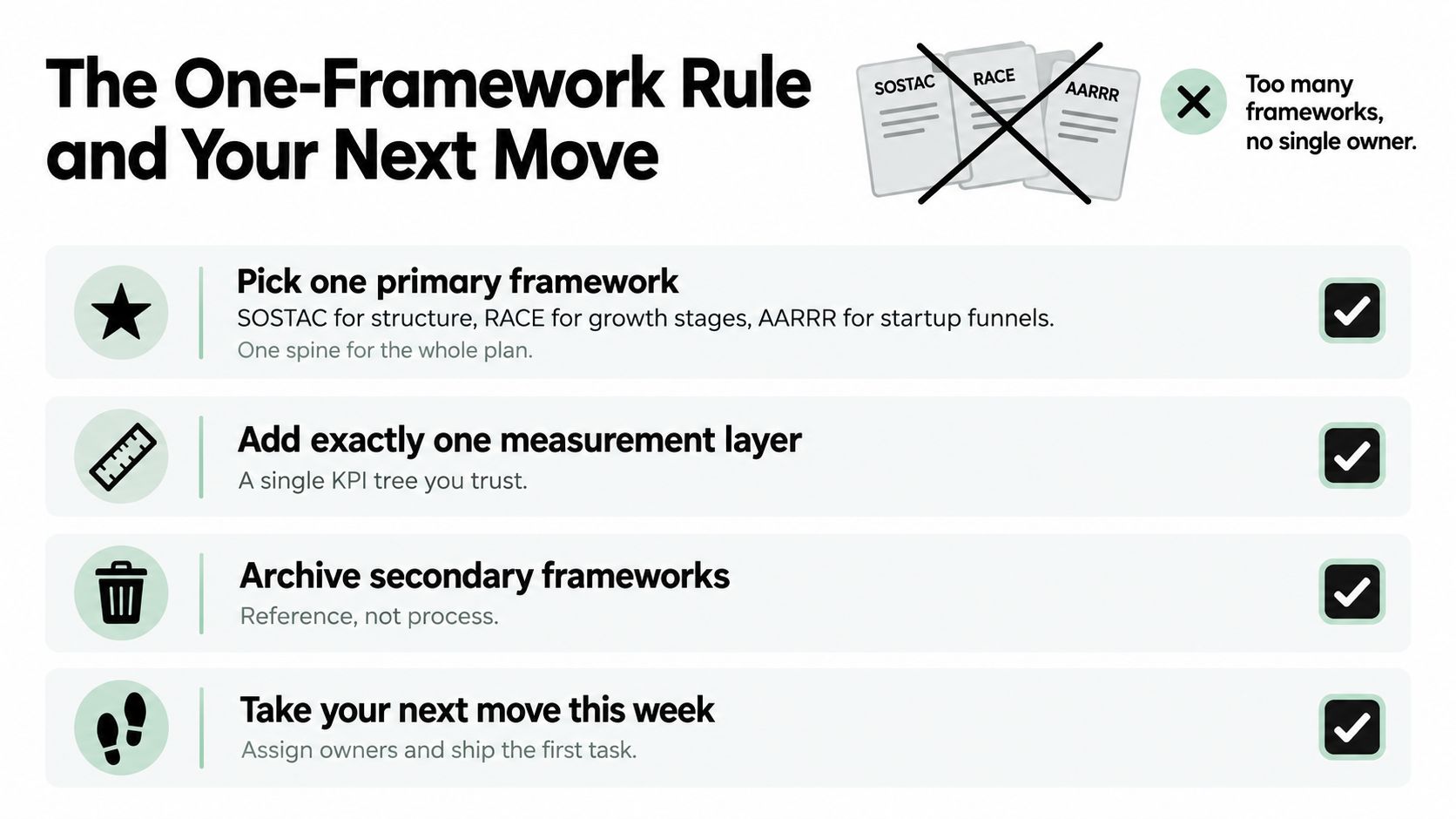
Audit the current stack this week. Write down every framework in the strategy document, assign one primary owner, archive the rest as reference material, and attach one KPI tree to the active model. Then connect the framework to the operating layer, with approval rules that determine what automation can execute and what requires a human decision.
Which framework fits a startup?
A startup usually needs 5Cs plus AARRR when customer evidence and product activation are the central uncertainties. STP should come first if the audience and positioning are still unclear.
Which framework fits an enterprise?
An enterprise often needs SOSTAC for coordination, supported by STP for audience decisions and Porter for competitive structure. The primary model should reflect the decision consuming executive attention.
How often should a team switch?
Switch when the dominant business question changes or the current framework no longer produces a decision. Don't switch because a new model is popular.
Do frameworks still matter in an AI-led stack?
Yes. AI can produce, send, and analyze work at scale, but it still needs an explicit objective, audience, constraint, and measurement rule. Without those, automation accelerates activity without guaranteeing strategic progress.
The AI CMO connects strategy frameworks to planning, production, sending, customer data, journeys, experiments, and measurement in one governed marketing operating system. Choose one framework for the next planning cycle, define its KPI and approval rules, then visit The AI CMO to put that operating model into action.
Share this article