How to Scale Marketing 10x Without Burning Out Your Team
The AI CMO team
Jan 14, 2026
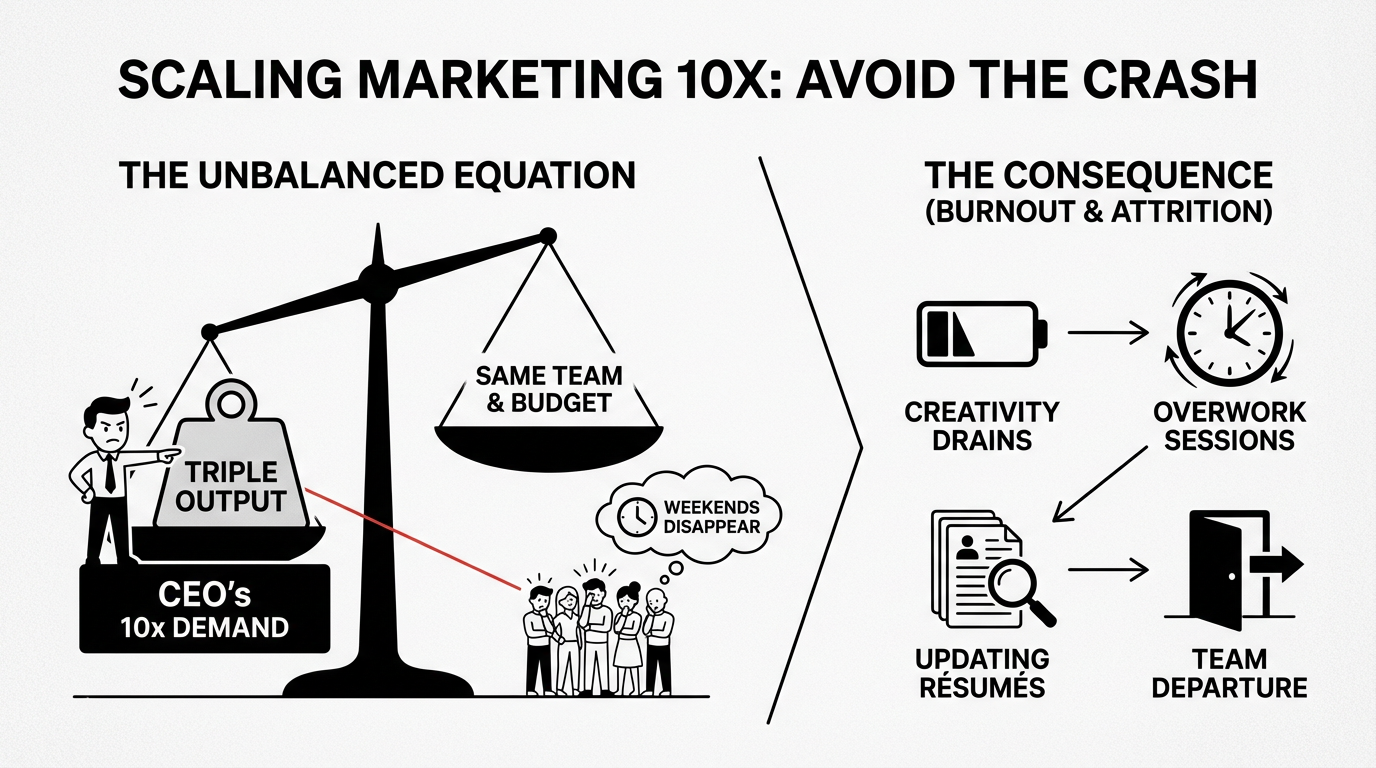
Picture this: Your CEO walks into Monday's leadership meeting and drops the news. "We need to triple content output next quarter." Same budget. Same team.
Most marketing leaders know what comes next. Evenings turn into work sessions. Weekends disappear. The team that was excited and creative three months ago? Now they're updating résumés.
Here's the thing though: teams producing 500 campaigns per month aren't working 80-hour weeks. They're not hiring armies of content creators. And they're definitely not sacrificing quality to hit those numbers.
They're doing something fundamentally different. They're scaling intelligence, not effort.
When marketing systems remember what works, enforce brand automatically, and compound knowledge over time, teams produce 10x more output with the same people working normal hours. Not someday. Right now.
This article breaks down the three-layer system that makes it possible, real examples from teams who've made the shift, and the practical framework for implementing it, regardless of your company size or industry.
The Scaling Paradox: Why More Output Usually Means More Burnout
Traditional scaling approaches all lead to the same place. Overwhelmed teams, declining quality, and eventually, your best people walking out the door.
Let's talk about why the "obvious" solutions fail.
Approach #1: Hire More People
The math seems simple. More hands equals more output. Distribute the workload, reduce stress per person, scale capacity.
Except that's not what happens.
New hires need 3-6 months before they're actually productive. During that time, coordination overhead explodes: more meetings, more alignment sessions, more handoffs between team members. Brand consistency starts degrading because everyone interprets your voice slightly differently. Knowledge stays fragmented because each person knows different things.
Here's the brutal math: One marketer produces baseline output. Five marketers produce maybe 3x that baseline, not 5x, because coordination overhead eats the gains. Ten marketers? You might get 5x output if you're lucky.
You hired 10x the people but only scaled 5x the output. And your costs scaled linearly the entire time.
Approach #2: Work Longer Hours
Same team, more hours. Temporary push to hit deadlines. Show commitment during the growth phase.
First month at 50-hour weeks? Output increases maybe 25%. Second month, quality starts slipping. Errors creep in. Third month, burnout begins and turnover risk rises sharply. Six months later, you've lost your best people.
Working 25% more hours doesn't yield 25% more output. Creativity drops when people are exhausted. Mistakes require rework, which creates time loss. Your top talent leaves, taking institutional knowledge with them.
Net result: temporary gain, permanent damage.
Approach #3: Accept Lower Quality
"Ship fast, iterate later." "Good enough" at scale. Speed over perfection.
Sounds reasonable until your brand voice starts drifting across campaigns. Customer experience fragments. Trust erodes incrementally. And here's the kicker: rework increases because you're constantly fixing "good enough" content that wasn't actually good enough.
Teams report that when they scale to 10x output by accepting lower standards, roughly 40% needs revision or gets scrapped entirely. Your actual usable output? Maybe 6x. Team frustration? Definitely 10x.
Why They All Fail
These approaches try to scale effort instead of intelligence.
More people = more effort. More hours = more effort. Lower standards = effort without quality. None of them address the core constraint: your marketing system doesn't get smarter with each campaign.
Campaign #100 is no smarter than Campaign #1. You're relearning the same lessons every single time.
The real solution? Build systems that remember what works, apply learnings automatically, and compound knowledge over time. When intelligence scales, output scales without proportional effort increase.
That's how you get 10x without burnout.
The Three-Layer System That Enables 10x Scale
Scaling without burnout requires three system layers working in concert: Knowledge Compounding, Brand Automation, and Strategic Orchestration.
Layer 1: Knowledge Compounding – Make Every Campaign Improve Future Campaigns
Traditional marketing operates like Groundhog Day. Each campaign starts from scratch, relearning the same lessons. The insights from your best-performing email in January? They're buried in a Slack thread by February.
Knowledge compounding changes this. Every campaign automatically improves future campaigns.
Performance memory in action: Subject line testing in January reveals that "How to..." format outperforms questions by 23% in your audience. The system remembers this pattern. All future campaigns automatically prioritize the proven format. No manual note-taking. No hoping someone remembers. It just happens.
Audience intelligence: Segment A responds better to data-driven content. Segment B prefers story-based approaches. The system applies these learnings automatically to future targeting. You get personalization without manually configuring segmentation rules every single time.
Failure prevention: That discount-heavy messaging that decreased customer lifetime value by 15% in your premium segment? The system flags when new campaigns trend toward this mistake. Past failures prevent future ones automatically.
Here's what the scale impact looks like. Month 1 is your learning phase, establishing baseline output. By Month 3, you're producing 2x output because you're applying accumulated learnings. Month 6? 5x output as compounded knowledge accelerates creation. By Month 12, you're hitting 10x output because the system is significantly smarter than humans working alone.
Same team. Exponentially better results.
Layer 2: Brand Automation – Eliminate Review Bottlenecks
Manual brand review creates the bottleneck that prevents scale. Three to five day review cycles. Multiple revision rounds that delay launches. And when teams skip review for speed? Inconsistency.
Brand automation enforces consistency during creation, not after.
Content gets generated within brand constraints from the start. No "check for brand voice" step needed. No revision rounds. Ship same day.
Quality becomes team-independent. New hire, ten-year veteran, freelancer: all produce on-brand content because the system ensures consistency automatically. Quality doesn't depend on individual skill at "getting" your voice.
This is how you produce 500 pieces per month with perfect brand consistency. No review bottleneck. No brand drift. No quality sacrifice.
The numbers tell the story. Traditional approach at 100 campaigns per month means 3 days average review time, 40% needing revision rounds, and team capacity maxed out. With automated guardrails at 500 campaigns per month? Zero review time because enforcement happens during creation. Only 5% need refinement for edge cases. Team capacity has room to grow.
Same team. 5x output. Less stress.
Layer 3: Strategic Orchestration – Humans Guide, AI Executes
Most marketers spend 80% of their time on execution and 20% on strategy. This ratio inverts what actually creates value.
Strategic orchestration shifts the model. Humans focus on judgment, taste, and direction. AI handles execution.
Traditional model: Marketer develops strategy for 2 hours. Writes 10 email variations for 6 hours. Creates social posts for 3 hours. Builds landing page copy for 2 hours. Total: 13 hours for one campaign.
Orchestration model: Marketer defines strategy, brand requirements, and goals for 2 hours. AI generates 10 email variations, social posts, and landing page in 10 minutes. Marketer reviews, refines, and approves in 30 minutes. Total: 2.5 hours for one campaign.
The role fundamentally shifts. From Marketing Manager who executes campaigns to Growth Architect who orchestrates systems.
Humans focus on strategic direction, brand taste and judgment, what resonates with audiences, and high-level creative decisions. AI handles execution of strategy across channels, applying brand guardrails, generating variations at scale, and remembering what works.
One Growth Architect can orchestrate what previously required five execution-focused marketers. Not because humans are replaced, but because human time shifts from low-value execution to high-value strategy.
Real Teams, Real Results: What 10x Scale Actually Looks Like
This isn't theoretical. Teams are achieving 10x scale right now.
Case Pattern #1: Agency Scaling Client Work
Before: Three account managers, each handling 4 clients for 12 total. Working 40-50 hour weeks under constant deadline stress. Quality inconsistency across clients.
After implementing compounding systems: Same 3 account managers, each managing 12-15 clients for 40+ total. Working 35-40 hour weeks. Campaigns ship faster. Consistent quality across all clients.
What changed? Knowledge from one client's campaigns improves all others. Brand guardrails enforce each client's voice automatically. The orchestration model means they strategize once and execute infinite variations. No re-learning for each client.
The result: 3.3x client capacity, less time, better quality. No burnout.
Case Pattern #2: In-House Team Going Multi-Channel
Before: Two-person marketing team. Email campaigns only, capacity maxed. Social media outsourced with inconsistent brand. No bandwidth for paid ads, content marketing, or SEO.
After intelligence scaling: Same 2-person team running email, social, paid ads, blog, and SEO. All channels maintain brand consistency. Higher output than when outsourcing.
What changed? One strategy cascades across all channels automatically. Brand stays consistent across email, social, ads, and blog. Content multiplies from a single strategic brief. System handles execution while humans guide strategy.
The result: 1 channel to 5 channels. Same team. Better results.
Case Pattern #3: Solo Marketer Managing Multiple Brands
Before: One marketer handling one brand. Producing 20-30 campaigns per month. Working 55+ hours per week. Barely keeping up.
After implementing memory systems: Same marketer managing 3 brands. Producing 120+ campaigns per month across all brands. Working 40 hours per week. Room to take on more.
What changed? Each brand has separate memory context so there's no bleed across brands. Learnings compound within each brand. Orchestration replaces manual execution. Strategic thinking scales across brands.
The result: 3x brands, 4x output, 15 fewer hours per week.
The Common Thread
These teams aren't working harder. They're working with systems that remember what works, enforce brand automatically, and let humans orchestrate instead of execute.
When intelligence scales, effort doesn't need to.
Teams using this approach report 70% time savings on campaign production, 5-10x output increase with same headcount, 95%+ brand consistency across all content, zero increase in work hours, and significant decrease in stress and burnout indicators.
This isn't theoretical productivity gains. These are measured outcomes from teams who made the shift.
The Implementation Framework: How to Start Scaling Intelligence
You don't need to transform everything overnight. Start with one system layer and expand.
Phase 1: Start With Knowledge Capture (Month 1)
Stop letting insights die after campaigns end.
After each campaign, document what worked and why: not just metrics, but strategic insights. Store learnings in an accessible system, not scattered across Google Docs and Slack threads. Make past insights searchable and actionable.
Quick win: Next campaign creator can reference what worked in similar past campaigns. Immediate quality improvement.
Phase 2: Automate Brand Consistency (Month 2-3)
Remove brand review as a bottleneck.
Define brand voice requirements clearly. Implement automated guardrails for content generation. Test with low-stakes content first. Expand as confidence grows.
Quick win: Cut 2-3 days from campaign timeline by eliminating review rounds. Ship faster without quality sacrifice.
Phase 3: Shift to Strategic Orchestration (Month 4-6)
Transition your team from executors to orchestrators.
Identify repetitive execution tasks. Implement AI-driven execution for those tasks. Redirect human time toward strategy and judgment. Measure whether marketers are spending more time on high-value work.
Quick win: One marketer's strategic brief generates complete multi-channel campaign in minutes instead of days.
The Compounding Effect
Month 1: Knowledge capture improves next campaign slightly. Month 3: Automated brand plus knowledge equals 2x faster production. Month 6: Full orchestration model delivers 5x capacity increase. Month 12: System intelligence compounds until 10x becomes achievable.
Critical Success Factors
Start small, prove value, then expand. Don't try to transform everything at once.
Measure the right things: not just output, but also team hours, stress levels, and quality consistency.
Focus on intelligence, not tools. The goal isn't adopting new software. It's building systems that learn.
Protect human judgment. AI executes. Humans provide taste and strategic direction.
Scale Intelligence, Not Effort
Scaling marketing 10x doesn't require 10x headcount, 10x hours, or accepting 50% quality standards.
It requires scaling intelligence through systems that remember what works, automated enforcement of brand standards, and strategic orchestration that lets humans guide while AI executes.
Teams achieving 10x scale report the same patterns: same or smaller team size, normal working hours with no burnout, higher quality because systems enforce consistency, and better results because compounded knowledge beats individual effort every time.
The shift is simple but profound. Stop asking "How do we produce more content?" Start asking "How do we make our system smarter so production becomes easier?"
When your marketing system compounds knowledge, enforces brand automatically, and orchestrates strategy into execution, scale becomes natural instead of stressful.
The companies achieving 10x scale aren't working harder. They're building systems that get smarter.
The future of marketing isn't grinding harder to produce more. It's building intelligence that compounds while your team works normal hours and produces extraordinary results.
That's how you scale 10x without burning out.
Share this article