The campaign looks ready. Product screenshots are polished, the headline sounds confident, and Facebook Ads Manager shows inexpensive clicks. Then sales reviews the leads: poor fit, unclear buying intent, and little connection between the ad's promise and the conversations that follow.
For a B2B SaaS growth team, the useful question isn't whether the copy sounds persuasive. It's whether the entire ad helps the right buyer take an appropriate next step.
Table of Contents
- Why Strong Facebook Ads Still Fail
- Build Copy Around the B2B Buyer
- Create Hooks and Value Propositions That Fit
- Assemble Every Facebook Ad Format
- Pair Copy With the Right Creative
- Review Compliance Before Launch
- Test Copy and Improve the Campaign
Why Strong Facebook Ads Still Fail
Consider a hypothetical SaaS campaign promoting workflow software. The ad promises effortless collaboration, shows an attractive dashboard, and invites everyone to book a demo. Marketing celebrates engagement. Sales wants to know which operational problem the prospects need solved.
The copy hasn't necessarily failed to attract attention. It may have failed to establish relevance and qualify interest. A broad promise can appeal to people who like the idea without giving suitable buyers a compelling reason to evaluate the product.
Diagnose the missing buying context
A useful campaign review starts with the buyer's situation rather than another headline formula.
- Trigger: What changed inside the company that makes the problem worth addressing?
- Outcome: Which business result would justify replacing the current approach?
- Credibility: What could the buyer inspect before accepting the promise?
- Commitment: Does the next step match the buyer's readiness?
Feature-led copy often skips those questions. “Automated workflows and powerful reporting” describes capabilities, but it doesn't explain why a marketing operations manager should interrupt a familiar process.
Practical rule: An ad should make the intended buyer recognize a relevant situation before asking for a commitment.
Treat copy as part of acquisition
Facebook ad copywriting developed alongside scalable advertising infrastructure, not as an isolated headline craft. Facebook introduced its broader self-service advertising system in November 2007, helping establish the foundation for audience-targeted, measurable advertising, as documented in Clarigital's Facebook advertising history.
That history supports an operating mindset: copy deserves systematic testing, not a single approval meeting followed by indefinite spending. The campaign needs a connected audience definition, offer, creative treatment, destination, and business measurement.
For teams examining that broader acquisition process, Lead Printer's 2026 SaaS lead generation playbook provides a complementary planning resource. The practical priority remains the same: establish which opportunity the campaign should create before optimizing the words used to attract it.
Build Copy Around the B2B Buyer
"Approvals scattered across email and chat" stops a marketing operations manager mid-scroll. "Workflow orchestration platform" does not. The first phrase came from how buyers describe their week. The second came from a product deck.
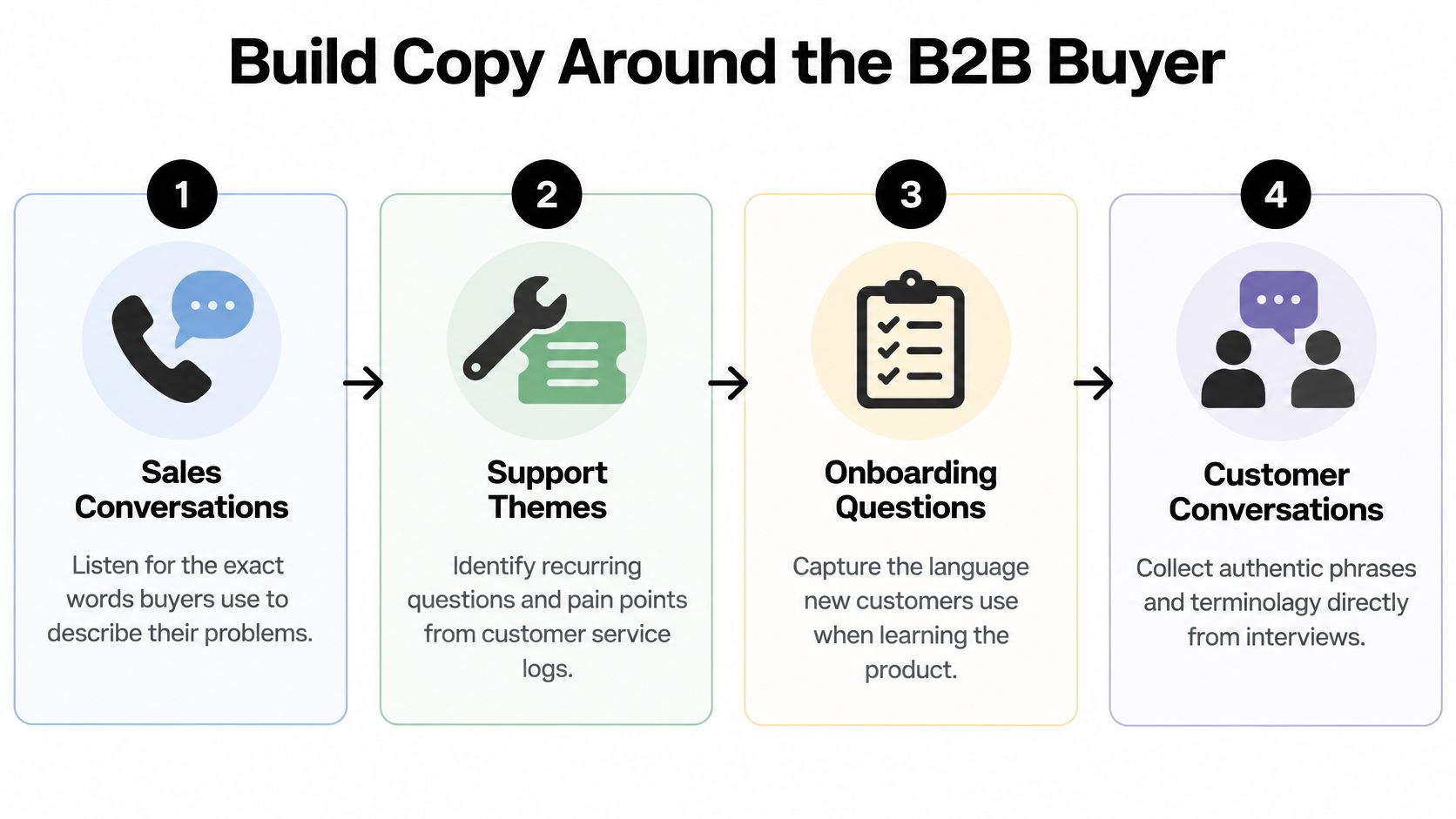
B2B ad copy often starts failing in that gap, and it is also the easiest gap to close because the raw material already exists. Sales calls surface the trigger events that push a team to look for something new. Support tickets record the friction users complain about, not the friction the product team assumes. Onboarding questions reveal what buyers failed to understand before they reached value. Customer interviews add the most useful input of all: the words people used before they learned your category's terminology.
Collect those phrases before writing a single headline.
Compress research into a working brief
The point of this research is exclusion. A useful audience brief gives a writer enough context to rule out irrelevant angles, and CapyScout's ICP examples for B2B sales can serve as a reference when translating account-level fit into campaign criteria.
Four fields do most of the work:
| Brief field | What it captures |
|---|---|
| Role and company context | The person evaluating the problem, the team involved, the operating environment |
| Trigger and current alternative | What changed, and whether the team relies on spreadsheets, manual coordination, or another product |
| Desired outcome | The business improvement that matters, stated without unsupported promises |
| Objections and evidence | What could block the decision and which approved proof answers it |
The brief then compresses into one working message: When [trigger] occurs, [role] struggles with [specific tension]. The offer helps deliver [relevant outcome] through [credible mechanism].
For an illustrative approval-management product, the tension might be unclear review ownership during campaign launches. The relevant outcome is visible responsibility, not an unsubstantiated claim about dramatic productivity gains.
Match the ask to the buying stage
Stage, role, and ask are separate components in a modular system. You change one without rewriting the others.
At awareness, copy helps a buyer name the problem and inspect a useful explanation. During consideration, it clarifies the mechanism and the meaningful differences from the current alternative. At decision, it addresses implementation, suitability, and unresolved objections. The same approval-routing feature supports all three stages with different angles. A marketing director cares about launch coordination; an operations evaluator cares about routing logic and permissions.
A reusable prompt keeps those boundaries explicit each time you produce a variant:
Develop copy for [role] at [company context], responding to [trigger]. Emphasize [tension] and [desired outcome], address [objection], use only [approved evidence], and offer [stage-appropriate next step].
The template fixes the edges of the writing task. It does not authorize a writer or an AI tool to fill evidence gaps with plausible claims.
Create Hooks and Value Propositions That Fit
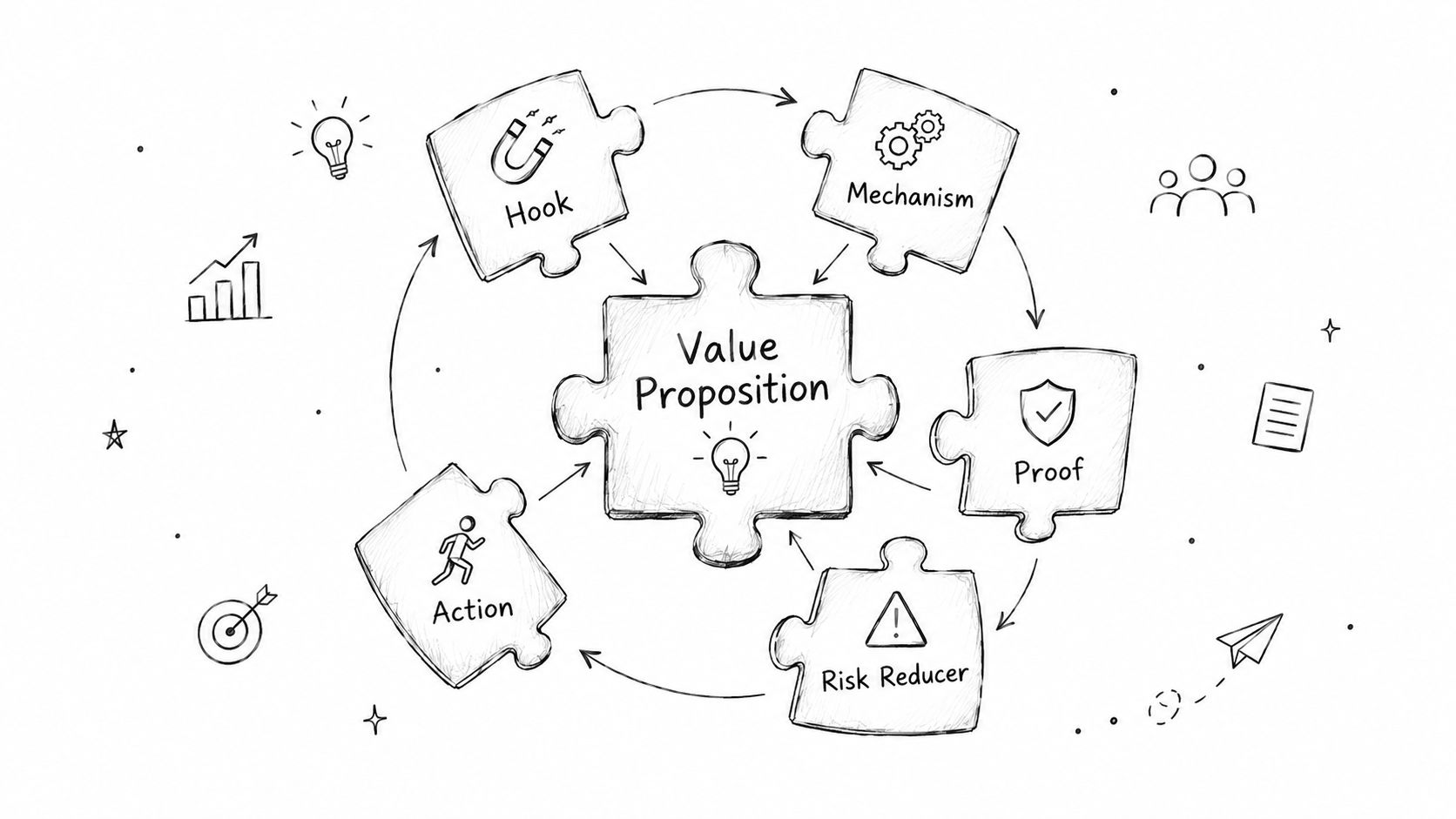
A demand gen manager sees two ads in the same account. One opens with a sharp line and gets clicks, but the buyer still cannot tell what the product changes. The other explains the mechanism clearly, yet gives no reason to stop scrolling. The hook earns relevance. The value proposition supplies the reason the offer matters.
Build the message from separable parts
For the illustrative approval-management product, three usable openings could sit in the same ad family: a trigger-led line such as “Another campaign launch, another approval thread”; an outcome-led line such as “Make campaign approval ownership visible”; or a mechanism-led line such as “Route campaign reviews by role and approval stage.” Each opening gives a different reason to investigate the same offer. None needs an empty superlative, and none claims an outcome the business hasn't substantiated.
The value proposition connects that opening to a useful result: "Bring campaign review steps into a shared approval workflow." The mechanism then makes the promise inspectable through assigned reviewers, visible status, and recorded decisions, provided the product supports those functions.
Proof stays in its own slot. An approved customer quotation, documented product capability, or inspectable demonstration can support the message. If customer results are not available, a product walkthrough is more defensible than an invented success story. A messaging framework template can keep those assets in reusable fields instead of burying them inside finished ads.
Keep the argument fixed while the surface changes
A risk reducer should answer a real concern without turning into a guarantee. “Preview the approval workflow before requesting a demo” works only when that preview exists, and the action should name the experience plainly.
A modular ad family needs a stable argument, not identical wording across every surface.
Feed can carry the fuller argument in primary text. Stories or Reels may need the opening compressed into spoken or on-screen copy. Carousel cards can spread the mechanism and evidence across frames so no single card has to repeat the whole pitch.
The following video offers an additional reference alongside the written framework.
Creative variety is worth testing, though the reporting needs careful reading. An analysis of more than 1.1 million creative variations reported up to a 32% improvement in CPA and a 9% increase in incremental reach for campaigns using diverse creative formats and messaging types, according to Social Media Today's coverage of Meta's creative guidance.
Those findings support testing a related portfolio of messages. They do not prove that changing a hook alone caused the reported gains. Keep the audience tension and offer stable while the selected module changes.
Assemble Every Facebook Ad Format
A coherent ad gives each field a distinct job. Repeating the same claim in the opening, headline, description, and CTA wastes space that could resolve an objection or explain the offer.
For Facebook Feed, documented recommendations include approximately 50–150 characters for primary text and 27 characters for headlines. These are recommendations, not universal hard limits, as explained in Metadata's Facebook ad text specification guidance.
Facebook Ad Copy Fields
| Field | Primary Job | Writing Focus | B2B SaaS Example |
|---|---|---|---|
| Hook or opening line | Establish relevance | Name the situation immediately | Another launch, another approval thread. |
| Primary text | Develop the argument | Connect problem, outcome, mechanism, and available proof | See how assigned reviewers and approval stages work together in a shared campaign workflow. |
| Headline | Compress the central idea | Make sense independently | Clear campaign approvals |
| Description | Add supporting context | Clarify the destination or experience | Product walkthrough |
| Call to action | Specify the next step | Match the button and destination | Watch the walkthrough |
The opening is part of primary text, not an additional Ads Manager field. Treating it separately during drafting helps the writer check whether the first line establishes relevance without depending on the rest.
Complete ads for the same offer
The following illustrative variants assume the product supports the stated capabilities and the destination contains a walkthrough.
Problem-led ad
Primary text: “Another campaign launch, another approval thread. Bring reviewers, feedback, and approval stages into a shared workflow. Explore how campaign reviews move from draft to sign-off.”
Headline: “Clear campaign approvals”
Description: “Explore the workflow”
CTA: “Watch the walkthrough”
Outcome-led ad
Primary text: “Make campaign approval ownership visible. Explore assigned reviewers and shared status views before evaluating whether the workflow fits the team.”
Headline: “See approval ownership”
Description: “A practical product tour”
CTA: “Explore the workflow”
Concise retargeting ad
Primary text: “Compare review stages, ownership, and sign-off requirements in the campaign approval walkthrough.”
Headline: “Evaluate the workflow”
Description: “Inspect the review process”
CTA: “View the walkthrough”
Shorter isn't automatically more efficient. In a controlled copy-length test summarized by Cropink's Facebook ad copy examples, the paragraph version produced 32 leads at $4.83 per lead, while the weakest single-sentence version produced 12 leads at $11.74 per lead. The result supports testing how much explanation the offer needs, not declaring a universal ideal length.
Before publication, the reviewer should check for repetitive fields, unclear next steps, unsupported claims, and mismatches with the destination. Placement preparation is a separate task: RenderIO's RenderIO Reels resizing tool is an option for adapting an asset's dimensions, but resizing doesn't replace a placement-specific copy review.
Pair Copy With the Right Creative
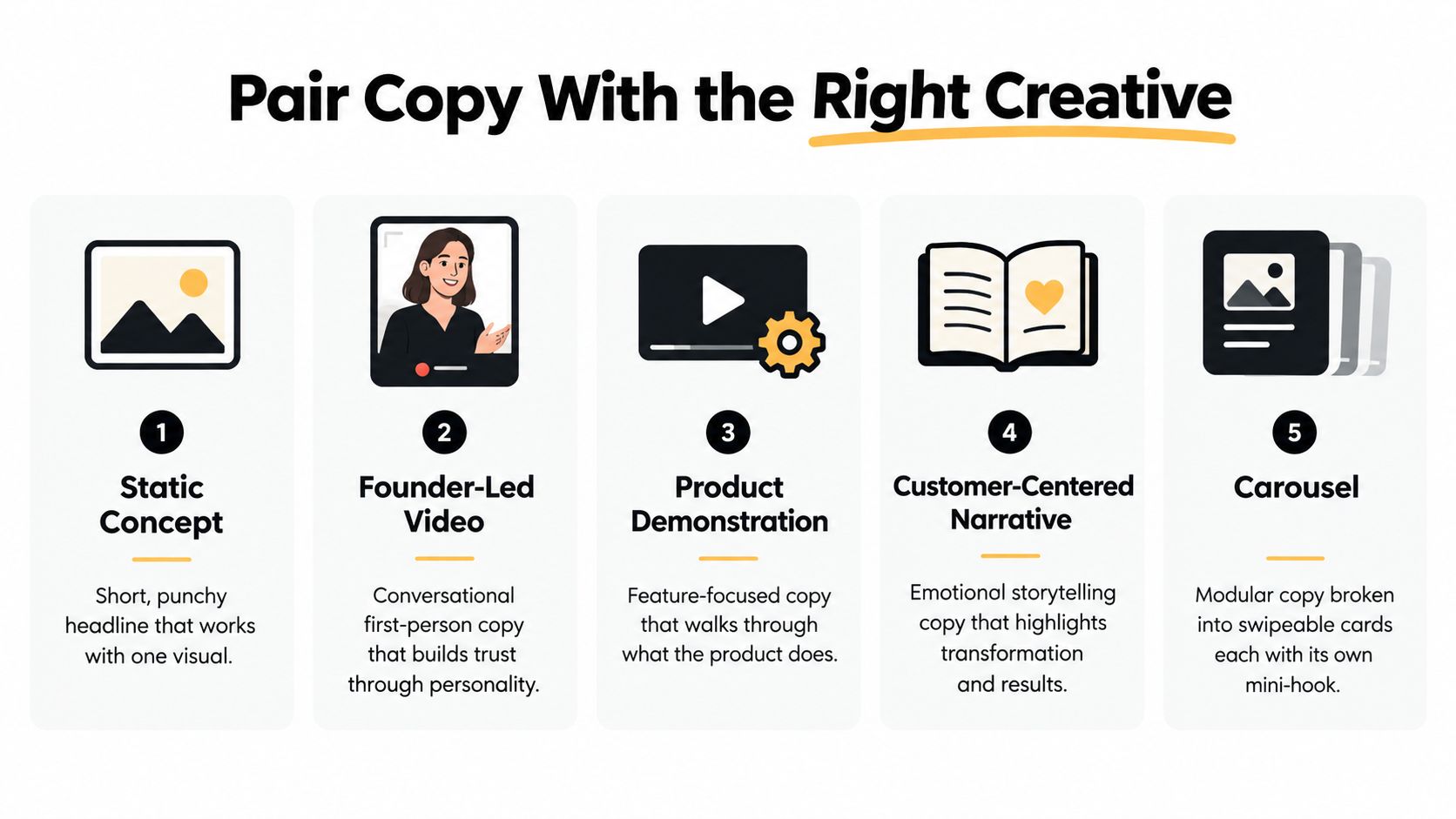
A static screenshot and a founder-led video shouldn't carry identical scripts. The underlying offer can stay consistent while the writer changes how the buyer encounters the problem, mechanism, and evidence.
The useful question is what the visual can demonstrate, and what still needs to be explained in words.
Choose the treatment that makes the argument inspectable
Static concept. A simple approval-status visual can pair with “Clear campaign approvals.” The primary text should explain the workflow rather than repeat the text inside the image. A detailed interface screenshot needs a clear focal point, not an added paragraph of promotional overlay.
Founder-led video. A founder can explain why the team built the workflow and demonstrate the problem it addresses. The script should remain conversational, but personality isn't evidence of product effectiveness. Product claims still need support.
Product demonstration. Copy should name the action visible on screen: assign a reviewer, inspect a review stage, or locate a decision. This treatment suits an evaluator who needs to understand how the product works rather than hear another broad benefit statement.
Give narrative and sequence different jobs
A customer-centered narrative should use an approved account, quotation, or documented experience. Without permission and supporting evidence, a hypothetical workflow can illustrate the problem, but it must not be presented as a customer success story.
A carousel can distribute the argument across cards: recognizable tension, product mechanism, available evidence, and evaluation step. Each card needs a clear purpose, while the sequence should remain understandable without an elaborate setup.
- Sound-off clarity: Captions and readable labels should preserve essential meaning without depending on narration.
- Evidence placement: On-screen proof should appear beside the claim it supports, with qualifications kept legible.
- Brand consistency: Product terminology, visual identity, and approved claims should stay stable while presentation varies.
Format variation should change the delivery of the argument, not quietly change the promise.
AI-generated imagery also needs separate interpretation from copy performance. Coverage reported 11% higher CTR and 7.6% higher conversion rates for campaigns using AI-generated imagery, but those figures do not isolate the effect of AI-written language, as discussed in House of Marketers' analysis of Meta's AI creative approaches.
A team evaluating persuasion should therefore label the treatment accurately. A new image, script, and audience combination is a creative-package test, not a clean copy test.
Review Compliance Before Launch
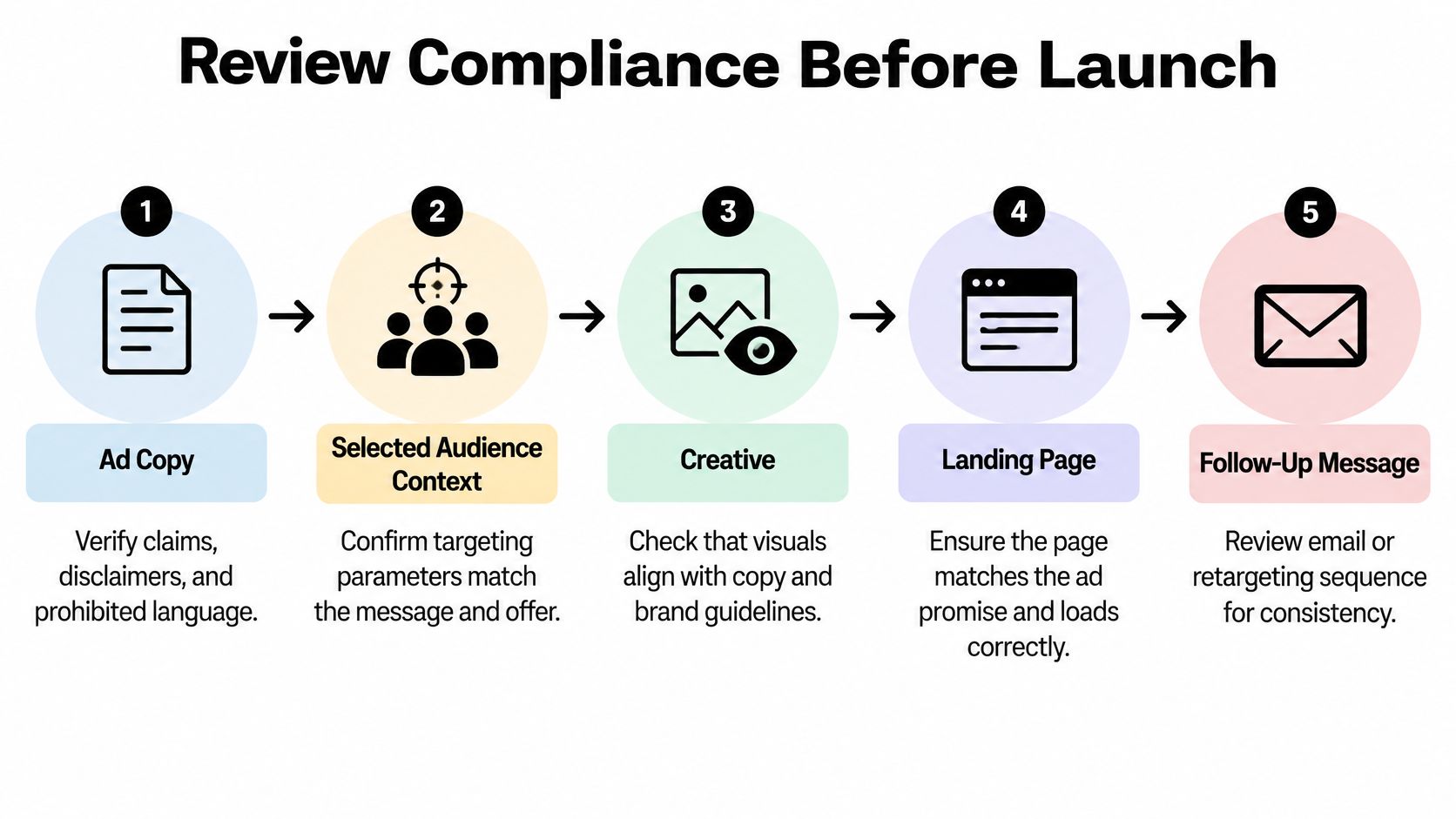
A campaign can look clean in Ads Manager and still fail because the landing page carries a stronger promise than the ad. Meta reviews the connected package, including images, text, selected audience, destination, downloadable app, and post-click messages for click-to-message campaigns, according to Meta's advertising review guidance. Treat review as a pass over the whole path, not a scan for banned words.
Check the promise end to end
Start from the claim a buyer would repeat back after clicking. If the ad says “reduce churn” and the page implies “guaranteed retention,” the mismatch is the problem. Use a documented marketing compliance checklist and archive the approved version so later edits do not drift.
| Review surface | What the reviewer compares | Common failure |
|---|---|---|
| Claims and guarantees | Ad promise, proof, qualifiers, landing-page wording | A cautious ad leads to a stronger page claim |
| Personal attributes | Copy implying the viewer's traits, status, or condition | “Struggling founders like you” framed as a fact |
| Audience and offer | Targeting, message, incentive, exclusions | A niche offer reads as discriminatory in context |
| Destination continuity | Ad CTA, page terms, next step, message follow-up | Price, trial, or condition changes after the click |
| Market version | Language, currency, legal claims, acceptable evidence | Literal translation turns a safe claim into a risky one |
Meta's Community Standards requirements for advertising set the floor above a prohibited-word list. Meaning, imagery, audience context, and the post-click experience all count.
Brand references need separate care. Meta's brand usage policy allows limited Facebook or Instagram references when clarifying destination, but it does not allow Meta's brands to become the most distinctive element, modified assets, or implied endorsement.
Sort policy risk from delivery cost
The old 20% image-text rule is no longer enforced as a hard requirement, though heavy image text can still hurt delivery and raise costs, according to Metadata's guidance on ad text limitations. Dense creative may deserve simplification on performance grounds. A spare layout can still carry a misleading claim.
If an ad is rejected, find the exact claim or experience that triggered it, fix the same issue everywhere it appears, then resubmit or request another review when the decision looks wrong. Swapping a synonym while keeping the same promise usually wastes a review cycle.
Test Copy and Improve the Campaign
A useful test begins with a written hypothesis: a trigger-led opening will generate more qualified interest than a feature-led opening among the selected audience. The team then creates 3–4 variants, testing the hook, value proposition, proof, and CTA in sequence while holding the audience, offer, placement, budget, landing page, and conversion event constant, following Stackmatix's Meta creative testing framework.
That framework recommends at least seven days and 500 impressions per creative for an initial read, with approximately 50 conversions per variant when assessing a roughly 20% difference at 95% confidence. Those conditions are planning guidance, not a guarantee that every test will produce a decisive result.
Record the business result
CTR and CPC help diagnose attention. Qualified-lead cost, CPA, purchase conversion rate, or ROAS should determine the business winner, depending on the campaign objective. A documented approach to measuring campaign success helps prevent click-focused reporting from replacing commercial evaluation.
The test log should contain the hypothesis, exact variation, audience, spend, dates, conversion count, downstream quality, result, and interpretation. Copy, targeting, bidding, and budget should remain unchanged during the test.
Reusable templates and launch controls
- Pain-led template: “[Recognizable workflow problem]. Explore how [verified mechanism] supports [relevant outcome]. [Specific next step].”
- Proof-led template: “[Approved evidence]. Inspect how [mechanism] supports that result and whether the approach fits [use case]. [Specific next step].”
- Retargeting template: “Evaluate [specific capability] against [remaining objection]. [Specific next step].”
The final launch check should confirm approved evidence, correct destinations, placement previews, conversion tracking, and a saved baseline. After evaluation, the team should preserve validated angles, document failed assumptions, and distinguish inconclusive tests from genuine losses.
The repeatable advantage isn't endless variation. It's an evidence base that makes each subsequent campaign brief more precise.
The AI CMO combines marketing planning, creative production, customer context, and performance reporting in a shared operating environment. Growth teams can visit The AI CMO to explore how campaign briefs, approved ad variants, and measured outcomes can support a connected Facebook advertising workflow.
Share this article