Customer Segment Analysis: A Practical Guide for Marketers

The AI CMO team
Oct 5, 2026
A growth team can have dashboards for conversion, revenue, engagement, paid media, and retention, yet still send the same message to every customer. The email calendar fills up, landing pages multiply, and campaign reports look busy. Meanwhile, conversion stalls, acquisition costs become harder to justify, and customers drift from active to disengaged between quarterly reviews.
The problem usually isn't a shortage of data or channels. It's the absence of customer segment analysis that connects customer differences to a decision, a trigger, and an accountable owner. A marketing team that can't identify the cohorts driving revenue, creating support demand, or showing churn risk will optimize averages while missing the people who need a different experience.
Table of Contents
- Why Your Marketing Feels Generic Right Now
- What Customer Segment Analysis Actually Means
- The Main Methods Marketers Use to Find Segments
- A Six-Step Workflow That Produces Actionable Segments
- Three Real-World Examples That Show Segments at Work
- The Mistakes That Make Segments Useless
- Turning Segments Into Journeys, Scores, and Triggers
- Your First 30 Days and Questions to Keep in Mind
Why Your Marketing Feels Generic Right Now
A typical campaign meeting starts with an aggregate report. The team sees an overall conversion rate, an average order value, a blended cost per acquisition, and a single retention curve. Those figures can describe what happened across the customer base, but they don't explain which customers created the result or which customers need a different next step.
One group may be buying frequently but responding poorly to discounts. Another may have purchased once, browsed repeatedly, and shown signs of product interest. A third may generate substantial revenue while creating expensive support or fulfilment work. When all three groups receive the same offer, the campaign can look acceptable in aggregate while wasting margin and attention.
Practical rule: A segment earns its place when it changes an allocation, message, journey, or service decision.
Generic marketing is often a symptom of an unresolved operating question. The team may need to decide whether paid spend should move toward higher-value prospects, whether a retention budget should focus on customers at risk, or whether a sales team should receive a product-qualified account signal. Without a structured customer segment analysis, those decisions default to channel averages and internal opinions.
Useful analysis starts by identifying groups that are measurable, substantial, stable, accessible, compatible, and actionable, rather than groups that merely look interesting in a chart. Research on successful customer segmentation criteria makes the same practical distinction: statistical neatness isn't enough if a segment is too small, difficult to reach, unstable, or disconnected from a business action.
The shift is from describing customers to operating differently for them. Once a segment has a clear entry condition, an intended treatment, and a success measure, it can move from a presentation into a marketing stack.
What Customer Segment Analysis Actually Means
Customer segment analysis divides a customer base into distinct groups that share relevant characteristics, then links each group to a measurable marketing or commercial action. The characteristics might include demographics, firmographics, purchase behavior, product usage, lifecycle stage, attitudes, geography, or predicted value. The important test is whether the grouping supports a different decision, such as retention, conversion, personalization, or cost control, as explained in this definition of actionable customer segmentation.
A persona document isn't automatically a segment analysis. Neither is a one-off cohort report. A useful analysis has three properties:
- Defined data source: The team can identify which CRM, transaction, product, survey, support, or engagement records feed the analysis.
- Reproducible method: Another analyst can apply the same rules, scoring logic, or model and reach a comparable classification.
- Executable output: The result becomes a campaign audience, lifecycle state, lead score, churn flag, pricing input, or service rule.
The discipline has deep roots. Historical accounts trace segmentation as a formal marketing concept to Wendell R. Smith's 1956 article, while earlier practical work by George B. Waldron between 1902 and 1910 used tax registers, city directories, and census data to estimate consumer education and income profiles for advertisers. Psychographic and geodemographic approaches expanded in the 1970s and 1980s as computerised data systems improved, according to this history of customer segmentation.
The underlying logic has remained consistent: group similar customers, understand the commercial potential of each group, and choose a more relevant action. Modern systems add RFM scoring, machine learning, predictive models, and near-real-time data, but technology doesn't replace judgment.
Teams building a stronger foundation can also use these data driven audience segmentation tips to improve data selection and activation. The bridge from data to action matters more than the sophistication of the method.
The Main Methods Marketers Use to Find Segments
No segmentation method is universally superior. The right choice depends on the business question, the quality of available data, and the action the marketing team can execute.
Demographic and firmographic segmentation is usually the quickest starting point. Age, income, education, occupation, company size, industry, and geography are easy to explain to sales and creative teams. Demographic customer segmentation was estimated to represent 22.3% of the global customer segmentation market in 2025, according to market segmentation data from DataIntelo. That role reflects its continuing usefulness, but demographic labels often explain who a customer is better than what the customer is likely to do next.
Behavioral segmentation groups customers by product usage, purchase behavior, channel engagement, content interaction, or lifecycle position. It supports journey logic because the inputs are close to the action. A B2B team might separate accounts that have adopted advanced features from accounts that only use basic functionality. A retail team might distinguish first-time purchasers, repeat buyers, discount-led shoppers, and dormant customers.
RFM analysis scores customers by Recency, Frequency, and Monetary value. It's simple, transparent, and particularly useful when a retention team needs a defensible way to prioritize customers. Lifecycle segmentation can then place people into stages such as acquisition, activation, engagement, retention, and reactivation, with lifecycle marketing guidance from Omnisend showing how these stages can shape welcome and winback programs.
Unsupervised clustering uses methods such as k-means or hierarchical clustering to expose patterns that a team didn't define in advance. It can reveal combinations of behavior, value, and engagement that manual rules miss. The trade-off is heavier data preparation, more interpretation, and a greater risk of creating groups that cannot be named or reached clearly.
Persona segmentation translates validated groups into human-readable stories. It helps copywriters, salespeople, and product marketers understand needs and objections, but a persona must remain tethered to observed behavior. A memorable label can improve creative alignment while still concealing weak data if the underlying definition isn't maintained.
Predictive segmentation uses models for churn, conversion propensity, expansion likelihood, or lifetime value. It directs attention toward future outcomes instead of only describing past activity. Predictive scores can be powerful, but they need validation, monitoring, and governance. A score that nobody understands or trusts won't produce better decisions.
| Method | Best For | Main Strength | Main Weakness |
|---|---|---|---|
| Demographic or firmographic | Broad targeting and sales planning | Fast and intuitive | Often too shallow for retention |
| Behavioral | Journey design and product-led campaigns | Closely tied to observed action | Requires reliable event data |
| RFM | Retention and customer value prioritization | Explainable and easy to operationalize | Can miss attitudes and intent |
| Clustering | Discovering hidden customer groups | Finds patterns beyond manual rules | Needs analytical capacity and interpretation |
| Persona | Creative and sales alignment | Makes segment needs easier to communicate | Can drift away from evidence |
| Predictive | Churn, propensity, and value allocation | Focuses spend on likely outcomes | Requires validation and ongoing monitoring |
Channel context can matter too. For teams planning community distribution, when to post on Reddit can complement audience analysis, but timing shouldn't substitute for understanding which audience is likely to value the message. A deeper treatment of intent, usage, and conversion signals is available in this guide to customer behavior analysis.
A Six-Step Workflow That Produces Actionable Segments
A defensible workflow begins with a decision, not a clustering algorithm. The process below keeps analysis tied to operating efficiency.
1. Lock the business decision
Define what the segments must change. The decision might involve reallocating paid spend, redesigning lifecycle messaging, prioritizing expansion accounts, or changing retention investment. If the team can't state the decision in one sentence, the analysis is still too broad.
Checkpoint: Can the commercial owner name the action that follows? If not, revise the question.
2. Assemble and reconcile first-party data
Bring together transactions, engagement, product usage, support interactions, consent status, and identity records. Resolve duplicate profiles and document missing fields before modelling. A unified customer intelligence approach helps analysts work from the same customer history rather than separate channel exports.
Checkpoint: Can the team explain which records belong to the same customer or account? If not, fix identity resolution first.
3. Choose variables that can move the outcome
Select inputs that relate to the decision. Recency and purchase frequency may matter for retention. Feature adoption and seat growth may matter for B2B expansion. Cost-to-serve may matter when a high-revenue group also creates substantial operational work. Vanity attributes that won't affect the treatment should stay out.
Checkpoint: Does every variable have a reason to exist? Remove inputs that only make the model look richer.
4. Build and stress-test the segments
Apply the chosen method, whether that means RFM rules, k-means, latent class analysis, persona synthesis, or a predictive model. Compare alternatives where the decision warrants it, then test whether the classifications remain coherent when the data changes.
Checkpoint: Are the groups distinct on action-driving variables, not just mathematically separated? If not, simplify or rebuild them.
5. Profile the commercial reality
Describe each segment using size, revenue contribution, churn risk, margin implications, and cost-to-serve. Give groups plain-language names that a sales, CX, or growth lead can recognize. A label such as “high-value dormant” is more useful operationally than an unexplained cluster identifier.
Checkpoint: Can a stakeholder state who belongs, what they need, and what the business will do? If not, the segment isn't ready.
6. Validate, deploy, and refresh
Test the classification on a fresh sample or holdout before embedding it into CRM, advertising, or journey systems. Set the refresh cadence according to behavior change, then define the channel, owner, trigger, suppression rules, and KPI before handoff.
Checkpoint: Is there a named owner and a measurement plan? If the answer is no, the segment belongs in revision, not production.
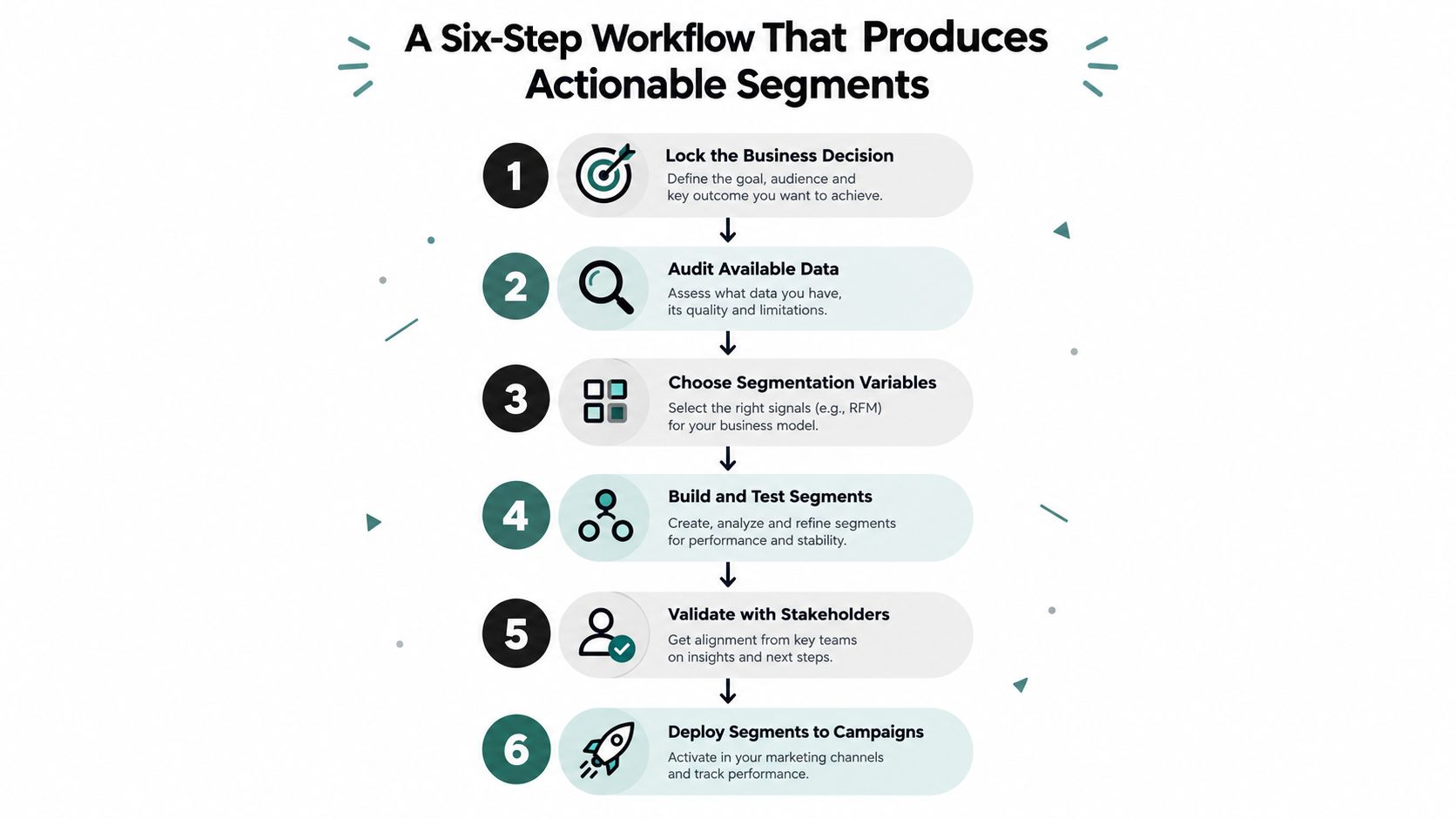
The technical workflow matters because segment quality depends on more than statistical fit. The practical methodology for customer segmentation emphasizes business decisions, purpose-built data, method comparison, and validation before operational deployment.
Three Real-World Examples That Show Segments at Work
The most useful examples are not persona slides. They show a trigger, a decision, and a different treatment. The following scenarios represent common operating patterns for DTC, SaaS, and retail teams. They are illustrative rather than reported case studies, so the outcomes are expressed qualitatively.
A DTC skincare brand
A mid-market skincare brand sees three different patterns inside its customer file: subscription-ready loyalists, high-AOV gifters, and lapsed bargain hunters. Treating them as one audience would produce conflicting offers. The loyalists need replenishment and subscription education, gifters need occasion-led merchandising, and lapsed bargain hunters need a relevant reason to return without training the whole base to wait for discounts.
The activation move is to route each group into a different paid and lifecycle treatment. The marketing team can shift budget toward the gifter audience during a seasonal period, while using replenishment signals for loyalists and controlled winback messaging for lapsed customers.
A B2B SaaS company
A SaaS business notices that some self-serve users are adopting advanced features without requesting sales contact. Behavioral clustering separates those users from accounts with shallow usage. The growth team then sends the advanced adopters into a sales-assisted nurture path built around business outcomes, implementation support, and expansion readiness.
The trigger is feature adoption, not company size alone. That distinction helps sales focus on accounts displaying product value rather than pursuing every account that matches a firmographic profile.
A regional grocery chain
A grocery chain layers RFM with cost-to-serve and identifies a group that purchases frequently but has weak margin after fulfilment and service costs. Rather than treating frequency as an automatic sign of value, the team limits expensive catalogue activity for that group and redirects retention attention toward lapsed customers with stronger long-term economics.
The lesson is direct: revenue contribution and operating cost belong in the same segment profile. This is the point where analysis becomes operational.
| Example | Method Used | Activation Move | KPI Impact |
|---|---|---|---|
| DTC skincare | Behavioral, value, and lifecycle grouping | Separate subscription, gifting, and winback treatments | Revenue per buyer and paid efficiency |
| B2B SaaS | Behavioral clustering | Sales-assisted nurture for advanced adopters | Expansion conversion |
| Regional grocery | RFM combined with cost-to-serve | Reduce costly contact for low-margin customers and prioritize valuable lapsed shoppers | Retention and contribution margin |
The Mistakes That Make Segments Useless
Most segmentation failures happen after the analysis. The model may be technically sound, but the campaign team can't use it, the data isn't refreshed, or finance discovers that the most valuable-looking audience is expensive to serve.
Over-segmentation is the most visible problem. A team can produce 18 micro-segments that sound precise but create too many audiences, messages, approvals, and reporting requirements. The practical fix isn't to preserve every distinction. It's to combine groups until each remaining segment has enough economic importance and a clearly different treatment.
Stopping at the slide creates a different failure. A segment without an owner, channel, trigger, suppression rule, or measurement plan is a description, not an operating asset. Every approved segment should have a short activation contract that states who manages it, what happens when someone enters, what removes them, and which result determines continuation.
Ignoring cost-to-serve makes revenue look like value. Returns, support volume, fulfilment effort, sales involvement, and discount dependency can change the economics of a group. Segment profiles should pair revenue and retention with the costs required to produce them.
A high-revenue segment isn't automatically a high-value segment. Margin and service effort can change the decision.
Treating segments as static causes the message to lag behind the customer. A person who was recently active may become dormant, while a low-engagement account may suddenly adopt a critical feature. Refresh rules should match the speed of the behavior and the risk of acting on stale membership.
Finally, demographic labels can obscure current intent. Demographics and firmographics have a place in planning, but recent behavior should carry more weight when the campaign depends on what customers are likely to do next.
Turning Segments Into Journeys, Scores, and Triggers
A finished segment becomes useful when the marketing operating system can do something with it without requiring an analyst to export a file each time. The handoff should convert classification into rules that a journey builder, CRM, ad platform, or sales workflow can execute and measure.
Start with the lifecycle journey. Each segment needs an entry rule, an exit rule, and a re-entry rule. A high-value dormant customer might enter a winback journey when recent activity falls below the defined threshold, exit after a purchase or meaningful action, and re-enter only after a new period of inactivity. Without these rules, customers can receive conflicting messages or remain trapped in a journey after their circumstances change.
Next, convert membership into scores where the business needs prioritization. A lead score can combine fit and engagement. A churn score can rank expected loss. A value group can influence promotion eligibility, service routing, or sales attention. The score shouldn't replace judgment, but it can make attention more consistent.
Behavioral triggers provide the final connection. A feature adoption event can start expansion education. A failed payment can start a recovery path. A meaningful drop in usage can notify a customer success owner. Each automation needs thresholds, consent handling, exclusions, monitoring, and a human owner who can pause or revise it.
The AI CMO offers a connected execution layer with a built-in customer data platform, RFM and lifecycle segments, predictive scoring, behavior-triggered journeys, holdout groups, and cross-channel sending. Its operating model is designed to keep customer records, activation, approvals, and measurement connected rather than distributing them across disconnected tools.
A unified record is especially important for teams that want consistent decisions across acquisition and retention. A single customer view gives marketers a stronger basis for deciding whether a customer should receive acquisition messaging, retention support, expansion outreach, or suppression.
The operating test is simple. If segment membership changes the next message, budget allocation, service level, or sales action, it has entered the revenue system. If it remains a file in a shared drive, the analysis is unfinished.
Your First 30 Days and Questions to Keep in Mind
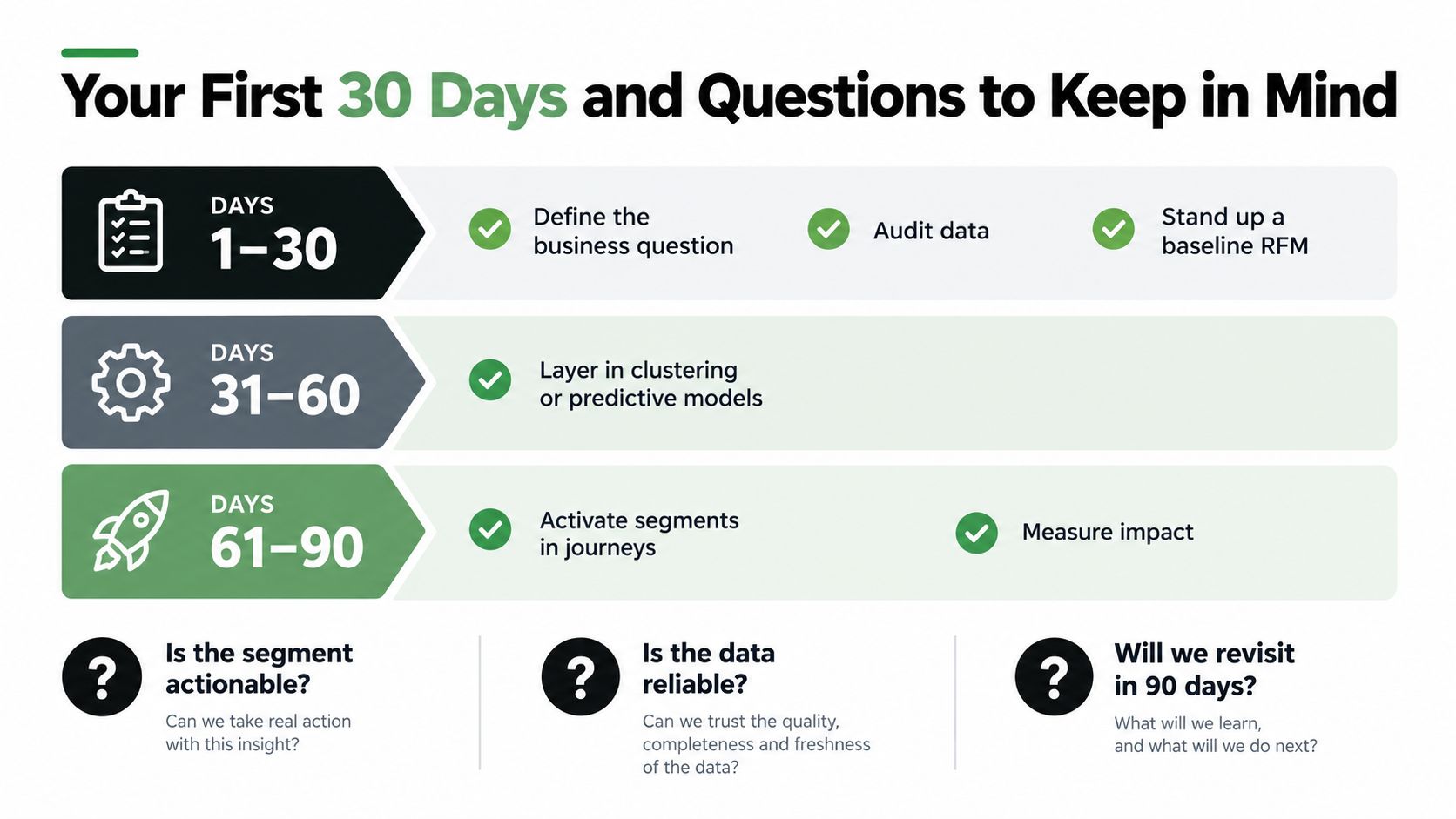
A practical rollout can begin with a focused 30-60-90 plan.
- Days 1-30: Define the commercial question, audit identity and event data, and establish a baseline RFM view for the relevant customer population.
- Days 31-60: Add behavioral clustering or predictive segments where the baseline leaves important questions unanswered, then test different messages or treatments by group.
- Days 61-90: Retire segments that don't change decisions, lock the automation rules, and measure revenue, retention, margin, and cost-to-serve.
How often should segments refresh? Refresh them as often as behavior changes and as often as the channel can respond. Fast-moving product or engagement signals need more frequent updates than stable firmographic fields.
How much data is enough? There isn't a universal minimum that makes a segment valid. The group must be large enough to support the intended action, measurable in the available systems, and stable enough for a fair comparison.
Should B2B and B2C teams segment differently? The principles are shared, but B2B analysis usually needs account, buying committee, product adoption, and sales-stage signals. B2C teams often rely more heavily on individual transactions, engagement, lifecycle, and RFM.
How can leadership see the return? Tie each segment to a treatment and compare its outcome with a credible baseline or holdout. Report the financial result alongside retention and cost-to-serve, not as a standalone engagement metric.
The AI CMO connects first-party customer data, RFM and lifecycle segments, predictive scores, behavior-triggered journeys, and measurement in one marketing operating system. Marketers ready to turn customer segment analysis into accountable campaigns can visit The AI CMO and explore how the platform supports approved automation across acquisition and retention.
Share this article