
Retention starts before the cancellation page. A widely cited finding in retention research says that increasing customer retention by 5% can raise profits by 25% to 95%, while acquiring a new customer can cost 5 to 25 times more than keeping an existing one, as summarized by retention research statistics from Worldmetrics. Those economics make retention more than a customer support responsibility. It's a coordinated marketing and martech operation.
For B2B SaaS teams, the practical question isn't whether customers are leaving. It's whether the business can recognize declining value early enough to respond with something more useful than a discount. Product behavior, lifecycle stage, support history, customer education, commercial value, consent, and campaign exposure all need to inform the same decision.
The strongest customer retention strategies operate as a closed loop. First, the team builds a trustworthy customer view from first-party data. Next, it detects risk and ranks accounts by likely value at stake. Then it intervenes through relevant journeys, proactive support, educational content, flexible plans, or carefully chosen incentives. Finally, it tests the intervention against a holdout so the team can distinguish caused revenue from revenue that would have happened anyway.
That approach also solves a common operational failure. Retention messages often continue after a customer has acted, creating fatigue across email, SMS, push, and onsite channels. Crescade's practical retention playbook is useful background, but SaaS operators need a system that connects strategy to event-level execution. The following ten customer retention strategies provide that operating sequence.
Table of Contents
- 1. Behavioral Segmentation and Predictive Churn Modeling
- 2. AI-Driven Personalized Email and Multi-Channel Journeys
- 3. Customer Success Automation and Proactive Support Integration
- 4. AI-Powered Content Marketing and Educational Retention
- 5. Loyalty Programs and Reward Engine Optimization
- 6. Win-Back and Re-engagement Campaigns with Dynamic Offers
- 7. First-Party Data Collection and Identity Resolution
- 8. Community Building and User-Generated Content Amplification
- 9. Subscription Pause and Flexible Plan Options
- 10. Measurement, Holdouts, and Incrementality Testing
- 10-Point Customer Retention Strategy Comparison
- Turn Retention Into a Compounding Growth Loop
1. Behavioral Segmentation and Predictive Churn Modeling
A churn model is only useful when it changes what the team does. A risk score sitting inside an analytics dashboard won't retain an account. A risk score that immediately changes the customer's journey, support priority, and success plan can.
SaaS teams should combine behavioral signals with commercial and service data. Login frequency, feature adoption, workflow completion, seat utilization, failed payments, renewal timing, support tickets, sentiment, and recent stakeholder activity can reveal different kinds of risk. A customer who logs in less often may need an adoption intervention. A customer opening several urgent tickets may need executive attention. A customer with strong usage but declining seats may need a value or budget conversation.
A practical workflow looks like this:
- Define the outcome: Use cancellation, downgrade, non-renewal, or prolonged inactivity as the target event.
- Create meaningful signals: Document which product and support behaviors preceded that outcome in the company's own history.
- Rank expected loss: Combine churn probability with account value so the team doesn't spend high-touch resources on every alert.
- Trigger a response: Send education, create a success task, surface in-app help, or route the account to a human.
- Measure causation: Keep a comparable holdout group out of the intervention.
The predictive analytics approach to marketing can help connect model outputs to executable segments. The AI CMO, for example, can use refreshed lifecycle and risk segments to support automated journeys while leaving the team in control of approval thresholds.
Practical rule: A signal belongs in a churn model only when someone can explain the intervention it will trigger.
A useful real-world scenario is a project-management SaaS product that detects fewer completed workflows, rising support activity, and an approaching renewal. The system can recommend a role-specific training path, alert customer success, and suppress unrelated promotional messages until the account returns to a healthy usage pattern.
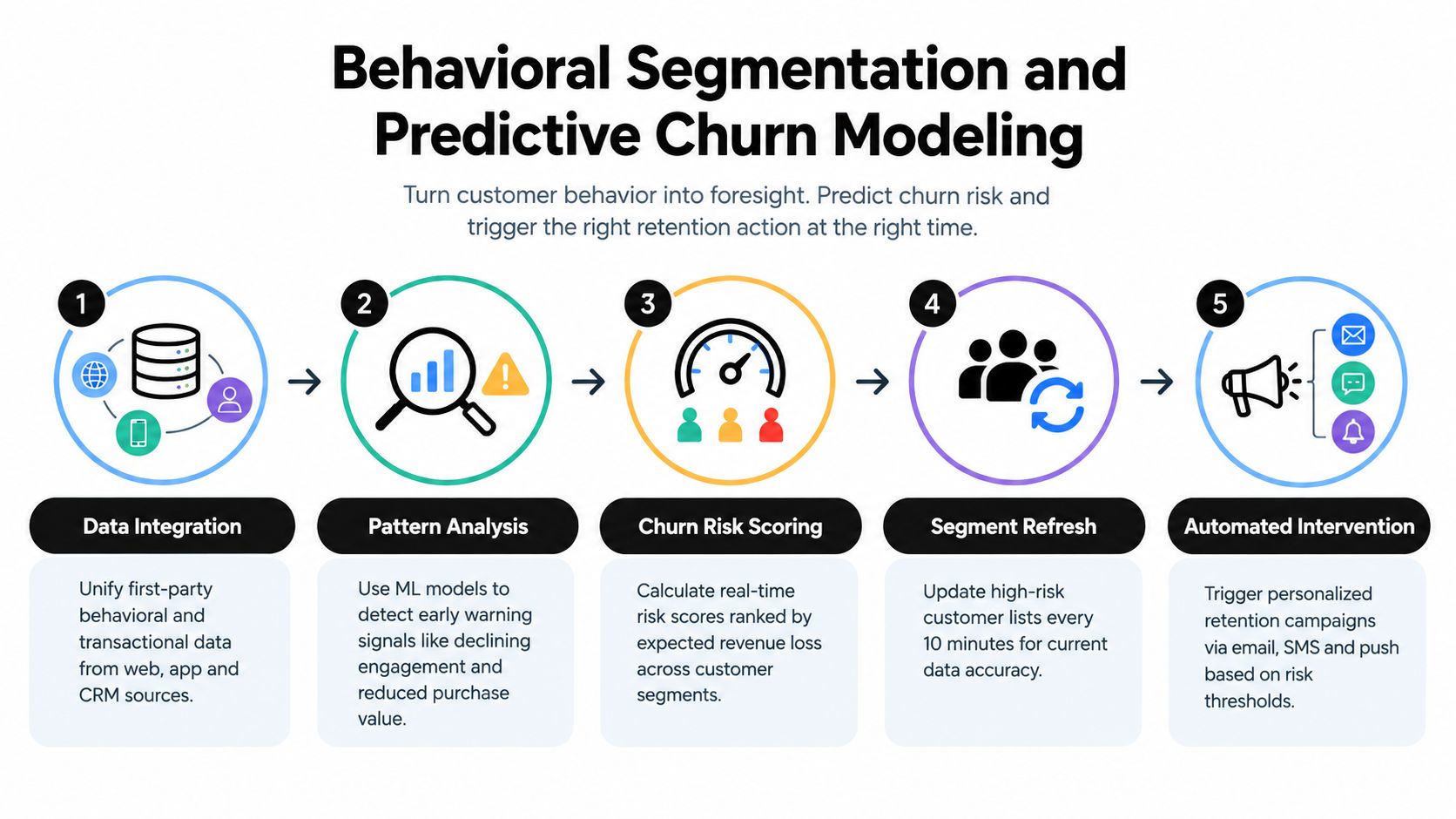
The team should refresh segments whenever meaningful behavior changes, rather than relying on a monthly export. It should also review false positives, false negatives, and intervention outcomes regularly. Generic churn benchmarks can provide context, but the company's own customer behavior remains the more useful source of truth.
2. AI-Driven Personalized Email and Multi-Channel Journeys
Personalization fails when it means inserting a company name into a generic email. Retention personalization should change the message, timing, offer, channel, and next action based on the customer's observed behavior.
A SaaS lifecycle team can begin with a small number of high-intent events: signup, first value achieved, feature adoption, usage decline, renewal proximity, support escalation, and cancellation intent. Each event should map to a journey with a clear objective. A new workspace might receive setup guidance. An account with declining usage might receive a workflow example specific to its role. A high-value account showing risk might receive coordinated outreach from marketing and customer success, not a sequence of disconnected offers.
The AI approach to email marketing can support content variation and channel coordination. Human approval remains important for claims, pricing, sensitive account context, and messages that could affect a commercial relationship.
Build suppression into every journey
A customer who completes the desired action should leave the journey immediately. If a user activates the feature, the activation reminders should stop. If an account books a success call, the booking prompts should stop. If support opens an incident, promotional messages should pause until the issue is resolved.
The operating rules should include:
- One customer state: Store journey status centrally so channels share the same truth.
- One next action: Don't ask the customer to complete several competing tasks.
- Channel preference: Use the customer's consent and observed preference rather than defaulting to every available channel.
- Revenue control: Test the journey against an untreated group.
- Fatigue monitoring: Watch unsubscribes, STOP replies, complaints, and declining engagement by journey.
A retailer might use email for a product education sequence and SMS only for a time-sensitive service update. A SaaS business could use in-app guidance for product adoption and reserve email for stakeholder-level value communication. The right mix depends on consent, urgency, and customer preference.
The email subject line capitalization guide can help teams maintain consistent editorial quality, but subject-line polish can't rescue an irrelevant journey. Relevance and suppression matter more than clever copy.
3. Customer Success Automation and Proactive Support Integration
Customer success automation should detect friction early and route the right response before dissatisfaction becomes a cancellation risk. Product telemetry identifies unusual behavior, while support context explains what the customer needs to achieve a useful outcome.
Start with a closed-loop workflow. Feed product events, account attributes, support history, satisfaction feedback, and renewal context into the customer record. The AI CMO can monitor these signals, classify accounts by risk, recommend an intervention, and prepare a customer-specific brief. Marketing automation can deliver approved guidance, while customer success owns decisions involving context, empathy, or commercial judgment.
An AI assistant can answer approved product questions, surface contextual help, summarize conversations, and identify repeated friction. It should not make contractual commitments, advise on security matters, handle sensitive account issues without authorization, or improvise beyond its approved knowledge. Give customers a clear route to a trained human when the request exceeds that scope.
Customer success teams can use these milestones to coordinate action:
- Activation: The customer completes the first meaningful workflow.
- Adoption: The customer uses the features tied to the promised outcome.
- Expansion readiness: Usage and stakeholder engagement support a relevant growth conversation.
- Risk: Product friction, unresolved tickets, or declining value require intervention.
- Recovery: The customer returns to a healthy pattern after support or education.
A CRM platform that detects repeated failed imports can display an approved troubleshooting guide, let the support assistant explain the fix, and create a task for the account owner if the issue continues. Marketing can then hold unrelated promotional activity until the account returns to a stable state. Track time to resolution, repeat contacts, feature adoption after intervention, customer feedback, and retention among treated accounts versus a holdout group.
Keep human approval at the decision points that carry relationship or revenue risk. Automation can rank accounts, gather history, draft the recommended next step, and measure follow-through. A customer success manager should decide when the account needs empathy, negotiation, product escalation, or executive involvement. The customer retention software guide for 2026 provides additional category context, but implementation should begin with operational risks and measurable recovery actions, not a tool list.
4. AI-Powered Content Marketing and Educational Retention
Retention content earns its place by helping customers reach value they have not yet achieved. Start with the customer's unresolved job, then build the asset, trigger, and measurement around that gap.
Build a lifecycle map from first login through mature usage. Early guidance should cover setup and the first meaningful outcome. Later education can address advanced workflows, team adoption, reporting, integrations, and expansion use cases. Win-back content should match the stalled account's likely cause, such as product complexity, unclear value, limited internal adoption, or changed priorities.
Behavior should determine timing. A customer who has not configured an integration can receive a short implementation guide. Repeated use of one feature can trigger an advanced workflow that connects it to another product capability. A decision-maker with little product activity may respond better to an outcome-focused customer story or executive briefing than to another feature announcement.
Build a closed-loop education workflow
The AI CMO can unify product events, lifecycle state, role, and prior content engagement, then recommend the next educational action. Automation can produce variations for audience, format, and channel. Human marketers must approve positioning, product accuracy, customer references, compliance language, and outcome claims before publication.
Run the workflow in this order:
- Map the friction: Tie every asset to a specific adoption or value problem.
- Select the trigger: Deliver it from product behavior and lifecycle state, not a fixed calendar.
- Match expertise: Keep advanced guidance away from new users who still need setup help.
- Coordinate delivery: Align email, in-app placements, help content, and customer success outreach.
- Measure the effect: Compare feature adoption, workflow completion, support deflection, renewal readiness, and expansion activity with an untreated holdout.
- Refresh the foundation: Review evergreen guidance when the product or customer workflow changes.
A design platform could recommend templates after a user creates a blank project. A collaboration product could show role-based guidance after a workspace invites colleagues but before the team establishes a repeatable process. The content serves the customer's current job and gives customer success a relevant follow-up point.
Clicks indicate attention, not retained value. Track whether education changes product behavior, reduces avoidable support demand, improves renewal readiness, or creates qualified expansion conversations. Keep human approval for content that affects trust or commercial decisions, while automation handles prioritization, drafting, delivery, and measurement.
5. Loyalty Programs and Reward Engine Optimization
Loyalty programs work best when they reinforce profitable behavior and make customer value visible. A points ledger with no clear reason to return turns into another feature customers ignore.
The case for loyalty is strong. A 2026 loyalty statistics summary from Rivo reports that 83% of consumers say a loyalty program makes them more likely to continue doing business with a brand, while 84% are likely to stick with a brand that offers one. The same source says loyalty programs can increase revenue by 15% to 25% annually, and that personalization within loyalty programs can raise retention by up to 10%. Those figures support loyalty as a revenue system, but they do not justify rewarding every action the same way.
B2B SaaS teams usually need a different reward mix. Service credits, training access, referral benefits, advisory sessions, and early access often fit better than consumer-style points. The reward should match both the customer's value and the behavior you want to drive. A software company might reward a successful referral, completion of an advanced certification, or adoption of a feature that increases stickiness. The AI CMO can automate qualification, balance updates, reminders, and fulfillment, while the marketing team still approves the economics and exception handling.
Design incentives without destroying margin
Tiered programs need visible progression. Customers should know what gets them to the next level and what they receive in return. The business should know whether that reward is improving retention, adoption, expansion, or advocacy.
A practical workflow is simple:
- Reward type: Access, credits, points, education, recognition, or commercial savings.
- Reward timing: Immediate reinforcement or milestone-based recognition.
- Eligibility: Broad access or limited to high-value and high-engagement segments.
- Personalization: Rewards aligned with role, category, or prior behavior.
- Incrementality: Rewarded behavior compared with a holdout.
That last point matters most. If a reward changes nothing, it is margin leakage. If it shifts product use, referrals, or renewal readiness, it earns its keep. Human approval should cover program economics, eligibility rules, expiration policies, and exceptions. Automation should handle the repetitive work so the team can focus on whether the program is changing customer behavior.
6. Win-Back and Re-engagement Campaigns with Dynamic Offers
Win-back work starts with a hard truth, some inactive customers are worth pursuing, and others are not. A customer who paused because of budget pressure needs a different path from one who never reached value, ran into poor support, or hit a missing capability.
Segment first by inactivity and likely cause. A SaaS team can separate a recently inactive account from a long-lapsed one, then layer in historical value, product usage, support history, and cancellation feedback. High-value accounts may justify a personal review, implementation help, or a product audit. Lower-value accounts may need a simpler education sequence. Price should enter only when it is a credible reason for churn and the offer still protects margin.
The cleanest workflow is to match the intervention to the reason for leaving.
- Recognize the change: Refer to the customer's earlier workflow or use case.
- Remove friction: Offer setup help, a migration path, or a short explanation of a relevant improvement.
- Prove current value: Show a feature tied to the customer's earlier goal.
- Offer a reason to return: Use a targeted incentive only when the economics support it.
- Stop cleanly: End the sequence when the customer reactivates, declines, unsubscribes, or stays unresponsive.
A commerce brand might surface new products in the category a customer bought before. A SaaS platform might offer a guided reactivation session instead of free months. Both choices preserve margin better than giving every lapsed customer the deepest discount.
The AI CMO can automate audience selection, message timing, offer routing, and suppression rules, while the marketing team keeps control of pricing, approval for exceptions, and the economics of each offer. That division matters because a bad reactivation win can still be a poor business outcome.
Measure reactivation against a holdout and inspect the quality of the return. A customer who comes back briefly and churns again is not the same as one who resumes durable usage. Channel performance, offer cost, resumed usage, and retained value should all shape the verdict.
7. First-Party Data Collection and Identity Resolution
Retention work breaks down fast when the customer record is split across systems. Marketing sees an email click, product analytics sees a login, support sees an open ticket, and finance sees an overdue invoice. If those signals do not resolve to one identity, the next message can arrive at the worst possible time.
Start with the data sources that explain actual retention risk. Transactions, CRM records, product events, subscription status, support activity, and email engagement matter more than collecting every possible signal.
A clean identity layer should begin with deterministic matches. Email address, phone number, CRM identifier, and authenticated account ID are stronger links than guesses based on device or browsing behavior. Probabilistic matching can fill gaps, but the rules need to be documented, versioned, and reviewed.
The operating workflow should cover source priority so conflicting values have a clear owner. Consent status needs to sit beside identity and channel data. Identity history should preserve the reason for merges and splits. Data quality checks should catch duplicates, missing identifiers, and stale attributes. Refresh logic should keep meaningful behavior available for segmentation without long delays. Audience boundaries should prevent one brand, region, or consent state from bleeding into another.
A Shopify business may need to unify purchase history, email engagement, and storefront behavior. A SaaS company may need to connect signup records, in-app events, subscription data, and support tickets. The goal is one customer view that marketing, customer success, support, and measurement can trust.
The AI CMO can help resolve identities, detect patterns, and keep audiences current. Human approval still has to govern matching rules, retention policies, consent handling, and access permissions before automation acts on the record.
8. Community Building and User-Generated Content Amplification
Community turns product usage into a shared practice. Peer advice, customer examples, and recognition can give customers reasons to stay engaged beyond a support interaction.
Start with one customer job, not a general forum. A design community might exchange templates and plugins. Developers may need implementation patterns, while SaaS operations teams may want repeatable workflows. Without a clear purpose, a customer community often becomes an announcement board filled with unresolved complaints.
Launch with a small cohort of credible power users. Ask them to test the discussion format, identify moderation requirements, and model useful contributions before wider access. A community manager should set participation guidelines, respond consistently, and create simple ways for less confident contributors to take part.
Make participation useful to the product
The operating loop should connect community activity to customer retention. Capture recurring questions and valuable examples, route suitable answers into help content or onboarding, and send product feedback to the appropriate owner. Automation can classify topics, detect sentiment, identify influential contributors, and recommend relevant user-generated content. The AI CMO can keep these signals connected to customer segments and journeys. Human reviewers must approve moderation actions and handle conflict, privacy concerns, misinformation, sensitive feedback, and permission for public reuse.
Use a small set of operating rules:
- Recognize contributors: Offer badges, featured work, advisory access, or direct appreciation.
- Reduce participation friction: Provide prompts, templates, office hours, and clear contribution paths.
- Connect community to product: Turn useful discussions into help content, onboarding material, and roadmap input.
- Measure by segment: Compare participation and retention for new, mature, healthy, and at-risk customers.
- Amplify responsibly: Obtain permission before using customer content in public marketing.
Figma Community, Notion template ecosystems, Shopify merchant forums, and Slack user groups represent different models. Choose the format that matches the behavior customers need, rather than copying another company's structure. Treat participation as an engagement signal, then compare members with similar non-members or holdout groups before claiming incremental retention.
9. Subscription Pause and Flexible Plan Options
A flexible plan can retain a customer whose cancellation reason is temporary. Offer a pause, downgrade, reduced-use plan, or free tier when the customer's needs or budget have changed. The goal is to preserve a viable relationship without pretending the original plan still fits.
Pause options suit customers between projects, restructuring a team, waiting for a new budget cycle, or unable to dedicate time to implementation. A downgrade can keep a price-sensitive customer on the core workflow instead of losing access altogether.
Place these choices before the final cancellation confirmation. Keep the path clear and voluntary, with no dark patterns. Explain what happens to data, product access, billing, support, and reactivation before the customer selects an option.
Treat the pause as a monitored lifecycle state, not an inactive record:
- Capture the reason: Classify price, timing, product fit, support, and internal change so future messaging reflects the actual problem.
- Set an end state: Define a review or return point rather than allowing indefinite inactivity without an owner.
- Prepare the return: Preserve relevant configuration, share applicable product updates, and offer implementation help when the customer is ready.
- Offer a suitable downgrade: Match plan capability to the stated need and confirm which features or support access will change.
- Measure the outcome: Track pause-to-reactivation, resumed usage, and later retention by customer segment.
A quick win is to route cancellation reasons into the customer record and trigger a reminder based on the selected end state. The AI CMO can coordinate eligibility, plan messaging, reminders, and journey enrollment across first-party data. Automation should recommend the next action, while a customer success owner approves exceptions and reviews strategic accounts.
Spotify, gyms, and subscription software products apply pause concepts differently. SaaS teams should set rules around provisioning costs, data retention, support obligations, customer value, contractual terms, and regulatory requirements. A preserved account that creates unresolved service cost may not be economically sensible. Human approval remains necessary for strategic accounts and unusual contract situations.
10. Measurement, Holdouts, and Incrementality Testing
Retention teams often report that a campaign performed well because the people who received it renewed or returned. That conclusion is incomplete. At-risk customers may have recovered without the campaign, and loyal customers may have received messages they didn't need.
Holdouts provide the counterfactual. A team can withhold a journey, offer, or loyalty treatment from a comparable group and compare outcomes over a defined measurement window. The test should specify the primary metric before launch, whether that's incremental revenue, reactivation, renewal, retained value, feature adoption, or a customer experience measure.
A rigorous retention test should include:
- A defined audience: Specify lifecycle stage, risk level, value, consent, and eligibility.
- A stable control: Keep the holdout exposed to normal business activity while removing the intervention being tested.
- One primary outcome: Avoid declaring success from whichever metric moved.
- Interference controls: Don't place the same customers in overlapping experiments.
- A longer view: Separate immediate revenue from durable retention.
- Model feedback: Use results to recalibrate churn scores and personalization rules.
The marketing ROI measurement framework supports the principle that campaign reporting should connect activity to financial outcomes. A journey platform can automate randomization, suppression, exposure logs, and nightly verdicts, while marketing leaders remain responsible for test design and interpretation.
Measurement discipline: A campaign that produces revenue isn't automatically a campaign that caused revenue.
A practical scenario is a win-back test in which one eligible group receives a personalized reactivation sequence and another receives business-as-usual communication. The team reviews reactivation, subsequent usage, margin after incentives, support burden, and longer-term retention before scaling the winner.
10-Point Customer Retention Strategy Comparison
| Strategy | Implementation complexity | Resource requirements | Expected outcomes | Ideal use cases | Key advantages |
|---|---|---|---|---|---|
| Behavioral Segmentation and Predictive Churn Modeling | High, ML pipelines, retraining, monitoring | Historical first‑party data, data scientists, engineering, monitoring | Early identification of at‑risk customers; prioritized retention; revenue saved | SaaS/subscription and high‑CLV businesses with rich behavioral data | Proactive targeting; revenue‑ranked risk scores; automated cross‑channel interventions |
| AI‑Driven Personalized Email and Multi‑Channel Journeys | Medium‑High, orchestration, channel integrations, consent enforcement | Unified customer profile, creative assets, deliverability ops, consent management | Higher engagement and conversions; measurable incremental revenue via holdouts | Ecommerce and SaaS needing real‑time multi‑channel messaging at scale | Real‑time personalization; multi‑channel delivery; experimentable incrementality |
| Customer Success Automation and Proactive Support Integration | Medium, CRM/product telemetry integration and chatbot flows | Support content, CS staff for escalations, engineering for integrations | Faster resolution, improved CSAT, lower support costs, increased adoption | Complex B2B SaaS or products with onboarding friction and high‑value accounts | In‑context help; prioritized human routing; reduced time‑to‑value |
| AI‑Powered Content Marketing and Educational Retention | Medium, content production + personalization layer | Content creators, SEO, AI tooling, distribution channels | Increased feature adoption, long‑term retention, organic traffic growth | Products that require education to deliver value (onboarding, workflows) | Long‑lived assets; lowers support; drives upsell and trust |
| Loyalty Programs and Reward Engine Optimization | Medium, reward logic, API fulfillment, tier design | Finance modeling, engineering integration, loyalty ops | Higher CLV, repeat purchases, referral lift | Retail, DTC, and frequent‑purchase businesses focused on repeat behavior | Incentivizes repeat buys; owned data; testable reward mechanics |
| Win‑Back and Re‑engagement Campaigns with Dynamic Offers | Low‑Medium, segmentation and automated sequences | Offer budget, dynamic creative, testing framework, holdouts | Quick reactivation revenue, insights into lapse reasons, improved LTV | DTC ecommerce, SaaS lapsed cohorts, seasonal churn recovery | Lower CAC vs acquisition; targeted reactivation; scalable offer testing |
| First‑Party Data Collection and Identity Resolution | High, data infra, SDKs, identity graph, consent | Engineering, data warehouse, privacy/compliance, identity tools | Unified Customer 360, improved personalization and attribution, cookie‑independence | Organizations prioritizing owned data and precise attribution | Consistent segments; better attribution; regulatory control over data |
| Community Building and UGC Amplification | Medium, platform setup and continuous moderation | Community manager, moderation tools, content amplification support | Lower churn for members, organic advocacy, reduced support tickets | Collaborative tools, creative platforms, brands seeking organic advocacy | Peer support; social proof; strong word‑of‑mouth and UGC |
| Subscription Pause and Flexible Plan Options | Low‑Medium, billing logic and UX flows | Billing/product engineering, communications, analytics | Reduced permanent churn, preserved profiles, potential short‑term ARR impact | Subscription services with seasonal usage or price‑sensitive customers | Keeps customers connected; easier reactivation; perceived fairness |
| Measurement, Holdouts, and Incrementality Testing | Medium‑High, experiment design and attribution | Analytics team, experimentation platform, data engineering, sample size | Clear incremental impact, optimized spend, improved predictive models | Any organization running retention campaigns that require causal measurement | Prevents wasted spend; feeds experiments into models; enables confident scaling |
Turn Retention Into a Compounding Growth Loop
Customer retention strategies create durable growth when they operate as connected decisions rather than isolated campaigns. A churn model without a usable customer record produces unreliable targeting. A loyalty program without incrementality testing can subsidize customers who would have returned anyway. A support chatbot without human escalation can increase frustration while making the dashboard look efficient.
The operating plan should begin with the data foundation. Unify customer identity, subscription status, product behavior, support history, commercial value, consent, and campaign exposure. The first version doesn't need every possible data source. It needs the sources that explain whether customers are reaching value, using the product, encountering friction, or approaching a commercial decision.
Next, define lifecycle and risk segments that people can act on. “At risk” is too broad unless it leads to a specific response. A new customer with incomplete setup needs enablement. A mature account with declining usage may need workflow redesign. A high-value account with an unresolved support problem needs an owner and a faster escalation path. A paused customer needs a reactivation plan, not a generic newsletter.
The first journey should target a high-intent moment. Activation, feature adoption, renewal readiness, or a meaningful usage decline usually provides a clearer test than a broad engagement campaign. The journey should have one objective, one next action, explicit entry and exit rules, and cross-channel suppression. When the customer acts, the system should stop asking for the action they've already completed.
Educational content and proactive support should follow closely. Marketing can explain the product's value, while customer success and support remove the practical barriers that prevent customers from achieving it. AI can draft content, classify signals, summarize conversations, and recommend the next action. People should approve product claims, sensitive responses, escalation logic, commercial exceptions, and changes to customer-facing policy.
Incentives belong later in the sequence. A discount can help when price is the genuine barrier, but it shouldn't compensate for broken onboarding, poor product fit, or unresolved support. Flexible plans, pause options, service credits, implementation help, and relevant education may preserve more value than a blanket offer.
Measurement should run through every stage. Major interventions need holdouts, defined measurement windows, and a primary outcome. Teams should review incremental revenue, retained value, churn, resumed usage, customer experience, support load, and margin together. CSAT and NPS can provide useful experience signals when collected at meaningful lifecycle moments. A 2026 benchmark summary from Zipdo associates CSAT above 80% with roughly 30% higher retention, CSAT around 90% with about 40% higher retention, and identifies NPS above 50 as a world-class loyalty benchmark. Those benchmarks can frame internal reporting, but they shouldn't replace the company's own cohort analysis.
The retention system also needs message governance. A customer who has renewed, resolved a support issue, completed onboarding, or requested no contact should not continue receiving the same intervention. Suppression, self-exclusion, consent, and channel preferences must be enforced where messages are sent, not merely documented in a separate planning file.
The AI CMO illustrates how one governed platform can connect Customer 360, first-party data, journeys, content, support, loyalty, approvals, and attribution. Its customer record can unify identity, lifecycle, value, and churn risk, while behavior-triggered automations can coordinate email, SMS, WhatsApp, push, and onsite messages. The platform also supports holdout groups, approval controls, built-in support workflows, and an append-only record of decisions and sends. That architecture doesn't remove the marketing team's control. It gives the team a way to decide what automation may do, where human approval is required, and how the outcome will be judged.
Retention compounds when each intervention improves the next decision. A support conversation sharpens the risk model. A content interaction informs the next journey. A holdout reveals whether the offer caused a return. A reactivated customer provides new behavioral evidence. Over time, the business stops treating churn as a surprise at the end of the funnel and starts managing customer value as an operating process.
The AI CMO connects first-party customer data, churn-risk segments, behavior-triggered journeys, content, support, loyalty, approvals, and holdout-based measurement in one marketing operating system. Visit The AI CMO to see how a retention workflow can move from customer signal to approved intervention to measured outcome.
Share this article