10 Bloomreach Alternatives for Modern Marketing Teams

The AI CMO team
Sep 29, 2026
The most popular advice about Bloomreach alternatives starts with the wrong question. It asks which platform has the longest feature list, as if one vendor must win ecommerce search, personalization, customer data, lifecycle messaging, experimentation, content, and AI execution at the same time. That approach creates expensive comparisons and weak migration decisions.
Bloomreach now competes across several distinct categories. Independent comparison pages list alternatives across marketing automation, ecommerce search, personalization, CDPs, and enterprise experience suites, while G2 separates best overall options from paid and free alternatives. Insider One, Braze, Salesforce Marketing Cloud, Klaviyo, Iterable, SAP Engagement Cloud, Algolia, Constructor, and Adobe products all appear in the wider buyer set on G2's Bloomreach alternatives comparison.
The strongest replacement depends on the job that matters most. A retailer may need better discovery. A lifecycle team may need deeper messaging and journey control. An enterprise may prioritize data governance, SAP alignment, or Adobe standardization. Another team may want a governed AI marketing operating model that unifies acquisition, retention, data, content, and measurement.
This list evaluates each option against the practical jobs marketers compare with Bloomreach: search, personalization, CDP depth, sending, orchestration, integrations, implementation effort, commercial fit, limitations, and switching readiness. Teams should also use a disciplined competitive intelligence guide for marketing before shortlisting vendors.
Table of Contents
- 1. The AI CMO
- 2. Adobe Experience Cloud
- 3. Salesforce Marketing and Commerce
- 4. Optimove
- 5. Algolia
- 6. Constructor
- 7. Dynamic Yield by Mastercard
- 8. Braze
- 9. Iterable
- 10. SAP Engagement Cloud
- Top 10 Bloomreach Alternatives: Feature Comparison
- Choose the Stack Your Marketing Model Can Sustain
1. The AI CMO
The AI CMO is a stronger fit for marketing leaders replacing fragmented execution than for teams seeking another campaign platform. It combines a native customer data platform, first-party warehouse, sending, AI specialists, content production, journeys, analytics, and governance in one marketing operating system.
That model changes the Bloomreach comparison. One brief can produce ads, emails, landing pages, social posts, images, and video in the brand voice. Behavior-triggered journeys can respond to customer activity while acquisition and retention teams use the same customer record. An append-only ledger records campaigns, sends, and spend, giving teams an auditable basis for decisions.
The data layer is part of the product, rather than a separate system marketing must connect and reconcile. Dedicated ClickHouse clusters are available for enterprise tenants. Attribution, experiments, campaign verdicts, and AI decisions use the same underlying rows, helping teams assess budgets and performance with greater consistency.
Where The AI CMO fits best
The AI CMO targets governed scale. AI specialists support PPC, SEO, content, brand, CRM, growth, social, analytics, and customer support. Studios create assets from one brief, while teams set specialists to ask first, delay publication, or publish immediately.
Key strengths include:
- First-party data ownership: A native warehouse and unified customer record support channels, segments, reports, and AI decisions.
- Built-in execution: Email, SMS, WhatsApp, web push, onsite messages, ads, social, landing pages, and content can run from one system.
- Operational scale: The AI CMO states it can run 10,000+ campaigns per month through one approval queue. Request a load reference or pilot throughput test before treating that figure as a planning benchmark.
- Governance at send time: Suppression, unsubscribe, STOP replies, blacklists, and self-exclusion are enforced where the send occurs.
- Enterprise controls: The platform provides 3,400+ app connections, a REST API, per-brand isolation, row-level separation, and dedicated enterprise clusters.
- Security posture: The AI CMO lists a public 99.9% SLA, a standard Article 28 DPA, and a policy that customer data isn't used to train models.
Practical rule: AI should operate inside explicit budgets, approval limits, consent rules, and audit trails. Speed without control creates operational risk.
The trade-off is commercial and organizational. Pricing isn't published, so teams should expect an enterprise-grade, quote-based conversation. Smaller teams must justify a managed operating model instead of comparing license fees alone. Adoption also requires new habits, with clear trust levels, approval policies, and ownership for AI-assisted execution.
The AI CMO suits marketing directors, growth teams, SaaS founders, agencies, and AI-driven marketing teams that need more output without matching headcount growth. Before switching from Bloomreach, compare search depth, personalization, CDP requirements, sending, orchestration, integrations, implementation effort, and commercial fit. Then test governed AI execution in a pilot before committing to migration. Visit The AI CMO for enterprise availability and a product discussion.
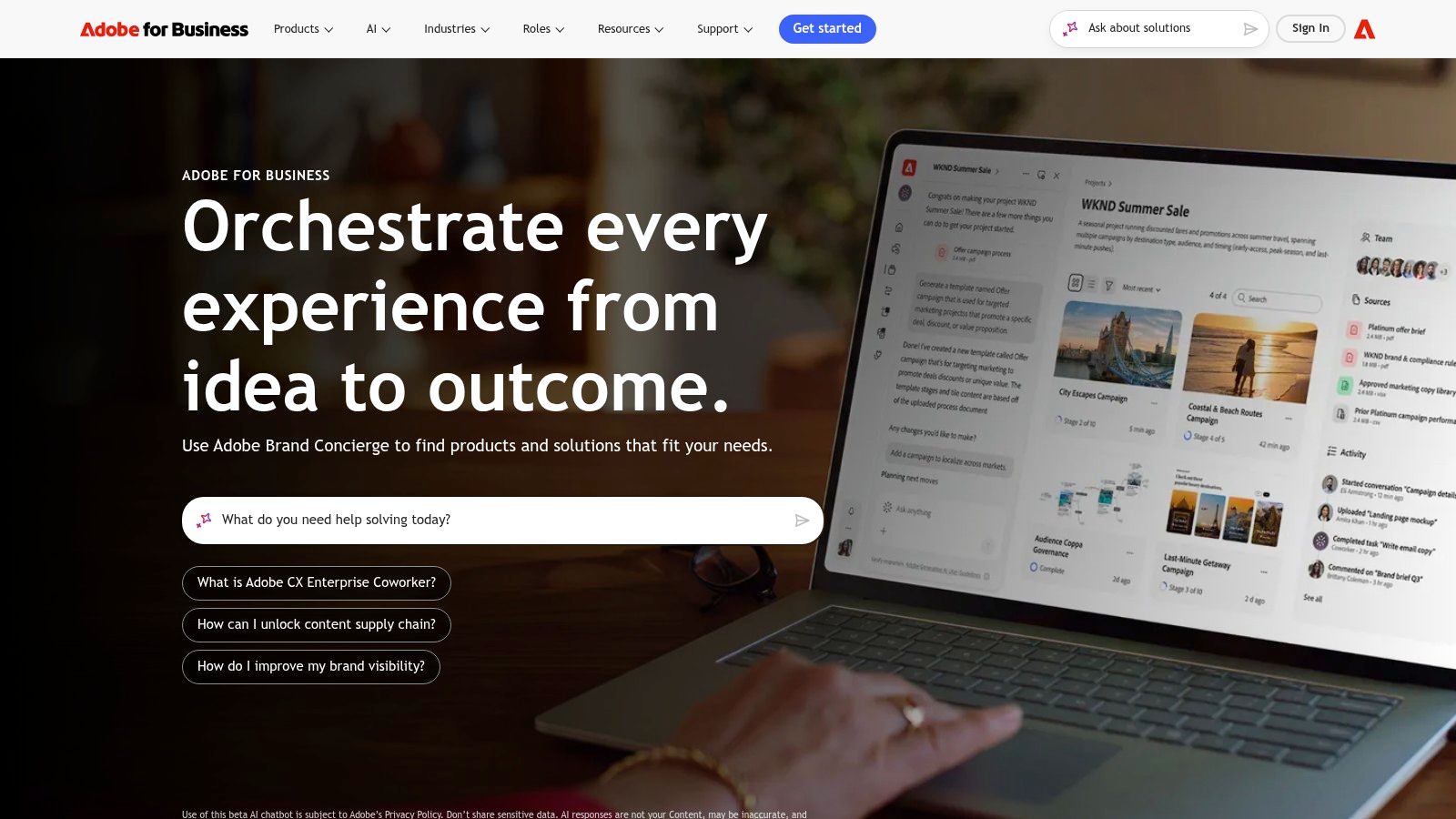
2. Adobe Experience Cloud
Adobe Experience Cloud is a strong Bloomreach alternative when the buying decision centers on enterprise content, first-party data, analytics, and governed journey execution. The relevant stack is Real-Time CDP, Journey Optimizer, and Adobe Experience Manager, not a single replacement product.
Real-Time CDP unifies customer data and supports audience activation. Journey Optimizer manages cross-channel orchestration and in-journey decisions. AEM provides content management, digital asset handling, authoring, and publishing infrastructure for complex global operations. Together, these products give Adobe an advantage when content governance and experience consistency matter as much as search or campaign execution.
Adobe fits teams with an existing Experience Cloud footprint. Adobe Analytics, Experience Manager, Target, and related products can support a shared architecture, while partner and systems integrator support helps large organizations build around it. Real-time profiles and audience activation strengthen personalization across channels.
The practical comparison with Bloomreach should start with jobs, not product labels. Adobe covers CDP depth, content operations, orchestration, analytics, and activation. Buyers still need to test merchandising search, personalization workflows, sending requirements, integration scope, identity resolution, and the amount of specialist work required. Its broader platform can support more governed execution, but that capacity comes with a heavier operating model.
A consumer engagement platform perspective also helps separate a visible journey builder from the controls behind data ownership, approvals, and activation. That distinction matters when teams want AI-assisted execution without giving automation unrestricted access to customer data or live campaigns.
Implementation is the main constraint. Identity design, data architecture, content models, analytics, and channel activation must align before campaigns can run reliably. Migration from Bloomreach therefore requires a staged plan, clear ownership, and a decision on which capabilities need to move first.
Best fit: Global enterprises with Adobe standardization and complex content operations.
Strongest jobs: Content, data unification, analytics, personalization, and cross-channel orchestration.
Migration risk: High when AEM and several Adobe products are included.
Commercial fit: Enterprise pricing must be assessed across the full product combination, implementation work, and specialist support.
Adobe is the better choice when governance and content depth outweigh rapid deployment. Mid-market teams seeking a focused Bloomreach replacement should choose it only if they can sustain the implementation program and operating complexity.
3. Salesforce Marketing and Commerce
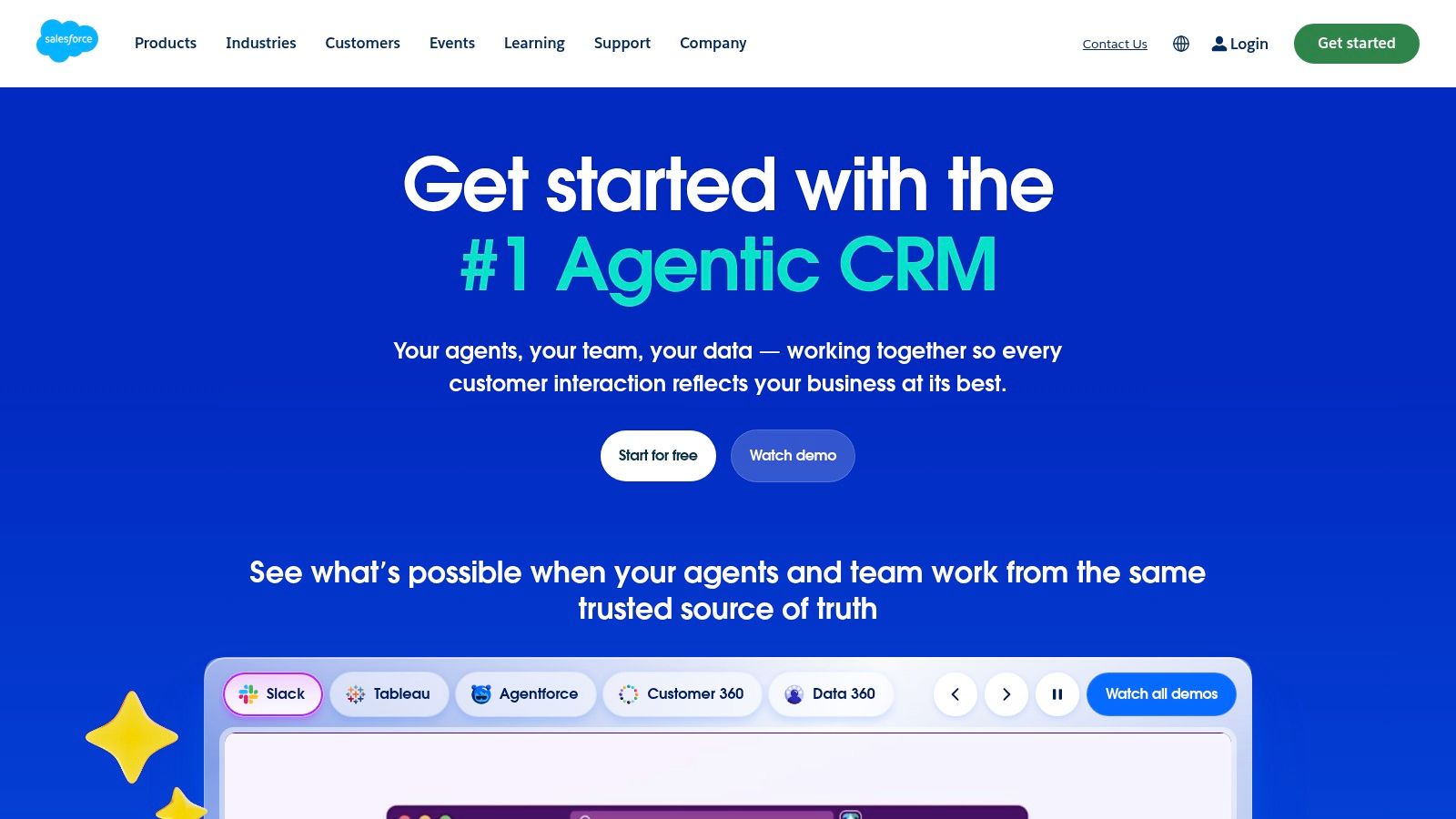
Salesforce makes the strongest case when the CRM already owns customer context. The relevant combination is Marketing Cloud Engagement, Salesforce Data Cloud, and Einstein for Commerce, covering sending, data unification, orchestration, search, sorting, and recommendations.
The buying question is less “Can Salesforce replace Bloomreach?” and more “Which parts of the operating model should Salesforce control?” Marketing Cloud Engagement handles cross-channel journeys and content management. Data Cloud connects customer data for segmentation and activation. Einstein for Commerce extends the stack into product discovery and recommendations, giving Salesforce broader coverage than a messaging-focused platform.
A Salesforce-first setup can connect sales activity, service history, commerce behavior, and marketing execution through a familiar CRM-centered model. That shared context suits organizations where teams already work in Salesforce and where integrations with the existing CRM matter more than adopting a separate customer data layer.
The trade-off is a multi-product implementation hidden inside a single-vendor story. Licenses, environments, data capacity, and specialist components can expand as requirements grow. Buyers also need to test specific workflows because capabilities differ between legacy Marketing Cloud Engagement components and newer Data Cloud and Einstein functions.
Review data reinforces the need to test commercial fit rather than assume enterprise scale guarantees mid-market suitability. Mid-market buyers represent 49.9% of Bloomreach reviews and 54.9% of Braze reviews, while review counts range from Braze's 1,737 reviews to Salesforce's 4,847 and ActiveCampaign's 14,795 on the Bloomreach and Braze comparison page.
For migration teams, the practical test is governance. Define the system of record, map identity and consent, confirm event ownership, and decide which journeys and commerce functions move first. That sequence supports governed AI-powered execution instead of adding automation before the data and approval model are ready.
Best fit: Salesforce-first businesses aligning CRM, marketing, and commerce.
Strongest jobs: CRM-connected orchestration, customer data unification, commerce discovery, and recommendations.
Implementation burden: Moderate to high, based on the number of clouds, integrations, and legacy components.
Main limitation: A single vendor can still create a complex, multi-product architecture.
Salesforce should lead the shortlist when the CRM is the system of record. Choose another Bloomreach alternative when faster migration, simpler execution, or clearer ownership of the data layer matters more.
4. Optimove
Optimove is a better Bloomreach alternative for teams that care more about CRM orchestration, customer insights, and multichannel retention than experimentation-led web optimization. Its platform combines customer marketing, audience management, journey orchestration, analytics, and AI-assisted optimization across channels such as email, SMS, mobile push, in-app, and web.
That makes the comparison more practical for lifecycle teams. Optimove is designed to help marketers identify segments, predict behavior, trigger campaigns, and measure uplift from one retention-focused operating layer. Rather than centering feature flags or site experimentation, it focuses on customer intelligence and coordinated engagement.
The strongest fit is an organization with a mature retention program and clear ownership of CRM performance. Teams can use behavioral data, predictive models, and campaign orchestration to improve repeat purchase, reactivation, churn prevention, and customer lifetime value. That is especially relevant for ecommerce brands, gaming companies, and subscription businesses that need more precision in ongoing customer communication.
Implementation still needs structure. Start with data ingestion, identity logic, consent handling, event mapping, and priority journeys. Then validate predictive scoring, channel execution, audience refresh timing, and reporting before expanding use cases. Without those controls, even a capable CRM platform can create fragmented programs and unreliable measurement.
Optimove is a strong fit for:
- Lifecycle marketing: Strong for retention, reactivation, churn reduction, and customer value growth.
- Personalization: Useful for segmented and behavior-driven engagement across channels.
- Customer intelligence: Stronger than many sending tools for analytics, insights, and next-best-action planning.
- Sending and orchestration: Well suited to multichannel CRM programs with recurring campaign logic.
- Search and commerce discovery: Not a replacement for onsite search, browse, or merchandising.
- Commercial fit: Better suited to organizations with enough CRM scale to justify a specialized retention platform.
Choose Optimove when the main gap is retention marketing and customer-led orchestration. Choose another Bloomreach alternative when the migration is driven by onsite discovery, experimentation, or the need for a broader all-in-one commerce stack.
5. Algolia
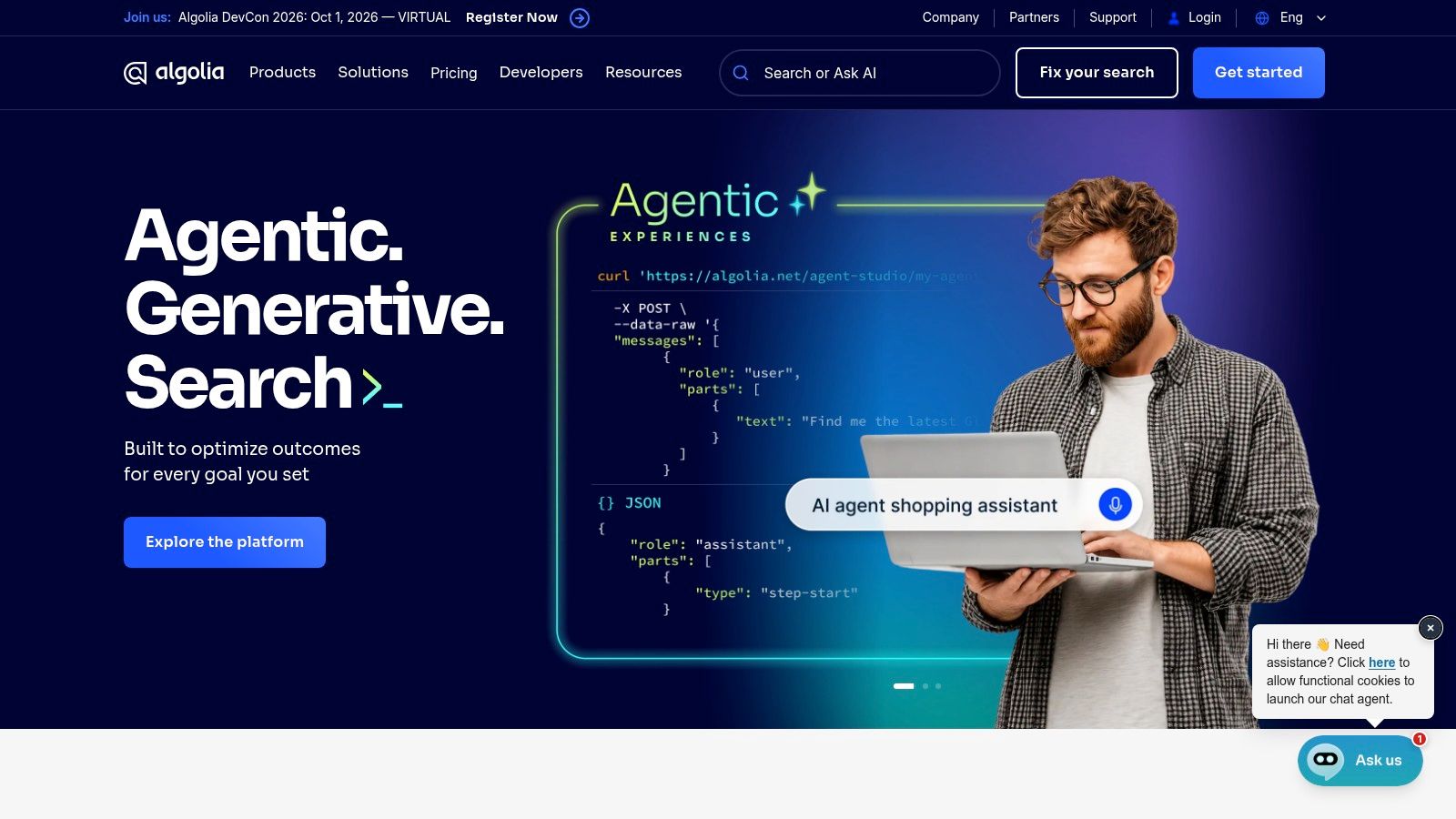
Algolia is a strong Bloomreach alternative when search and product discovery cause the most commercial friction. It delivers a focused SaaS layer for ecommerce and content search, covering neural and AI search, recommendations, merchandising controls, fast indexing, APIs, SDKs, and integrations.
The practical choice is architectural: improve onsite discovery without replacing the engagement stack that already handles customer data, sending, or campaigns. Algolia supports synonyms, rules, experimentation, recommendations, and merchandising actions such as pinning, boosting, and burying products. Developers get direct APIs and SDKs, while merchandisers can set business rules without waiting for engineering for every adjustment.
Search performance depends on the surrounding data. Teams must connect catalog events, customer identity, recommendation signals, and analytics, then agree on how results will be measured. That work is smaller than a full Bloomreach migration, but it still requires clean product data, reliable event tracking, and ownership across commerce and marketing.
The platform's boundary is clear. Algolia does not provide Bloomreach's full engagement operating model, so customer data management, lifecycle messaging, consent, campaign reporting, and broader orchestration stay in other systems. This makes it a good fit for a composable stack, provided integrations are governed rather than added piecemeal.
A Stimulead ecommerce revenue example can help frame the commercial case for AI-assisted discovery. The final decision should use the buyer's search behavior, catalog quality, margin goals, and migration constraints.
Assess Algolia against the jobs that matter:
- Search and personalization: Strong for relevant discovery, recommendations, and merchandising; personalization depends on connected data.
- CDP and sending: Not its role. Keep these capabilities in dedicated platforms.
- Orchestration and integrations: APIs and SDKs support composable execution, but the team owns coordination across systems.
- Implementation effort: Lower than a full-suite replacement, with catalog and analytics integration still required.
- Commercial fit: Pricing tiers and a free tier support trials or proof-of-concepts; advanced AI features require higher tiers.
Choose Algolia when search is the bottleneck and the team wants governed AI-powered discovery without replacing every engagement system. Do not position it as a complete Bloomreach Engagement replacement.
6. Constructor
Constructor targets one problem directly: helping retailers turn complex product catalogs into better discovery and more revenue per visit. Its core tools cover AI-guided search, browse, collections, recommendations, merchandising, and ranking workflows.
Choose Constructor when search quality, category navigation, or merchandising is limiting commerce performance. The platform can handle complex catalog structures and dynamic pricing, while merchandising teams set rules for campaigns, inventory priorities, and margin goals. That focus makes it a stronger discovery layer than a general engagement suite, especially for large B2B and B2C retailers.
The trade-off is architectural. Constructor can improve product discovery without requiring a full replacement of the engagement stack, but the retailer still needs separate systems for lifecycle messaging, CDP operations, and broader orchestration. Integrations with commerce platforms, product feeds, analytics, and customer data therefore determine the overall implementation effort.
Before approving a migration, audit the inputs that drive relevance. Missing attributes, inconsistent taxonomy, unreliable availability, and inaccurate pricing will weaken search and recommendations regardless of the engine. Feed quality is part of the business case, not a technical detail.
Use this decision filter:
- Search and personalization: Strong for AI-driven discovery, recommendations, ranking, and merchandising. Personalization improves with reliable commerce behavior and catalog signals.
- CDP and sending: Not a replacement for customer data management or campaign delivery.
- Orchestration and integrations: Works within a composable stack, with the retailer responsible for coordination across systems.
- Implementation effort: Focused on commerce discovery, but dependent on catalog governance, feed quality, and existing architecture.
- Commercial fit: Primarily enterprise sales with limited public pricing.
Constructor fits when Bloomreach Discovery is the source of friction. For a full Bloomreach migration, pair it with a separate data and engagement platform, then govern AI-powered recommendations through clear rules, owners, and measurement.
7. Dynamic Yield by Mastercard
Dynamic Yield by Mastercard suits enterprise ecommerce teams that prioritize personalization, recommendations, testing, and merchandising across web, app, and email. Its value is highest when the company already has customer data and sending systems, then needs a decisioning layer to select relevant experiences.
The platform covers audience targeting, segmentation, product and content recommendations, experimentation, and merchandising workflows. Some solutions can connect with Mastercard data and insights, giving organizations another signal to evaluate when that use case is clearly defined.
The operating model matters more than the feature list. Dynamic Yield needs an owner who can set business rules, coordinate creative variants, maintain an experimentation roadmap, and establish measurement standards. Without that ownership, complex decisioning can produce more campaigns to manage rather than clearer customer experiences.
For Bloomreach buyers, the comparison should begin with the job being replaced. Dynamic Yield is strong for onsite and in-app decisioning, email recommendations, targeting, and merchandising. It does not remove the need for a separate search engine, CDP, messaging platform, or broader orchestration layer where those capabilities are required. Teams should map identity, event, catalog, consent, and reporting flows before approving a migration.
A practical definition of personalization also helps stakeholders distinguish individual decisioning from simple audience-based content changes.
- Search and personalization: Strong for recommendations, targeting, testing, and merchandising. Search depth depends on the surrounding stack.
- CDP and sending: Supports personalization workflows but is not a complete CDP or engagement platform.
- Orchestration and integrations: Fits a composable architecture, with integration work across data, content, commerce, and messaging systems.
- Implementation effort: Moderate to high when multiple channels, feeds, and data sources are involved.
- Commercial fit: Custom enterprise pricing, suited to teams that can fund program ownership.
- Main limitation: Its capabilities require governance, testing discipline, and a dedicated operating owner.
Choose Dynamic Yield when personalization sophistication leads the business case. For a full Bloomreach replacement, pair it with fit-for-purpose search, data, and engagement components, then use governed AI execution with defined owners and measurable rules.
8. Braze
Braze is a strong Bloomreach alternative when real-time messaging and lifecycle orchestration carry more weight than onsite search. It supports email, push, in-app messaging, SMS, WhatsApp, and web push, with event-based triggers, journey design, audience synchronization, feature flags, and AI-assisted decisioning.
Its strongest job is coordinating customer engagement after a known interaction. A product view, app event, purchase, or profile change can start a journey, adjust channel selection, or trigger a follow-up. Mobile engagement and deliverability receive significant attention, making Braze a practical choice for enterprise lifecycle teams with established CRM operations.
Braze fits a messaging-led operating model. Marketing teams can define cross-channel programs around customer behavior, while product and data teams support the events, identity rules, and consent controls those programs require. That division improves control, but it also makes ownership and implementation discipline part of the business case.
The trade-off behind Braze
Braze does not replace site search, product discovery, or merchandising. Retailers that need those capabilities must add a search platform such as Algolia or Constructor, or retain an existing discovery layer. The resulting stack can work well, but teams must connect identity, events, product data, consent, suppression rules, and measurement across systems.
CDP depth also requires careful validation. Braze can support audience and customer data workflows, yet teams should test its identity model, profile structure, event retention, and activation needs against their own requirements. A separate CDP may still be appropriate.
Forecast the full commercial fit before migration. Event volumes, channel usage, data flows, implementation services, and companion search or CDP products can change the total cost substantially. Comparing license prices alone will produce an incomplete decision.
Braze suits teams that prioritize:
- Messaging and sending: Broad channel coverage with real-time triggers.
- Orchestration: Visual, event-driven journeys for lifecycle programs.
- Integrations: Strongest when data and consent flows have clear owners.
- Implementation effort: Higher when search, commerce, analytics, and identity remain separate.
- Main limitation: No native site search or merchandising replacement.
Choose Braze when messaging is the dominant requirement and the organization can govern a composable stack. For a broader Bloomreach migration, pair it with fit-for-purpose search and data components, then use governed AI execution with explicit owners, approval rules, and measurable outcomes.
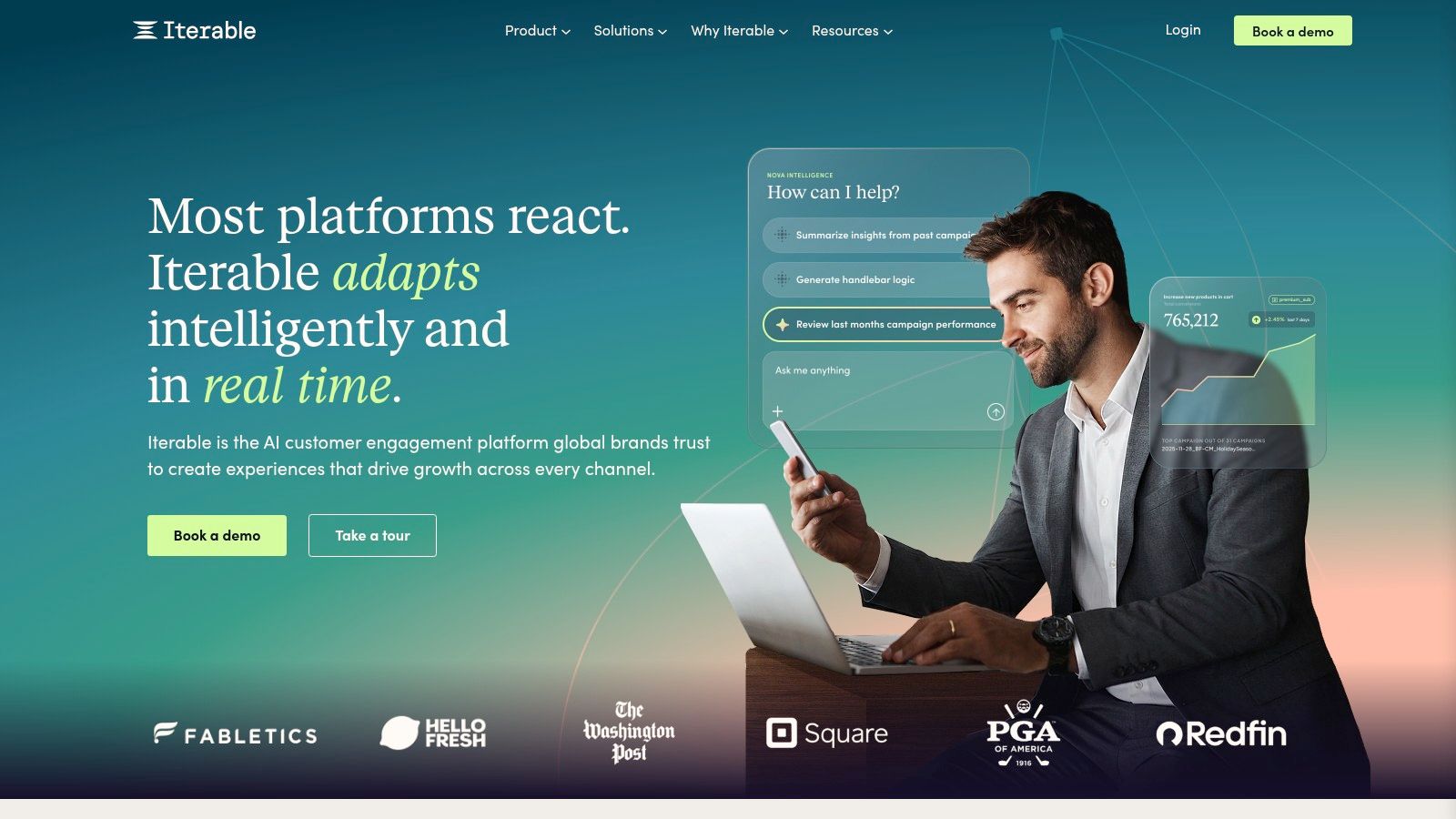
9. Iterable
Iterable earns consideration when the primary job is coordinated lifecycle engagement. It combines segmentation, visual journey design, AI-assisted optimization, and broad channel support across email, SMS, push, in-app, web push, and WhatsApp. That makes it a credible Bloomreach alternative for organizations with mature CRM operations.
The platform's visual journey builder lets teams create event- and attribute-based programs without stitching every workflow together manually. Its integrations support detailed audience construction, while AI features can inform send-time, audience, and content decisions. The trade-off is clear: Iterable strengthens execution and orchestration, while search and merchandising remain outside the product.
Evaluate the migration around the missing layer
Iterable does not replace onsite search or ecommerce merchandising. A company moving from Bloomreach must specify the companion search system, product-data flow, identity rules, suppression logic, and reporting model before approving the migration. Without that design, the team may gain better campaign execution while losing control of the customer experience across discovery and messaging.
AI should also operate inside that governance model. An AI for email marketing framework can help teams judge whether AI improves planning and production or only adds recommendations to an existing send workflow.
Iterable fits teams that need:
- Best fit: Enterprise lifecycle programs with broad channel requirements.
- Strongest job: Segmentation and multi-step engagement journeys.
- Sending: Email, SMS, mobile, web push, and WhatsApp support.
- Integration effort: Flexible, with effort shaped by event, catalog, and channel volume.
- Commercial fit: Custom pricing.
- Main limitation: Search and merchandising need companion tools.
Choose Iterable for the engagement side of Bloomreach, then document the discovery architecture, ownership model, approval rules, and success measures before migration. It is a strong orchestration platform, not a complete commerce discovery stack.
10. SAP Engagement Cloud
SAP Engagement Cloud, previously SAP Emarsys Customer Engagement, fits SAP-centric retailers and brands that need lifecycle automation tied to enterprise data. It supports personalized interactions, omnichannel campaigns, AI-driven segmentation, recommendations, templates, and industry playbooks.
The platform's main advantage is operational alignment. Connections with SAP S/4HANA, SAP Analytics Cloud, SAP CDP, and the wider SAP Customer Experience environment can reduce integration work for companies already using SAP processes and controls. That alignment also supports consistent governance across customer data, campaign execution, and reporting.
SAP Engagement Cloud is strongest when SAP already anchors the marketing and commerce stack. Outside that environment, implementation can add complexity rather than simplify a Bloomreach migration. Teams should assess the full operating model before committing, including data ownership, identity resolution, consent handling, catalog synchronization, and measurement.
Search deserves separate scrutiny. SAP Engagement Cloud handles engagement and lifecycle use cases, but buyers should confirm which search, merchandising, and recommendation capabilities come from SAP or companion systems. They also need to test how product data reaches campaigns and how customer responses return to analytics.
Best fit: SAP-first retailers and enterprise brands.
Strongest job: Lifecycle automation connected to SAP data and analytics.
Governance: Strong where established enterprise controls already exist.
Implementation effort: Lower inside a mature SAP environment, higher outside it.
Commercial fit: Enterprise procurement, with fewer entry points for smaller businesses.
Main limitation: Its value depends heavily on broader SAP adoption.
Choose SAP Engagement Cloud when SAP alignment shapes the migration decision, not just because its campaign features resemble Bloomreach. Governed AI can support segmentation, recommendations, and execution, but teams still need clear approval rules and ownership across the connected SAP stack.
Top 10 Bloomreach Alternatives: Feature Comparison
| Product | Core features | UX & performance | Value / USP | Best for | Pricing & notes |
|---|---|---|---|---|---|
| The AI CMO | Unified marketing OS + native CDP & warehouse, Studios, 24/7 AI specialists, Journeys, append-only ledger, 3,400+ integrations | Fast segment refresh (≈10 min), dedicated ClickHouse for enterprise, 10k+ campaigns/mo capacity, nightly campaign verdicts | AI-native platform; send-path suppression & consent enforcement; audit-ready governance; scales marketing without headcount | Marketing leaders, growth teams, enterprise SaaS, agencies | Enterprise/quote, demo required; dedicated clusters & enterprise contracts |
| Adobe Experience Cloud (Real‑Time CDP + Journey Optimizer + AEM) | Real‑Time CDP, Journey orchestration, AEM content & authoring, analytics integrations | Mature, powerful analytics and personalization; high implementation complexity | Deep content+analytics ecosystem; composable enterprise suite | Complex global brands, enterprises | Enterprise pricing; longer time‑to‑value |
| Salesforce Marketing + Commerce | Marketing Cloud Engagement, Data Cloud, Einstein commerce | Strong CRM-native experience; large SI ecosystem; modular complexity | Single‑vendor CRM→marketing→commerce path; strong commerce AI | Organizations standardized on Salesforce, large enterprises | Modular/enterprise licenses; costs can add up |
| Optimove | Customer marketing platform, segmentation, journey orchestration, predictive insights, multichannel CRM | Strong retention workflows, flexible audience management, analytics-led optimization | Retention and lifecycle marketing with customer intelligence at the center | CRM and retention teams in ecommerce, gaming, and subscriptions | Enterprise/custom pricing; best fit with mature lifecycle programs |
| Algolia | Neural/AI search, recommendations, merchandising controls, robust APIs | Fast time‑to‑value; excellent developer DX; needs integration with catalog & analytics | High‑performance discovery layer, transparent tiers & Free trial | Ecommerce dev teams, composable stacks | Transparent tiered pricing; Free/POC tiers available |
| Constructor | AI search, browse, recommendations, merchandising for large catalogs | Revenue‑driven discovery; built for complex catalogs & dynamic pricing | Purpose‑built to maximize revenue per visit for retailers | Large B2C/B2B retailers with big catalogs | Enterprise sales; limited public pricing |
| Dynamic Yield by Mastercard | Personalization engine, recommendations, targeting, testing | Mature personalization workflows; strong merchandising tools | Robust 1:1 personalization; optional Mastercard data ties | Ecommerce teams needing advanced personalization | Custom enterprise pricing |
| Braze | Journey orchestration, messaging (email, push, SMS, in‑app, WhatsApp), data platform | Robust deliverability; proven at scale; strong journey tooling | Messaging and engagement at scale; reliable multi‑channel sends | Engagement teams prioritizing messaging & journeys | Enterprise/custom pricing; packaging can be complex |
| Iterable | Cross‑channel engagement, AI segmentation, visual journeys | Flexible data model; strong integrations; good for lifecycle programs | Visual multi‑step orchestration + AI audience optimization | Lifecycle marketing teams in enterprises | Custom/volume‑based pricing |
| SAP Engagement Cloud (Emarsys) | Omnichannel campaigns, AI segmentation & recommendations, SAP integrations | Strong fit in SAP ecosystems; enterprise governance | Native ties to SAP CX/ERP/analytics; vertical playbooks | SAP‑centric retailers and brands | Enterprise procurement model; best with broader SAP stack |
Choose the Stack Your Marketing Model Can Sustain
There isn't one universal winner among Bloomreach alternatives. The market has split because Bloomreach is evaluated as a combined stack while most competitors specialize in one or two jobs. The CDP layer is expanding as well. A 2026 projection places the global CDP market at USD 7.34 billion in 2026 and USD 14.04 billion by 2031, with a 13.8% CAGR in MarketsandMarkets' CDP market analysis. That shift explains why buyers increasingly compare infrastructure CDPs, marketing CDPs, engagement platforms, and ecommerce discovery products in one procurement process.
The first decision is architectural. Determine whether the business needs to replace Bloomreach entirely or replace one module. Algolia and Constructor can address discovery. Braze, Iterable, and Optimove can address engagement. Adobe, Salesforce, SAP Engagement Cloud, and The AI CMO can support broader operating models, but each carries different implementation and governance implications.
Match the platform to the primary gap
A practical decision sequence starts with the business constraint, not the vendor brand.
- Discovery gap: Shortlist Algolia or Constructor, then validate catalog quality, search relevance, merchandising controls, recommendations, and analytics.
- Personalization gap: Compare Dynamic Yield, Optimove, and broader suites against decisioning quality, audience intelligence, and program ownership.
- Lifecycle engagement gap: Compare Braze, Iterable, Optimove, SAP Engagement Cloud, Salesforce, and The AI CMO on sending, journeys, triggers, deliverability, and channel coverage.
- Data unification gap: Evaluate Adobe Real-Time CDP, Salesforce Data Cloud, SAP's connected data approach, and The AI CMO against identity resolution, data ownership, activation speed, and reporting consistency.
- Retention marketing gap: Put Optimove first when CRM intelligence and lifecycle optimization drive the growth agenda.
- SAP alignment gap: Put SAP Engagement Cloud first when SAP systems already govern customer and operational data.
- Governed AI execution gap: Put The AI CMO first when acquisition, retention, content, sending, measurement, approvals, consent, and AI specialists need to work from one first-party operating model.
The scoring model should include channel coverage, data ownership, integration dependencies, implementation capacity, pricing transparency, consent controls, reporting, and migration risk. A cheaper license can become an expensive stack once the business adds a separate CDP, analytics layer, search engine, personalization system, and implementation partner.
Prepare the switch before selecting the vendor
Bloomreach itself positions marketing automation around unified customer and product data, personalization across channels, and integration depth. Its documentation describes profiles built from behavioral and transactional data that support email, mobile messaging, push, web, and paid media campaigns, while the company says it offers 130+ pre-built integrations across systems including Shopify, Magento, BigCommerce, and Salesforce Commerce Cloud in its real-time customer journeys overview. A migration must preserve the operating logic behind those capabilities, not only export contact records.
The switch checklist should cover:
- Inventory data and journeys: Document Bloomreach profiles, events, attributes, campaigns, workflows, templates, recommendations, and reporting dependencies.
- Map identities and consent: Define how anonymous, known, merged, deleted, unsubscribed, and self-excluded customers will be represented.
- Document events and catalog feeds: Record schemas, field meanings, update frequency, product availability, prices, taxonomy, and ownership.
- Preserve suppression logic: Recreate global exclusions, channel preferences, STOP handling, blacklists, and legal restrictions before production sends.
- Recreate priority segments: Start with revenue-critical lifecycle, churn, acquisition, cart, product, and engagement audiences.
- Test sends and recommendations: Use controlled audiences to test rendering, deliverability, personalization, search ranking, recommendation logic, and frequency limits.
- Run parallel measurement: Compare baselines, attribution, holdouts, conversion paths, and revenue reporting before shutting down the old system.
- Define rollback criteria: Set explicit conditions for pausing the migration, restoring the previous workflow, or reducing traffic.
- Train owners before cutover: Give campaign, data, commerce, compliance, analytics, and engineering owners clear responsibilities.
Bloomreach's marketing automation materials also describe attribution tracking, conversion tracking, and campaign performance reporting in its omnichannel orchestration product information. The replacement should therefore be judged on measurement continuity, not only send capability.
The AI CMO deserves priority for teams seeking a first-party, AI-native operating model with built-in data, execution, approvals, suppression enforcement, and auditability. Adobe is better for Adobe-centered enterprises. Salesforce is better for CRM-led organizations. Optimove is better for retention-led CRM growth. Algolia and Constructor are better for specialized discovery. Dynamic Yield is better for mature personalization programs. Braze and Iterable are better for messaging depth. SAP Engagement Cloud is better for SAP-first operations.
The right decision gives marketing teams more control and clarity, not just another large platform. The winning stack is the one the organization can govern, integrate, measure, and sustain after the migration project ends.
The AI CMO unifies first-party customer data, AI specialists, Studios, built-in email and messaging, behavior-triggered journeys, measurement, and approval controls in one governed marketing operating system. Teams comparing Bloomreach alternatives should see how one brief can move from planning to production, sending, attribution, and audit without adding disconnected tools. Visit The AI CMO to assess whether its AI-native operating model fits the next stage of marketing execution.
Share this article