
AI adoption is no longer a side project for marketing teams. Jasper's 2026 survey of 1,400 marketing professionals found that 91% of teams use AI, up from 63% the previous year, while 65% have designated AI roles and 95% plan to increase AI spending (Jasper's 2026 State of AI in Marketing). The surprising conclusion is that the biggest competitive risk isn't failing to buy the right tool. It's keeping an operating model built for human-only execution while competitors redesign how strategy, production, approvals, and measurement work together.
An AI marketing team isn't a chatbot added to a content calendar. It's a managed workforce of specialists operating against shared data, explicit policies, and measurable commercial outcomes. Marketing leaders who treat AI as a collection of shortcuts will improve isolated tasks. Leaders who treat it as an operating model can increase capacity without allowing brand, budget, or compliance decisions to run uncontrolled.
Table of Contents
- Redefining the Modern Marketing Operating Model
- Designing Roles and the Human-AI Operating Model
- Establishing Governance and Trust Levels
- Building the Data and Technology Foundation
- Measuring Impact with Experiments and Holdouts
- Your Step-by-Step Adoption Roadmap
- Executing at Scale with The AI CMO
Redefining the Modern Marketing Operating Model
The old assumption says AI helps a marketer finish the same job faster. That assumption is now too narrow. AI is changing how marketing organizations define roles, distribute work, and respond to customer behavior.
Digiday's annual survey trend shows the direction clearly. Company investment in AI rose from 44% of brand and agency professionals in 2022 to 57% in 2023, 71% in 2024, and 86% in 2025 (Digiday's research on AI applications and agentic marketing). In the same 2025 survey, 85% of respondents said their companies used out-of-the-box AI tools, while 72% used AI for copy generation and 64% used it for multimedia generation. Creative production became the entry point, but the operating-model question is broader: who plans the work, who checks it, who publishes it, and who decides whether it created incremental revenue?
A mature AI marketing team treats software as a set of accountable specialists rather than a passive application. An SEO agent can identify content gaps and prepare briefs. A CRM agent can monitor lifecycle changes and recommend a retention sequence. An analytics agent can identify a performance anomaly and route it to an approval queue. Human marketers still define the commercial objective, audience, positioning, and acceptable risk.
From headcount limits to capacity design
Human-only organizations scale by adding people, contractors, or agencies. That model creates predictable bottlenecks around research, production, quality assurance, reporting, and handoffs. An AI operating model changes the constraint. The team can assign repeatable work to agents while preserving human attention for judgment-heavy decisions.
That shift doesn't mean every task should become autonomous. It means each task should have an explicit owner, a defined input, a quality standard, and a trust level. The AI marketing team should be managed with the same discipline applied to human employees: role descriptions, weekly priorities, access permissions, performance reviews, and escalation paths.
Operating principle: AI should expand the team's capacity, not remove accountability from the team.
The strongest structure separates strategy, execution, and control. Strategy remains with marketing leaders and specialists who understand positioning, customer economics, and business priorities. Execution can move to agents for drafting, variant generation, QA, segmentation, and deployment. Control sits in policies, approval queues, spending limits, suppression rules, and audit records.
This is why AI adoption has moved beyond experimentation. The same Jasper report says 66% of marketing teams expect AI to take 10% or more of their marketing budget in 2026, a projection that signals formal resource allocation rather than casual tool usage (Jasper's 2026 State of AI in Marketing). The practical response isn't another isolated subscription. It's a redesign of the marketing department around coordinated specialists and governed automation.
Designing Roles and the Human-AI Operating Model
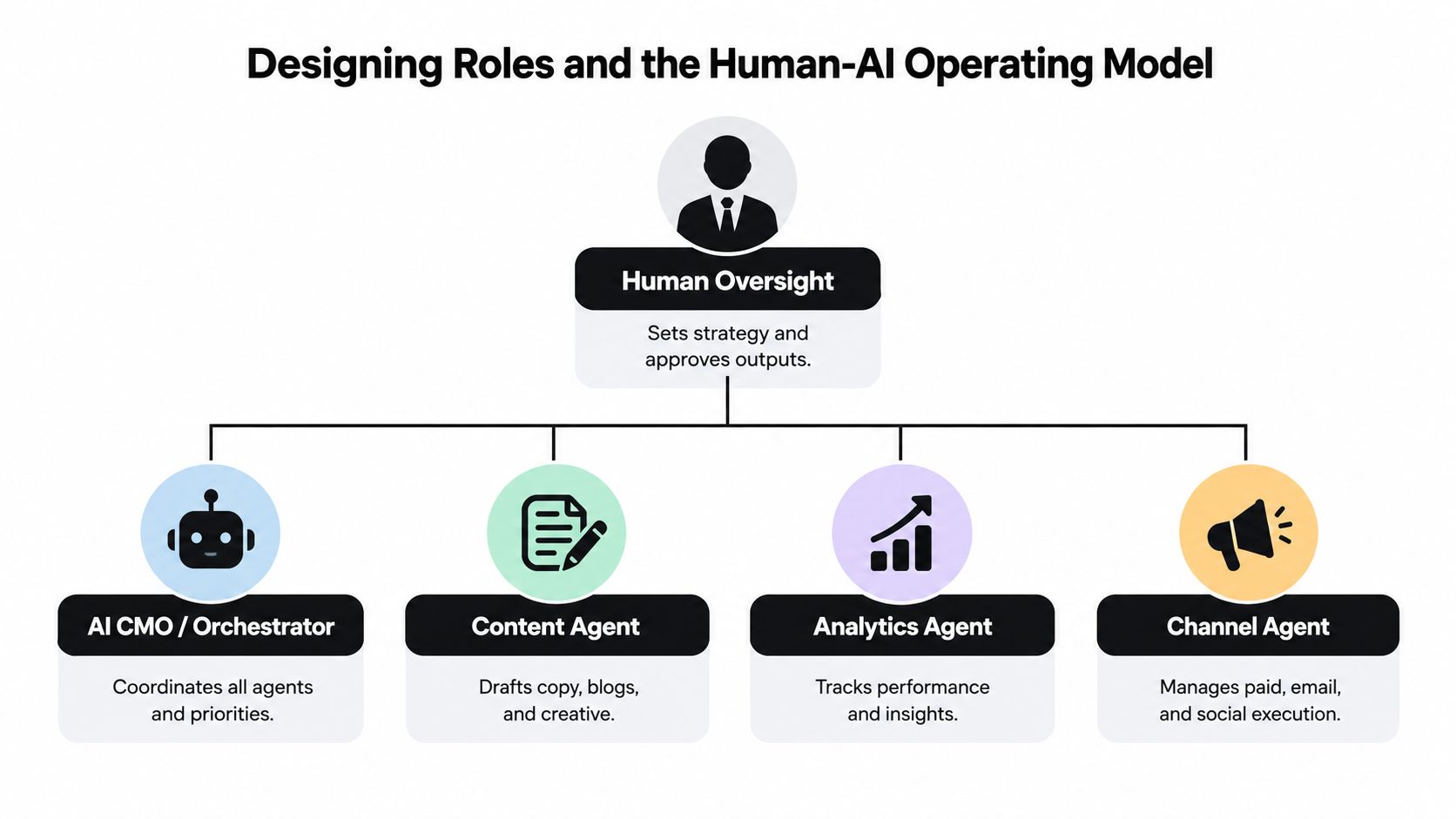
An AI marketing team should never be configured as one general-purpose assistant with access to everything. A general agent has broad context but weak accountability. Specialist agents have narrower scopes, clearer success criteria, and safer permissions.
A useful structure includes:
- AI CMO or orchestrator: Converts company priorities into weekly agendas, assigns work across agents, watches dependencies, and escalates conflicts.
- PPC specialist: Builds audience and creative variants, monitors budget conditions, and prepares changes for approval.
- SEO specialist: Maps search intent, evaluates content opportunities, briefs writers, and checks technical and on-page requirements.
- Content specialist: Produces articles, landing-page copy, email drafts, social variations, and creative concepts within brand rules.
- CRM specialist: Watches lifecycle movement, identifies retention opportunities, and prepares behavior-triggered journeys.
- Brand specialist: Reviews language, claims, visual consistency, and prohibited phrasing before publication.
- Analytics specialist: Tracks performance, investigates anomalies, and connects campaigns to experiments and commercial outcomes.
Each specialist should open the week with an agenda, a defined budget or resource boundary, and a list of actions that can be taken without human intervention. The agent shouldn't decide its own scope. A marketing leader should specify whether the agent can recommend, draft, schedule, or publish.
The approval queue is the management layer
Human marketers don't disappear from this model. Their work moves upward. Instead of manually producing every variation, they set the strategy, define the brief, approve exceptions, and improve the rules that agents follow.
AI can handle the heavy lifting of variant generation, QA, formatting, tagging, and deployment. Humans should retain authority over positioning, material claims, sensitive audiences, crisis communications, pricing, and irreversible brand decisions. That division preserves judgment while removing repetitive coordination.
The model works best when every task has a clear handoff:
- A human leader sets the objective and success measure.
- The orchestrator decomposes the objective into channel-specific work.
- Specialist agents create drafts, analyses, and proposed actions.
- Automated checks screen for policy, data, and formatting failures.
- Humans approve high-risk outputs or exceptions.
- Approved work is deployed and measured.
- Results feed back into the next agenda.
The structure described in effective digital marketing team models offers useful context for separating strategic ownership from specialist execution. An AI model extends that principle by making the specialist layer active throughout the week instead of waiting for a meeting or brief reassignment.
A practical reference for the manager's role is AI marketing manager. The manager doesn't need to inspect every line of generated copy. The manager needs visibility into priorities, queue status, exceptions, budget exposure, and whether the system is learning from reliable outcomes.
The result is a team that can work continuously without confusing speed with permission. Agents create throughput. Humans define what good means.
Establishing Governance and Trust Levels
Governance is the operating system of an AI marketing team. Without it, automation makes uncontrolled decisions faster.
A practical governance framework starts by assigning a trust level to every agent and action. The level should reflect the downside of an error, the reversibility of the action, and the sensitivity of the audience or data involved.
Match autonomy to risk
Three trust levels create a useful baseline:
- Ask first: The agent researches, recommends, or drafts, but a human must approve every action.
- Publish after 24 hours: The agent can prepare and schedule approved categories of work, with a defined review window for intervention.
- Publish immediately: The agent can execute within narrow rules for low-risk, reversible actions that have passed automated checks.
A content agent might receive permission to draft SEO briefs without approval, while publication of regulated product claims stays at ask first. A CRM agent might trigger a non-sensitive onboarding reminder automatically, but a high-value retention offer could require review. A paid media agent might adjust bids within a constrained budget while any new audience or creative concept enters an approval queue.
The governance framework should also define the data each role can read, the tools each role can access, the maximum spend it can authorize, and the conditions that force escalation. These controls belong in the execution path, not in a policy document that agents and operators must remember manually.
Make compliance impossible to bypass
GDPR-focused email guidance states that marketing consent must be freely given, specific, informed, and unambiguous, and that automated messages must remain within the lawful basis and scope of the consent provided (GDPR email marketing compliance guidance). That means consent, unsubscribes, suppression lists, STOP responses, and self-exclusions must be checked at send time.
A segment created earlier in the day isn't enough. Customer status can change between segmentation and delivery. The send path should read the current suppression state and block delivery when the recipient no longer qualifies.
Practical rule: If an automated action can't prove that the recipient, message, channel, and permission are valid at execution time, it shouldn't execute.
Every action also needs an append-only record. The record should capture the agent, human approver, trust level, policy version, audience, action, timestamp, and spend. This gives marketing leaders a defensible explanation for what happened without relying on screenshots or informal Slack approvals.
A broader marketing governance framework can help teams formalize these responsibilities. Governance isn't a brake on growth. It's what allows leaders to increase autonomy without increasing uncertainty at the same rate.
Building the Data and Technology Foundation
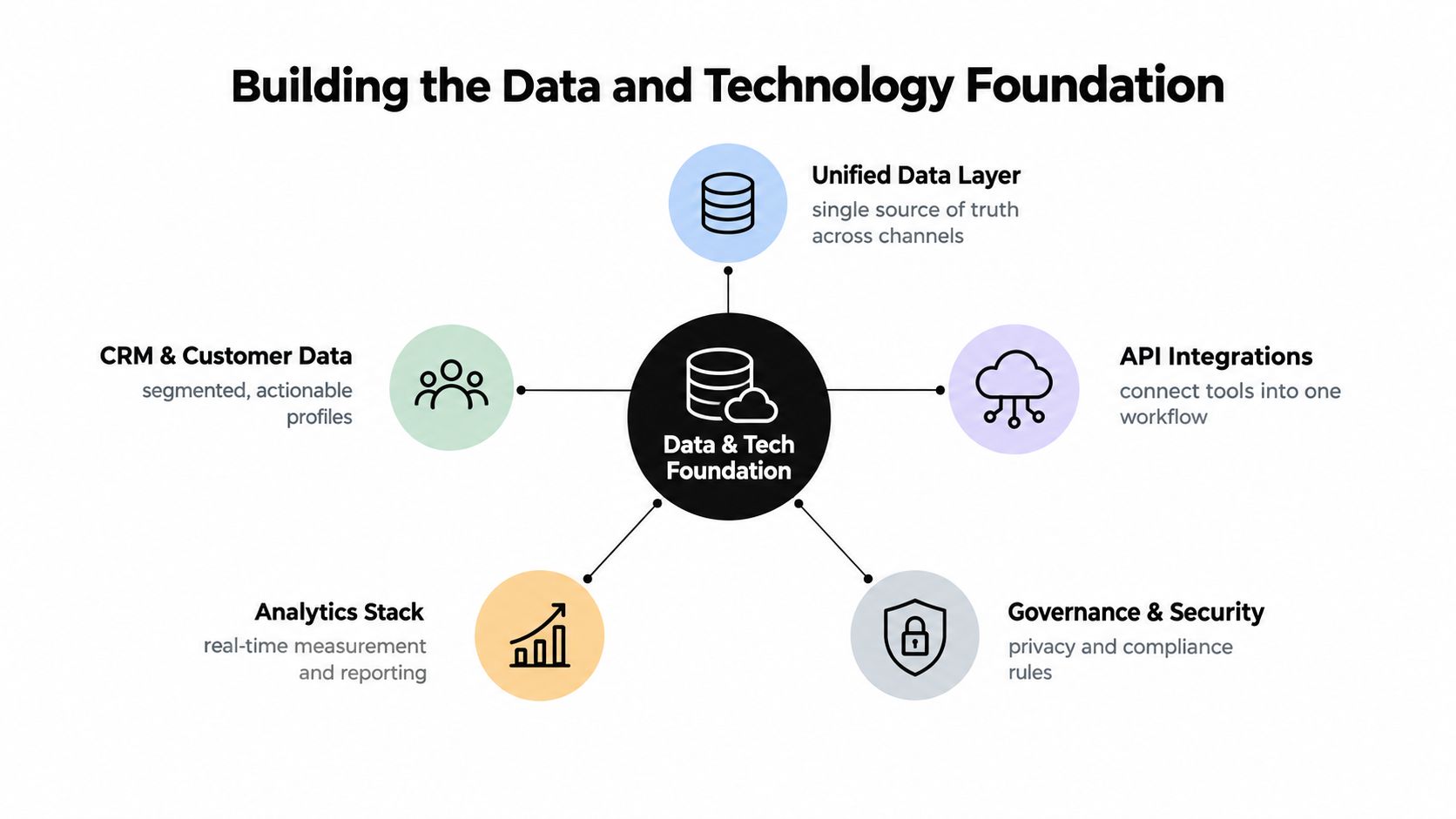
An AI specialist can't make a reliable decision from fragmented customer records. If the website, CRM, advertising platform, billing system, and email tool disagree about identity or lifecycle stage, the agent will produce inconsistent segments and contradictory recommendations.
A customer data platform unifies data from websites, apps, CRM systems, warehouses, and marketing tools into unified customer profiles, giving an AI marketing team a shared customer record across channels (G2's customer data platform overview). That record should connect identity, behavior, transactions, consent, lifecycle status, value, and channel eligibility.
Build one operational source of truth
The data layer needs more than storage. It needs usable marketing states. A practical foundation includes:
- Identity resolution: A governed method for connecting known and anonymous activity without duplicating customers.
- Lifecycle staging: A current view of whether a customer is a prospect, active user, expansion opportunity, or retention risk.
- Value and risk signals: Revenue contribution, engagement, purchase behavior, and likely loss should be available to the agents making prioritization decisions.
- Event freshness: Behavioral changes should reach the journey engine quickly enough to support relevant intervention.
- Consent state: Permission must be available alongside behavioral data, not stored in a separate system that execution can't reliably query.
The first-party warehouse should ingest signals from websites, CRMs, billing systems, ad platforms, files, webhooks, and APIs. The marketing platform should either include that layer or connect to it without creating competing versions of the customer record.
Remove the context gap
The most damaging technical failure isn't a bad prompt. It's stale or incomplete context. An agent may write a relevant message for a customer who has already converted, recommend an offer to someone who opted out, or classify a churn risk using an outdated subscription state.
Industry guidance describes AI marketing automation as software that can plan, execute, optimize, and personalize campaigns while learning from customer behavior in real time rather than following only static rules (AI marketing automation overview). That promise depends on the underlying data being current, permission-aware, and accessible to every relevant workflow.
The first-party data strategy should therefore be designed around decisions, not only collection. Every important AI action should answer three questions: which customer record supplied the signal, when was it updated, and which policy permits the action?
A unified foundation makes the same data available to segmentation, journeys, reporting, and AI answers. That consistency matters more than adding another analytics dashboard.
Measuring Impact with Experiments and Holdouts
Last-click attribution is convenient, but convenience isn't causality. A customer may convert after receiving an email because the customer was already ready to buy. If the marketing team gives the email full credit, the AI may optimize toward messages that appear effective while adding little incremental revenue.
An AI marketing team needs a measurement design that separates conversion from caused conversion. Independent campaign measurement guidance recommends geo holdouts, audience splits, and matched control cohorts to isolate true lift from baseline behavior (multi-channel campaign measurement guidance).
Attribution versus incrementality
| Measurement approach | What it answers | Main weakness |
|---|---|---|
| Last click | Which tracked touchpoint appeared before conversion? | It can over-credit the final interaction. |
| Multi-touch attribution | How should credit be distributed across recorded touches? | It still relies on modeled assumptions about causality. |
| Holdout testing | What happened to a similar group that didn't receive the intervention? | The control design must remain comparable and protected. |
| Incrementality testing | What additional revenue did the campaign cause? | It requires disciplined experimentation and sufficient observation. |
The practical design is straightforward. A triggered journey receives a treatment cohort and a similar holdout cohort. The treatment receives the sequence. The holdout doesn't. The team then compares revenue and relevant downstream behavior after accounting for baseline differences.
The holdout shouldn't be treated as lost revenue. It's the evidence required to determine whether the journey deserves more budget, a different message, or removal. A good system also protects the holdout from overlapping campaigns that would contaminate the comparison.
Put the experiment inside the journey
Journey-level measurement is stronger than adding an experiment after the campaign has already launched. The AI marketing team can define the audience, treatment, holdout, goal, observation window, and stopping rule before execution.
A useful scorecard includes:
- Incremental revenue against the holdout.
- Net margin after incentives and media costs.
- Retention or churn movement.
- Unsubscribe, complaint, and suppression behavior.
- Time to conversion where timing matters.
- Performance by audience, channel, and customer value.
The incrementality testing guide for marketers provides a useful framework for teams moving beyond surface engagement metrics. Opens and clicks still help diagnose creative and delivery, but they shouldn't be the final verdict on whether an AI-managed sequence created business value.
The measurement agent can report nightly, but it shouldn't rewrite the conclusion when results disappoint. Human leaders decide whether the test was valid, whether the audience was correctly defined, and whether the result supports scaling.
Your Step-by-Step Adoption Roadmap
An AI marketing team should be built in stages. Immediate full autonomy creates too many unknowns at once, especially when data quality, brand rules, and approval habits aren't mature.
The roadmap below prioritizes repeatability first and autonomy second.
Phase 1 Assess the operating reality
Start with an inventory of recurring marketing work. List briefs, research tasks, content production, creative adaptation, QA, campaign setup, reporting, audience creation, and optimization. For each workflow, identify the current owner, input data, approval point, failure mode, and commercial outcome.
The assessment should also examine data readiness and team skills. A content agent can't deliver consistent work if the brand library is scattered. A CRM agent can't trigger relevant journeys if lifecycle fields are stale. A paid media agent shouldn't receive access before budget boundaries and escalation rules exist.
Phase 2 Pilot one constrained agent
Select one high-volume, low-risk workflow. Content variant generation, metadata QA, internal linking suggestions, reporting summaries, or creative resizing are strong starting points because errors can be reviewed before publication.
Define the brief template, brand rules, prohibited claims, review checklist, and acceptance criteria before the agent goes live. The pilot should produce a visible queue of completed, rejected, and escalated work. That queue becomes the feedback loop for improving prompts, data access, and policy logic.
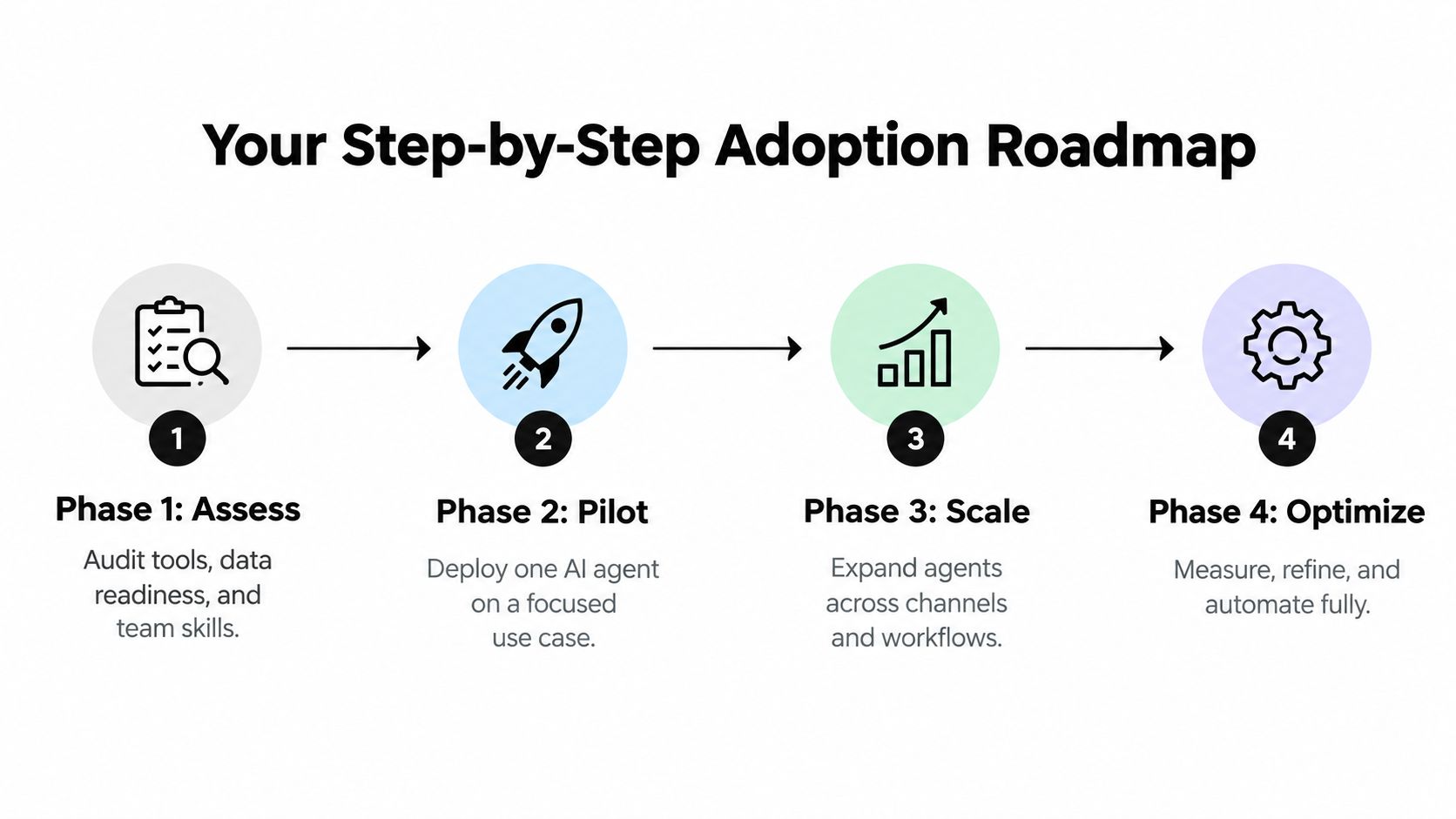
Phase 3 Scale across connected workflows
Once the pilot is stable, connect adjacent functions. A content agent can work with an SEO agent and a brand checker. A CRM agent can work with an analytics agent to identify a segment, prepare a journey, and route the action for approval.
The team should standardize briefs and review gates across functions. Every brief needs an objective, audience, offer, channel, source data, exclusions, deadline, and success measure. Every review gate needs an owner and a clear reason for rejection.
A 2026 industry synthesis reports that 87% of marketers use generative AI in at least one workflow, while a survey of 14,000 respondents found an average saving of 6.1 hours per marketer per week. The same source reports senior practitioners saving 8 to 10 hours and junior staff saving 3 to 4 hours (AI marketing adoption and productivity data). The operational lesson is that savings won't distribute evenly unless teams standardize how work enters and leaves the system.
Phase 4 Optimize trust and measurement
Increase autonomy only after the agent demonstrates reliable output, clean policy checks, and useful measurement. Move low-risk actions from ask first to delayed publication, then consider immediate execution where the action is reversible and tightly bounded.
The adoption roadmap should also include weekly planning. Each agent needs a current agenda, performance feedback, unresolved exceptions, and a record of decisions that changed its operating rules. The team should expand scope when evidence supports it, not because the platform makes a new capability available.
This progression turns AI from a novelty into organizational muscle. The agents gain permission gradually, while the humans gain confidence from observable controls.
Executing at Scale with The AI CMO
A unified marketing operating system brings the operating model, governance, data foundation, and measurement layer into one workflow. The brief becomes the starting point. AI specialists turn it into channel assets, journeys, approvals, and experiments. The customer record and reporting layer determine whether the work was relevant and commercially useful.
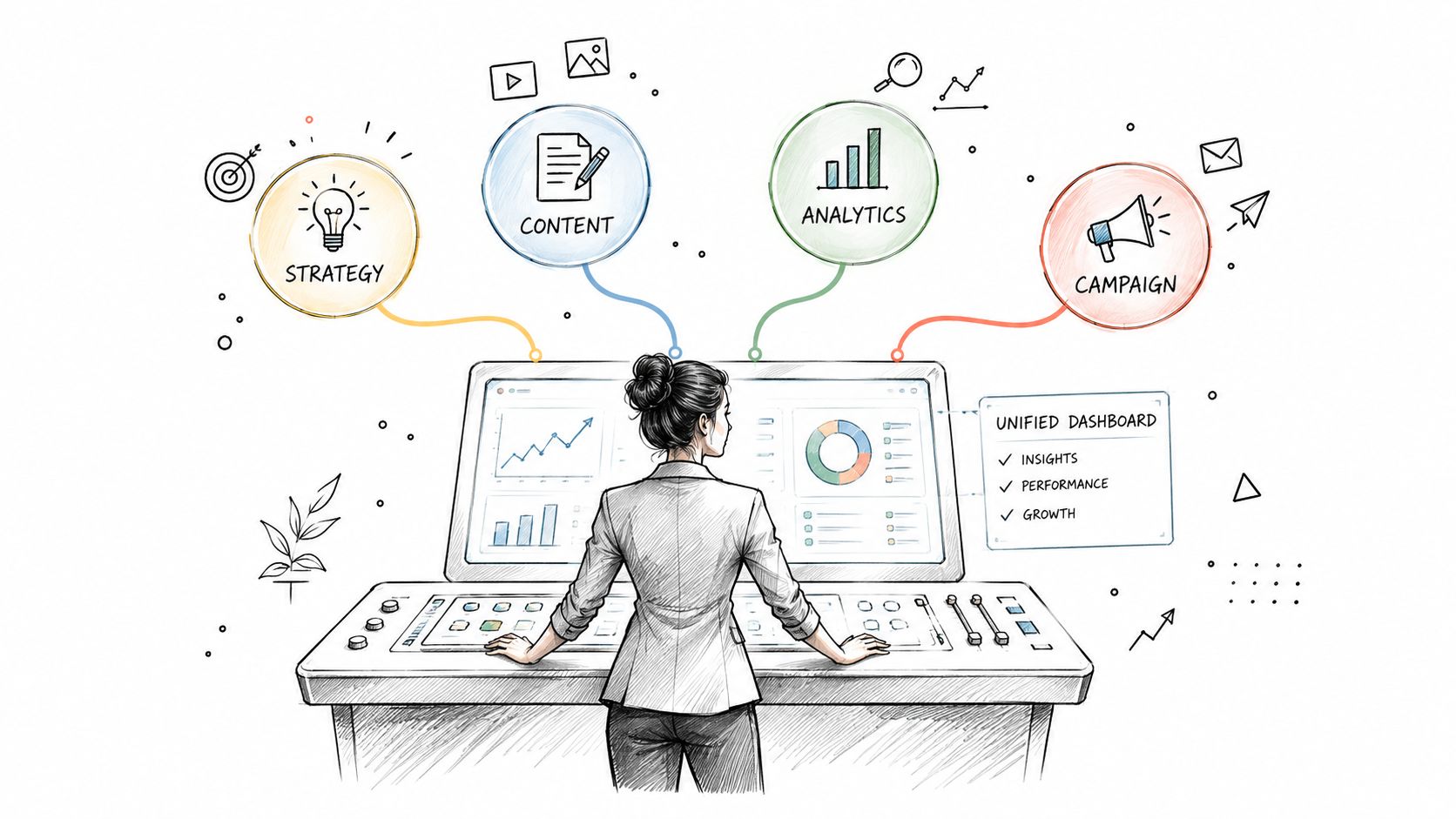
A marketing director might brief a retention campaign around customers showing signs of declining engagement. The analytics specialist identifies the relevant audience from the unified customer record. The CRM specialist drafts email, SMS, WhatsApp, web push, and on-site variations. The brand specialist checks the language. The orchestrator routes the sequence through the correct approval level, while the journey engine protects suppression and consent rules at send time.
The same workflow can produce ads, landing pages, articles, and lifecycle messages from one brief. Built-in sending removes the need to move approved work through a disconnected ESP, while separate transactional infrastructure keeps operational messages distinct from marketing communication. The result is less manual handoff and a clearer record of which policy allowed each action.
For teams rebuilding organic acquisition, specialized AI SEO services can complement broader agent workflows, particularly where technical analysis, content planning, and search-focused production need defined ownership. SEO still needs commercial strategy and editorial judgment. Automation should handle repeatable analysis and production steps, not decide the company's positioning.
The execution layer also needs financial and brand separation. Multiple brands should have distinct voices, data boundaries, senders, and credit budgets. An append-only record should preserve every decision, send, and dollar so an auditor can trace what happened and who authorized it.
The AI CMO combines these operating requirements in a single environment. It includes AI specialists for marketing roles, Studios for asset production, built-in multi-channel sending, behavior-triggered journeys, a customer data platform, first-party analytics, approval controls, and an immutable activity record. The platform's role is not to remove the marketing team. It is to give the team a controlled way to decide how much work agents can perform autonomously.
The industry is already moving toward this model. A HubSpot-linked 2026 marketing report says 19.20% of marketers are using AI agents to automate marketing initiatives end to end (HubSpot-linked AI predictions for marketing). At the same time, a 2025 performance index found that 77% of marketers believe AI should remain under human oversight or provide insights only, while 21% of teams were testing agentic AI in live environments and nearly three-quarters expected to implement it within two years (2025 AI and Marketing Performance Index). The winning design sits between blind automation and permanent manual review: specialists execute within boundaries, and humans control strategy, trust, and exceptions.
The right AI marketing team doesn't scale by publishing more activity. It scales by connecting customer data, specialist execution, governed autonomy, and causal measurement in one operating rhythm.
Marketing leaders seeking that operating model can use The AI CMO to coordinate AI specialists, customer data, content production, multi-channel journeys, approval levels, and experiment-based measurement in one system. Teams can start with a controlled workflow, define the trust boundary, and expand autonomy as the data and governance foundation prove reliable.
Share this article