Agentic Workflow Automation: The 2026 Marketer's Playbook

The AI CMO team
Oct 16, 2026
Monday mornings have a familiar kind of chaos for growth teams. One person is in a campaign brief, another is hunting for audience rules, someone else is updating copy in a doc, and Slack is already asking for a performance number that nobody can trust yet. The work is moving, but the workflow is not.
Agentic workflow automation changes who does the connective work between systems. Instead of making marketers click through every handoff, it lets AI agents carry bounded sequences across tools, while people keep the approvals, policy calls, and budget decisions that matter. That's why McKinsey's 2025 State of AI findings reported that 23% of organizations were scaling agentic AI in at least one business function, while another 39% were experimenting with agents, meaning 62% had moved beyond complete nonuse. For a practical overview of how marketers are thinking about this broader shift, AI marketing insights from Veo3 AI is a useful companion read.
The point is not another dashboard. It's a different operating model for campaign work, where the handoffs happen inside the system instead of inside a human's calendar.
Table of Contents
- The Monday Morning Your Marketing Stack Finally Talks to Itself
- What Agentic Workflow Automation Actually Means
- Trigger Patterns and Orchestration Models
- How a Multi-Step Campaign Actually Runs
- Guardrails, Consent, and the Control Plane
- Measuring Whether the Workflow Worked
- A Practical Implementation Path for Marketing Teams
The Monday Morning Your Marketing Stack Finally Talks to Itself
By the time the first coffee cools, the usual campaign scramble is already in motion. One tab holds the brief, another has audience exclusions, the creative team is waiting on a final angle, and the reporting sheet still hasn't pulled yesterday's numbers. That gap between intent and execution is where most marketing time disappears.
From manual glue to agentic execution
Agentic workflow automation is the shift from humans stitching systems together to agents doing the stitching. The marketer still defines the goal, but the agent handles the sequence, the check-ins, and the follow-through. In marketing terms, that can mean preparing a campaign, updating a segment, routing a draft, and triggering a send without requiring a person to babysit every step.
That matters because generative AI adoption is moving hardest in marketing and sales, where McKinsey's 2024 Global Survey found reported use more than doubled from the prior year. The change is not copy generation by itself. It's the move toward AI being embedded in repeatable marketing processes, not bolted on as a one-off helper.
Practical rule: if a task crosses three tools and needs a decision before it's done, it's probably a workflow problem, not a prompt problem.
For teams trying to separate hype from actual operating change, the useful mental model is simple. A chatbot answers. An agent acts inside a bounded process. A marketing operating system coordinates both under rules the team sets.
When the stack finally “talks to itself,” the day doesn't become magical. It just stops being a scavenger hunt.
What Agentic Workflow Automation Actually Means
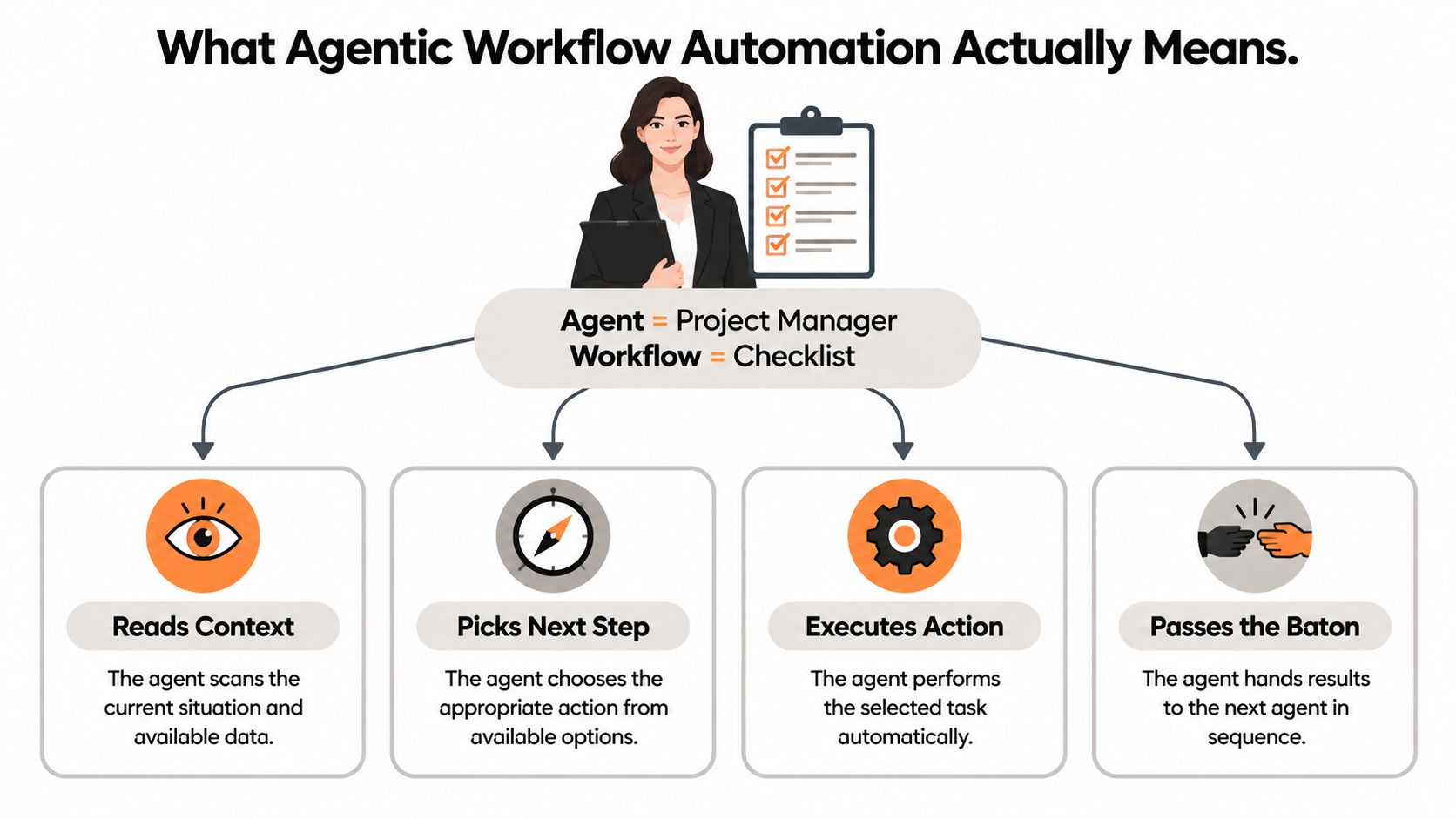
Think of an agent as a project manager with a checklist. A checklist says what belongs in the process, but the project manager notices when something changes, chooses the next move, and asks for help when the situation goes outside the plan. That is the core difference between agentic work and fixed automation.
The four parts that make an agent useful
An agent needs context, planning, execution, and memory.
Context tells it what is happening right now. In marketing, that might be a lifecycle stage, a suppressed contact, an underperforming audience, or a campaign that needs a revision.
Planning lets it choose the next action. A good agent does not just continue blindly. It decides whether to draft, route, wait, escalate, or stop.
Execution is the tool use. The agent sends the email, updates the CRM, writes the note, or calls the API.
Memory records what already happened so the next step does not repeat the last mistake.
That loop is why agents differ from classic rules-based automation. Traditional automation runs the branch you drew in advance. Agentic workflow automation adjusts inside the run based on what just happened. For a deeper product-side explanation of how these systems keep moving across content and tools, how websites keep up is a helpful reference, and the autonomous agents documentation shows how this logic maps into a marketing operating environment.
If the workflow can't remember its last action, it can't safely take the next one.
That is why the useful question isn't, “Can an AI write the message?” It's, “Can an AI notice the right signal, choose the right next step, execute it through the right system, and keep enough state to avoid repeating itself?”
Trigger Patterns and Orchestration Models
A marketing agent needs a signal before it can act. Those signals usually fall into three families, and each one calls for different workflow logic.
Three trigger families marketers use every week
Behavioral triggers begin with a customer action. Someone abandons a cart, revisits a pricing page, or stops engaging with a trial. The workflow should connect that signal to a timely response, such as a message, segment update, or sales task, while checking identity and consent before any customer-facing action.
Lifecycle triggers begin with a change in customer state. A subscriber becomes a churn risk, a lead becomes sales qualified, or a new customer completes onboarding. The agent applies the playbook for that stage, while preserving the person's history so the next action fits the journey.
Operational triggers begin inside the marketing system. A budget runs low, a feed fails, attribution falls behind, or a campaign needs another creative variant. The agent can route the issue, pause activity, or propose a fix. Spend limits and approval rules determine what it may do without human review.
A trigger is only the starting point. The workflow also needs an operating model that decides which agent acts, what context it receives, and where the result is recorded.
Choosing the right orchestration pattern
| Pattern | Best fit | Marketing example |
|---|---|---|
| Single agent | One bounded task with clear rules | Drafting a follow-up email after a trial milestone |
| Planner plus executor | A task that needs one system to decide and another to act | Selecting an audience, then sending the approved campaign |
| Multi-agent team | A multi-step journey with specialist handoffs | Planning, creative, QA, sending, and reporting across a lifecycle program |
Orchestration works like air traffic control for campaign work. One agent may handle segmentation, another creative, and another measurement. A control layer keeps their context aligned, checks the person's identity, confirms consent at send, enforces spend limits, and preserves an immutable record of decisions and actions. Holdout rules can also be set before activation, so measurement is part of the workflow rather than an afterthought.
The marketing orchestration guide from The AI CMO describes the same operating model in campaign terms. The important distinction is governance. Agentic automation is a governed operating system for marketing work, not simply a chatbot connected to more tools.
Choose the smallest pattern that can handle the job. A bounded draft may need one agent. A coordinated campaign may need a planner and executor. A lifecycle program with specialist handoffs may justify a multi-agent team, provided the control layer can show who acted, why, and under which limits.
How a Multi-Step Campaign Actually Runs
A dormant-subscriber campaign is a good example because every step has a real consequence. The team wants revenue, not just more sends, so the workflow has to coordinate timing, relevance, and control all at once.
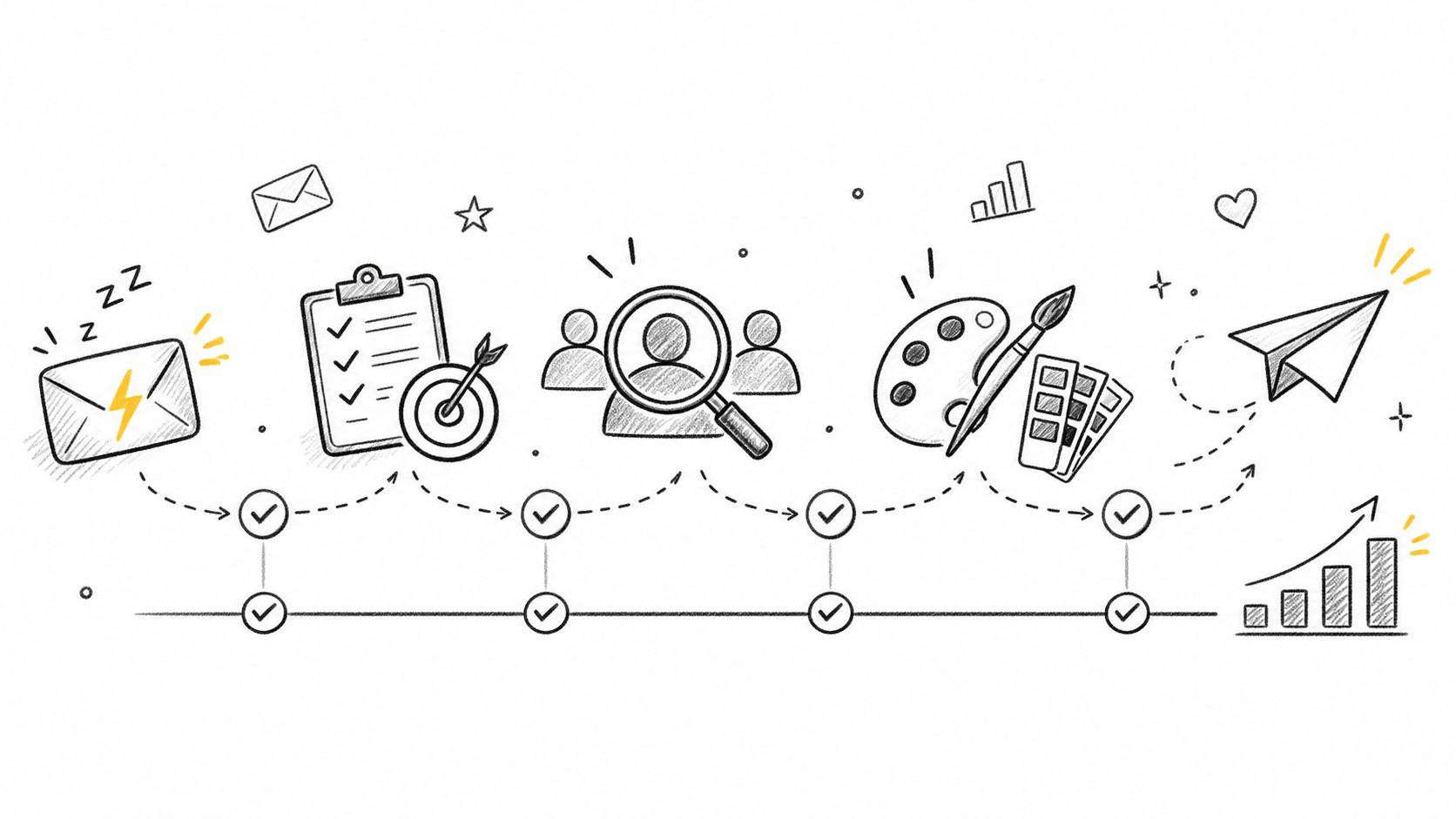
The planner agent starts by drafting the offer and framing the campaign goal in plain language. The audience agent then proposes a holdout group so the team can see whether the workflow caused any lift at all. The creative agent generates two message variants, and a human reviews which one matches the brand and the policy.
The sending agent should not fire just because the copy is ready. It should schedule delivery based on the customer's lifecycle timing, suppress anyone who should not receive it, and respect any frequency limits before the message leaves the system. The measurement agent then waits for the result, compares the outcome to the holdout, and recommends what to do next.
Approval belongs at the side effect, not at the draft. The closer the action is to a customer-facing change, the more important the human gate becomes.
That matters because a campaign can look elegant on paper and still fail in motion. An API can time out halfway through a send. A suppression rule can block a subset of the list. An attribution pull can return incomplete data and leave the team guessing. The system needs recovery logic for all of that, not just a hopeful retry button.
The video below is useful for seeing how the moving pieces fit together in a live workflow.
The useful skill for a growth team is not memorizing every agent role. It's being able to sketch the handoffs for one campaign and point to the exact place where the human review should stay in the loop.
Guardrails, Consent, and the Control Plane
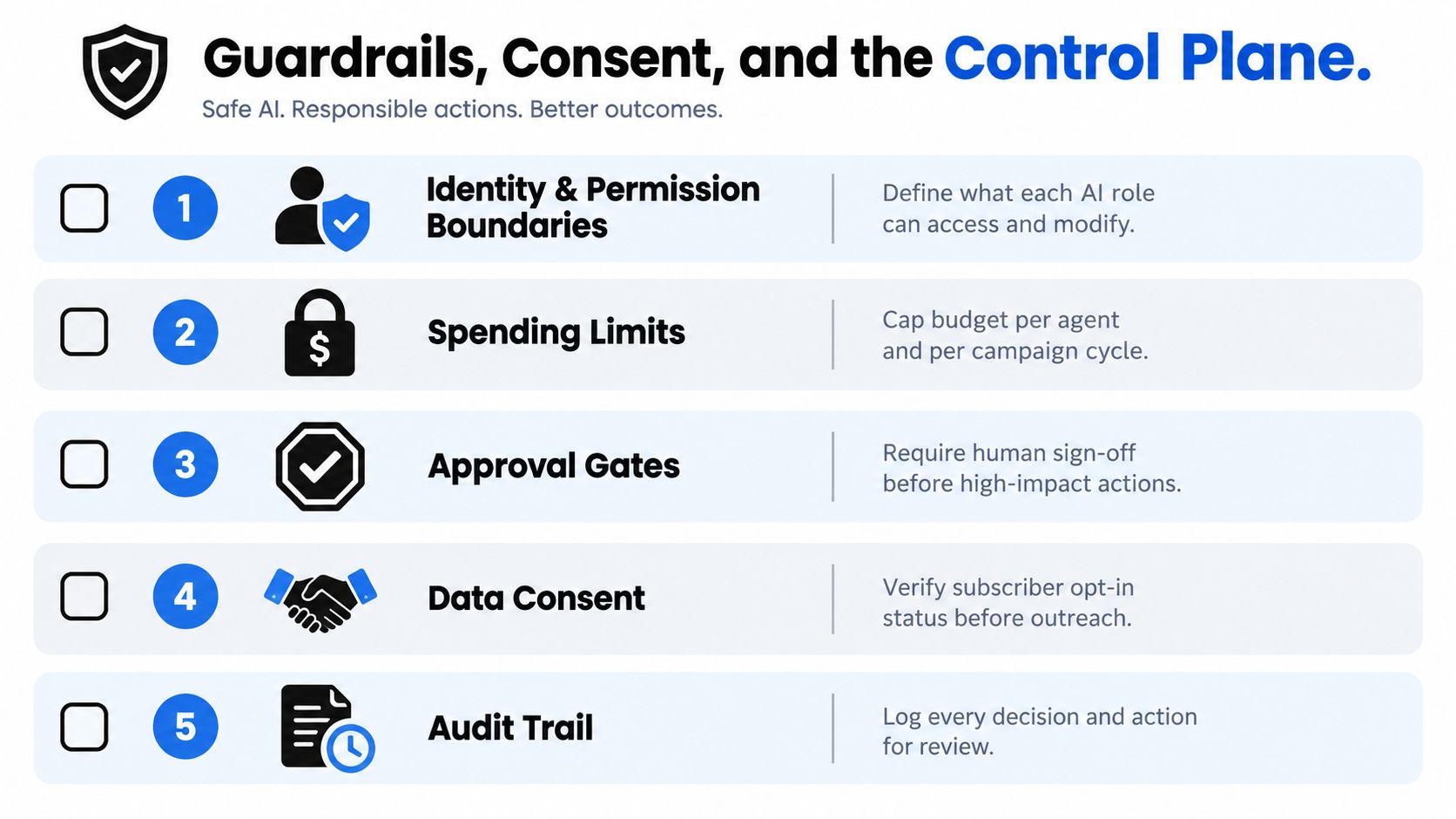
A marketing agent that can act without boundaries is risk wearing a friendly interface. The control plane keeps agentic workflow automation useful while protecting the brand, budget, and customer relationship. It works like an operating system for campaign decisions, defining who may act, what each action can affect, and which records the team can inspect later.
The seven controls that should not be optional
- Identity boundaries: each AI role needs a defined scope, so a creative agent cannot behave like a billing agent.
- Permission limits: access should match the task, not the enthusiasm of a demo.
- Spend caps: every workflow needs a ceiling for budget and pacing.
- Approval thresholds: high-impact actions should pause at a human gate.
- Consent checks at send: suppression and opt-in status must be enforced where the message leaves the system, not reviewed later in a report.
- Audit logging: every action should be attributable, readable, and preserved in an immutable record.
- Rollback or quarantine paths: when something goes wrong, the system should stop, isolate, or reverse the action.
These controls matter most at the points where automation changes customer state: a message is sent, a CRM record is edited, or budget is committed. A policy can describe the expected behavior, but enforcement has to sit inside the send path, CRM write, and campaign approval flow.
Trust remains a practical bottleneck. In a 2025 PwC survey of 308 US executives, lack of trust in AI agents ranked among the leading challenges, while connecting agents across applications and workflows ranked lower. The implication for marketing operations is direct: integration alone does not make an agent safe to run.
For developer teams, security context for development teams reinforces the same principle. Permissions, auditability, and controlled execution belong in the system design, not in a later review.
The AI CMO's governance framework treats consent, role boundaries, and immutable records as parts of the operating model. That gives a growth team useful questions for a vendor demo: which identity can trigger a send, where is consent checked, what stops overspending, and what record remains when an action is reversed?
Measuring Whether the Workflow Worked
A busy dashboard can hide a weak campaign. An agent may complete tasks, produce drafts, send messages, and fill reporting panels without creating profitable customer behavior.
The right question to ask
Measure whether the workflow improved business outcomes while operating within acceptable oversight. Separate activity metrics from outcome metrics. Activity covers volume, speed, and completed work. Outcomes include revenue, margin, retention, error cost, and the human effort required to approve or correct actions.
Autonomy can increase speed and mistakes at the same time. McKinsey reported that 51% of organizations using AI had experienced at least one negative consequence, with nearly one-third citing AI inaccuracy (McKinsey report). That finding makes error tracking part of performance measurement, not a separate compliance exercise.
Use a holdout group and set a baseline before launch. For example, if an automated workflow sends more campaigns while the holdout performs just as well, the additional activity produced no measured value. If re-engagement improves but error costs or approval work rise, compare the net gain rather than celebrating the conversion lift alone.
Salesforce research found that marketers using AI agents reclaim approximately eight hours per week, roughly one full working day, for strategy and creative work (Salesforce research). Treat that as a productivity signal, then test whether the recovered time improves campaign quality, speed to market, or commercial results.
A useful report can fit on one page.
Report the quarter in five numbers. Incremental revenue, margin, retention, error cost, and approval burden provide a clearer view than tasks completed.
The number of agents matters less than the evidence behind their work. A growth team should be able to explain those five measures to a CFO, identify which workflow caused the change, and show the immutable record supporting that conclusion.
A Practical Implementation Path for Marketing Teams
Marketing teams can start small. The goal is to turn fragmented execution into governed automation without disrupting the data layer that campaigns depend on.
Start with the data foundation
Salesforce research shows that marketers often struggle to unify customer data and remove barriers to personalization. That gap explains why agentic systems can look capable in a demo yet fail in production. An agent can make sound decisions only when it has a usable customer record and clear permission to act.
Begin with one customer record, a shared identity model, and accessible behavioral events. Unified data also makes timely responses easier because the workflow can connect activity, consent, audience membership, and campaign history before selecting an action. Fix the foundation before adding more agents.
Then phase the rollout
Phase one is a data and trust audit. Define what each agent may access, what it may change, and where human approval is required. Record the rules in a form that both operators and systems can inspect.
Phase two is one bounded sequence, such as a welcome journey or cart recovery. Keep approval in place for every customer-facing side effect, and compare results with a holdout group.
Phase three adds orchestrated journeys, split testing, scheduled verdicts, and an immutable record. That record should show who acted, which policy applied, what data supported the decision, and whether a person approved the step.
A marketing operating system built around a customer data platform, role-based AI specialists, journeys, and an append-only record fits this sequence. A fragmented stack can support parts of it, but coordination becomes harder when identity, sending, analytics, and approvals sit in separate systems. Consolidating those functions reduces handoffs and gives the growth team one place to inspect campaign behavior.
The AI CMO illustrates this architecture as a marketing operating system with built-in data, journeys, sending, and recordkeeping.
For a team mapping its next 90 days, the practical question is whether the system can govern, measure, and repeat campaign work without losing control of the customer.
If a growth team is ready to turn agentic workflow automation into an operating model, The AI CMO combines data, journeys, sending, and audit trails in one marketing system. That structure supports bounded automation while keeping approvals, consent, and measurement visible.
Share this article