Your 40-Page Brand Book Is Useless. Here's What Actually Enforces Brand Consistency.
The AI CMO team
Jan 11, 2026
Your company dropped $40K on brand guidelines last year.
Forty beautiful pages. Custom typography examples. Pantone swatches. Tone of voice frameworks with helpful labels like "professional yet approachable" and "confident but not arrogant." Three months of workshops. Final PDF delivered, shared in Slack, saved to the shared drive.
Nobody's opened it since week two.
Meanwhile, your social posts sound different every week. Email campaigns feel like they're written by three separate companies. Every piece of content created by freelancers requires at least two revision rounds to "make it sound more like us." And somehow, despite all the brand review meetings, you're still shipping stuff that makes your creative director wince.
Here's the uncomfortable truth: brand guidelines fail at scale not because they're poorly written – they fail because they're structurally incapable of enforcement.
When you're producing 200 pieces of content per month across six channels with eight different people creating it, a PDF sitting in your Google Drive isn't a system. It's hope disguised as infrastructure.
Real brand consistency in 2026 doesn't come from better guidelines. It comes from automated guardrails that prevent violations during creation, not suggestions that catch problems after content is already made.
Let's talk about why brand guidelines fail, what actually happens when content volume meets reality, and what enforcement – not documentation – actually looks like.
Why Brand Guidelines Fail: The Review Theater Problem
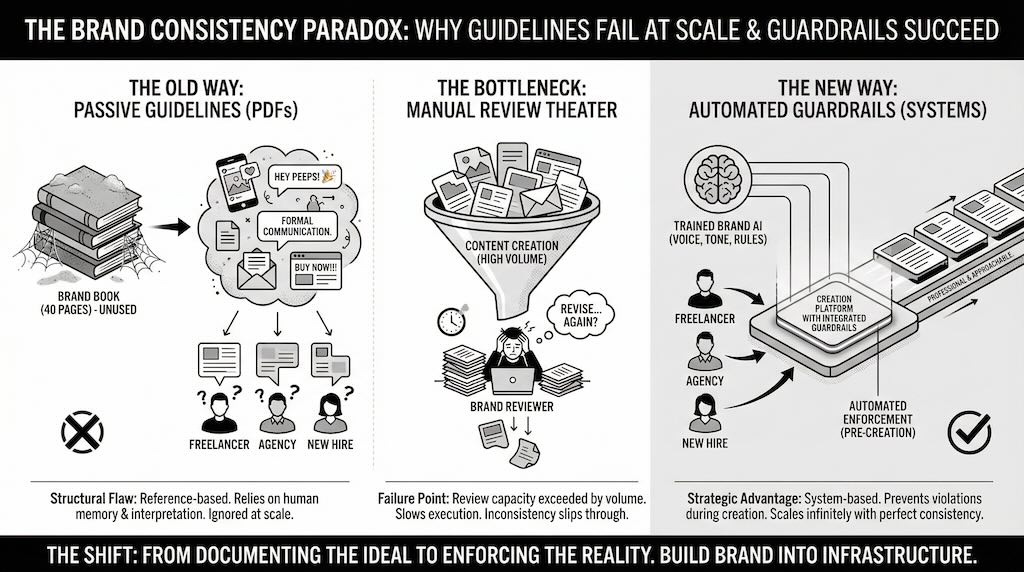
Brand guidelines are designed to be referenced, not enforced. That's the core structural flaw.
Look at what your brand book actually says: "Our voice is professional yet approachable, confident but not arrogant, friendly without being overly casual."
What happens in practice?
Marketer #1 reads "professional yet approachable" and writes in formal business tone. Marketer #2 interprets the same phrase as permission to write like they're texting a friend. Your agency partner thinks "confident but not arrogant" means use lots of exclamation points. The freelancer you just hired reads "friendly without being overly casual" and adds emojis to everything.
All four people genuinely believe they're following the guidelines.
Then comes the review cycle. The content gets created – already off-brand, but the creator doesn't realize it. It gets submitted for "brand review." Three days of back-and-forth begins: "Can you make it sound more like us?" Revisions sort of address the feedback but never quite nail the voice. Everyone's tired. Deadlines loom. You ship it anyway.
Repeat for the next 200 pieces of content this month.
This isn't a workflow. It's corporate Groundhog Day.
The problem is structural. Guidelines live in a PDF. Content gets created in Google Docs, email builders, social schedulers, design tools. There's a fundamental gap between "here's the ideal" and "here's what actually shipped."
The brand book can't actively prevent violations. It can only catch them after creation, when the creator has already invested time, deadlines are tight, and "close enough" starts feeling acceptable. Nobody wants another revision round.
Let's do the math on this. Say your company produces 200 pieces of content monthly. You've got 8 team members creating content, 3 contributing agencies, and 5 freelancers on rotation. That's 16 different people who need to "follow" the guidelines.
Even if everyone has an 80% adherence rate – which is actually pretty good – you're shipping 40 off-brand pieces every single month. That's 480 brand violations per year.
Now multiply that by the reality that customers typically see 7-10 touchpoints before purchase. Brand confusion isn't a risk. It's mathematical certainty.
Most companies respond to this problem in predictable ways. Option A: Add more review layers, which slows everything down. Option B: Accept brand drift as "the cost of scaling," which destroys consistency. Option C: Only trust 2-3 people to create content, which creates an immediate bottleneck.
None of these solve anything. They just force you to choose which dysfunction you can live with.
And here's the question nobody asks: If brand guidelines actually worked, why does every single piece still need brand review?
Because guidelines suggest compliance. They don't enforce it.
Brand Drift at Scale: What Happens When Guidelines Meet Reality
Brand consistency doesn't break all at once. It erodes slowly across hundreds of tiny violations until customers can't recognize you anymore.
Companies rarely have catastrophic brand failures. What they have is cumulative degradation.
Month 1: One email uses slightly more casual tone than approved. Performance is good. Nobody flags it.
Month 2: The next email uses that casual tone as the baseline. Goes slightly further. Still performing well.
Month 3: Social posts start matching the new email tone. The freelancer creating ads mimics what they see on social.
Month 6: Your "professional yet approachable" voice has drifted to "hey friends! 🎉" without anyone making a conscious decision to change it.
Month 12: A new employee reviews the brand guidelines and asks, "Wait, is this even our voice anymore?"
We've seen this pattern repeatedly. Here's what it looks like in specific channels.
The Welcome Email Chaos
Welcome email v1 (2024): Professional, clear, perfectly aligned with brand guidelines.
Welcome email v2 (written by new hire, early 2025): Casual, emoji-heavy, completely different tone.
Welcome email v3 (revised by agency, mid-2025): Trying to split the difference, sounds like neither version.
A customer signs up, gets all three across their lifecycle. Experiences brand whiplash.
The Multi-Channel Mess
Instagram feels fun, casual, emoji-filled because the social team runs it. Email campaigns read professional and corporate because lifecycle marketing owns them. Blog content skews academic and formal – that's the content team's style. Paid ads? Hype-driven and promotional, handled by an external agency.
Same company. Four completely different voices. Zero consistency.
The Freelancer Problem
Every freelancer writes in their own natural voice, then tries to "adjust" to your brand by reading a few example pieces. The result? Their voice plus surface-level brand mimicry equals almost right, never quite there.
You end up with content that's 80% brand-aligned. Which means it's 20% off. Multiply that across 50 freelancer-created pieces and you've got a nightmare.
The Agency Translation Game
You tell the agency: "Make it more like us."
They revise. It's closer but still not quite right.
You respond: "Hmm, can you make it sound less corporate?"
They swing too far casual.
You try again: "Maybe somewhere in between?"
Now it's bland.
After round four, everyone's exhausted. You ship something that's "good enough." Next month, same dance.
According to research at https://www.marq.com/blog/brand-consistency-competitive-advantage, brand consistency can increase revenue by 10-20%, yet 77% of organizations struggle with off-brand content. The gap isn't knowledge – it's enforcement.
What This Actually Costs
Direct costs: Review cycles add 2-4 days per campaign. Revision rounds cost $500-2K in agency and freelancer time per project. Delayed launches mean missed revenue opportunities.
Hidden costs: Brand recall drops when voice is inconsistent. Customer trust erodes with fragmented messaging. Your template library becomes useless because every template needs heavy editing anyway. Onboarding new team members takes longer because they can't learn from examples that don't match the guidelines.
And there's the scaling trap. At 10 pieces of content monthly, manual brand review is annoying but manageable. At 100 pieces monthly, it becomes a bottleneck that delays everything. At 500 pieces monthly? Literally impossible.
Most companies respond by either accepting lower quality and consistency (brand drifts), creating review bottlenecks (slows everything), or limiting output (can't scale). All three options suck.
The uncomfortable truth: Brand guidelines fail at scale not because they're poorly written. They fail because they're structurally incapable of enforcement when content volume exceeds human review capacity.
You can't manual-review your way to consistency at scale. The math doesn't work.
From Guidelines to Guardrails: What Actually Works
The future of brand consistency isn't better guidelines. It's automated guardrails that prevent violations during creation, not after.
So what do brand guardrails actually mean? Not suggestions. Enforcement. Not "please follow these." Prevention of violations. Not post-creation review. Pre-creation guardrails.
Think of it like this:
Brand Guidelines: "Here's our approved voice. Please try to match it."
Brand Guardrails: "The system won't generate content that violates your brand. Violations are impossible."
One is a reference document. The other is infrastructure.
As brandyhq.com points out, PDF brand guidelines were built for a fixed brand era – when identity systems lasted years without change and marketing channels were limited. Today's brands exist across websites, apps, social platforms, video, email, and dozens of other touchpoints. Content is produced daily, sometimes hourly. Static documents can't keep up.
How Guardrails Work in Practice
The System Knows Your Brand
Not generic "professional" or "casual" – your specific voice. Trained on your approved content, your messaging, your tone. It understands the nuances: your humor style, technical depth, formality level. It knows what you'd never say, and it won't generate it.
Creation-Time Enforcement
Content gets created within guardrails from the start. Not flagged after creation. Prevented during creation. A team member can't accidentally drift off-brand because the system constrains output. Freelancers and agencies automatically produce on-brand content without needing to memorize guidelines.
The Difference This Makes
❌ Old way (Guidelines):
- Create content
- Review for brand
- Request revisions
- Review again
- Ship (maybe on-brand)
Timeline: 3-5 days
Brand accuracy: 70-80%
Team frustration: High
✅ New way (Guardrails):
- Create content (system enforces brand)
- Ship
Timeline: Same day
Brand accuracy: 95-100%
Team frustration: None
The AI CMO has built this kind of real-time brand governance directly into content creation tools. Our Marketing Operating System automatically extracts brand rules from existing guidelines and enforces them as content is generated – not as an afterthought.
Real-World Applications
Email Marketing: Welcome series, lifecycle emails, promotional campaigns – all automatically on-brand. Ten different team members creating content, same consistent voice. No review delays, ship faster.
Social Media: Multiple channels, multiple team members, unified brand voice. Freelancers create posts that sound exactly like the internal team. Agency content is perfectly aligned without revision rounds.
Paid Advertising: Google Ads, Meta ads, LinkedIn – consistent messaging across all of them. Multiple campaigns running simultaneously with the same brand standards. External agency management without brand drift.
Content Marketing: Blog posts, case studies, whitepapers with a unified voice. Different writers, same output quality. Freelancers and agencies producing content that doesn't need the "almost right" revisions.
What This Enables at Scale
Produce 500 pieces of content monthly with perfect brand consistency. Onboard unlimited freelancers and agencies without extensive brand training. Scale output 10x without adding review layers. Ship campaigns same-day instead of waiting for approvals.
The compounding effect is real. Month 1: Brand consistency across all new content. Month 3: Every channel sounds cohesive. Month 6: Customer recognition increases – consistent voice builds stronger brand recall. Month 12: Your brand guidelines actually match what you're shipping, because guardrails enforce them automatically.
Why this changes everything: Guidelines ask humans to remember and apply complex rules consistently. Humans are terrible at this. Guardrails encode rules into systems. Systems are perfect at this.
Guidelines hope for compliance. Guardrails guarantee it.
The Infrastructure Shift
This isn't about buying a better PDF template for brand guidelines. It's about building brand consistency into your marketing infrastructure.
Not "here's how we want our brand to sound." But "our system won't let us sound any other way."
According to averi.ai, 83% of marketers report creating content faster with AI, but only 25.6% say it outperforms human content. The gap? Most teams are using AI like a cheap ghostwriter instead of an intelligent tool that can actually learn and maintain brand voice.
What Brand Consistency Actually Requires in 2026
Brand consistency at scale requires three things traditional guidelines can't provide.
Requirement 1: Automated Enforcement
Manual review doesn't scale past 50 pieces monthly. You need systems that prevent violations, not catch them.
What this looks like: Content generation happens within brand constraints from the start. The system has learned your voice and applies it automatically. There's no "review for brand" step – brand is enforced during creation.
Requirement 2: Knowledge Permanence
Every brand refinement should improve all future content. Not just the next piece.
With guidelines: You make one correction and hope people remember it.
With guardrails: You make one correction and the system applies it forever to all future content.
Example: You decide "solutions-focused" is better than "problem-solving." With guardrails, every piece of future content automatically uses "solutions-focused." With guidelines, you'll see "problem-solving" again in three weeks when someone forgets or doesn't check.
As we in theaicmo.com point out, the future of marketing is a system that captures expertise, enforces standards, and compounds everything you learn. Knowledge stays. Quality scales. Chaos ends.
Requirement 3: Team-Independent Consistency
Your brand voice shouldn't depend on who's creating content.
With guidelines: Your best writer creates on-brand content. Everyone else struggles.
With guardrails: Everyone produces the same quality because the system enforces it.
New hire, ten-year veteran, freelancer, agency partner – the output sounds identical because brand is in the system, not dependent on the person.
What This Means for Marketing Teams
Freedom to scale without brand fear. Produce unlimited content. Speed increase through eliminated review bottlenecks. Quality consistency where every piece meets brand standards automatically. Resource efficiency by stopping the endless revision rounds.
The strategic advantage is real. Your competitors with brand guidelines are slowing down to maintain consistency. Companies with brand guardrails are scaling fast while maintaining consistency.
That's not a feature difference. That's a strategic moat.
Research from beautiful.ai confirms that brand consistency can increase revenue by 10-20%, yet as AI accelerates content creation, maintaining that consistency becomes harder than ever. The organizations that win are building brand protection directly into their creation systems.
Beyond Theater
Your 40-page brand book isn't useless because it's poorly written. It's useless because it's a reference document trying to solve an enforcement problem.
Guidelines can't scale. Review cycles can't keep up. Manual compliance doesn't work when you're producing hundreds of pieces across multiple teams, channels, and partners.
The shift required is simple but fundamental.
Stop asking: "How do we get people to follow brand guidelines?"
Start asking: "How do we make brand violations structurally impossible?"
The answer isn't better training. It's better systems.
Brand consistency in 2026 looks different. Not PDFs gathering digital dust. Not review cycles delaying every launch. Not hoping freelancers "get" your voice.
But automated guardrails that enforce your brand in every piece of content, created by anyone, across any channel, at unlimited scale.
You have a choice. Keep treating brand as a reference document people should follow. Or build brand into your marketing infrastructure so consistency is automatic.
One scales. The other doesn't.
Real brand consistency doesn't come from better guidelines. It comes from systems that won't let you violate your brand – even if you tried.
Share this article