You Don't Need to Know AI. You Need AI That Knows Your Brand.
Here's the paradox killing B2C marketing teams in 2026: AI can create content in seconds, but you can't actually use it.
The AI CMO team
Jan 29, 2026
Your e-commerce director opens ChatGPT.
"Write product descriptions for our new summer collection."
30 seconds later: 12 product descriptions. Perfect length. SEO-optimized. Ready to use.
Except...
"Adventure awaits with this stylish piece": your brand doesn't say "adventure awaits"
"Perfect for the modern woman": you target Gen Z, not "modern women"
"Elevate your wardrobe": you're a streetwear brand, not a luxury label
"Crafted with care": generic filler that could be any brand
Your team spends 2 hours rewriting what AI "generated" in 30 seconds.
Sound familiar?
Here's the paradox killing B2C marketing teams in 2026: AI can create content in seconds, but you can't actually use it. Because brand voice isn't negotiable in consumer marketing. One off-brand Instagram post can damage customer trust you spent years building.
So you're stuck. The content volume demands keep growing (50+ product descriptions monthly, daily social posts, email campaigns, seasonal launches, ad variations). Your team is drowning. AI promises relief. But every piece needs so much editing that you're not sure it's saving time at all.
Most advice? "Master prompt engineering! Take AI courses! Build detailed prompt libraries!"
That's not the solution. That's treating the symptom.
Here's what actually works: You don't need to know AI. You need AI that knows your brand.
Why B2C Brands Can't Use AI (Yet)
The numbers tell a weird story. According to recent industry research, 73% of B2C companies have access to AI tools. But only 12% use them regularly for customer-facing content.
Why such a massive gap?
It's not because marketers are technophobic or resistant to change. It's because generic AI fundamentally doesn't work for B2C brands.
Problem 1: Brand Voice Isn't Optional
B2B can be more forgiving. "Solutions-driven approach" is generic but acceptable. Enterprise buyers care about features and ROI, not brand personality. A slight tone variation doesn't break trust.
B2C is ruthlessly unforgiving.
Your audience knows your voice instantly. When something doesn't sound like you, they scroll past. Brand voice is your competitive moat. As searchengineland.com points out, "AI-generated content is now standard, but drafts often sound generic, flat, or emotionally neutral. They drift from your brand voice unless you teach the model what 'on-brand' means."
Look at this comparison:
B2B SaaS post (generic AI works fine):
"Streamline your workflows with our new automation features. Book a demo today."
Fashion brand post (generic AI fails):
"Look stylish this season with our new collection. Shop now."
Nobody talks like that second example. The brand is dead on arrival.
Problem 2: High Volume Meets High Stakes
B2C content needs are relentless:
- 50+ product descriptions monthly (new inventory drops)
- Daily social posts across multiple platforms
- Email campaigns segmented by audience
- Seasonal campaigns (holidays, trends, cultural moments)
- Influencer briefs that actually sound like your brand
- Ad variations for A/B testing
The current workflow goes like this: Use ChatGPT to generate content. Review every output. Rewrite 80% of it. Publish maybe 20%. AI didn't save time. It added a review layer.
Honestly, sometimes it feels faster to just write it yourself from scratch.
Problem 3: The Prompt Engineering Trap
To get decent brand voice from ChatGPT, you need to:
- Write detailed prompts (200+ words each time)
- Include brand guidelines in every prompt
- Show examples of good copy
- Iterate 3-5 times per piece
- Build and maintain prompt libraries
- Train your entire team on effective prompting
This works if you have 1-2 people handling all AI content, and they basically become full-time prompt engineers.
This fails when you have a 5-person marketing team where everyone needs to create content fast, nobody has time to learn prompt engineering, and results are still wildly inconsistent.
The bottleneck just shifted. Before AI: "We can't create content fast enough." After AI: "We can't review and fix AI content fast enough."
Problem 4: Generic Equals Death in B2C
B2B brands can get away with "innovative solutions" and "industry-leading platform" and "drive efficiency."
B2C brands that talk like this fail immediately.
Glossier doesn't say "beauty solutions." Liquid Death doesn't say "premium hydration." Gymshark doesn't say "activewear for modern athletes."
They have voice. Distinctive, recognizable, impossible to confuse with competitors. And AI doesn't speak it... unless you train it specifically on your brand.
According to averi.ai, 77% of consumers can identify AI-generated content, and 68% trust it less than human-created content. The bigger problem isn't that people can tell. It's that AI content that sounds like it could be from anyone actively damages your brand differentiation.
The real problem? Current AI tools are blank slates. You have to train them every single time. B2C brands need AI that's already trained on their brand.
What "AI That Knows Your Brand" Actually Means
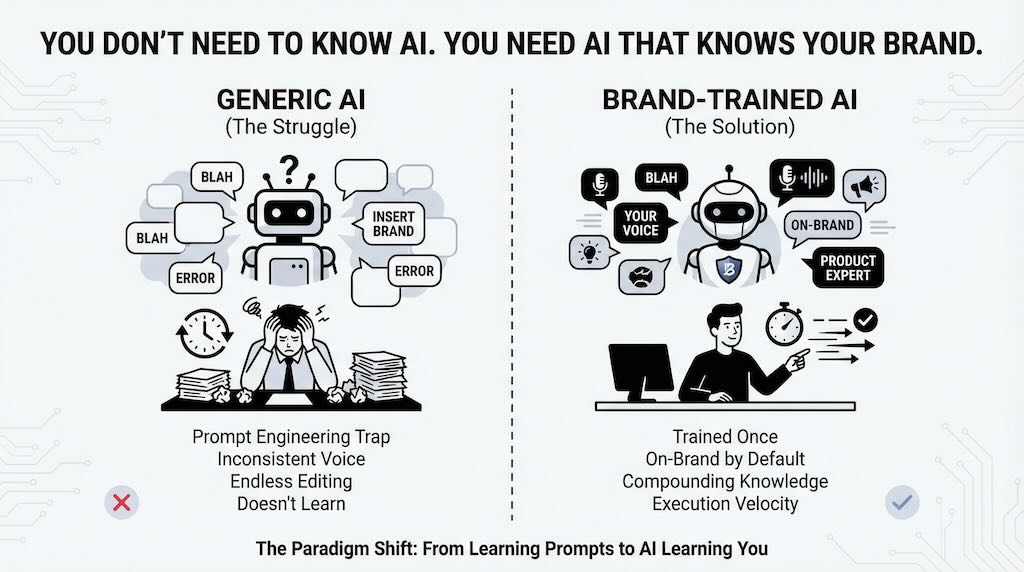
There's a fundamental difference between generic AI and brand-trained AI that most people miss.
Generic AI (ChatGPT, Claude, etc.):
- Trained on the entire internet
- Knows everything about everyone
- Knows nothing specific about YOU
- Every interaction starts from zero
Brand-Trained AI:
- Trained specifically on YOUR brand
- Knows your voice, products, audience, positioning
- Remembers corrections permanently
- Every interaction builds on previous knowledge
Component 1: Brand Voice Training
Instead of telling AI your brand voice every single time ("We're a sustainable activewear brand targeting Gen Z female athletes with a playful, authentic tone inspired by Outdoor Voices and Girlfriend Collective..."), you train it once.
How it works:
- Upload brand guidelines
- Show examples of on-brand copy (your best social media posts, emails, product descriptions)
- Feed it customer reviews (how they actually talk about you)
- Include product descriptions that performed well
The system learns your vocabulary, sentence structure, personality, and how your audience speaks. Every piece of content sounds like your brand by default, not by editing.
As airops.com discovered in their research, "Brand voice guidelines became a prerequisite for any team publishing with AI at scale. Prompt quality improved fastest when teams trained on their own top-performing content."
Component 2: Product Knowledge That Sticks
With generic AI, every time you need product descriptions, you paste product details, features and benefits, target audience, brand voice... wait for output... fix what's wrong... repeat for the next product.
Brand-trained systems store product info permanently. All SKUs with attributes. Product categories and positioning. Features that matter for each audience segment. Similar products for consistency reference.
Example difference:
Generic AI: "This comfortable t-shirt is perfect for everyday wear."
Brand-trained AI (sustainable fashion brand): "Organic cotton that's soft as hell. Wear it everywhere, wash it forever, love it for years."
The difference? The system knows your products AND your voice AND your audience. No prompting required.
Component 3: Learning That Compounds
Generic AI resets every conversation. You teach it something. Next conversation, it forgot.
Brand-trained AI captures every correction:
You edit: "We don't say 'premium quality,' we say 'built to last'"
System learns: Never use "premium quality" again. Always use "built to last."
Performance learning happens automatically. Email subject line A got a 42% open rate? Email subject line B got 18%? System learns: Style A works better, produce more like this.
Audience insights compound. Instagram posts about sustainability get 3x engagement versus product features? System learns: Lead with sustainability, then mention product.
You reject 5 pieces of content for being "too corporate"? System learns: Avoid formal, business-like language.
The compounding effect is real. Month 1, you're training the AI (lots of edits). Month 3, AI produces 80% ready content. Month 6, AI produces 95% ready content. Month 12, AI writes better brand copy than new hires.
Because it learned from every correction, every campaign, every result.
Generic AI never gets better. Brand-trained AI compounds.
Component 4: Brand Guardrails (The Enforcement Layer)
This is honestly the game-changer for B2C brands.
Generic AI: You hope it follows your guidelines.
Brand-trained AI: It CAN'T violate your guidelines.
How guardrails work in practice:
Brand voice rules:
- ❌ Never say: "innovative," "cutting-edge," "solutions"
- ✅ Always use: casual contractions, action verbs, customer language
- ❌ Tone violations: corporate speak, excessive adjectives, buzzwords
- ✅ Tone requirements: conversational, specific, benefits-first
Product rules:
- Never claim benefits not scientifically proven
- Always include key product differentiators
- Must mention sustainability for eco-line products
Compliance rules:
- No health claims without disclaimers
- No comparative advertising without proof
- Age-appropriate language for target demographic
Result: Brand violations aren't possible. The system enforces consistency by design, not review.
Summary of "AI That Knows Your Brand": Trained on your specific brand (not the internet). Remembers your products, audience, voice permanently. Learns from corrections and performance. Enforces brand rules automatically.
You don't train it every time. You trained it once. Now it's your brand expert.
The Generic AI vs. Brand-Trained AI Comparison
Let's see this in action with real examples.
Example 1: Sustainable Fashion Brand
Brand: EcoThreads (sustainable activewear, Gen Z female audience, playful activist tone)
Prompt: "Write an Instagram post for our new recycled polyester leggings."
Generic AI (ChatGPT) Output:
"Introducing our new eco-friendly leggings! 🌱 Made from recycled materials, these stylish leggings are perfect for your active lifestyle. Comfortable, sustainable, and fashionable. Shop now and make a difference! Link in bio. #SustainableFashion #EcoFriendly #ActiveWear"
Problems:
- "Eco-friendly" – generic sustainability talk
- "Perfect for your active lifestyle" – every activewear brand says this
- "Make a difference" – vague call-to-action
- Emoji use doesn't match brand
- Sounds like 50 other brands
Brand-Trained AI Output:
"Okay but these leggings are made from 20 recycled plastic bottles and they're somehow softer than regular polyester???
Science or magic, idk but your thighs will thank you.
Plus: Every pair = 20 fewer bottles in the ocean. Cute AND helpful. 💅
Shop: link in bio"
What it got right:
- ✅ Conversational, Gen Z tone ("Okay but," "???," "idk")
- ✅ Specific benefit (20 bottles, softer than regular)
- ✅ Playful personality matches brand
- ✅ Benefit-driven, not feature-driven
- ✅ Emoji use matches audience
- ✅ Short, punchy sentences
Why? System was trained on EcoThreads' voice, knows their audience, learned from past high-performing posts.
Example 2: Craft Beer Brand
Brand: RoughHouse Brewing (adventurous, irreverent, male 25-40 audience)
Prompt: "Write a product description for our new IPA: 'Trail Boss' – citrus notes, 7.2% ABV, hoppy finish."
Generic AI Output:
"Trail Boss IPA is our newest addition to the RoughHouse family. With refreshing citrus notes and a bold, hoppy finish, this 7.2% ABV beer is perfect for the discerning craft beer enthusiast. Whether you're relaxing after work or enjoying time with friends, Trail Boss delivers exceptional flavor and quality in every sip."
Problems:
- "Discerning craft beer enthusiast" – sounds pretentious
- "Exceptional flavor and quality" – meaningless filler
- "Relaxing after work" – boring use case
- No personality, could be any brewery
Brand-Trained AI Output:
"Trail Boss IPA: 7.2% ABV | Citrus-Forward | Aggressively Hoppy
This beer isn't subtle. Big citrus punch, bigger hop bite, finish that reminds you why you like IPAs in the first place.
Named after the friend who takes a wrong turn on every hike and somehow finds a better view.
Pairs with: Tacos. Arguments about hiking trails. More of this beer."
What it got right:
- ✅ Direct, no-BS tone matches brand
- ✅ "Isn't subtle" – personality in product description
- ✅ Storytelling (why "Trail Boss")
- ✅ Humor that resonates with audience
- ✅ Pairing suggestions are brand-appropriate
- ✅ No corporate speak
Example 3: Skincare Brand
Brand: Glow Lab (science-backed skincare, millennial women, education-focused, sophisticated but accessible)
Prompt: "Write an email subject line for our Vitamin C serum launch."
Generic AI (10 options):
- "New Product Alert: Vitamin C Serum 🌟"
- "Brighten Your Skin with Our New Serum"
- "Introducing: Our Most Powerful Vitamin C Yet"
- "Get Glowing: Vitamin C Serum Now Available"
- "Your Skin Will Thank You: New Vitamin C Launch"
Problems: Generic product announcements. No specificity. Emoji use doesn't match sophisticated brand. No education angle.
Brand-Trained AI (10 options):
- "15% L-Ascorbic Acid. Stable. Finally."
- "Why most Vitamin C serums oxidize before you finish the bottle"
- "The Vitamin C stability problem: solved"
- "Tested on 200 women. 87% saw visible results in 3 weeks."
- "This is what actual Vitamin C science looks like"
What it got right:
- ✅ Specific formulation details (15%, L-Ascorbic Acid)
- ✅ Addresses real customer pain point (stability/oxidation)
- ✅ Education-first approach matches brand
- ✅ Data-driven messaging (200 women, 87% results)
- ✅ Sophisticated tone without being corporate
The pattern is clear. Generic AI sounds like everyone else. Brand-trained AI sounds like YOUR brand.
Why "Learning AI" Isn't The Answer
The advice you keep hearing: "Master prompt engineering! Take AI courses! Build a prompt library! Hire an AI specialist!"
This works for tech companies with AI teams, B2B brands with simple voice, agencies with dedicated prompt engineers, or companies creating 10-20 pieces monthly.
This fails for B2C brands with high content volume (50+ pieces/week), marketing teams where everyone needs to generate content, brands where voice consistency is make-or-break, and teams that don't have time for 40-hour AI courses.
The math doesn't work:
Prompt Engineering Approach:
- Time to train one marketer on effective prompting: 20-40 hours
- Time to craft a good prompt: 10-15 minutes
- Time to iterate to get brand voice right: 5-10 attempts
- Time per piece of content: 30-45 minutes
For a 5-person team creating 100 pieces monthly: 100-200 hours training the team, 50-75 hours per month on prompting. Still inconsistent results. Still requires review and editing.
Brand-Trained System Approach:
- Time to train the AI on your brand: 1-2 hours (one-time)
- Time to generate on-brand content: 30 seconds
- Time to iterate: Minimal (already knows your brand)
- Time per piece of content: 5 minutes (generate + light review)
For a 5-person team creating 100 pieces monthly: 2 hours training (one-time), 8-10 hours per month creating content. Consistent results. Minimal editing required.
The difference: 50 hours/month versus 8 hours/month.
But there's a bigger problem with "learning AI." Even if your team masters prompt engineering, generic AI still doesn't remember your brand. New team members have to learn prompting. Prompt libraries get outdated. Results are still inconsistent. Knowledge doesn't compound.
You're teaching humans how to teach AI. Better approach: Use AI that's already taught about your brand.
The role reversal: Old thinking says humans need to learn AI's language (prompts). New thinking says AI needs to learn your brand's language (training).
You shouldn't have to become an AI expert. AI should become a brand expert.
How Brand-Trained AI Actually Works (Behind the Scenes)
Most B2C marketers don't care about technical details. But understanding the "how" builds trust.
The Setup (Happens Once)
Step 1: Brand Knowledge Capture
The system ingests brand guidelines (tone, voice, personality), best content examples (top-performing social posts, emails, product descriptions), product catalog (all SKUs, attributes, positioning), customer language (reviews, testimonials, how they describe your products), and anti-patterns (things you NEVER say, competitive brands to avoid sounding like).
Example upload for fashion brand: Brand guideline doc (PDF), 50 top Instagram posts, 30 email campaigns with high engagement, product feed (CSV with 200 SKUs), 100 customer reviews.
Time required: 1-2 hours.
Step 2: AI Training
The system analyzes vocabulary patterns (words you use frequently versus never), sentence structure (length, complexity, rhythm), tone markers (contractions, punctuation, emoji use), product positioning language (how you describe benefits), and audience alignment (what resonates with your customers).
It creates a brand voice model specific to you, product knowledge base that's searchable and connected, audience preference map showing what works and what doesn't, and compliance ruleset with brand guardrails.
This happens automatically. You upload, system learns.
Step 3: Guardrail Configuration
You set rules. Never use corporate buzzwords, competitor phrases, off-brand terms. Always include key differentiators, sustainability mentions, product specifics. Tone requirements like casual contractions, action verbs, benefit-focused language.
Example for sustainable fashion brand: Block "eco-friendly" (overused), "modern woman" (generic), "elevate" (too luxury). Require specific sustainability facts, Gen Z language patterns, conversational tone. Flag health claims without proof, comparative statements, vague benefits.
The Execution (Every Time You Create Content)
Step 1: You Request Content
Simple, conversational requests: "Write Instagram posts for our new winter collection." "Create product descriptions for these 10 SKUs." "Generate email subject lines for the holiday sale."
No detailed prompts needed. The AI already knows your brand.
Step 2: System Generates On-Brand Content
The AI automatically uses your brand voice (learned from training), references product details (from knowledge base), applies audience preferences (from performance data), and enforces guardrails (blocks off-brand content).
Output: Content that sounds like your brand by default.
Step 3: Learning Loop
Every interaction improves the system. When you edit ("This is too formal"), system learns to use more casual language. When you approve ("This is perfect"), system learns this style/tone/structure works. When campaigns perform (Email A: 35% open rate), system learns this subject line style resonates.
Result: Month 3 content is better than Month 1. Month 6 is better than Month 3.
According to medium.com, "Most generative AI projects fail for governance reasons, not model quality. Workflows, data, and roles are rarely redesigned around responsible AI."
The key difference: Generic AI requires training every single time (via prompts). Brand-trained AI gets trained once, remembers forever, and gets better.
What This Means for B2C Marketing Teams
The practical impact changes everything.
Impact 1: Speed Without Sacrifice
Before brand-trained AI: High volume meant hire more people or sacrifice quality. Fast meant generic and off-brand. On-brand meant slow and manual.
After brand-trained AI: 50 product descriptions in 30 minutes (not 10 hours). All sound like your brand. Quality stays high at volume.
Real example: Fashion brand with monthly inventory drop (40 new SKUs). Old process took 2 days to write descriptions (1 copywriter). New process takes 2 hours to generate and review (same copywriter). Time saved: 14 hours. Quality: On-brand, consistent, no generic filler.
Impact 2: Team Can Focus on Strategy
Before, your senior marketers spent time writing basic product descriptions, crafting routine social posts, generating email variations, creating ad copy iterations.
After, AI handles routine execution. Your team focuses on campaign strategy, creative direction, audience insights, and performance optimization.
The shift goes from "Can you write 10 Instagram posts by EOD?" to "Let's analyze why our sustainability content outperforms product-focused content."
Your team becomes strategists, not production workers.
Impact 3: Consistency at Scale
The beauty brand problem: 5 marketers creating content, each with slightly different interpretation of brand voice. Content across channels feels inconsistent. New hires take 6 months to "get" the voice.
With brand-trained AI: Everyone uses the same AI (trained on the same brand). Every output matches the brand voice. New hires create on-brand content from day one. Consistency across all channels, all creators.
Brand voice becomes enforceable, not aspirational.
Impact 4: Testing Without Waste
Old A/B testing approach meant creating 2-3 variations manually, which took hours or days, limited test variations, and missed opportunities.
Brand-trained AI testing: Generate 20 variations in 5 minutes, all on-brand, test more angles, find winners faster.
Example with email subject lines: Old approach tested 2-3 manually written options. New approach generates 20 variations (question-based, benefit-driven, curiosity, urgency, etc.), tests top 5. Result: 2-3x higher chance of finding high-performer.
Impact 5: Knowledge That Stays
The agency/freelancer problem: They learn your brand, create great content, then leave. Knowledge walks out the door.
Brand-trained AI: All learnings stay in the system. Every correction is permanent. Every performance insight compounds. Team changes don't reset your marketing.
Company knowledge becomes an asset, not tied to individuals.
The Real B2C Marketing Problem (And Why Most Solutions Miss It)
Let's be honest about what B2C marketing teams actually struggle with.
It's not ideas. You have 100 campaign ideas. You can't execute 95 of them.
It's not strategy. You know what works (customer testimonials, sustainability content, UGC-style posts).
It's not budget. You have budget. You're paying agencies or tools that don't deliver.
It's execution velocity.
You need to launch seasonal campaigns every 4-6 weeks, post daily across Instagram, TikTok, Facebook, create product content for 30+ new SKUs monthly, test 5-10 ad variations per campaign, write email sequences for 3-5 segments, respond to trends within 24 hours, and create UGC-style content at scale.
With a 3-5 person team.
Why traditional solutions fail:
Hiring more people: Takes 3-6 months to onboard, costs $60K-80K per hire, doesn't scale infinitely, knowledge loss when people leave.
Using agencies: $5K-15K/month for basic support, slow turnaround (1-2 weeks), knowledge stays with agency, still need internal team to manage them.
Using generic AI tools: Outputs don't sound like your brand, requires expertise to get good results, team spends time reviewing and editing, doesn't learn or improve.
What actually solves this? Brand-trained AI that executes at the speed of thought (seconds, not days), maintains brand voice automatically (no review tax), handles volume without more headcount, costs $99-499/month not $10K/month, and gets better over time through compounding.
The goal isn't to eliminate humans. It's to eliminate the execution bottleneck so humans can focus on what AI can't do: strategic thinking, creative direction, audience empathy, brand evolution.
The B2C marketing paradigm shift: Old way was small team leads to low output leads to hire more people leads to still not enough leads to hire agency leads to expensive and slow. New way is small team uses AI for execution leads to high output leads to team focuses on strategy leads to faster and cheaper.
The unlock: Execution speed is no longer limited by team size.
Getting Started: From Generic AI to Brand-Trained System
If you're currently using ChatGPT, Claude, or other generic AI, here's what to migrate.
What to migrate:
Brand assets: Brand guidelines document, best-performing content (emails, social, product descriptions), product catalog with attributes, customer reviews/testimonials, anti-pattern examples (content that flopped or felt off-brand).
Knowledge to capture: What makes your brand voice unique? What words/phrases do you always/never use? How do customers describe your products? What content themes perform best? What are your brand guardrails?
Workflows to systemize: Product description creation, social media content, email campaigns, ad copy generation, seasonal campaign development.
The transition process:
Week 1: Upload brand knowledge and train the system. Takes 1-2 hours. System analyzes and creates your brand model.
Week 2: Test with low-risk content. Generate social posts, product descriptions. Review, edit, provide feedback. System learns from corrections.
Week 3-4: Scale up usage. Use for email campaigns, ad copy. Monitor for brand consistency. Less editing needed as system learns.
Month 2+: Full execution velocity. Most content ready with minimal editing. Team focuses on strategy and creative direction. System handles production volume.
Timeline to ROI:
- Month 1: Time savings (less prompting/editing)
- Month 2: Quality improvements (better brand consistency)
- Month 3: Strategic focus (team works on higher-value tasks)
- Month 6: Compounding returns (system is brand expert)
The switch isn't risky. You can run brand-trained AI alongside your current tools until you're confident.
The Future: AI That Knows Your Brand Better Than New Hires
Where this is heading.
Today: Brand-trained AI generates content that sounds like your brand.
6 months from now: AI understands your brand strategy and suggests campaign ideas based on market trends and performance data.
12 months from now: AI runs end-to-end campaigns autonomously: generates content, publishes, monitors performance, optimizes, reports results.
The trajectory moves from "AI that generates on-brand content" to "AI that thinks strategically about your brand."
What this means for B2C brands: The competitive advantage shifts. It won't be "Who has the best AI tools?" (everyone will have access). It will be "Whose AI knows their brand best?" (accumulated knowledge).
Example: Brand A uses ChatGPT (resets every conversation). Brand B uses brand-trained AI for 12 months (captured 1,000+ corrections, 100+ campaigns, 50,000+ customer interactions).
Brand B's AI knows what works for their audience, understands seasonal performance patterns, has learned from every campaign, and captures institutional knowledge.
Brand A's AI starts from zero every time, has no memory or learning, and generic outputs require heavy editing.
The gap widens every month.
The brands that win will be those who start training AI on their brand NOW, capture learnings from every campaign, build compounding marketing intelligence, and let AI handle execution while humans handle strategy.
The brands that lose will be those who wait for "better AI" to emerge, keep using generic tools, reset marketing knowledge every quarter, and view AI as a content generator, not a brand expert.
The window is now. Start training AI on your brand today. By 2027, you'll have a 2-year compounding advantage.
You Don't Need to Know AI
Here's what you actually need.
You don't need a prompt engineering certification. You don't need to become an AI expert. You don't need to learn how to "talk to AI." You don't need 47 different AI tools.
You need AI that already knows how to talk like YOUR brand.
The shift happening in B2C marketing right now: From marketers learning AI's language (prompts) to AI learning your brand's language (training). From generic AI that needs instruction every time to brand-trained AI that remembers everything. From AI as a tool you use to AI as a team member that knows your brand.
The competitive advantage: It's no longer about having access to AI. Everyone has ChatGPT. It's about having AI that's trained specifically on YOUR brand, YOUR products, YOUR audience, YOUR voice.
That compounds over time.
Start training your brand AI today. In 12 months, it'll know your brand better than most of your team. In 24 months, it'll be impossible to catch up to.
Share this article