The Real ROI of AI Marketing Tools in 2026
AI tools make a marketing team feel productive. Here is how to measure whether they move revenue.

The AI CMO team
Jan 2, 2026
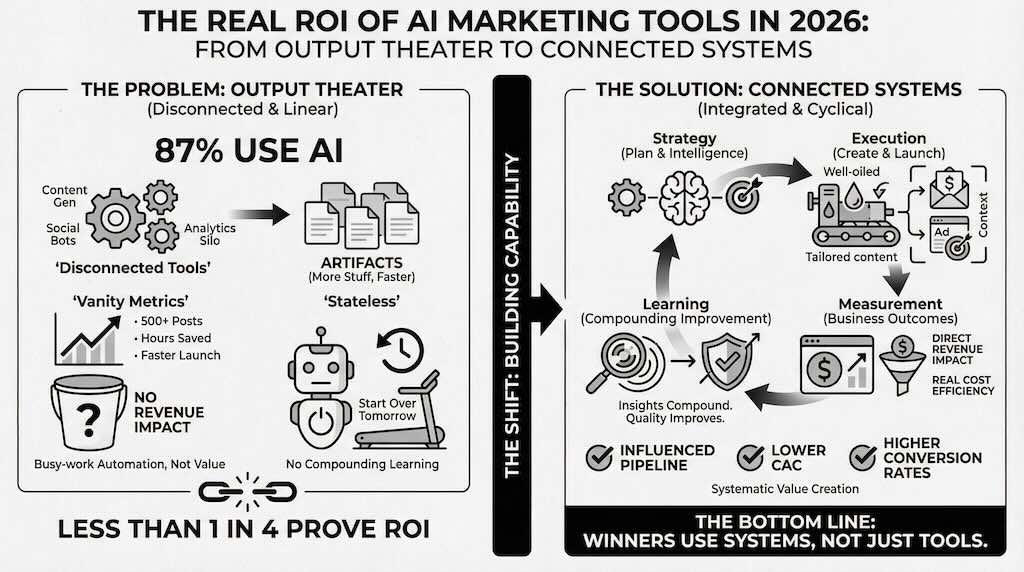
Eighty-seven percent of marketing teams now use AI tools, but less than 1 in 4 can prove actual revenue impact.
Here’s why that matters: Your CFO doesn’t care that you generated 500 social posts last month. He or she wants to know if those posts generated pipeline. Your CEO doesn’t care that you saved 20 hours using AI. He or she wants to know if that time translated into better conversion rates or lower customer acquisition costs.
And honestly? Most marketing teams can’t answer those questions.
I’ve watched this play out dozens of times over the past two years. Marketing leaders get excited about AI tools. They sign up, generate content, automate tasks, feel productive. Then three months later, someone asks the inevitable question:
“So what did we get for this investment?”
Crickets.
The problem isn’t that AI doesn’t work. It’s that most teams are measuring the wrong things entirely.
The Measurement Problem Nobody Talks About
Walk into any marketing department using AI tools today and ask them to prove ROI. You’ll hear things like:
- “We created 300 pieces of content last month instead of 50.”
- “Our copywriter saves 15 hours a week.”
- “We can launch campaigns 3× faster now.”
All true. None of it matters if:
- Those 300 pieces of content perform worse than the original 50
- Those 15 saved hours didn’t redirect toward higher-value work
- Launching campaigns faster just means failing faster
This is what I call output theater. It looks impressive in a slide deck but tells you nothing about business impact.
The harsh reality? Most AI marketing tools are built to measure the wrong things because measuring the right things is harder. It’s easier to count blog posts generated than track how those posts influenced buyer decisions six months later. It’s simpler to measure time saved than prove that saved time compounded into better strategic thinking.
So vendors optimize for vanity metrics. And marketing teams celebrate motion instead of progress.
What Real ROI Actually Looks Like
Let me break this down into four categories that actually matter. Not the stuff that sounds good in meetings, but the metrics that determine whether you keep your budget next quarter.
1. Direct Revenue Impact
This is the obvious one, but apparently we need to say it out loud: Did the AI tool contribute to revenue?
I’m talking about:
- Measurable conversion improvements
- Pipeline generated from AI-optimized campaigns
- Increases in average deal size because messaging resonated with the right buyers
- Higher email conversion rates directly attributable to improved copy
One company I consulted with spent $400/month on an AI content tool and generated approximately nothing in measurable pipeline.
Another spent $1,200/month on a connected AI marketing system and tracked $340,000 in influenced pipeline over six months.
Same industry. Similar size.
The difference? The second team connected AI outputs to buyer journeys and measured what happened.
2. Cost Efficiency (The Real Kind)
Time saved is cute. Cost reduction is what matters.
If your AI tool saves your content manager 10 hours a week, but you’re still paying three freelancers $5,000/month, where’s the efficiency?
Real cost efficiency looks like:
- Reducing agency spend from $15,000/month to $3,000/month
- Cutting paid ad costs by 30% through better targeting and copy
- Eliminating multiple $300 point solutions because one system replaces them
I’ve seen teams save 40 hours a week with AI while their marketing budget stayed exactly the same.
That’s not ROI. That’s busy-work automation.
3. Speed to Market (Where Most Teams Miss the Point)
Speed matters, but not because launching faster is inherently valuable.
Speed matters because it enables compounding iteration cycles.
If you can launch a campaign in 2 days instead of 2 weeks:
- You don’t just save time once
- You gain the ability to test 4× more ideas
- You learn faster
- You compound improvement
One SaaS company cut launch time from 3 weeks to 4 days.
Nice, but the real win?
They went from testing 2 campaign angles per quarter to 12.
By Q3, conversion rates were 2.3× higher than Q1.
The speed wasn’t the ROI. The learning was.
4. Compounding Improvement
This is where real ROI lives, and where most tools fail.
Most AI tools are stateless:
- Generate content
- Use it
- Start over tomorrow
Connected AI systems learn:
- Brand voice sharpens over time
- Content becomes a reusable asset
- Audience insights deepen
- Performance improves month over month
I have a B2B manufacturing client:
- Month 1: content was fine
- Month 2: noticeably better
- Month 5: outperforming their agency
- Month 8: indistinguishable from expert-written work
That’s compounding quality, not just increasing volume.
Why Most AI Tools Fail at ROI
Here’s the pattern I see in around 80% of companies:
- Adopt an AI tool for one task
- Add another for something else
- Add another
- End up with six disconnected tools
Strategy in one place. Content in another. Analytics somewhere else.
Nothing connects.
These tools create artifacts, not outcomes:
- A blog post without pipeline attribution
- Social posts without buyer insight
- Ad copy without revenue feedback
It’s atomic task automation instead of systematic value creation.
And without connection to strategy and measurement, you can’t:
- Learn
- Improve
- Prove value
You’re just generating more stuff, faster.
The Connected System Approach
What actually works?
Strategy → Execution → Measurement → Learning → Strategy
Simple. Rare.
In connected platforms (like The AI CMO), the flow looks like this:
Plan
Strategic intelligence that informs everything downstream.
Create
Content generated in context, aligned to positioning, audience, and goals.
Launch
Campaigns iterate on what’s already working.
Measure
Actual business outcomes feed back into the system.
Learn
Insights compound. What works scales. What doesn’t disappears.
This isn’t theory. I’ve watched it happen.
The Bottom Line
Most AI marketing tools make you feel productive, not effective.
Real ROI comes from:
- Connected systems
- Compounding learning
- Business outcomes over vanity metrics
If you can’t tie AI usage to revenue impact, you’re renting efficiency instead of building capability.
When budget season comes around and finance starts asking hard questions,
“we generated 500 pieces of content” won’t cut it.
The companies winning with AI in 2026 aren’t using more tools.
They’re using systems that turn marketing activity into measurable business value.
See how The AI CMO connects strategy, execution, and measurement into a single compounding system.
Request a demo and see exactly how connected AI platforms drive real ROI, not just impressive output volumes.
Share this article