The Compounding Intelligence Framework: How to Build Marketing That Gets Smarter Every Campaign
Your marketing team has run campaign after campaign. How many of those learnings are being applied to today's work?

The AI CMO team
Jan 2, 2026
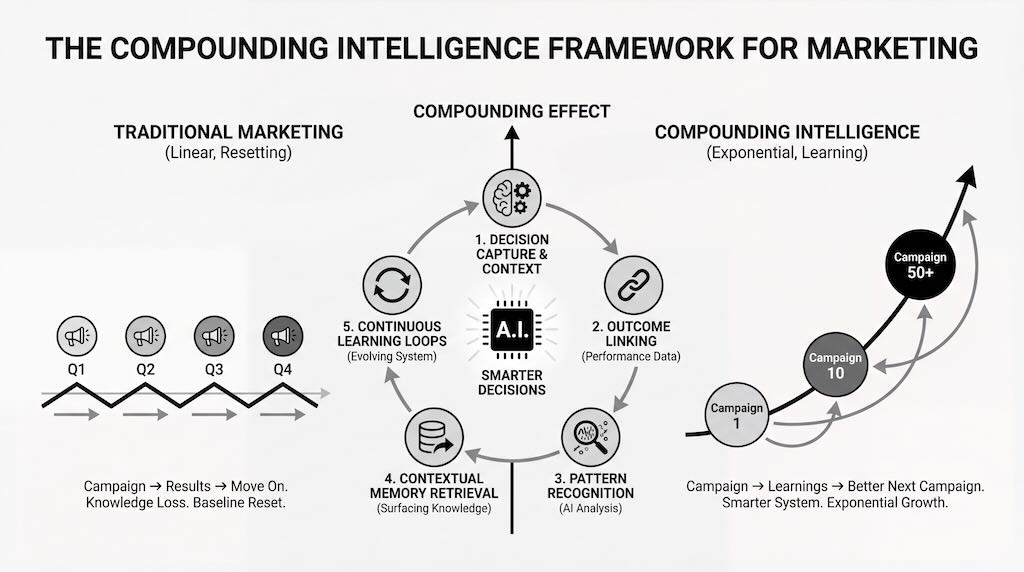
Your marketing team has run 247 campaigns in the past two years. How many of those learnings are being applied to today's work?
If the answer is "I don't know" or "maybe some," you don't have a learning problem. You have an architecture problem.
Here's what happens in most marketing departments:
- Q1: Run campaigns, some work, some don't
- Q2: Run different campaigns, forget what worked in Q1
- Q3: Accidentally repeat a failed Q1 experiment because nobody remembered
- Q4: New team member joins, starts learning from scratch
Two years of campaigns. Zero compounding knowledge. Every quarter resets to baseline.
Most marketing tools create outputs but don't capture intelligence. They help you make content faster, but they don't make you smarter. The more you use them, the more content you have – but your marketing judgment doesn't improve. You're just running faster on the same treadmill.
We built The AI CMO around a different principle: every campaign should make the next one better. Every decision should inform future choices. Every outcome should teach the system something new.
That's Compounding Intelligence – marketing infrastructure that learns, remembers, and continuously improves.
This isn't about automation. It's about building a system where your marketing gets exponentially smarter over time instead of resetting every quarter.
What Is Compounding Intelligence?
Compounding Intelligence in marketing means your system:
- Captures decisions and the rationale behind them (not just outputs)
- Connects those decisions to outcomes (what worked, what didn't)
- Recognizes patterns across campaigns that humans miss
- Applies those learnings to improve future recommendations
- Evolves continuously as new data comes in
The difference from traditional marketing
| Traditional Marketing | Compounding Intelligence |
|---|---|
| Campaign → Results → Move on | Campaign → Results → Learning → Better Next Campaign |
| Every campaign starts fresh | Every campaign builds on past learnings |
| Intelligence lives in people's heads | Intelligence lives in the system |
| Team turnover = knowledge loss | Team turnover = knowledge persists |
| Best practices from industry | Best practices from YOUR data |
Without Compounding Intelligence, Year 3 of your marketing is barely better than Year 1. Sure, you've created more content. But have you learned what messaging resonates? Which channels drive conversions for your audience? What timing works? What creative angles fall flat?
With Compounding Intelligence, Year 3 is exponentially smarter than Year 1 because every campaign in between taught the system something.
A real example from our platform: One user ran 23 email campaigns over 8 months.
Traditional approach: 23 separate emails, maybe some manual A/B testing.
With Compounding Intelligence: The system tracked that this user's audience responded 3.4× better to emails with questions in subject lines, ignored urgency CTAs in Q1–Q3 but engaged with them in Q4, and preferred detailed content over short summaries.
After 10 campaigns, recommendations were hyper-personalized.
After 20, they were remarkably accurate.
That's intelligence compounding.
The Five Components of Compounding Intelligence
Component 1: Decision Capture
Most tools capture outputs (the blog post, the ad copy, the strategy doc). Compounding Intelligence captures decisions.
Why did you choose positioning A over positioning B?
What alternatives did you consider?
What market conditions informed your choice?
That context is where the intelligence lives.
In The AI CMO, when you make marketing choices, the system captures:
- Which option you selected
- Why you chose it (optional rationale)
- The context (business goals, competitive landscape)
- Who made the decision and when
Example:
You're choosing between two ad variations. Instead of just tracking "User chose Variation A," the system captures:
"Chose Variation A because Variation B's urgency angle didn't align with current brand positioning. Market research showed our audience is in consideration phase, not decision phase."
That context makes the decision reusable. Six months later, the system surfaces:
"Last time you faced this scenario, you chose X because Y. Market conditions: similar."
Architecture principle:
Decision capture has to be frictionless. If it requires a separate "log this" step, nobody does it. It needs to happen inline, as a natural part of workflow.
Component 2: Outcome Linking
Capturing decisions is half the equation. The other half is connecting those decisions to results.
It's not enough to know "we chose email sequence A."
You need "we chose email sequence A, it drove 34% higher open rates and increased demo conversions by 23%."
The AI CMO tracks performance through:
- Inline rating: Great / Good / Poor after 7 days
- Performance feedback: Optional metrics (impressions, clicks, conversions, revenue)
- Edit tracking: The system learns what humans change
- What's Working page: Dashboard of top-performing campaigns
Every piece of content has a performance context.
Why this compounds:
- Campaign 1 → run + rate
- Campaign 2 → system adjusts based on Campaign 1
- Campaign 3 → built on Campaigns 1 & 2
Linear execution becomes exponential improvement.
Component 3: Pattern Recognition
Humans are terrible at spotting patterns across 100+ decisions. Systems excel at it.
The AI CMO analyzes patterns across:
- Content length
- Questions vs statements
- Numbers and statistics
- Emoji usage
- Platform performance
- Content types
- Tone
- Timing
After 10+ rated campaigns, patterns emerge:
"Your LinkedIn posts with questions get 2.3× more engagement."
"Thursday afternoon emails outperform Tuesday mornings by 41%."
These aren’t industry best practices. They’re your best practices.
Intelligent Playbook Detection
When 3+ campaigns rated Great share traits, the system:
- Identifies the pattern
- Auto-generates a playbook
- Suggests it non-intrusively next time
One user’s fourth product launch outperformed the previous three by following an auto-generated playbook.
Want to see which patterns your campaigns are hiding? Try The AI CMO's pattern analysis →
Component 4: Contextual Memory Retrieval
Knowledge is useless if it doesn’t surface at the moment of decision.
When creating a product launch, The AI CMO:
- Shows previous launches and results
- Surfaces patterns
- Warns about failed approaches
- Suggests proven tactics
When writing email copy, it retrieves:
- Best-performing subject lines
- Tone patterns
- High-converting CTAs
Memory system features:
- Deduplication (92% similarity threshold)
- User-editable memories
- Usage insights
- Auto-capture from success
Result: new hires inherit years of institutional knowledge instantly.
Component 5: Continuous Learning Loops
What worked in Q1 may fail in Q4. Intelligence must evolve.
The AI CMO learning loop:
- Campaign launched → Decision logged
- Results tracked → Performance rated
- Patterns updated → AI analyzes data
- Recommendations refined
- New campaign uses updated intelligence
- Repeat
Learnings are injected directly into content generation prompts.
The Compounding Effect in Action
Month 1–3: Baseline
- Campaigns run
- Decisions captured
- No patterns yet
Month 4–6: Patterns Emerging
- 15+ campaigns rated
- Early insights appear
- Recommendations improve
Month 7–12: Intelligence Compounds
- 30+ campaigns
- Accurate AI suggestions
- Failed approaches filtered
Month 13+: Exponential Improvement
- Auto-generated playbooks
- Cross-campaign insights
- Marketing measurably smarter
By December:
- 47 captured decisions
- 82 performance ratings
- 23 learned patterns
- 5 playbooks
- 2.3× conversion improvement
Why Most Marketing Tools Don't Compound
Most tools help you do, not learn.
They lack:
- Decision capture
- Outcome linking
- Pattern recognition
- Memory systems
- Learning loops
They execute tasks but don’t accumulate intelligence.
From Tools to Intelligence Systems
Tools help you work faster.
Systems help you get smarter.
The real competitive moat is compounding expertise competitors can’t copy.
If your marketing is producing more output but not getting smarter, you don’t have a performance problem.
You have an architecture problem.
Compounding Intelligence is that architecture.
Share this article