AI Brand Voice Consistency: How to Stop Sounding Like 12 Different Companies
Why most teams lose trust across channels, and how AI with memory fixes it
The AI CMO team
Jan 2, 2026
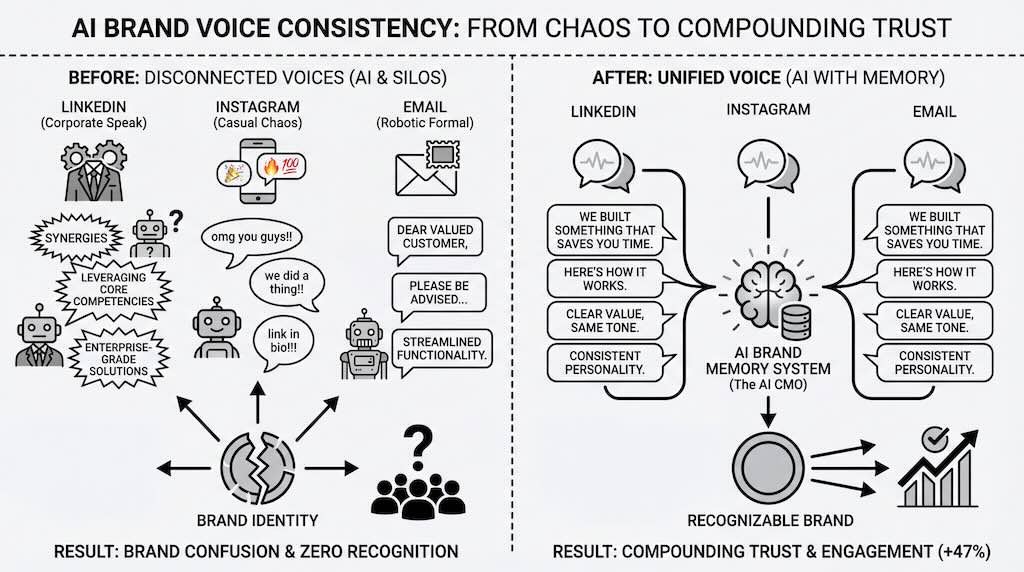
Here’s what showed up in my feed last Tuesday from the same software company:
LinkedIn:
“We’re thrilled to announce our Q4 strategic initiatives focused on delivering enterprise-grade solutions that empower organizations to achieve operational excellence.”
Instagram Story:
“omg you guys!! we did a thing!! link in bio!!! 🎉🔥💯”
Email Newsletter:
“Dear Valued Customer,
Please be advised that our platform has undergone enhancements to facilitate improved user experience and streamlined functionality.”
Same brand.
Three completely different personalities.
And honestly? I couldn’t tell you what they actually do.
You’ve seen this. Maybe you’ve done this.
When every channel sounds like it’s run by a different person with a different personality (because it is), your brand becomes unrecognizable. Customers can’t connect the dots between your LinkedIn post and your email. They see your Instagram and wonder if they’ve got the right company.
The problem isn’t that you’re inconsistent on purpose.
It’s that staying consistent across channels is genuinely hard when you’re creating content at scale.
The Multi-Channel Chaos Problem
Your LinkedIn sounds like it went to business school.
All corporate speak. Synergies. Leveraging core competencies.
Because Sarah from marketing writes those, and she’s convinced LinkedIn needs to sound “professional.”
Your Instagram sounds like your intern took over after three Red Bulls.
Casual to the point of confusing. Emojis everywhere.
Because Jake handles social, and he read that Gen Z wants authentic content.
Your email marketing sounds like a 1997 customer service bot had a baby with a legal disclaimer.
Formal. Distant. Robotic.
Because it’s templated copy that nobody’s touched in 18 months.
And your blog?
That’s outsourced to three different freelancers who’ve never met each other and definitely haven’t read your brand guidelines.
The Result
This isn’t just inconsistency.
It’s brand confusion.
When a customer sees your LinkedIn post, then gets your email, they don’t connect them as the same company. You lose the compounding effect of brand recognition. Every touchpoint starts from zero instead of building on the last one.
I had a client last year who couldn’t figure out why their email click rates were terrible even though their social engagement was solid.
Turns out people literally didn’t recognize the emails were from the same brand they followed on Instagram.
Different voice.
Different personality.
Might as well have been different companies.
Why This Happens (And Why It’s Getting Worse)
Most companies blame their team.
“If Sarah would just write more casually…”
“If Jake understood B2B…”
But that’s not really the problem.
The Real Issue Is Structural
Teams are organized by channel:
- LinkedIn person
- Instagram person
- Email person
Each brings their own writing style and their own interpretation of what the brand should sound like.
Then AI tools enter the picture:
- ChatGPT for blog posts
- Jasper for social media
- Copy.ai for emails
None of these tools talk to each other.
None of them remember what you created yesterday.
Each session starts fresh.
Which means each piece of content reinvents your brand voice from scratch.
And that brand voice document your agency created two years ago?
The one buried in Google Drive?
Nobody’s reading it.
Even worse, translating vague guidance like “professional but approachable” into actual writing is harder than it sounds.
So you end up with 12 different versions of your brand.
Probably more.
What Brand Voice Actually Is
Before fixing this, let’s get clear on what brand voice actually means.
It’s not tone.
It’s not style.
It’s not “sounding good.”
Your brand voice is the consistent personality that comes through in everything you write.
It’s made up of four things:
1. Tone
Formal or casual?
Serious or playful?
Authoritative or conversational?
2. Vocabulary
Do you say customers, clients, or users?
Industry jargon or plain English?
3. Sentence Structure
Long and complex or short and punchy?
Questions?
Fragments for emphasis?
4. Personality Traits
If your brand were a person, who would they be?
The helpful expert?
The rebellious challenger?
The trusted friend?
Examples
-
Mailchimp sounds like a funny, slightly quirky friend who’s great at their job.
“We’re here to help you sell your stuff, make your thing, or just generally get the word out.”
-
Patagonia sounds like an activist who happens to sell outdoor gear.
“We’re in business to save our home planet.”
-
Apple sounds like a confident minimalist who never over-explains.
“Think different.”
The key word is consistent.
Apple doesn’t sound like Patagonia on Instagram and Mailchimp in emails.
They sound like Apple everywhere.
The AI Amplification Problem
AI was supposed to make content creation easier.
And it does.
But it also amplifies whatever problems you already had.
Generic AI tools produce generic brand voices:
“In today’s digital landscape, businesses are leveraging innovative solutions…”
You know the voice.
Everyone using AI without customization sounds exactly the same.
Even worse, AI tools don’t remember what you did yesterday.
I tested this last month:
- Same fictional brand
- Three new chats
- Three social posts
Result?
Three completely different personalities.
Corporate.
Lifestyle blogger.
Tech startup.
Same brand. Same day. No consistency.
AI isn’t creating consistency.
It’s creating content.
How to Build AI-Powered Brand Voice Consistency
Let’s fix it.
Step 1: Define Your Brand Voice (For Real This Time)
Not vague principles.
Actual, usable rules.
Ask yourself:
- If your brand was a person at a party, how would they talk? What would they never say?
- What’s one word you’d use to describe every piece of content? One you’d never use?
- Do you use contractions? Exclamation points? Rhetorical questions?
- What jargon do you embrace, explain, or avoid completely?
Write:
- 3–5 sentences that sound exactly like your brand
- 3–5 sentences that absolutely don’t
Real Example (B2B SaaS)
We sound like:
The senior engineer who explains things clearly. Technical but not condescending. Confident without ego.
We say:
“Here’s how it works.”
We don’t say:
“Leverage our innovative solution to optimize your workflow.”
We use:
Contractions, short sentences, occasional dry humor.
We avoid:
Corporate jargon, excessive exclamation points, press-release language.
Example:
“Your data pipeline breaks at 2am. We fix it before you wake up.”
Not example:
“Our cutting-edge platform delivers enterprise-grade reliability.”
That’s usable.
Step 2: Train Your AI System (Not Just Better Prompts)
Most advice stops at “write a better prompt.”
That’s like training a dog with one command and hoping it remembers forever.
You need AI that remembers your brand voice across everything.
This is where systems like The AI CMO differ from standalone tools.
Instead of starting fresh every time:
- Your brand voice is stored once
- Every channel pulls from the same memory
- Social, email, blog all sound like the same company
Think of it this way:
- ChatGPT = a new freelancer every time
- AI with memory = one writer who learns and improves
Consistency becomes automatic.
Step 3: Create Consistency Guardrails
Even with memory, you need checks.
Use this checklist:
- Does this sound like us if read out loud?
- Does it match our example sentences?
- Would someone recognize this as the same brand they saw yesterday?
- Are we using our vocabulary consistently?
The Coffee Shop Test
If someone overheard this content in a coffee shop, would they recognize it as your brand?
If not, edit.
Step 4: Let the System Learn What Works
The best systems don’t just stay consistent.
They learn.
- High-engagement LinkedIn posts inform future ones
- High open-rate emails shape tone and structure
- Patterns compound over time
Your brand voice doesn’t just stay stable.
It gets sharper.
The Memory Advantage
Brand voice consistency isn’t a one-time setup.
It’s a compounding advantage.
Each consistent touchpoint:
- Builds recognition
- Builds trust
- Makes the next interaction stronger
One client switched from one-off AI usage to a system with brand memory.
After three months:
- Social engagement increased 47%
- Not because content was flashier
- But because it was recognizably theirs
Trust compounds.
Before / After: What Consistency Looks Like
BEFORE
LinkedIn:
“We are pleased to announce the launch of our innovative new platform feature…”
Instagram:
“New feature alert!! 🤯🔥”
Email:
“Dear Valued Customer…”
Different tone.
Different vocabulary.
Different brands.
AFTER
LinkedIn:
“We built something that saves you about 4 hours a week. Here’s how it works.”
Instagram:
“New feature. Saves you 4+ hours weekly. Here’s what it does.”
Email:
“You’re getting 4 hours back every week. Here’s the feature.”
Same voice.
Same clarity.
Same value.
The Bottom Line
Brand voice consistency isn’t about perfection.
It’s about being recognizably you every single time.
AI lets you create content at scale.
But without memory, it just scales inconsistency.
The fix isn’t less AI.
It’s smarter AI.
Define your voice clearly.
Train systems that remember it.
Build guardrails that protect it.
Let consistency compound.
Because sounding different every time someone meets your brand?
That’s not a strategy.
That’s just noise.
Share this article