Stop Lying About Being Data-Driven: Why Your Retention Strategy Fails Without Memory and Brand Guardrails

The AI CMO team
Jan 9, 2026
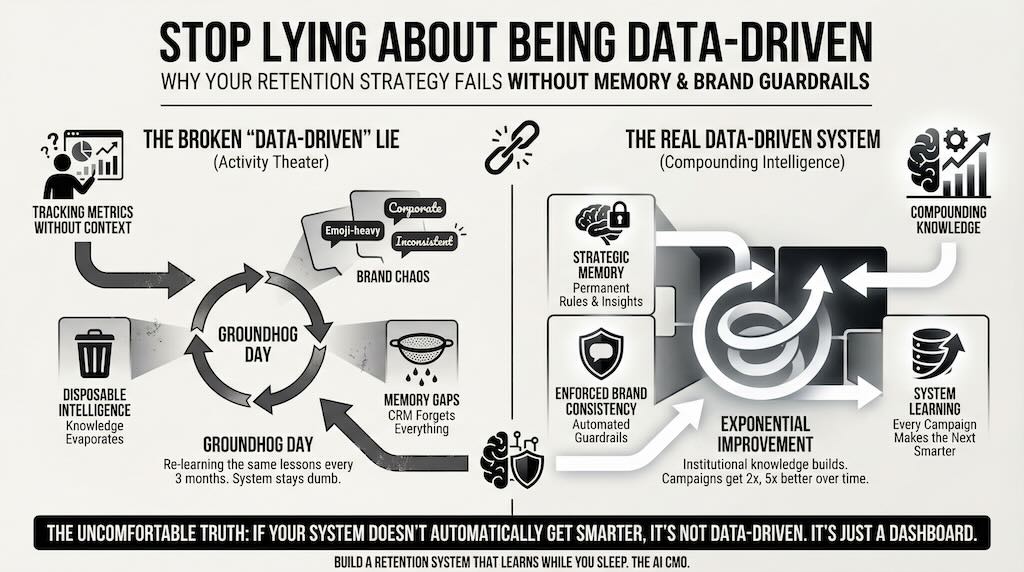
Let's be honest: your "data-driven" customer retention strategy is bullshit.
Everyone tracks metrics. That's not data-driven. That's just... having a dashboard.
Here's the uncomfortable truth most marketing teams won't admit: You're optimizing campaigns but never optimizing THE SYSTEM. You track open rates, but your campaigns don't remember what subject lines crushed it six months ago. You segment audiences, but your brand voice changes with every email depending on who wrote it that week. You analyze performance in spreadsheets, then those insights sit in a folder somewhere while your next campaign starts from scratch.
You call this "data-driven." I call it data-aware at best. Activity theater at worst.
The real problem? Being "data-driven" has become marketing BS-speak in 2026. Looking at click rates isn't intelligence – it's just recording what happened. Real data-driven retention means your system gets SMARTER with every campaign, follows strategic guardrails automatically, and enforces brand consistency without needing six rounds of review.
This article covers the three missing pieces that actually make retention strategies data-driven: compounding knowledge that doesn't die after each send, strategic memory that survives team changes, and enforced brand consistency that scales. Without these, you're just sending emails into the void and pretending the analytics matter.
The Data-Driven Lie – Activity ≠ Intelligence
Tracking metrics without compounding knowledge is vanity theater. Full stop.
Let me show you what I mean.
What "Data-Driven" Actually Means (And Doesn't):
❌ NOT data-driven: "We track email performance in our ESP dashboard"
❌ NOT data-driven: "We A/B test subject lines every month"
❌ NOT data-driven: "We segment our audience by behavioral triggers"
✅ ACTUALLY data-driven: "Our system remembers which approaches worked for which segments and automatically applies those learnings to future campaigns without anyone having to manually translate insights into action."
See the difference?
Most retention marketing teams celebrate tracking the wrong things. You get excited about a 25% open rate – but did that campaign make your NEXT campaign better? You obsess over click-through rates – but does your CRM marketing system remember WHY that CTA worked? You analyze cohort retention in beautiful charts – but do those insights automatically shape your next lifecycle sequence?
If the answer is "no" to any of these, you're just collecting data. Not using it.
The Compounding Knowledge Gap:
Here's what kills me. Most customer retention strategy campaigns are "disposable intelligence." You run a campaign, analyze the results, maybe mention findings in a Slack thread, then... nothing. That knowledge evaporates.
Real data-driven retention looks different:
- Every successful campaign creates a permanent strategic rule
- Every winning message becomes a template that automatically improves
- Every failed approach gets flagged so your system won't suggest it again
- Every audience insight compounds into smarter segmentation over time
But that's not how most teams operate. Customer #1000 gets the SAME quality email as Customer #1. No improvement. No learning. Just the same template you wrote in 2024.
New team members start from zero because nothing's documented beyond "here's how to use Klaviyo." Seasonal campaigns repeat last year's mistakes because nobody remembers what bombed. You're optimizing individual tactics while your overall system stays exactly as dumb as it was on day one.
Why This Destroys Retention:
Think about it this way. You've sent 500 retention campaigns over the past 18 months. That's 500 experiments. Thousands of data points. Millions in customer interactions.
But campaign #501? It's no smarter than campaign #50.
That's not a retention strategy. That's Groundhog Day with better analytics.
The brutal question every marketer should ask: "If I lost my email marketing manager tomorrow, would my customer retention strategy get noticeably dumber?"
If yes – and let's be real, it is yes for most companies – you're not data-driven. You're person-dependent. And person-dependent systems don't scale, don't compound, and definitely don't survive team turnover.
Brand Chaos Destroys Retention (And You're Probably Causing It)
Inconsistent brand voice in retention campaigns kills trust. And trust is literally the only thing keeping customers around.
But nobody talks about this.
Why Most Customer Lifecycle Marketing Has Multiple Personality Disorder:
Your welcome email was written by marketer #1 back in March. Professional tone. "We're thrilled you joined us." Very corporate.
Your win-back campaign got created by marketer #2 last month. Super casual. "Hey, we miss you 👋" Emoji-heavy.
Your upsell sequence? That was the freelancer who "gets your brand." Except they don't, really. It sounds like a completely different company wrote it.
Now imagine being a customer receiving all three of these across six months. You're getting emails from what feels like three separate businesses. Trust erodes. Brand recall weakens. Retention dies.
The "Data-Driven" Excuse:
Here's what teams say to justify this mess:
"We're testing different tones!" – No, you're confusing customers.
"We're personalizing for different segments!" – Maybe, but is it STRATEGIC or just based on whoever wrote it that day?
"Different lifecycle stages need different approaches!" – Sure. But different approaches within a consistent brand voice, not completely different personalities.
I've heard all of it. It's all rationalization for not having systems in place.
Real Talk: Brand Guidelines Don't Work
You probably have a brand book. Forty pages of "our voice is friendly but professional" and approved color codes. I'm guessing it was created by an agency in 2023, lives in a shared drive, and nobody's looked at it in eight months.
Meanwhile, every retention campaign requires "brand review" that adds three days to the timeline. Freelancers and agencies never quite nail your voice on the first try. "Please make it sound more like us" becomes an endless game of telephone. By the time the email ships, it's been watered down by five rounds of feedback and sounds like nothing.
Result? Brand drift across every single customer touchpoint.
What Actually Works: Enforced Brand Guardrails
Not suggestions. ENFORCEMENT.
Not "check after creation" – PREVENT during creation.
Not guidelines that someone might follow if they remember – automated rules that make brand violations literally impossible to ship.
This is what retention marketing platforms should do but don't. The system should know your brand voice so well that it won't generate anything that violates it. Ever. No matter who's creating the campaign or how rushed they are.
Why does this matter for customer engagement strategy?
Consistency equals trust. When customers recognize your brand voice across every email – from welcome through win-back through upsell – they develop stronger brand recall. That translates to higher engagement rates.
Efficiency equals speed. No more three-day brand review rounds. Content ships instantly because violations are prevented upfront, not caught in review.
Scale equals quality. You can produce 100 retention emails per month with perfect brand consistency. Try doing that with manual review. You can't.
And here's the kicker: Brand memory means every refinement applies to ALL future content automatically. You make one correction to tone, and it improves every campaign going forward. Forever. That's compounding.
The question: "Can you guarantee every retention email sounds like your brand – even if written by five different people across three months?"
If no – and it's no for most teams – your customer retention strategy has a brand problem, not a data problem.
The Memory Gap – Why CRM Campaigns Forget Everything
If your retention system doesn't remember anything, it's not a system. It's just software you rent monthly.
The Shocking Truth About Most CRM Platforms:
Your ESP and CRM tools remember some things really well:
- Contact data (names, emails, purchase history)
- Behavioral data (opens, clicks, conversion events)
- Segment rules you manually built
What they DON'T remember (the fatal gaps):
- WHY you chose that specific subject line approach
- WHICH messaging angle resonated with this customer segment
- WHAT you learned from that failed campaign in Q2
- THE strategic reasoning behind your lifecycle sequencing decisions
- WHICH brand voice adjustments improved performance last quarter
This isn't a feature gap. It's a philosophy gap.
CRM tools are STORAGE systems. They store data points. You need LEARNING systems that compound knowledge. Storage does not equal intelligence. Not even close.
The Retention Death Spiral This Creates:
Let me walk you through how this plays out in real life.
Campaign 1 (January 2026):
You test subject lines for your welcome series. After analyzing results, you discover "Your journey starts here" outperforms "Welcome to [Brand]!" by 18%. Great. You note it in a Google Doc titled "Email Insights Q1 2026" that three people will ever read. Then you move on.
Campaign 2 (March 2026):
Different marketer creates a win-back campaign. They have no idea about your January learning because who has time to read old docs? They use "Welcome back!" as the subject line – basically the losing approach from your earlier test. Performance is meh. They shrug and move on.
Campaign 3 (June 2026):
Original marketer returns to create an upsell sequence. They vaguely remember something about subject line testing but can't recall the details. Too busy to dig through past campaigns. So they start testing from scratch. Again.
WHY ARE WE PAYING PEOPLE TO RE-LEARN THE SAME LESSONS EVERY THREE MONTHS?
This is insane. But it's how most retention campaigns actually operate.
What Memory-Based Customer Retention Strategy Looks Like:
✅ Strategy Memory:
The system remembers: "This segment responds 34% better to curiosity-driven subject lines than benefit-driven ones." That knowledge automatically applies to every future campaign targeting that segment. New team member creates their first campaign? The system suggests proven approaches based on 18 months of learnings.
✅ Performance Memory:
"This specific CTA placement drove 23% more clicks in Q1." The system prioritizes that layout automatically in future templates. Every campaign builds on accumulated wins instead of starting from templates you created in 2024.
✅ Brand Memory:
A customer complained that your welcome emails felt too corporate. You adjust tone. That correction applies to ALL future welcome emails automatically, across all segments, forever. One fix, permanent improvement.
✅ Failure Memory:
"Discount-heavy messaging decreased customer lifetime value by 18% in our premium segment." System flags it when a new campaign trends toward excessive discounting in that segment. Past mistakes actually prevent future ones.
The Compounding Advantage:
Here's the math that matters:
Month 1: Learning phase. Everything's new.
Month 6: Campaigns are legitimately 2x better because they're built on accumulated learnings.
Month 12: Campaigns are 5x better because knowledge compounds.
Month 24: Your retention system becomes a strategic asset competitors literally cannot copy.
Without memory: 100 campaigns = 100 fresh starts = marginal improvement
With memory: 100 campaigns = 100 compounding lessons = exponential improvement
That's the difference between activity and intelligence.
What "Actually Data-Driven" Retention Looks Like in 2026
So what does real data-driven retention require? Three non-negotiables.
1. Knowledge Compounding Infrastructure
Every campaign has to feed the next campaign. Not through someone manually reading a report and maybe remembering something. Automatically.
Learnings can't live in docs or people's heads – they live in THE SYSTEM. New campaigns must start from accumulated intelligence, not zero. Performance patterns have to become strategic rules that apply automatically going forward.
This is what separates actual retention marketing systems from glorified email tools.
2. Enforced Brand Consistency
Not guidelines. Guardrails that make violations impossible.
Not post-creation review. Pre-creation prevention.
Not human-dependent. System-enforced.
Your brand voice stays perfect across unlimited campaigns, multiple team members, and every customer lifecycle stage. No exceptions. No drift. No "well, this one's a little off-brand but we're launching tomorrow so..."
3. Strategic Memory That Persists
Campaign decisions get captured with full context. "Why did this work?" matters as much as "Did this work?" Insights flow into future strategy automatically without manual translation. The system remembers corrections, preferences, and failures forever.
When someone leaves your team, their knowledge doesn't walk out the door with them.
What This Enables for Retention:
Welcome sequences that genuinely improve with every new customer who signs up. Win-back campaigns that remember exactly what re-engaged churned customers in the past. Upsell messaging that compounds learning about WHAT customers buy and WHY they buy it.
Lifecycle triggers informed by patterns across thousands of customer interactions. Segment-specific approaches that refine themselves over time without anyone manually updating them.
This is the shift: Stop optimizing individual campaigns. Start building a customer retention strategy that gets smarter every single day.
Your competitive advantage isn't your tactics. Anyone can copy tactics. It's how fast your SYSTEM learns and compounds that knowledge into better performance.
Why Most Companies Won't Do This:
Want the uncomfortable truth?
This requires admitting your current "data-driven" approach is actually just "data-aware." It means investing in actual systems instead of just running more campaigns. It demands that insights MUST flow into automation, not just dashboards.
And honestly? A lot of marketers protect their jobs by being the "knowledge holders." If the system remembers everything, what makes them irreplaceable? (Spoiler: their strategic thinking, not their ability to recall what worked last quarter.)
The 2026 Reality:
Companies that compound retention knowledge will dominate their markets. Their customer engagement strategy improves daily while competitors reset every campaign.
Companies that reset knowledge every week will slowly bleed customers to competitors who actually learn.
Choose.
The Retention Strategy That Doesn't Lie
You're not data-driven if your campaigns don't get measurably smarter over time. If your brand voice changes based on who wrote the email that day. If your system forgets everything after each send. If insights live in pretty dashboards instead of flowing into actual strategy.
You ARE data-driven if every campaign makes the next one better. If brand consistency is enforced by the system, not encouraged in guidelines nobody reads. If strategic memory compounds indefinitely. If new team members inherit institutional knowledge instantly instead of starting from scratch.
The Choice:
Keep calling yourself "data-driven" while running disposable campaigns that reset knowledge every week. Keep celebrating open rates while your retention system stays exactly as dumb as it was 12 months ago.
Or build an actual retention system that LEARNS – where strategy compounds automatically, brand stays perfect at scale, and intelligence accumulates whether you're working or sleeping.
The Uncomfortable Question:
If your entire customer retention strategy disappeared tomorrow and you had to rebuild from scratch, how much knowledge would you lose?
If the answer is "a lot" – months or years of learnings trapped in people's heads, old docs, and email threads – stop lying about being data-driven.
Real retention isn't about tracking metrics. It's about building systems that get smarter while you sleep. Everything else is just activity theater with better dashboards.
Ready to build a retention system that actually compounds knowledge? See how The AI CMO captures your best decisions and turns insights into permanent improvements → Learn more about the marketing operating system that learns
Share this article