How to Write a Marketing Plan: Template + Examples (2026)

The AI CMO team
Jan 22, 2026
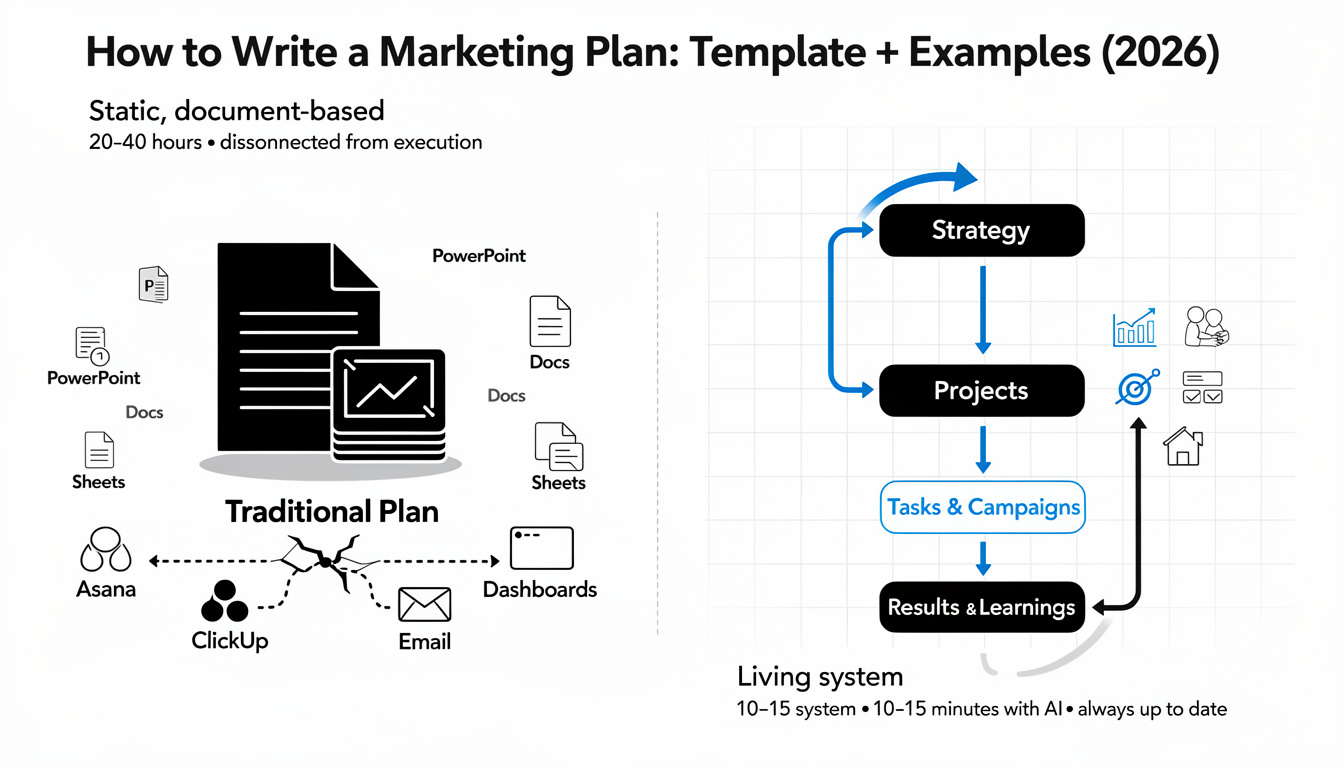
A marketing plan is a strategic document that outlines your marketing objectives, target audience, channels, tactics, budget, and timeline for a specific period – typically 30-90 days or annual.
Here's what goes into one:
- Marketing objectives and goals (what you want to achieve)
- Target audience definition (who you're trying to reach)
- Channel strategy (where you'll market)
- Tactics and campaigns (what you'll actually do)
- Budget allocation (how you'll spend your money)
- Timeline and milestones (when things happen)
- Success metrics or KPIs (how you'll measure results)
Two approaches exist today:
Traditional: Static document updated quarterly or annually. Takes 20-40 hours to create. Usually lives in PowerPoint or Google Docs.
Modern (Strategy→Projects): Living system where strategy flows directly into executable projects. Takes 10-15 minutes with AI assistance. Lives in your execution platform.
Time to create: 2-8 hours doing it the old way, or literally minutes with AI assistance.
Let's get into it.
Why Most Marketing Plans Fail
Here's the brutal truth nobody talks about.
Most marketing plans get created in January, presented to leadership with a nice slide deck, then collect dust until December when someone realizes... nothing actually got executed.
I've seen this happen at companies with 5 people and companies with 5,000 people. The pattern's always the same.
Why does this keep happening?
The gap between planning and execution. The plan lives in a PowerPoint deck. Execution happens in Asana, ClickUp, Monday, Google Sheets, email threads, Slack messages, and someone's notebook. These systems don't talk to each other. So the plan becomes this theoretical document that nobody references when deciding what to work on.
Too high-level to be actionable. "Increase social engagement by 40%" sounds strategic. But what does that mean on Monday morning? Nobody knows what task to complete. So they just... keep doing whatever they were doing before.
No connection between daily work and the plan. Your content writer doesn't know how their blog post ties to the quarterly objectives. Your social media manager doesn't see how their posts connect to the revenue goal. Everyone's working, but nothing compounds toward the actual plan.
Static document in a dynamic market. You spend weeks creating the perfect plan. Then a competitor launches something new. Or your best channel's algorithm changes. Or your ICP shifts based on early traction. The market moves – your plan doesn't. So you either ignore reality or ignore the plan.
Created once, never updated. Plans don't capture learnings. That Facebook ad campaign that crushed it in March? That knowledge doesn't make it into April's execution. What worked gets lost. What failed gets repeated. No learning loop exists.
The result? Leadership thinks marketing has a plan. The team doesn't know what to prioritize. Everyone works on random tactics that seemed good at the time. And nothing compounds.
What's needed instead is a marketing plan that's also your execution system. Where strategy automatically becomes projects, projects become tasks, and results feed back to strategy.
This is what the Strategy→Projects approach actually solves.
Traditional Marketing Plan vs Strategy→Projects Approach
Let me show you the difference.
Traditional approach looks like this:
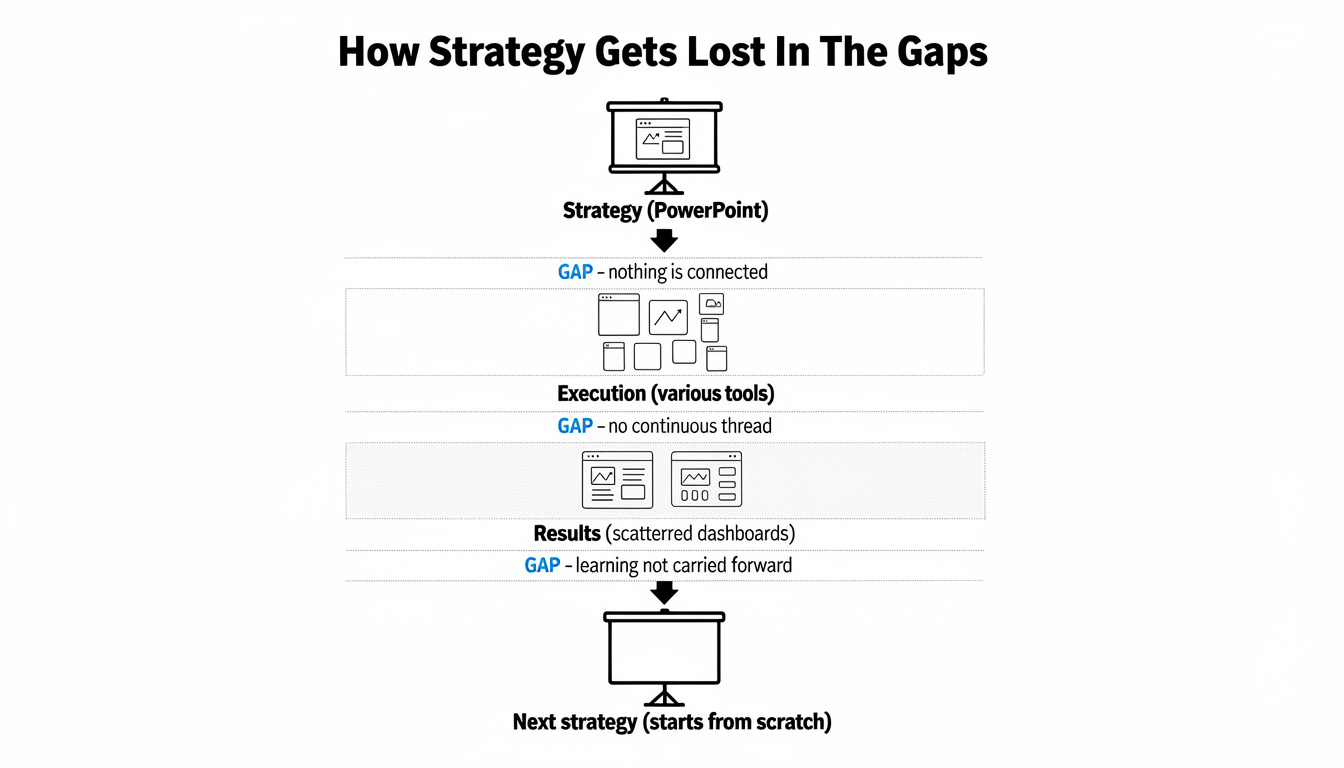
The problems compound at every gap. Execution gets disconnected from strategy. You can't track if tactics actually support goals. Results don't inform the next plan cycle. Knowledge resets every quarter or year.
According to Airtable's marketing research, most marketing teams struggle because their planning and execution systems don't integrate – they're separate tools with manual handoffs.
Strategy→Projects approach works differently:
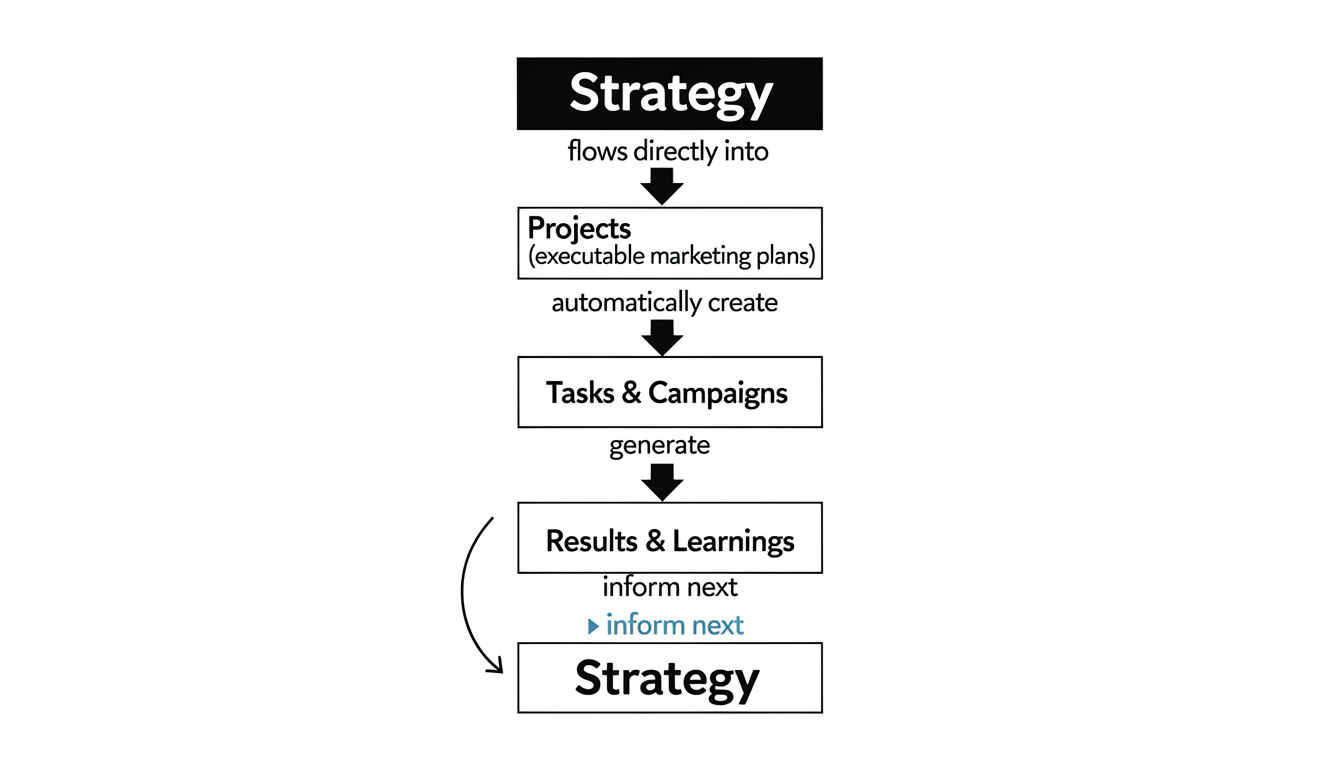
What's actually different here:
Strategy is the execution plan. Not separate documents. Your marketing plan isn't a document you write once – it's a living system of projects that execute and learn.
Projects are living plans that get updated based on performance. Not quarterly reviews – real-time adjustments based on what's working.
Automatic task creation happens. Strategy breaks down into actual work that team members can execute. "Generate 500 leads" becomes "publish 3 LinkedIn posts per week about X topic to Y audience."
Results loop back to strategy. What worked in Project 1 automatically informs Project 2. You're not manually transferring knowledge – the system captures it.
Knowledge compounds over time. Each project makes the next one smarter. By month 6, you're operating with 6 months of learnings baked in.
In this approach, your "marketing plan" equals a series of time-bound projects. Each project contains strategy plus tactics plus timeline plus metrics. Projects execute, learn, improve. The marketing plan evolves continuously instead of getting rewritten annually.
What Goes Into a Marketing Plan (Traditional Framework)
Before I show you the modern way, let's cover what traditional marketing plans include. This establishes we're not skipping fundamentals – we're just organizing them differently.
Executive Summary
This section gives leadership the 30,000-foot view:
- Business overview (what you do, who you serve)
- Marketing objectives at the highest level
- Key strategies you'll pursue
- Budget summary (total spend and major allocations)
- Expected outcomes (revenue, leads, growth targets)
Most people write this last even though it goes first. Makes sense – hard to summarize something you haven't written yet.
Situation Analysis
This is where you assess the landscape.
Market Analysis includes:
- Market size and growth trends
- Growth opportunities you can capture
- Competitive landscape (who else is fighting for attention)
- Industry challenges everyone's facing
SWOT Analysis breaks down:
- Strengths: Internal advantages (your team, tech, brand)
- Weaknesses: Internal limitations (budget, resources, gaps)
- Opportunities: External possibilities you can exploit
- Threats: External risks (competitors, market shifts, regulations)
Current State assessment:
- Existing marketing performance (what's your baseline?)
- What's actually working right now
- What's definitely not working
- Resource inventory (tools, budget, team capacity)
According to SCORE's marketing planning guide, understanding your current market position is foundational – you can't plan where to go without knowing where you are.
Target Audience
Who are you marketing to? This needs specificity.
Demographics: Age, location, income, job title, company size, industry
Psychographics: Values, interests, behaviors, how they spend time, what they care about
Pain points and needs: What problems keep them up at night? What are they trying to achieve?
Buying behavior: How do they research? Who influences decisions? What's the typical sales cycle?
Customer journey stages: Awareness, consideration, decision, retention
Create actual personas with names and roles. "Sarah, VP of Marketing at 50-person B2B SaaS companies" is more actionable than "B2B decision makers."
Marketing Objectives & Goals
Objectives should follow the SMART framework (yeah, I know it's overused, but it works):
- Specific: Clear and concrete, not vague
- Measurable: You can track progress with numbers
- Achievable: Realistic given your resources and timeline
- Relevant: Actually supports business goals
- Time-bound: Has a clear deadline
Examples that actually work:
- Generate 500 qualified B2B leads by end of Q2 2026
- Increase organic traffic from 10K to 14K monthly visitors in 6 months
- Achieve 15% conversion rate on email campaigns (up from 8%)
- Launch successfully in 2 new geographic markets by December 2026
Notice these all have numbers and dates. "Improve brand awareness" isn't a goal – it's a wish.
Marketing Strategy
This section covers the how and why.
Positioning:
- What makes you different from alternatives?
- Why should customers choose you specifically?
- Key messages that communicate your value
Channel Strategy:
- Which channels will you use? (SEO, social media, email, paid ads, partnerships, etc.)
- Why these specific channels? (Where's your audience actually spending time?)
- Resource allocation per channel (not equal – prioritize what works)
Budget Allocation:
- How much per channel
- Tools and software costs
- Agency or contractor expenses
- Ad spend by platform
Salesforce research shows that successful marketing plans allocate budget based on expected ROI per channel, not just equal distribution.
Marketing Tactics (The What)
Now we get specific about execution.
Content Marketing:
- Blog posts (specific topics, publishing frequency)
- Videos (types, platforms, production schedule)
- Ebooks and guides (topics, lead magnets)
- Case studies (which customers, what stories)
Social Media:
- Platforms you'll prioritize and posting frequency
- Content themes and pillars
- Engagement tactics (how you'll build community)
Email Marketing:
- List building strategies
- Campaign types (nurture sequences, promotional, newsletters)
- Automation workflows
Paid Advertising:
- Platforms (Google Ads, Facebook, LinkedIn, etc.)
- Campaign types and structure
- Targeting strategy and audience segments
- Budget per campaign and platform
SEO:
- Keyword targets (primary and secondary)
- On-page optimization priorities
- Link building strategy
- Technical SEO improvements
Timeline & Milestones
Monthly or quarterly breakdown of what happens when:
Q1 2026: Launch campaigns X, Y, Z
Q2 2026: Expand into new channels based on Q1 learnings
Q3 2026: Optimize and scale what's working
Q4 2026: Double down on winners, kill the losers
Include key milestones like major product launches, seasonal campaigns, and performance review dates.
Metrics & KPIs
How you'll actually measure success:
- Traffic metrics: Visitors, traffic sources, bounce rate
- Engagement metrics: Time on site, pages per session, social engagement
- Lead metrics: MQLs, SQLs, conversion rates by channel
- Revenue metrics: Deals closed, pipeline value, marketing-sourced revenue
- Channel-specific metrics: Email open rates, ad CTR, SEO rankings
Team & Responsibilities
Who owns what:
- Roles and specific owners
- Internal team vs external resources (agencies, contractors)
- Approval processes and stakeholder management
Here's the thing though.
This traditional approach is comprehensive. It's thorough. It checks all the boxes. But it also takes 20-40 hours to create. It's usually outdated by the time you finish writing it. And most importantly – it doesn't tell your team what to work on Monday morning. The plan stays disconnected from actual execution.
That's exactly why the Strategy→Projects approach exists.
The Strategy→Projects Framework
Here's how marketing planning actually works in 2026.
Instead of creating a static 40-page document that lives in Google Docs, you create living marketing projects that connect strategy directly to execution.
What is a Project in Marketing?
A project is a time-bound marketing initiative that contains:
- Clear objective – what you're trying to achieve
- Strategy – how you'll achieve it
- Tactical execution plan – what you'll create and launch
- Timeline – start/end dates, milestones, publishing schedule
- Success metrics – how you'll measure performance
- Built-in learning loop – results inform next projects
Examples of projects:
- "Q1 Product Launch Campaign" (30-day sprint)
- "SEO Content Strategy – February 2026" (monthly recurring)
- "Lead Nurture Email Sequence" (ongoing with optimization)
- "Facebook Ads Testing – Spring 2026" (quarterly experiment)
Think of projects as mini marketing plans that actually get executed. Not theoretical – operational.
How Strategy→Projects Works
Step 1: Define High-Level Strategy
This is your traditional "marketing plan" content, but simplified:
- Business goals (revenue targets, growth objectives, market position)
- Marketing objectives (leads, awareness, retention, expansion)
- Target audience (who you're reaching)
- Core positioning (why you vs alternatives)
- Available resources (budget, team size, existing tools)
Time investment: 1-2 hours if doing manually, or literally 10 minutes with AI assistance.
Step 2: Break Strategy Into Projects
Your strategy automatically generates specific, executable projects.
Here's a real example:
Strategy: "Generate 500 qualified B2B leads in Q1 2026"
This becomes these projects:
Project 1: LinkedIn Organic Content Strategy (Jan-Mar)
- Goal: 200 leads from organic LinkedIn content
- Tactics: 3 posts per week, thought leadership focus
- Timeline: 12 weeks continuous
Project 2: Google Ads Lead Gen Campaign (Jan-Mar)
- Goal: 150 leads from paid search
- Tactics: 5 ad groups, dedicated landing pages
- Timeline: 12 weeks, optimize weekly
Project 3: Email Nurture Sequence (Jan-Mar)
- Goal: 150 leads from existing email list
- Tactics: 8-email automated sequence, segmented by behavior
- Timeline: 6 weeks to build, then runs ongoing
Each project equals an executable plan with specific tasks, timeline, and budget allocated.
Step 3: Projects Generate Campaigns & Content
Projects aren't just plans sitting somewhere – they're execution engines.
Take Project: LinkedIn Organic Content Strategy
This auto-generates:
- 36 LinkedIn posts (3 per week × 12 weeks)
- Content themes based on audience pain points
- Publishing schedule with optimal times
- Engagement tracking mechanisms
- Performance benchmarks to measure against
Or Project: Google Ads Lead Gen Campaign
This auto-generates:
- Ad copy variations (multiple headlines and descriptions)
- Landing page content and structure
- Audience targeting parameters
- Budget pacing and bid strategies
- Weekly optimization task list
Everything needed to execute lives inside the project.
Step 4: Track Performance Within Projects
Unlike traditional plans where tracking is separate (usually in a different tool or spreadsheet), project-based plans have built-in performance tracking.
Each project monitors:
- Goal progress in real-time (500 leads goal → 247 achieved so far)
- Channel performance breakdown (LinkedIn: 89 leads, Google: 102 leads, Email: 56 leads)
- Campaign-level results (which specific ads or posts perform best)
- Cost per result (CPL by channel and campaign)
- Timeline status (on track, ahead of schedule, or behind)
You see this in real-time. Not at quarterly business reviews – daily or weekly as needed.
Step 5: Projects Learn & Improve
This is where the compounding actually happens.
Let's say Project 1 (January) delivers these results:
- LinkedIn posts about "specific pain point A" got 3x more engagement than other topics
- Google Ads converting at 8% (well above your 5% benchmark)
- Email subject lines formatted as questions performed 40% better than statements
Project 2 (February) automatically applies these learnings:
- More LinkedIn content focuses on pain point A
- Google Ads budget increases (it's working, so scale it)
- All email subject lines now use question format
You don't manually transfer this knowledge between projects. The system captures it. That's the difference.
Strategy→Projects vs Traditional Planning
Traditional approach:
- Create plan: 20-40 hours of work
- Execution: Disconnected from plan, happens in other tools
- Tracking: Manual monthly or quarterly reviews
- Learning: Gets lost between planning cycles
- Updates: Annual (way too slow for modern markets)
Strategy→Projects approach:
- Create plan: 10 minutes to 2 hours
- Execution: The plan IS the execution system
- Tracking: Automatic and real-time
- Learning: Captured and applied automatically project-to-project
- Updates: Continuous (projects evolve based on performance)
The result? Your "marketing plan" is no longer a document. It's a living system of projects that execute, measure, learn, and improve continuously.
Strategy flows into projects. Projects flow into campaigns. Results flow back to strategy. Everything's connected.
This is how modern marketing teams operate in 2026.
How to Create Your Marketing Plan (Step-by-Step)
Let me walk you through both approaches so you can choose what fits your situation.
Traditional Approach (Manual)
If you're creating a traditional marketing plan document from scratch:
Step 1: Research & Analysis (4-6 hours)
- Conduct market research on your industry and competitors
- Perform competitor analysis (who are they, what are they doing, what's working for them)
- Complete SWOT analysis for your business
- Research customer needs and behaviors
Step 2: Define Strategy (3-4 hours)
- Set clear objectives and SMART goals
- Define your target audience with specific personas
- Determine positioning and key messages
- Select which channels to focus on
Step 3: Build Tactical Plan (6-8 hours)
- List all campaigns and content pieces you'll create
- Create detailed timeline and content calendar
- Assign budgets to each initiative
- Define KPIs and measurement framework
Step 4: Document Everything (4-6 hours)
- Write the actual plan document (usually 20-40 pages)
- Create presentation slides for stakeholder buy-in
- Get approval from leadership
- Distribute to team members
Step 5: Set Up Execution (Ongoing)
- Brief team on the plan and their roles
- Set up separate tracking systems
- Begin execution in whatever tools you're using
- Hope everything connects back to the plan
Total time: 20-40 hours spread over a week or two
Typical outcome: Comprehensive plan exists, but execution feels disconnected from it
Strategy→Projects Approach (Modern)
Here's how it works with a system designed for this methodology:
Step 1: Input Your Strategy (10-15 minutes)
You either answer strategic questions or upload existing strategy documents.
Key inputs needed:
- What product or service are you selling?
- Who's your target audience? (demographics, role, pain points)
- What are your goals for Q1/Q2/annual? (specific numbers)
- What's your available budget?
- Which marketing channels will you use?
Step 2: Generate Projects (Instant)
Based on your strategy inputs, the system suggests specific projects.
Example output:
"Based on your goal of 500 leads in Q1 2026, here are recommended projects:
- LinkedIn Content Strategy (projected 200 leads)
- Google Ads Campaign (projected 150 leads)
- Email Nurture Sequence (projected 100 leads)
- Referral Program (projected 50 leads)"
You review these suggestions, edit them to fit your context, and approve.
Step 3: Projects Generate Execution Plans (Instant)
Each approved project automatically creates:
- Campaign briefs with messaging and positioning
- Content themes and topic ideas
- Budget allocation breakdown
- Timeline with specific milestones
- Success metrics and KPIs to track
Everything you need to execute is now in the project.
Step 4: Execute Projects (Ongoing)
Projects contain everything your team needs:
- Task lists with clear owners and due dates
- Content generation tools (create social posts, emails, ads directly)
- Publishing workflows and approval processes
- Performance tracking dashboards
The strategy you defined in Step 1 is now being executed through these projects.
Step 5: Track & Learn (Automatic)
The system continuously captures:
- What's working (so you can double down on it)
- What's not working (so you can adjust or kill it)
- Insights that inform future projects
- ROI by project and channel
Total time: 15 minutes to set up, then ongoing execution
Outcome: Strategy, execution, and learning all in one connected system
With AI Assistance (The AI CMO Approach)
You can now build complete marketing plans in literal minutes using AI.
The workflow:
- Tell the AI: "Create a marketing plan for [your product/service]"
- AI asks clarifying questions about goals, audience, budget, timeline
- Generates complete strategy based on your answers
- Automatically breaks strategy into executable projects
- Each project includes campaigns, content ideas, timelines ready to go
Then you simply:
- Review and refine the generated plan
- Approve projects you want to execute
- Start executing directly from the plan
- Track performance in real-time
Example prompt you could use:
"Create a 90-day marketing plan to generate 300 qualified B2B SaaS leads with a $10,000 budget, focusing primarily on LinkedIn organic content and Google Ads."
AI returns:
- Complete strategic framework
- 3-4 time-bound projects with specific timelines
- Budget allocation across projects
- Campaign ideas for each project
- Content themes and messaging
- Success metrics to track
You edit based on your specific context, approve what looks good, and start executing. The entire marketing plan creation process just went from days to minutes.
Marketing Plan Templates
Here are templates for different scenarios you might be facing.
Template 1: Product Launch Marketing Plan
Use when: Launching new product or service
Duration: 30-90 days
Focus: Generating awareness and initial traction
Download Product Launch Templates File
What's included:
- Pre-launch buzz building (teasers, waitlist, beta program)
- Launch day coordination (press, social, email, ads)
- Post-launch scaling (amplifying what works)
- Success metrics (signups, trials, early revenue)
Template 2: Lead Generation Marketing Plan
Use when: Primary goal is generating qualified leads
Duration: Quarterly (renewable based on performance)
Focus: Channel mix optimized for lead volume and quality
Download Lead Generation Templates File
What's included:
- Multi-channel strategy (organic + paid channels)
- Content calendar aligned to buyer journey
- Nurture sequences for lead progression
- Conversion optimization experiments
Template 3: Brand Awareness Marketing Plan
Use when: Building market presence and recognition
Duration: 6-12 months
Focus: Reach, impressions, and share of voice
Download Brand Awareness Templates File
What's included:
- Content strategy for thought leadership
- Social media expansion plan
- PR and partnership initiatives
- Reach and awareness metrics
Template 4: Customer Retention Marketing Plan
Use when: Reducing churn and increasing customer lifetime value
Duration: Ongoing with quarterly reviews
Focus: Engagement, satisfaction, and expansion revenue
Download Customer Retention Templates File
What's included:
- Onboarding optimization program
- Engagement campaigns for active users
- Loyalty and referral programs
- Retention and LTV metrics
Template 5: Market Expansion Marketing Plan
Use when: Entering new market segment or geography
Duration: 6-12 months
Focus: Market research and traction in new territory
Download Market Expansion Templates File
What's included:
- Market research and validation
- Positioning adaptation for new market
- Channel testing and optimization
- Local partnerships and presence
How to Use These Templates
Option 1: Download and fill out manually (traditional approach)
Option 2: Use AI to generate from template
Tell the AI: "Create a [template type] for [your business]" and it fills everything based on your specific context.
Option 3: Use a Marketing Planning System
Select your goal, answer a few questions about your business, get a complete executable plan in under 60 seconds.
Marketing Plan Examples
Let's look at real examples showing how this actually works.
Example 1: B2B SaaS Lead Generation Plan
Company: TaskFlow (project management software for remote teams)
Goal: 500 qualified leads in Q1 2026
Budget: $15,000
Timeline: January 1 – March 31, 2026
Strategy→Projects Breakdown:
Project 1: SEO Content Strategy
- Goal: 150 organic leads
- Tactics: Publish 12 blog posts (4 per month) on topics like "project management tips for remote teams" and "how to coordinate distributed teams"
- Lead magnets: Downloadable templates and productivity guides
- Budget: $3,000 (content creation and SEO tools)
- Timeline: 3 months, measure performance monthly
Project 2: Google Ads Campaign
- Goal: 200 paid leads
- Tactics: 3 ad groups targeting different industries, dedicated landing pages for each segment, test 5 headline variations
- Budget: $8,000 (pure ad spend)
- Timeline: 3 months, optimize weekly based on conversion data
Project 3: LinkedIn Organic Content
- Goal: 100 leads from thought leadership
- Tactics: Founder posts 3x per week, company page posts 2x per week, active engagement strategy in comments
- Budget: $2,000 (content creation and graphic design)
- Timeline: Daily execution for 3 months
Project 4: Email Nurture Sequence
- Goal: 50 leads from existing email list
- Tactics: 6-email automated sequence showcasing case studies and product features, segmented by company size
- Budget: $2,000 (copywriting and email design)
- Timeline: Build in January, run continuously Feb-Mar
Tracking approach:
- Weekly: Campaign-level performance (which ads, posts, emails work best)
- Monthly: Project goal progress (are we on track to hit 500?)
- Quarterly: Overall plan success and learnings for Q2
Example 2: E-commerce Product Launch Plan
Company: GreenHome (eco-friendly home products)
Goal: $100,000 revenue from new sustainable cookware line
Budget: $25,000
Timeline: 60 days (pre-launch + launch + post-launch)
Strategy→Projects Breakdown:
Project 1: Pre-Launch Content & Buzz (Weeks 1-3)
- Teaser social media posts building anticipation
- Email waitlist building with early-bird discount
- Influencer seeding (send products to 10 eco-lifestyle influencers)
- Budget: $5,000
Project 2: Launch Week Campaign (Week 4)
- Coordinated launch across all channels on specific date
- Facebook and Instagram ads driving to product pages
- Email blast to entire list announcing availability
- PR push to eco-lifestyle publications
- Budget: $10,000
Project 3: Post-Launch Scaling (Weeks 5-8)
- User-generated content ad campaigns featuring customer photos
- Retargeting campaigns for site visitors who didn't buy
- Email upsell sequences for first-time buyers
- Budget: $10,000
Each project contains specific campaigns, detailed content plans, and clear success metrics.
Why these examples work:
Clear goals directly tied to business objectives. Not "increase awareness" – actual numbers.
Projects have specific tactics you can execute. Not vague strategies – concrete actions.
Budgets are allocated by project and channel. You know exactly where money goes.
Timeline is realistic and structured. Not "sometime this quarter" – specific weeks and milestones.
Easy to track progress and make adjustments. You can see what's working by week 2, not month 6.
Common Marketing Plan Mistakes
Let me save you from the mistakes I've seen repeatedly.
Mistake 1: Being Too Vague
❌ "Increase social media engagement"
✅ "Achieve 500 LinkedIn post engagements per month through 3 posts per week focused on industry trends"
Vague goals lead to vague execution. Be specific.
Mistake 2: No Budget Reality Check
Don't plan for $50,000 worth of marketing activities when you have a $10,000 budget. I've seen this so many times – ambitious plans that ignore resource constraints.
Start with your actual budget, then decide what's possible within it.
Mistake 3: Disconnected from Sales Goals
Your marketing plan exists to support business objectives, which usually means revenue. If your plan doesn't connect to sales goals, leadership won't care about it.
Make the connection explicit: "These 500 leads should generate $200K pipeline based on our historical 15% close rate."
Mistake 4: Set-It-and-Forget-It Mentality
Markets change. Competitors launch new things. Algorithm updates happen. Your customer's needs evolve.
Your marketing plan can't be static. Build in regular review points – weekly for tactics, monthly for projects, quarterly for strategy.
Mistake 5: Spreading Too Thin Across Channels
It's better to absolutely dominate 2 channels than be mediocre across 8 channels.
Pick channels where your audience actually is, then go deep. As Amplitude's research shows, focused channel strategies outperform scattered approaches.
Mistake 6: No Clear Owners
"The marketing team will handle this" means nobody specifically owns it, which means it probably won't get done.
Every tactic, campaign, and project needs a specific person responsible for execution.
Mistake 7: Focusing on Vanity Metrics
10,000 Instagram followers doesn't matter if zero of them buy anything.
Focus on metrics that tie to business outcomes: leads generated, pipeline created, revenue influenced, customer acquisition cost.
Mistake 8: No Budget for Testing
Allocate 10-20% of your budget specifically for experiments and new channel tests. That's how you discover what works before competitors do.
The rest of your budget should go to proven channels – but keep that testing budget protected.
Tools for Creating & Executing Marketing Plans
The right tools make the difference between a plan that executes and one that sits in a drawer.
Traditional Tools
Google Docs/Sheets: Free and collaborative, but completely manual. You're building everything from scratch each time.
Asana/Monday/ClickUp: Good for project management, but not marketing-specific. You need to build your own frameworks.
HubSpot/Marketo: Powerful marketing automation, but your strategy lives separately from execution.
Excel/Google Sheets: Works for budget tracking and timelines, but doesn't help with strategy or learning loops.
Modern Tools (Strategy→Projects Approach)
The AI CMO Marketing Planning System:
This is specifically designed for the Strategy→Projects methodology:
- AI generates complete marketing plans in 60 seconds based on your inputs
- Strategy automatically breaks down into executable projects
- Built-in campaign and content generation for each project
- Performance tracking integrated within projects (not separate dashboards)
- Learning loops that capture what works and apply it to next projects
- Brand guardrails ensure everything matches your voice and standards
The difference: Traditional tools separate planning from execution. This connects them into one system where strategy flows directly into campaigns.
What You Need in a Marketing Planning Tool
Whether you build your own system or use a platform, here's what actually matters:
- ✅ Strategy input: Easy way to capture and update your strategic foundation
- ✅ Automatic project creation: Strategy should generate specific projects, not just sit there
- ✅ Campaign generation: Projects should create actual campaigns and content, not just task lists
- ✅ Timeline management: See what's happening this week, this month, this quarter
- ✅ Budget tracking: Know where money goes by project and channel
- ✅ Performance dashboards: See results within each project, not in separate analytics tools
- ✅ Learning capture: System remembers what worked so next projects start smarter
Most traditional tools give you 2-3 of these. Modern systems give you all of them in one place.
Your Next Steps
Marketing plans fail when they're disconnected from execution.
That document-based approach worked when campaigns took weeks to create and markets moved slowly. But in 2026, when AI can generate complete campaigns in seconds and competitors can pivot overnight, your planning system needs to keep up.
The Strategy→Projects approach solves this fundamental problem:
- Strategy flows directly into executable projects (no gap)
- Projects contain everything needed to execute (campaigns, content, timelines)
- Results automatically inform the next projects (learning loops)
- Knowledge compounds over time instead of resetting
This isn't just faster. It's fundamentally different. Your marketing plan becomes a living system instead of a static document.
Here's What to Do Right Now
Option 1: Start Traditional
If you want to build a plan manually, use the framework we outlined. Budget 20-30 hours. Create your document. Then figure out how to connect it to execution.
Option 2: Use The AI CMO
Generate a complete marketing plan in under 60 seconds. Get specific projects with campaigns ready to execute. Start running them immediately. Let the system capture what works.
Option 3: Start with One Project
Don't plan everything at once. Pick your most important goal. Create one project around it. Execute that project well. Learn from results. Then add the next project.
Bottom line: A mediocre plan that actually gets executed will beat a perfect plan sitting in Google Docs every single time.
Start simple. Execute consistently. Learn continuously. Improve systematically.
That's how marketing actually compounds in 2026.
Share this article