The Death of the Traditional CMO Org Chart
Why Traditional Marketing Structures Have to Change

The AI CMO team
Dec 11, 2025
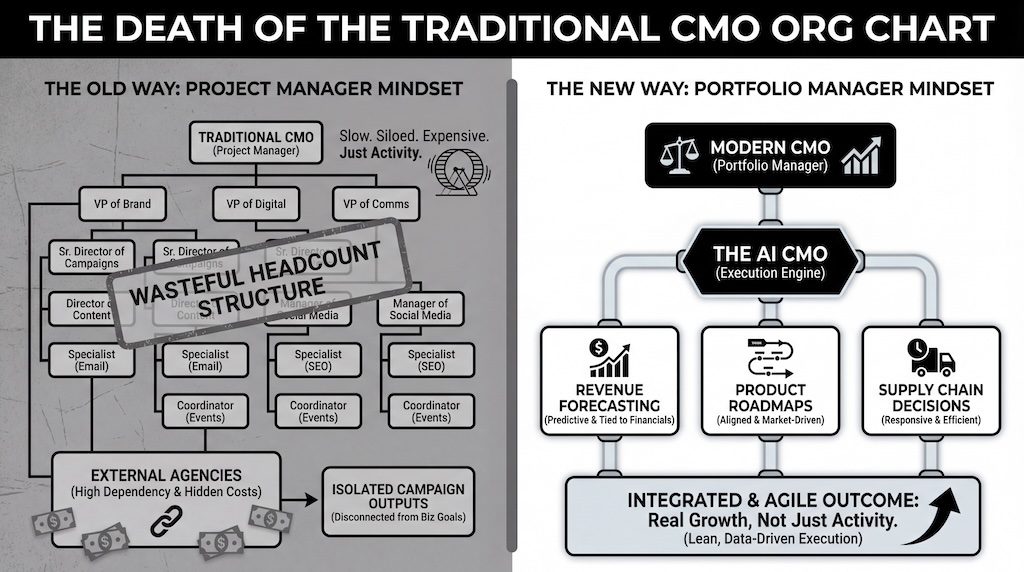
Let me be blunt: your CMO org chart is probably burning cash like it's 2019.
I’m talking about the classic pyramid structure: VP of Demand Gen, VP of Brand, VP of Content, maybe a VP of Product Marketing if you're fancy. Each owns their own fiefdom, each has managers, coordinators, specialists, and an intern or two fetching coffee.
And the agency retainers? Don’t get me started.
Here’s the truth nobody wants to admit:
This structure made sense when marketing was a cost center. It no longer does.
A Fortune report recently highlighted a healthcare company that replaced a team of 10 engineers with 3 people overseeing AI agents.
Not 8. Not a “leaner team of 7.”
Three humans. The AI handled the execution.
Moderna merged their entire HR and tech divisions under a single Chief People and Digital Officer. Why?
Because AI eliminates the need for layers of middle management.
Meanwhile, marketing teams are still hiring like it’s 2015.
The Real Cost of Your Org Chart
Let’s run conservative math for a mid-sized B2B marketing team:
- CMO: $250K
- VP Demand Gen: $180K
- VP Content: $160K
- 2 Marketing Managers: $110K each
- 3 Content Specialists: $75K each
- 2 Coordinators: $55K each
- Benefits (30%): ~$300K
Total headcount cost: ~$1.6M annually.
Then add:
- Agency retainers: $180K–$360K/year
- Martech stack: $100K–$150K/year
- Freelancers: $50K–$100K/year
You’re easily at $2 million per year. See it yourself with our ROI calculator.
And for what?
- Campaign execution
- Project management
- Stitching together tools
- Making decks
- Endless alignment meetings
Meanwhile marketing is rarely tied to revenue forecasting, product decisions, or supply chain signals - because everyone is drowning in execution.
The Portfolio Manager vs. Project Manager Problem
Most CMOs think their job is managing projects and people.
They’re wrong.
A modern CMO must operate like a portfolio manager, not a project manager.
A portfolio manager:
- Allocates capital
- Monitors performance
- Rebalances based on conditions
- Makes strategic bets
They don’t execute trades. They have systems for that.
A modern CMO should:
- Connect marketing signals to revenue forecasting
- Alert supply chain to shifts in demand
- Influence product roadmap decisions
- Monitor competitive signals continuously
But you can’t do that when 60% of your time is spent managing headcount and reviewing creative briefs.
The Execution Engine You’re Missing
Here’s where marketing leaders are still stuck in 2020.
The AI CMO isn’t another tool. It’s an execution engine.
Instead of hiring:
- 3 people for content
- 2 for campaigns
- 1 for analytics
…you use a system that executes instantly, consistently, and cross-functionally.
Examples:
- Full marketing strategy (normally $10K+ from an agency) → Generated in 60 seconds
- 127 content assets → Done instantly
- Social posts → 2.3 seconds
- Email sequences → 4.1 seconds
- Blog articles → 12.8 seconds
All in your brand voice. See demo.
But here’s the real unlock:
The AI CMO connects marketing insights to product, revenue, finance, and supply chain - automatically.
That “seat at the table” CMOs want?
This is how you get it.
The Integration Layer Nobody Talks About
Most AI tools are party tricks.
“Look, it wrote an email!”
Cute. Your intern can write emails.
The AI CMO integrates with:
- HubSpot
- Shopify
- Salesforce
- 15+ enterprise platforms
- Custom workflows via API
This is an execution engine connected directly to your business systems.
McKinsey deployed thousands of AI agents internally for deck creation, research synthesis, and logic verification. Amazon is removing layers of middle management. These aren’t experiments.
This is the new operational model for large enterprises.
Your marketing team structure hasn’t caught up.
What This Actually Looks Like
A modern marketing org chart looks like this:
- CMO (Portfolio Manager & Strategic Allocator)
- VP of Growth Strategy
- Connects marketing → revenue → product → supply chain
- 2–3 AI Operations Specialists
- Oversee AI execution, optimization, and workflows
- Creative Director
- Oversees brand guardianship
That’s it.
AI handles:
- Content creation
- Campaign execution
- SEO
- Ads
- Analytics
- Reporting
- Competitive monitoring
Humans handle:
- Strategy
- High-level creative
- Oversight
- Cross-functional alignment
Headcount drops from $1.6M to ~$600K.
Output increases 5–10x.
Execution speed becomes instant.
And yes, it works better.
The Agency Dependency Trap
Most companies spend $15–30K/month on agency retainers.
That’s $300K+ annually.
What are you paying for?
- Account managers
- Strategists
- Writers
- Designers
- Project managers
- Layers of markup
And 70% of it is execution work AI can now do faster and better.
With AI:
- Retainer drops to $50K/year for strategy only
- 90% of execution moves in-house
- Speed multiplies
- Costs collapse
The financial logic is not subtle.
Real Numbers From Real Companies
Traditional model:
- 10-person team
- $1.2M annual cost
- Limited output
AI-enabled model:
- 3 strategic marketers
- $450K fully loaded
- AI platform: $30K
- Total: $480K
- 5x output
Savings: $720K annually
Productivity: massively higher
This is not theory.
This is the operational model of The AI CMO today.
The Cross-Functional Game Changer
Traditional marketing is isolated.
- Creates campaigns
- Tracks vanity metrics
- Hopes someone notices
Why?
Because the data doesn’t matter outside marketing.
But when your execution engine connects to business systems:
- Demand signals → influence inventory
- Content performance → informs product roadmap
- Channel performance → improves revenue forecasting
- Competitive intel → feeds strategic planning
Suddenly marketing becomes a strategic growth center.
Not a cost center.
Not a deck-making service.
A driver of business decisions.
The Uncomfortable Truth
Most CMOs won’t make this shift.
They’ll nod.
They’ll agree.
They’ll return to their bloated charts and agency retainers because it feels familiar.
But the companies that change now?
- Will run leaner
- Will operate strategically
- Will outproduce their competitors
- Will influence business decisions
- Will spend $1M less annually than traditional teams
The ones that don’t?
They’ll keep burning millions while AI-enabled teams run circles around them.
You cannot hire your way into modern marketing.
You need a new structural model where strategy and execution are decoupled -
humans strategize, AI executes.
Bottom Line
The traditional CMO org chart is dead. It just doesn’t know it yet.
The question is:
Will you restructure proactively - or after burning another few million?
Your move.
Share this article