AI Marketing in 2026: Why Your System Should Remember Every Decision You Make

The AI CMO team
Jan 9, 2026
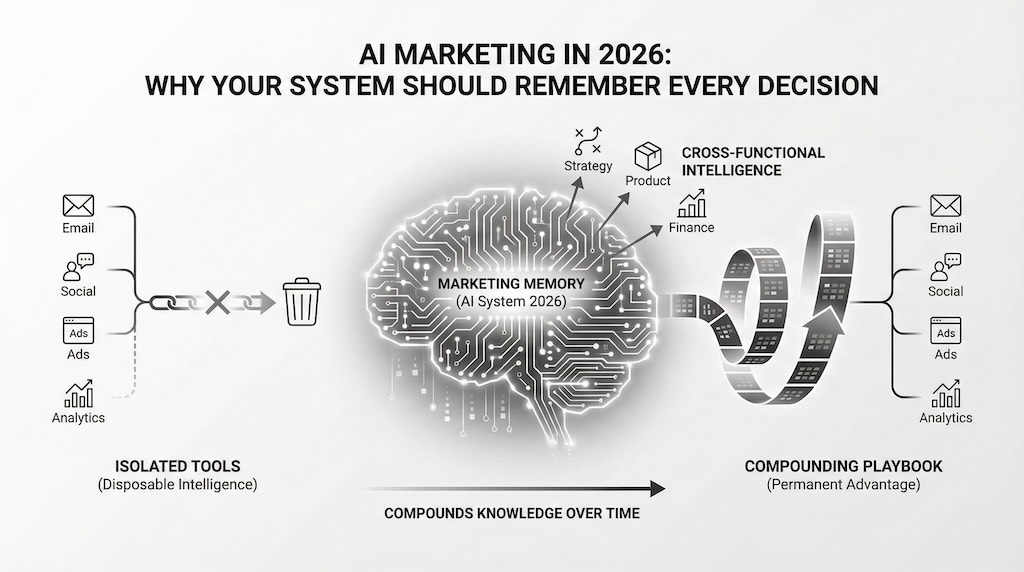
Your marketing team uses 47 different tools. Ask me how I know–because I counted mine before and that's what I had. Email platform, social scheduler, analytics dashboard, content calendar, ad manager, SEO tool, design software. The list goes on.
Here's what hit me: none of them talk to each other. Worse? None of them actually remember what you learned last month.
You run a campaign. It bombs. You figure out why. Great. Next campaign? You're starting from zero again. Maybe you remember to avoid that mistake. Maybe your teammate doesn't. Maybe you wrote it in a doc somewhere that nobody will ever read.
This is what I call disposable intelligence. Your tools execute. They don't learn. They definitely don't compound.
The real shift happening in AI marketing right now isn't about better content generators or smarter automation. It's about systems that turn every single campaign into permanent competitive advantage. Systems with marketing memory.
Think about it this way: you've got tools that DO things versus systems that LEARN things. That difference? It's everything in 2026.
The Compounding Marketing Playbook: How Permanent Memory Transforms Campaign Performance
I've been managing marketing campaigns for different brands since 2019. The same pattern plays out everywhere. You spend three weeks perfecting a campaign. Learn what works. Then two months later, someone (maybe you, maybe a teammate) makes the exact same mistakes because the knowledge lived in your head, not in the system.
What if every correction you made stuck forever?
Marketing memory means your system captures what worked, what didn't, and crucially–WHY it didn't. Not in some notes doc. In the actual system that generates your campaigns.
Here's how this actually works. You tell your AI system: "Don't use the word 'cheap' in any of our messaging. It positions us wrong." In traditional tools, you'd need to remember that every single time. Check every piece of content manually. Hope your team reads the brand guide.
With marketing memory? You say it once. The system never forgets. It's enforced automatically across every piece of content, every campaign, every channel. Forever.
But it goes way deeper than word choices.
The Compounding Effect Nobody Talks About
Let's say you run an email campaign. Subject line A gets 34% open rate. Subject line B gets 19%. Traditional approach? You note it down somewhere. Maybe. Probably forget it by next month.
With a system that remembers: it knows your audience responds better to direct questions than clever wordplay. That insight now informs every future email subject line. Automatically.
You're not just executing better campaigns. You're building a compounding marketing playbook.
Your brand voice refinements apply to all future content without you doing anything. Audience insights inform strategy decisions automatically. Performance patterns optimize campaigns before you even launch them. Failed approaches never get repeated.
I saw this firsthand managing three different B2B SaaS brands last year. By month six, campaign quality was substantially better than month one–not because I got smarter, but because the SYSTEM got smarter. Every correction, every preference, every insight accumulated.
Contrast This With How We've Always Done It
Traditional approach: each campaign starts from zero. You build from scratch. Reference old campaigns manually if you remember to. Hope you don't repeat mistakes.
Tool approach: slightly better, but you still have to remember and re-input everything. The LinkedIn scheduler doesn't know what worked on your blog. The email platform has no idea what converts in your ads.
Memory approach: the system learns from EVERYTHING. Gets smarter with every execution. Your best performing LinkedIn post informs your email tone. Your ad copy insights shape your blog headlines.
This isn't theoretical anymore.
What This Actually Looks Like
Campaign quality improves over time without more effort. That's the key part–WITHOUT more effort. You're not working harder. The system is working smarter.
New team member joins? They inherit institutional knowledge instantly. No three-month ramp. They get access to everything the system learned before they arrived. Every correction. Every preference. Every insight.
Strategic decisions backed by accumulated data instead of guesswork. You're not wondering which approach might work. You KNOW which approach works because the system has pattern recognition across hundreds of previous campaigns.
One client told me their new marketing hire was productive on day three because the system basically onboarded them. Showed them what voice worked. What didn't. What topics resonated. What fell flat.
Cross-Functional Marketing Intelligence: When Your Marketing System Influences Product and Finance
Marketing in 2026 doesn't just create campaigns. It generates business intelligence that matters way beyond the marketing department.
Here's what changed. CMOs used to report campaign metrics–clicks, opens, conversions. Now they're in strategy meetings showing product teams which features actually resonate in market messaging. Showing finance teams leading revenue indicators from campaign performance. Showing sales which value propositions close deals.
Marketing leaders are becoming growth architects. Not executors. Strategists.
But you can't do this with scattered tools. You need a marketing system that learns, remembers, and makes those insights accessible across teams.
Why Marketing Should Own More (And Actually Can Now)
When your marketing system learns, it generates insights that transform how Product builds, how Finance forecasts, how Sales positions.
To Product: your campaigns show which features people actually care about in real-world messaging. Not what they SAY they want in surveys–what messaging about those features actually converts. That's product roadmap gold.
To Finance: marketing campaigns predict revenue trends weeks before sales data confirms it. Campaign engagement in specific segments signals demand shifts. Ad performance forecasts pipeline movement. Leading indicators everywhere.
To Sales: content performance literally shows which value props close deals. That case study that got 500 shares but zero conversions? Sales team knows to skip it. That technical whitepaper that converts like crazy? Sales team leads with it.
To Operations: marketing demand signals inform inventory planning, hiring decisions, capacity needs. You're seeing market movement before it shows up in orders.
I worked with a SaaS company last year where marketing data flagged an enterprise segment showing unusually high engagement three months before sales noticed the trend. By the time competitors figured it out, they'd already built and launched an enterprise tier.
The System Requirements That Make This Possible
Marketing data can't live in silos anymore. Period.
Insights need to be accessible and actionable across teams. Not trapped in your ESP or your social scheduler or your analytics dashboard. In one system that connects everything.
This is why marketing memory matters so much. Scattered tools hide patterns. When everything lives in one learning system, patterns become visible. Obvious, even.
Your email campaign performs crazy well in the healthcare vertical. Your ad campaigns show the same vertical has the lowest cost per acquisition. Your content shows healthcare searches spiking. Traditional setup? These insights live in three different tools. Nobody connects them.
Marketing operating system? It sees the pattern instantly. Recommends doubling down on healthcare. Maybe suggests product features that healthcare segment keeps asking about in your content comments.
Why This Specifically Matters in 2026
Boards aren't asking CMOs about impressions anymore. They want to know how marketing influences company strategy. How marketing intelligence informs product decisions. How marketing predicts revenue.
The companies winning right now are those where marketing intelligence flows everywhere. Product teams pull marketing insights to guide roadmaps. Finance teams use marketing signals to refine forecasts. Sales teams leverage marketing content performance to close deals faster.
Marketing evolved from cost center to growth engine. But only if your system actually learns and shares that intelligence.
The Growth Architect Model: Orchestrating Strategy, Execution, and Learning in One Platform
The new marketing operating model isn't about execution. It's about orchestration.
Think conductor, not musician. You're setting the strategy, defining the taste, applying the judgment. The AI marketing platform handles execution, learning, and optimization.
And here's the crucial part: the system remembers and compounds the playbook.
What Being a Growth Architect Actually Means
You're not creating 10 social posts anymore. You're defining what resonates, then letting the system produce unlimited variations that all follow those rules.
You're not writing email campaigns. You're setting the narrative arc, and the system handles the sequences. Subject lines. Body copy. CTAs. All following your strategic direction. All learning what works.
You're not managing 47 different tools. You're orchestrating one operating system.
Honestly? This felt weird at first. I spent years being GOOD at writing Facebook ads. Letting a system handle it felt like giving up control. But that's not what's happening.
The Three Layers That Make This Work
Strategy intelligence. The AI understands your business context–not just your brand voice, but your market position, your competitive landscape, your growth goals. It suggests approaches based on what's worked historically. Not generic best practices. YOUR historical performance.
Brand enforcement. This is where most systems fail. They make suggestions. They check things AFTER you create them. Growth architect model? Brand violations are impossible. Not just caught after–prevented during.
You define forbidden words. The system blocks them before you ever see generated content. You specify required phrases. They're included automatically. You list competitors to never mention. The system catches them, including variations and synonyms.
Unlimited execution. Once strategy is set and brand guardrails are active, produce infinite variations without quality degradation. Because every piece follows the rules. Every piece learns from performance. Every piece compounds the knowledge base.
How This Actually Changes Your Daily Work
Your morning used to look like: open seven tools, manually create content across platforms, hope you remembered the brand guidelines, hope you didn't repeat that thing that didn't work last time.
Now: you open one system. Define what you want to accomplish. The system generates options that already follow your rules, already incorporate past learnings, already maintain brand consistency.
Your best campaigns become templates automatically. That email sequence that crushed it? The system analyzed why. Now future sequences incorporate those elements.
Your corrections become permanent rules. Told it once that your audience hates corporate jargon? Never appears again. Across any content type. Any channel.
Your insights become institutional knowledge. New team member doesn't need to read 47 old campaign reports. The system inherited all that knowledge. They just start creating from day one.
Managing Unlimited Brands Without Losing Your Mind
Growth architects often manage multiple brands or clients. Used to be a nightmare. Different voice for each. Different rules. Different audiences. Easy to mix things up.
With proper context separation, each brand has its own memory, its own rules, its own voice. The learning compounds WITHIN each brand–doesn't bleed across. Client A's insights don't accidentally influence Client B's content.
But your efficiency compounds ACROSS brands. You get faster at orchestration. Better at strategy definition. Quicker at spotting what works.
I manage five brands right now. Three B2B SaaS, one ecommerce, one consulting. Each completely different voice and strategy. The system keeps them perfectly separate. But I'm way more efficient than managing five brands separately would normally allow.
What This Actually Means for Your Marketing in 2026
The AI marketing revolution people keep talking about? It's not about better content generators.
It's about systems that turn every campaign into permanent competitive advantage. Every decision into institutional knowledge. Every correction into a rule that never gets broken.
Marketing memory plus cross-functional intelligence plus orchestration capability. That's the growth architect model. That's what separates companies with "marketing tools" from those with "marketing operating systems."
Here's the shift that matters.
Stop asking: "How do I create this campaign?"
Start asking: "How does this campaign make my system smarter?"
Because campaign execution is commodity now. Anyone can generate content. What's not commodity? A system that learns from every campaign. Compounds that knowledge. Enforces brand standards automatically. Generates cross-functional intelligence that influences entire business strategy.
The Uncomfortable Truth
Companies dominating in 2026 aren't those with the best marketers executing campaigns. They're the ones whose marketing systems LEARN from every campaign, COMPOUND that knowledge, and turn marketing intelligence into business strategy.
Your competitor with a marketing operating system that remembers everything beats your team of talented marketers using scattered tools. Every single time. Because their system gets smarter. Yours resets.
The good news? You can build this. The infrastructure exists right now. Marketing platforms with permanent memory, brand guardrails that actually enforce (not just suggest), cross-functional intelligence that flows naturally.
But you have to make the shift from thinking about marketing tools to thinking about a marketing operating system. From execution to orchestration. From creating campaigns to building a compounding playbook.
That's what AI marketing means in 2026. Not automation. Not content generation. System intelligence that compounds.
So yeah. Your system should remember every decision you make. Because that's how you compound competitive advantage instead of just executing campaigns.
Ready to build a marketing operating system that compounds your expertise? Create your account and start with your brand, or arrange a walkthrough with our team.
Share this article